
AWS 039: Troubleshoot CLI authentication, Region, permission, and pagination failures
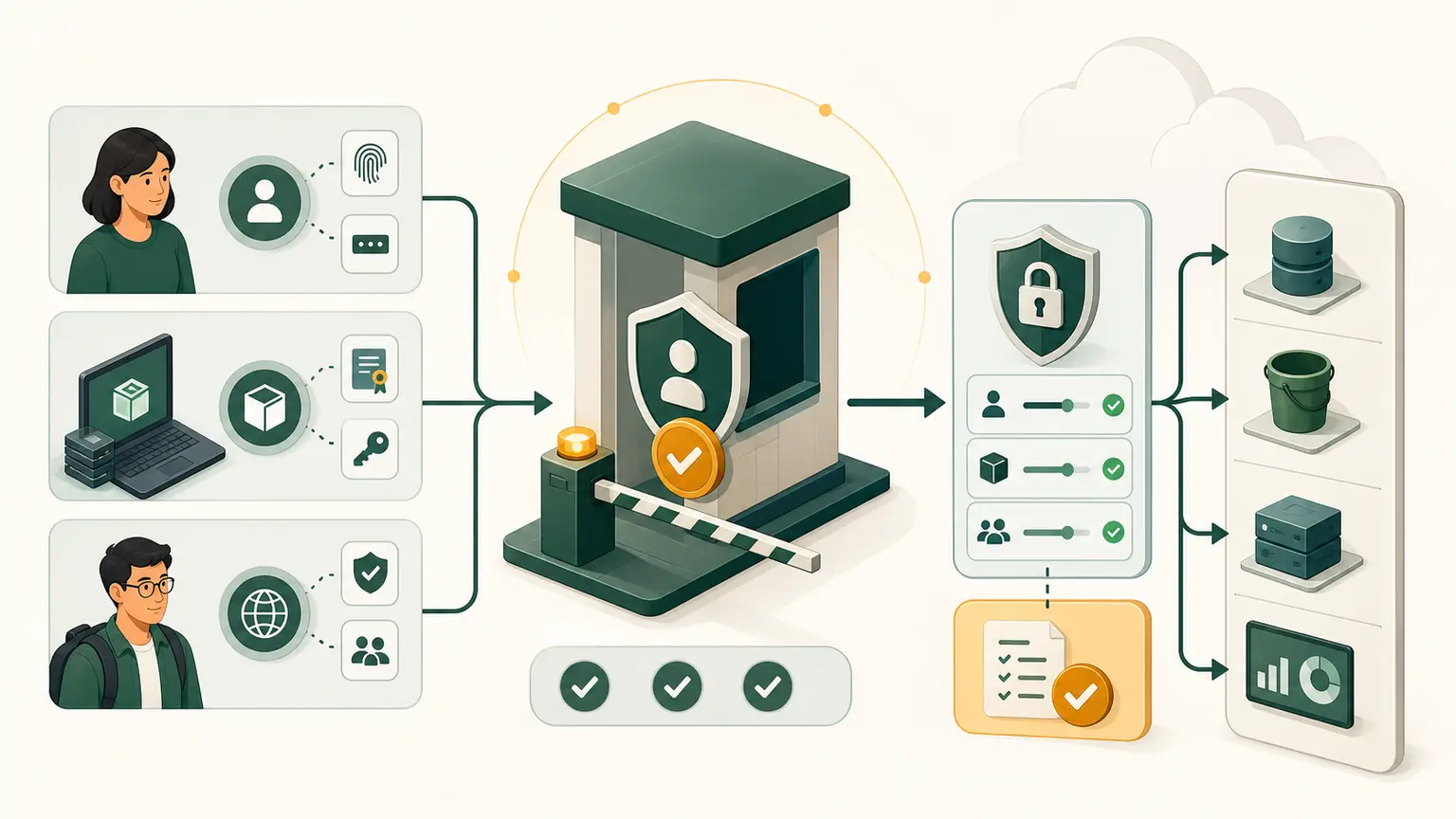
The problem
When a CLI command fails, beginners often reconfigure credentials, add administrator access, change Regions, or rerun commands randomly. This destroys evidence and can turn a simple scope problem into a security problem.
Final outcome
You will diagnose four controlled failures using symptoms, exit codes, configuration sources, and service errors. You will restore the known-good course profile without creating resources or broadening permissions.
Diagnostic order
1 syntax and local executable
2 profile and credential source
3 caller identity
4 account and Region
5 endpoint and network
6 authorization
7 request parameters
8 pagination and output interpretation
9 service state
Start with evidence. Do not run aws configure reflexively.
Prepare
Run the known-good baseline:
aws --version
aws configure list --profile course
aws sts get-caller-identity \
  --profile course \
  --output json \
  --no-cli-pager
Record the successful exit code privately. Confirm non-root identity and fixed Region.
Never include secrets in the troubleshooting transcript.
Failure 1: missing profile
Intentionally use a nonexistent profile:
aws sts get-caller-identity \
  --profile course-profile-does-not-exist \
  --no-cli-pager
printf 'exit=%s\n' "$?"
Expected symptom: the configuration profile cannot be found. This fails before a signed service request.
Diagnose:
aws configure list-profilesCorrection: use the approved course profile. Do not create a new default profile with unknown credentials merely to silence the error.
Failure 2: profile precedence
Set a temporary wrong profile environment variable:
AWS_PROFILE="course-profile-does-not-exist"
export AWS_PROFILE
aws configure list
aws sts get-caller-identity --no-cli-pager
printf 'exit=%s\n' "$?"
Then prove that an explicit option can override it:
aws sts get-caller-identity \
  --profile course \
  --output json \
  --no-cli-pager
Restore:
unset AWS_PROFILELesson: environment state can silently change commands that omit --profile.
Failure 3: invalid Region
Use a deliberately invalid endpoint scope for a read-only operation:
aws ec2 describe-availability-zones \
  --profile course \
  --region invalid-region-1 \
  --no-cli-pager
printf 'exit=%s\n' "$?"
Expected direction: endpoint resolution, connection, or Region validation failure. Exact wording can vary by CLI version and network.
Diagnose:
aws configure list --profile course
aws configure get region --profile course
Correction:
aws ec2 describe-availability-zones \
  --profile course \
  --region ap-south-1 \
  --query 'AvailabilityZones[].ZoneName' \
  --output table \
  --no-cli-pager
Do not confuse invalid Region with an opt-in Region that exists but is disabled for the account.
Failure 4: permission boundary
Use a read-only Organizations query:
aws organizations describe-organization \
  --profile course \
  --output json \
  --no-cli-pager
printf 'exit=%s\n' "$?"
In a standalone personal account or a restricted identity, the call may return an access or organization-state error. In an authorized organization account, it may succeed. Both are evidence.
If denied, record:
- principal type;
- API action
organizations:DescribeOrganization; - account context;
- error code;
- request ID if safe;
- whether the operation was required.
Do not attach administrator access. If the operation is not required, accept the boundary. If it is required, request only the documented permission through the owner.
Failure 5: limited pagination
Use a large read-only image inventory but intentionally return two items:
aws ec2 describe-images \
  --profile course \
  --region ap-south-1 \
  --owners amazon \
  --max-items 2 \
  --query '{Images:Images[].{Id:ImageId,Name:Name},NextToken:NextToken}' \
  --output json \
  --no-cli-pager
Inspect whether a continuation token is provided. The two results are not the complete Amazon-owned image inventory.
Run again without the artificial item limit only if there is a valid reason. The unbounded response can be large. A better production query uses specific owners, names, architecture, state, and dates.
Distinguish:
--max-items: limits aggregated results returned to the CLI user;--page-size: changes items requested per service call;--no-paginate: prevents automatic service-page traversal;--no-cli-pager: disables terminal display pagination.
Authentication compared with authorization
| Result | Meaning |
|---|---|
| no credentials found | request cannot be signed |
| expired token | credential existed but session is no longer valid |
| invalid client token/signature | credentials or time/signing context failed |
| access denied | caller was identified but action was not authorized |
| resource not found | could be Region, account, ID, permission masking, or deletion |
Do not rotate a credential because of every access denial. Determine whether the principal should have the action.
Debug logging
--debug can reveal request construction, credential-provider decisions, endpoints, and response metadata. Use it only after simpler evidence and never paste raw debug logs publicly.
If debug is required:
- reproduce with a read-only command;
- write to a protected temporary location;
- inspect for headers, IDs, paths, and tokens;
- redact carefully;
- delete the protected copy when the case is complete;
- rotate any credential accidentally exposed.
Troubleshooting worksheet
Create cli-failure-lab.md:
| Failure | Exit code | Error stage | Evidence | Root cause | Correction | Retest |
|---|---|---|---|---|---|---|
| missing profile | local config | |||||
| precedence | provider selection | |||||
| invalid Region | endpoint/scope | |||||
| permission | authorization | |||||
| pagination | 0 possible | interpretation |
Pagination can be a logical failure even when the command exits 0.
Common unsafe responses
- running as root;
- attaching
AdministratorAccess; - deleting all profiles;
- pasting credentials into environment variables;
- disabling TLS verification;
- using
--no-verify-ssl; - rerunning a mutating command after timeout without idempotency;
- treating a first page as complete;
- sharing debug logs without redaction.
Completion gate
Pass when all controlled failures are reproduced or safely classified, each has evidence and a smallest correction, the known-good profile is restored, identity preflight succeeds, environment overrides are removed, and no permission was broadened.
No resources were created or changed.