Run cloud environments as one operating system
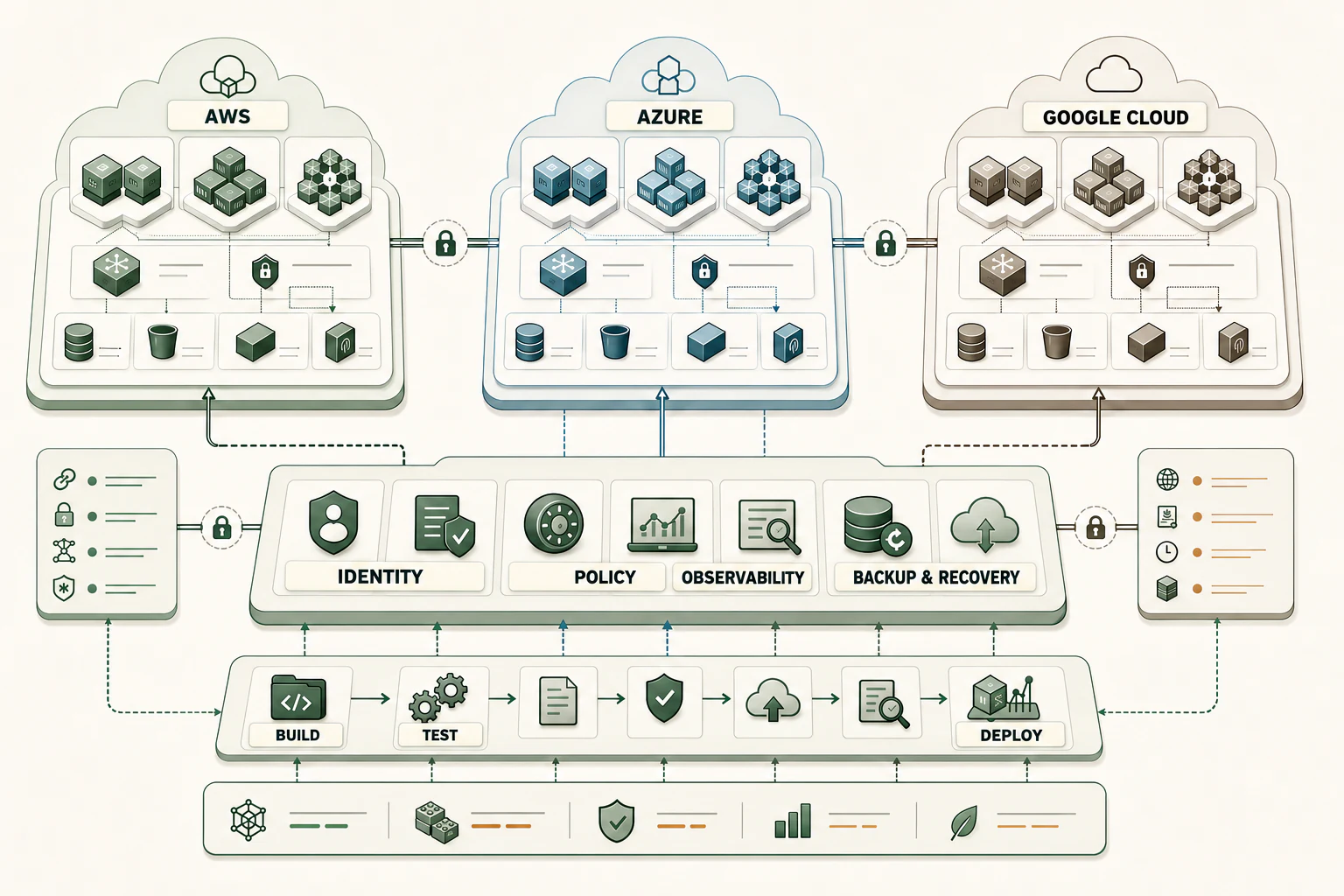
Multi-cloud work becomes difficult when identity, networking, security, workloads, data, monitoring, and ownership are designed separately. NitWings helps teams understand the complete environment and turn inconsistent cloud resources into an operable platform.
Support covers AWS, Microsoft Azure, Google Cloud Platform, hybrid systems, migrations, shared services, production incidents, and ongoing cloud operations.
What the work can cover
Architecture and assessment
Current-state review, target architecture, landing zones, account or subscription structure, regional design, hybrid integration, cross-cloud connectivity, and migration planning.
Compute and application platforms
Virtual machines, containers, managed Kubernetes, serverless systems, load balancing, auto scaling, environment design, and workload placement.
Networking and identity
Virtual networks, routing, DNS, VPN, private links, firewalls, security groups, IAM, RBAC, service identities, secrets, certificates, and key management.
Data and shared services
Object and block storage, managed databases, backup, image registries, centralized DNS, logging, monitoring, time services, and shared platform controls.
Security, resilience, and governance
Cloud security, high availability, disaster recovery, policy, compliance, inventory, tagging, access review, recovery testing, and operating ownership.
Automation, performance, and cost
Infrastructure as code, cloud automation, standardized modules, drift control, performance tuning, capacity, cost monitoring, optimization, and operational support.
How a review starts
Share the cloud providers, accounts or subscriptions, regions, workload, network path, recent change, visible problem, and any architecture, logs, metrics, or deployment history available.
Does this require three cloud providers?
No. The service also applies to one cloud, hybrid infrastructure, or a planned move where the design must remain portable and operable.
Can NitWings help with migration?
Yes. Work can include assessment, dependency mapping, target design, connectivity, security, data movement, automation, validation, rollback, and handover.
What marks completion?
The required workloads and controls are validated, monitoring and recovery are usable, ownership is clear, and the team has operating documentation.