
AWS 070: EBS volume types and performance
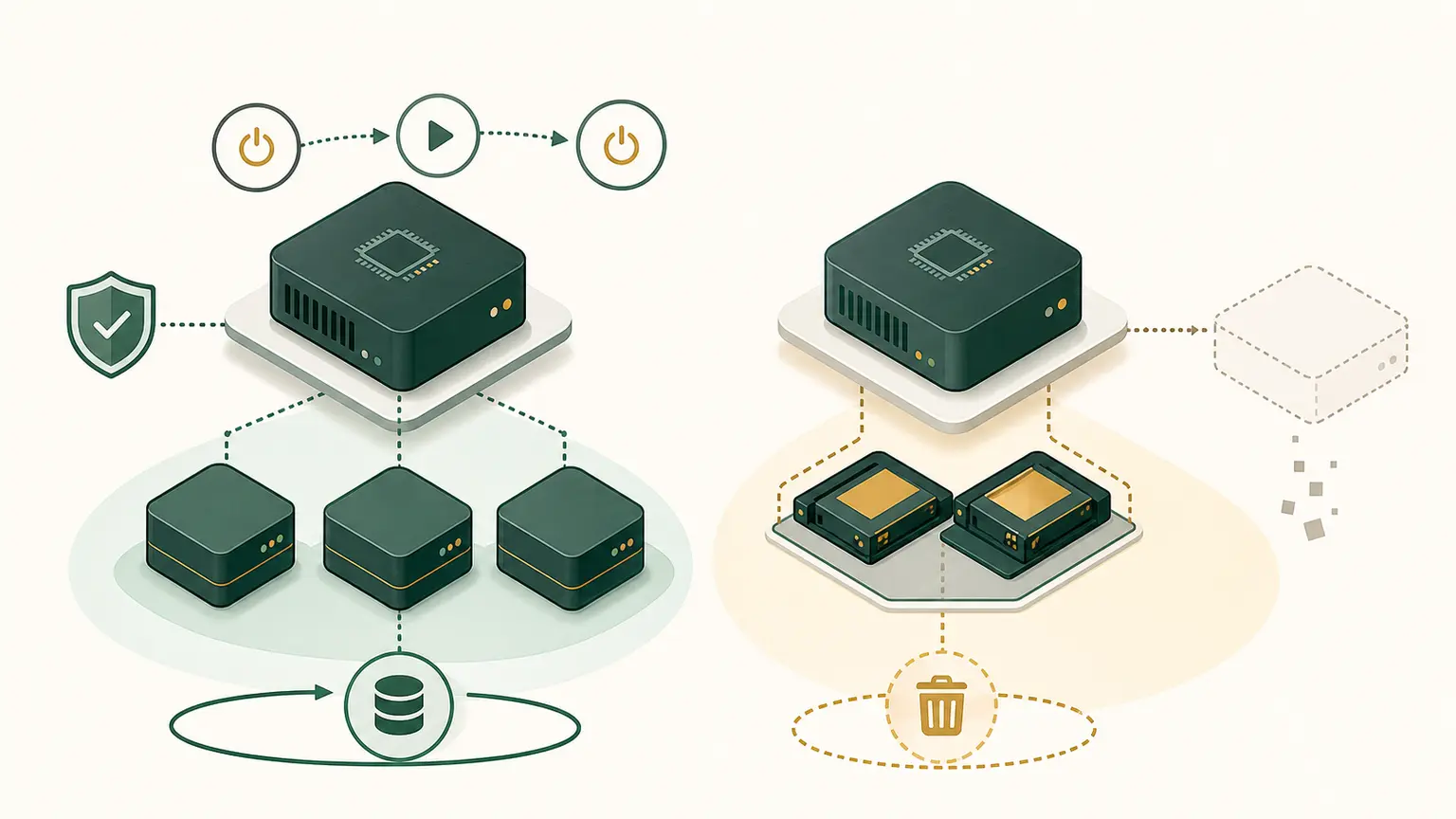
The problem
A team uses EBS volume types and performance as a label or Console setting without proving the identity, scope, behavior, failure boundary, cost, or operational result. The configuration appears complete but the real requirement remains untested.
Final outcome
The learner will inspect, explain, test, and document EBS volume types and performance. The submission must connect the Console and CLI view to the same AWS control, state what the evidence proves, diagnose one likely failure, and make a requirement-based architecture decision.
Learning outcomes
You will be able to:
- explain gp3 general purpose;
- explain gp2 behavior;
- explain io2 provisioned iops;
- explain st1 throughput optimized;
- explain sc1 cold hdd;
- distinguish successful configuration from successful workload behavior;
- preserve redacted evidence and complete the stated cleanup or retention decision.
Mental model
requirement
   -> identity and permission
   -> account, Region, and resource scope
   -> configuration or request
   -> observable state
   -> workload result
   -> failure evidence
   -> cleanup or controlled retention
Never begin with a create button or a copied command. Start with the result that must be proven and the boundary that must remain protected.
Core facts
| Concept | What it means in practice |
|---|---|
| gp3 general purpose | gp3 separates baseline size from provisioned IOPS and throughput within documented limits and is the normal starting point for many workloads. |
| gp2 behavior | gp2 performance is tied to volume size and uses burst credits for smaller volumes. Existing workloads require measurement before migration. |
| io2 provisioned IOPS | io2 targets latency-sensitive, IOPS-intensive workloads and supports capabilities such as higher durability and Multi-Attach under documented constraints. |
| st1 throughput optimized | st1 uses HDD media for large sequential throughput workloads and cannot be a boot volume. |
| sc1 cold HDD | sc1 targets infrequently accessed, throughput-oriented data with low storage cost and cannot be a boot volume. |
| Performance path | Volume type, size, provisioned IOPS, throughput, instance EBS bandwidth, queue depth, filesystem, block size, and application behavior all affect observed performance. |
How to reason about it
Choose from workload evidence: IOPS distribution, throughput, latency percentiles, block size, read/write mix, burst duration, capacity, durability, and recovery. A volume specification does not guarantee the instance can drive it.
Monitor VolumeReadOps, VolumeWriteOps, throughput, queue length, latency-related application signals, BurstBalance where applicable, and instance EBS limits before changing type or performance.
Use the following decision table as a starting point, then change the answer when the scenario changes.
| Requirement | Preferred direction | Why |
|---|---|---|
| General Linux root/data volume | gp3 | Independent performance controls and predictable baseline. |
| High-value database needing sustained IOPS | io2 after measurement | Provisioned IOPS and durability fit the requirement. |
| Large sequential log processing | st1 | Throughput matters more than random IOPS. |
| Cold sequential archive staging | sc1 | Low-cost HDD when access pattern fits. |
Prerequisites, permissions, Region, and cost
Run this lesson as the approved non-root course identity. Begin with aws sts get-caller-identity, confirm the private account record, and set the fixed project Region before any regional query. IAM resources are global within an account, while STS endpoints and the services reached by an identity can be regional.
Use only the read or change actions required for this lesson. An AccessDenied result is evidence to analyse, not permission to switch to root or attach AdministratorAccess. Record the action, resource, principal type, request context, and smallest justified correction.
The listed cost tier is T0 - no resource creation. Free Tier eligibility and credits are account-specific. Before a mutating lab, identify every resource that can charge, estimate its duration, start a timer, and write the reverse cleanup order. A budget reports cost after billing data arrives and is not a real-time stop control.
AWS Management Console method
- Open EC2, Volumes, and inspect type, size, IOPS, throughput, encryption, AZ, state, and attachment.
- Open the attached instance type specifications and compare EBS bandwidth limits.
- Open CloudWatch volume metrics and correlate the same time window with application latency.
For every step record the service page, selected account and Region, exact object, visible state, and why that state matters. A Console label or green status is not enough unless it is tied to the final workload outcome.
AWS CLI or API evidence
Inspect project volumes and their provisioned performance.
aws ec2 describe-volumes --region ap-south-1 --filters Name=tag:Project,Values=NitWings-P04 --query 'Volumes[].{Id:VolumeId,Type:VolumeType,GiB:Size,Iops:Iops,Throughput:Throughput,AZ:AvailabilityZone,State:State}' --output tableThe result proves configured volume characteristics, not achieved workload performance.
Before running the command, replace every placeholder, explain each option, and decide whether the operation is read-only or mutating. Capture the exit code immediately. Redact account IDs, ARNs, public addresses, request identifiers, and personal data before sharing.
The CLI and Console are clients of AWS APIs. Matching state across them increases confidence, but neither substitutes for data-plane or application verification.
Practical work
Complete p04-ebs-performance.md using the selected 8 GiB gp3 root volume and future 4 GiB gp3 data volume. Record baseline and configurable IOPS/throughput, the selected instance's EBS limit, expected block pattern, monitoring metrics, bottleneck hierarchy, and the requirement that would justify io2, st1, or sc1. Do not provision a volume.
The evidence package must include:
- non-root principal type, account verified privately, and Region;
- exact intended and observed state;
- one Console observation and the matching CLI or API result;
- one successful result and one denied, failed, or counterexample result;
- what each result does not prove;
- cost state and elapsed lab time;
- cleanup evidence or a named retained-state owner and next lesson.
Verification standard
Use three levels of proof:
- Control plane: the object or policy exists with the intended configuration.
- Data plane or behavior: the request, packet, session, storage path, or application does what the requirement states.
- Operations: monitoring, failure diagnosis, cost, ownership, and cleanup are known.
A control-plane response can precede final readiness. Use waiters or state polling where supported, then test the actual behavior. If a request times out, do not assume it failed. Inspect state and use documented idempotency before retrying a mutation.
Troubleshooting method
| Symptom | Evidence first | Smallest safe response |
|---|---|---|
| command cannot authenticate | credential source, expiry, caller preflight | restore approved temporary login |
| access is denied | action, resource, principal, all policy layers | correct only the missing or conflicting control |
| object appears missing | account, Region, filters, pagination, permission | align scope before creating anything |
| configured state exists but behavior fails | route, identity, dependency, logs, service state | test the next boundary in the path |
| cleanup is blocked | dependency inventory and owning service | remove dependants in reviewed reverse order |
Keep the original symptom and timestamp. State one hypothesis, make one reversible change, repeat the original test, and record rollback. Never open a management port to the world, expose credentials, disable TLS verification, format an unknown disk, or add broad permissions as a generic fix.
Architecture and certification decisions
Professional-level questions provide competing valid features. Identify the requirement that decides between them: human or workload identity, same-account or cross-account access, regional or zonal scope, stateful or stateless filtering, durable or ephemeral data, latency, RTO/RPO, cost, or operational ownership.
Explain why the selected option fits and why each plausible alternative fails one stated requirement. Do not rely on feature memorization or reproduce protected certification questions.
Knowledge check
- Does larger gp3 automatically add IOPS?
Expected direction: No. gp3 size and provisioned performance are independent within limits.
- Can st1 be a boot volume?
Expected direction: No.
- What can bottleneck a fast volume?
Expected direction: The instance EBS path, filesystem, and workload among other layers.
- Should type be chosen from labels alone?
Expected direction: No. Use measured requirements.
Cost, cleanup, and retained state
Retain only the state explicitly required by the next P04 lesson and record it in the private resource ledger.
Cleanup evidence includes the final state query, not only a successful delete response. Search related resources, other Regions used by the lab, retained storage, public IPv4 addresses, logging destinations, and service-managed dependencies. Schedule a later billing review because cost data can lag.
Completion gate
Pass when the practical artifact explains the real problem, matches Console and CLI evidence, answers every knowledge check, diagnoses one failure without broadening access, records cost, and proves cleanup or approved retention. The learner must defend one decision orally and name the requirement that would change it.