
AWS 160: AWS Batch, Outposts and Wavelength
Why this lesson matters
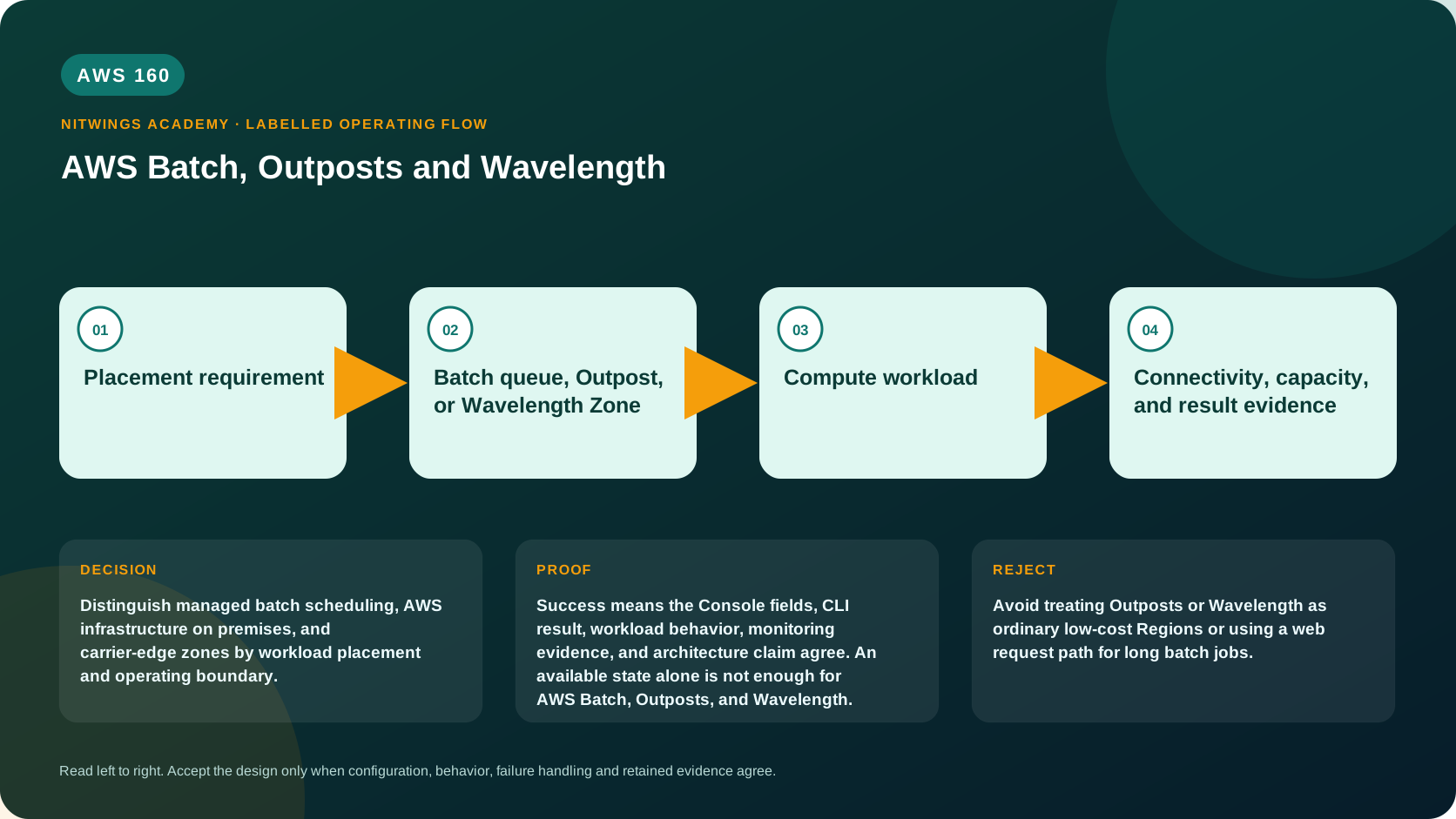
Distinguish managed batch scheduling, AWS infrastructure on premises, and carrier-edge zones by workload placement and operating boundary.
These services answer unrelated placement questions. Batch decides when and on what compute finite jobs run. Outposts places AWS-managed infrastructure at a customer site. Wavelength places selected AWS resources inside a telecommunications provider network. Combining their names without latency, connectivity, capacity and ownership evidence produces unsafe architecture.
What you will be able to do
By the end, you can:
- explain aws batch, outposts and wavelength in plain language;
- locate the current service controls in the AWS Management Console;
- run the matching CloudShell or AWS CLI queries and explain every important field;
- draw the identity, network, data, failure, and monitoring path;
- choose the service from requirements and reject it when those requirements are absent;
- diagnose a failed or misleading result from evidence;
- state the cost owner and prove cleanup or a no-create result.
Before you start
- Use a personal AWS account only when its owner has approved the lesson. Do not use the root user for daily work.
- CloudShell is the default command environment. AWS028 explains CloudShell; AWS029 and AWS030 explain local AWS CLI installation and profiles.
- The course example Region is
ap-south-1. Global services and services with a required control Region are called out in their commands. - Run
aws sts get-caller-identityprivately. Redact the account number before sharing evidence. - Never paste access keys, passwords, secret values, private object data, presigned URLs, or full account-specific ARNs into a submission.
- This is a no-create lesson. Every Console action and AWS CLI command is read-only. Create the practical artifact locally.
- Console wording can change. Use the Console service search if a menu label has moved, then confirm the current field in the official documentation.
The core model
| Question | What it means in this lesson |
|---|---|
| Purpose | Distinguish managed batch scheduling, AWS infrastructure on premises, and carrier-edge zones by workload placement and operating boundary. |
| Scope and boundary | The learner must identify the account and Region scope, resource boundary, identity path, data or network path, failure behavior, observability, and cleanup ownership for AWS Batch, Outposts, and Wavelength. |
| Evidence of success | Success means the Console fields, CLI result, workload behavior, monitoring evidence, and architecture claim agree. An available state alone is not enough for AWS Batch, Outposts, and Wavelength. |
| Cost model | These services can have significant infrastructure, compute, storage, network, and transfer costs. Use supplied architecture evidence only in a personal account. |
| Safe rejection rule | Avoid treating Outposts or Wavelength as ordinary low-cost Regions or using a web request path for long batch jobs. |
How the request flows
+-------------------------+
|  Placement requirement  |
+-------------------------+
            |
            v
+--------------------------------------------+
|  Batch queue, Outpost, or Wavelength Zone  |
+--------------------------------------------+
                      |
                      v
+----------------------+
|   Compute workload   |
+----------------------+
           |
           v
+-----------------------------------------------+
|  Connectivity, capacity, and result evidence  |
+-----------------------------------------------+
For AWS Batch, Outposts, and Wavelength, the important boundary is this: The learner must identify the account and Region scope, resource boundary, identity path, data or network path, failure behavior, observability, and cleanup ownership for AWS Batch, Outposts, and Wavelength. Success means the Console fields, CLI result, workload behavior, monitoring evidence, and architecture claim agree. An available state alone is not enough for AWS Batch, Outposts, and Wavelength. That is why the lesson pairs the Console with CLI output and a practical artifact. One interface may hide a field, use a cached view, or be scoped differently. Matching evidence is stronger than a screenshot alone.
Architecture decision table
| Situation | Direction | Reason |
|---|---|---|
| Requirement matches | Use each offering only when its placement and operating model matches a measured requirement. | Select only after scope, behavior, security, recovery, operations, and price evidence agree. |
| Requirement does not match | Avoid treating Outposts or Wavelength as ordinary low-cost Regions or using a web request path for long batch jobs. | Rejecting an attractive service is a valid architecture result. |
| No create permission or cost approval | Use supplied evidence and local design work | Learning does not depend on creating an hourly resource. |
| Existing resource is unknown or unowned | Inspect only, then stop | Never change or delete a resource merely because it resembles a course example. |
AWS Batch: queued finite work
A job definition versions container image, command/parameters, vCPU/memory/GPU, roles, environment/secrets, volumes, timeout/retry and platform. A submitted job waits in a job queue with priority/fair-share/resource-aware scheduling and dependencies/arrays. The queue maps in order to compute environments using EC2 On-Demand/Spot, Fargate, ECS Managed Instances, EKS or supported service environments. Batch schedules capacity but your code owns checkpointing, idempotency, exit codes and output commit.
Jobs move through submitted/pending/runnable/starting/running/succeeded/failed. RUNNABLE for a long time usually means no compatible/available compute, quota, image/network or scheduling constraint. Spot termination and retries can repeat partial work; write output to attempt-specific paths and atomically publish a completion marker. Multi-node parallel, GPU, EFA, large local disk or privileged requirements guide EC2 versus Fargate. Fair-share and consumable resources prevent one tenant or scarce license/API quota from being exhausted.
Outposts: AWS infrastructure at the site
Outposts racks/servers extend supported AWS services/APIs into an on-premises location while the parent Region provides control-plane/service-link dependencies. The customer owns site power, cooling, physical security, network/LAN/WAN and stated capacity planning; AWS owns supplied hardware/service operations according to the model. Capacity cannot appear on demand like a Region - lead time, spare capacity, hardware maintenance and failure replacement matter.
Distinguish local gateway routing to on-premises networks, service link to the Region, local versus Regional data/control paths, supported instance/service/storage features and backup destination. During WAN/service-link degradation, existing local workloads may have different operating behavior from control-plane changes or Regional dependencies. “Data must stay onsite” requires tracing logs, snapshots, IAM, DNS, keys and service metadata too. Outposts has contractual/site and capacity costs, not normal pay-only-per-second elasticity.
Wavelength: carrier edge
A Wavelength Zone is associated with a Region and a carrier network for ultra-low-latency mobile/edge applications. Workloads use Wavelength subnets and carrier gateway paths to carrier users; Regional services/control remain dependencies across the network. Service/instance availability, quotas, IP model, carrier coverage, data transfer and deployment differ by location. Put only the latency-critical stateless/replicated component at the edge; keep durable source of truth and failover design explicit.
Measure user-to-edge latency, edge-to-Region latency, throughput and loss. Plan fallback to Region/another zone when carrier edge capacity or connectivity fails. Do not select Wavelength for ordinary CDN caching (CloudFront) or global anycast acceleration (Global Accelerator) without a compute-at-carrier requirement.
AWS Management Console, step by step
Sign in with the normal non-root learning identity. Write the expected starting state before opening the service.
- Use the Console service search and open AWS Batch Job queues, AWS Outposts, and EC2 Availability Zones filtered for Wavelength; confirm the account and Region before reading the page.
- Inspect the supplied or owned resource's status, configuration, permissions, networking, encryption, monitoring, tags, and dependencies without changing it.
- Open the related metrics, logs, events, or history view and record one timestamped signal that would prove or disprove the expected behavior.
- Return to the resource list, clear filters, and record the final inventory. On the read-only track, do not choose Create, Save, or Delete.
CloudShell and AWS CLI, step by step
Start with a known caller and Region:
export AWS_DEFAULT_REGION="ap-south-1"
aws sts get-caller-identity --query Arn --output text
aws configure list
Redact the account part of the ARN in shared evidence. Now run the topic queries:
aws batch describe-job-queues --query 'jobQueues[].{Name:jobQueueName,State:state,Status:status,Priority:priority}' --output table
aws outposts list-outposts --query 'Outposts[].{Name:Name,Id:OutpostId,State:LifeCycleStatus,Site:SiteId}' --output table
aws ec2 describe-availability-zones --filters Name=zone-type,Values=wavelength-zone --query 'AvailabilityZones[].{Zone:ZoneName,Parent:ParentZoneName,OptIn:OptInStatus}' --output table
Expected interpretation
The services solve different problems: queued compute jobs, hybrid location requirements, and mobile-edge latency or resilience. Empty regional results can be correct.
Practical work
Choose placement for overnight media jobs, a factory with data residency and local operation, and a carrier-edge game service. Define latency, connectivity failure, capacity, hardware, data path, and cost.
For Batch, calculate queue wait/runtime, vCPU-hours, Spot interruption/checkpoint interval, output idempotency and fair-share. For Outposts, draw local/service-link/Region dependency and 72-hour WAN-loss behavior with spare capacity. For Wavelength, benchmark mobile-to-edge and edge-to-Region, define source-of-truth synchronization and Regional fallback. Test stuck RUNNABLE job, Spot interruption, full local capacity, service-link loss, carrier loss and stale edge data.
Diagnose this topic from its own evidence
Batch diagnosis begins with job status reason, queue state/priority/scheduling, compute-environment validity/capacity and ECS task reason. Outposts begins with local hardware/capacity, service-link/network and whether the failed API/data path is local or Regional. Wavelength begins with client carrier route/IP, subnet/gateway/SG, edge capacity and Region link. Scaling Regional capacity cannot fix a full rack or unsupported edge instance.
Cost and cleanup
These services can have significant infrastructure, compute, storage, network, and transfer costs. Use supplied architecture evidence only in a personal account.
Knowledge check
- What operational purpose is this lesson solving?
Expected direction: Distinguish managed batch scheduling, AWS infrastructure on premises, and carrier-edge zones by workload placement and operating boundary.
- Which scope or ownership boundary must be proved first?
Expected direction: The learner must identify the account and Region scope, resource boundary, identity path, data or network path, failure behavior, observability, and cleanup ownership for AWS Batch, Outposts, and Wavelength.
- What evidence is strong enough to accept the result?
Expected direction: Success means the Console fields, CLI result, workload behavior, monitoring evidence, and architecture claim agree. An available state alone is not enough for AWS Batch, Outposts, and Wavelength.
- Which tempting design or shortcut must be rejected?
Expected direction: Avoid treating Outposts or Wavelength as ordinary low-cost Regions or using a web request path for long batch jobs.
- Which cost dimensions and retained resources need an owner?
Expected direction: These services can have significant infrastructure, compute, storage, network, and transfer costs. Use supplied architecture evidence only in a personal account.
Lesson acceptance
Pass when the learner keeps scheduling, on-premises AWS placement and carrier edge distinct; maps resources/control/data paths; quantifies capacity/latency/offline behavior; and designs security, recovery, observability and cost. Fail if Batch is a persistent service orchestrator, Outposts is treated as disconnected by default, or Wavelength is called a CDN.