
AWS 196: AWS Well-Architected Framework
Why this lesson matters
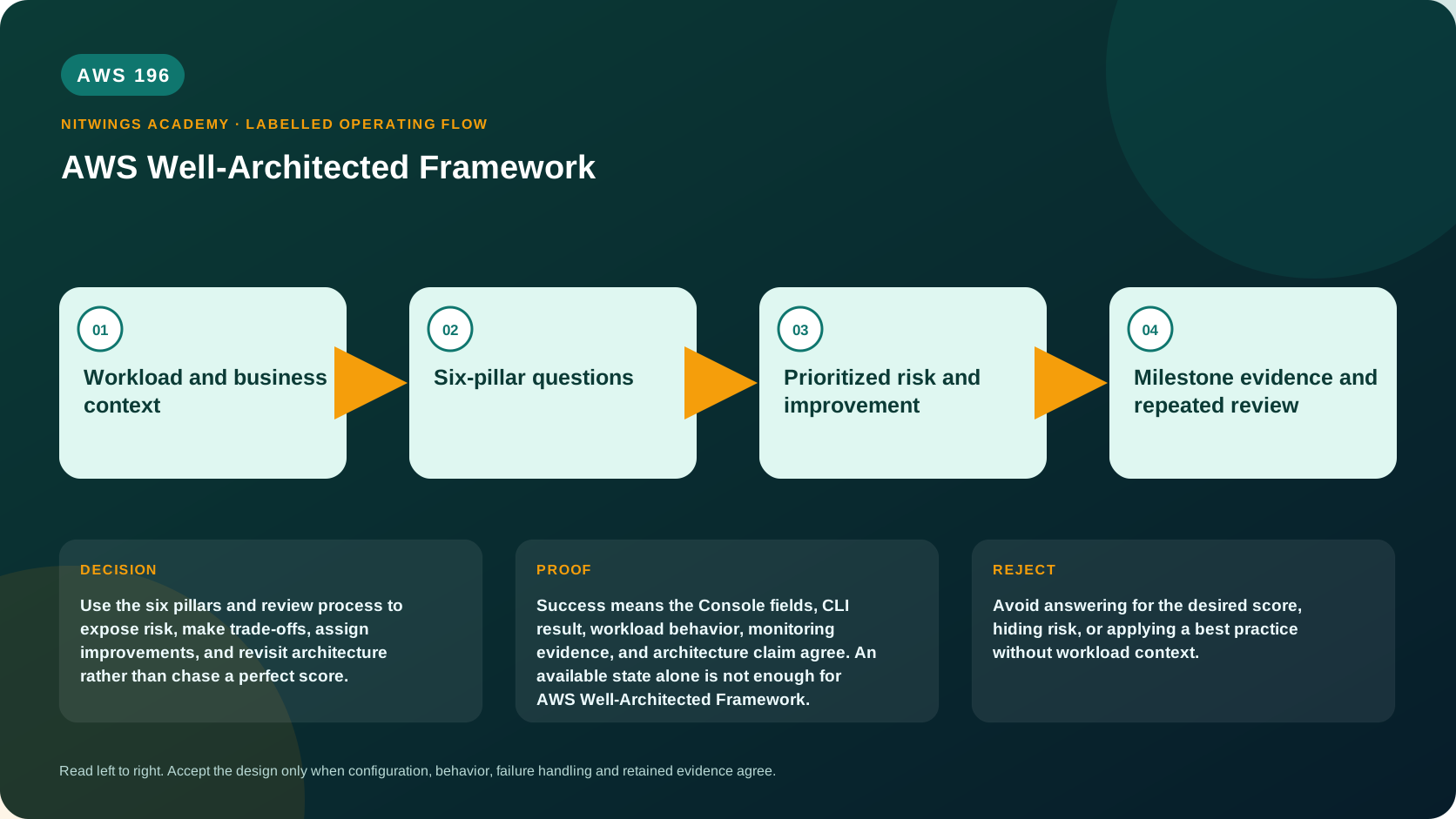
Use the six pillars and review process to expose risk, make trade-offs, assign improvements, and revisit architecture rather than chase a perfect score.
What you will be able to do
By the end, you can:
- explain aws well-architected framework in plain language;
- locate the current service controls in the AWS Management Console;
- run the matching CloudShell or AWS CLI queries and explain every important field;
- draw the identity, network, data, failure, and monitoring path;
- choose the service from requirements and reject it when those requirements are absent;
- diagnose a failed or misleading result from evidence;
- state the cost owner and prove cleanup or a no-create result.
Before you start
- Use a personal AWS account only when its owner has approved the lesson. Do not use the root user for daily work.
- CloudShell is the default command environment. AWS028 explains CloudShell; AWS029 and AWS030 explain local AWS CLI installation and profiles.
- The course example Region is
ap-south-1. Global services and services with a required control Region are called out in their commands. - Run
aws sts get-caller-identityprivately. Redact the account number before sharing evidence. - Never paste access keys, passwords, secret values, private object data, presigned URLs, or full account-specific ARNs into a submission.
- This is a no-create lesson. Every Console action and AWS CLI command is read-only. Create the practical artifact locally.
- Console wording can change. Use the Console service search if a menu label has moved, then confirm the current field in the official documentation.
The core model
| Question | What it means in this lesson |
|---|---|
| Purpose | Use the six pillars and review process to expose risk, make trade-offs, assign improvements, and revisit architecture rather than chase a perfect score. |
| Scope and boundary | The learner must identify the account and Region scope, resource boundary, identity path, data or network path, failure behavior, observability, and cleanup ownership for AWS Well-Architected Framework. |
| Evidence of success | Success means the Console fields, CLI result, workload behavior, monitoring evidence, and architecture claim agree. An available state alone is not enough for AWS Well-Architected Framework. |
| Cost model | Requests, running capacity, storage, logs, data transfer, retained state, and optional features must be priced for the exact design. |
| Safe rejection rule | Avoid answering for the desired score, hiding risk, or applying a best practice without workload context. |
How the request flows
+---------------------------------+
|  Workload and business context  |
+---------------------------------+
                |
                v
+------------------------+
|  Six-pillar questions  |
+------------------------+
            |
            v
+------------------------------------+
|  Prioritized risk and improvement  |
+------------------------------------+
                  |
                  v
+------------------------------------------+
|  Milestone evidence and repeated review  |
+------------------------------------------+
The six pillars are decision lenses
| Pillar | Core architect question | Example evidence |
|---|---|---|
| Operational Excellence | Can teams operate, observe, change and improve safely? | runbooks, deployment/rollback records, operational metrics and learning reviews |
| Security | How are identities, data, infrastructure and incidents protected? | threat model, least privilege, key/log/finding and response evidence |
| Reliability | Does the workload recover from faults and meet demand? | quotas, failure tests, backup restores and measured RTO/RPO |
| Performance Efficiency | Are resource types/configurations selected and evolved from evidence? | load tests, latency/saturation, architecture selection and review cadence |
| Cost Optimization | Does spend deliver business value with ownership? | allocation, forecasts, unit economics, utilization and optimization records |
| Sustainability | Is resource use minimized for business outcome across lifecycle? | utilization, managed-service/Region choices, data/compute reduction and retirement |
Pillars interact. Reducing capacity can increase failure and latency; retaining every log forever increases cost and footprint; multi-Region improves some resilience while adding spend and complexity. Document trade-offs and business owners instead of maximizing each pillar independently.
Run an evidence-based review
- Define workload, lifecycle stage, owners, business criticality, architecture diagram, data classification and objectives.
- Choose the Framework plus only applicable lenses; a lens adds domain questions rather than replacing the core Framework.
- Interview builders/operators/security/finance/business stakeholders. Reviews are collaborative and blameless, not audits of individuals.
- Answer questions from current architecture and evidence. Record unknown as unknown - not “not applicable.”
- Identify high/medium risks and improvement items with owner, priority, due date, cost and success measure.
- Export/save review milestone before major architecture change, launch or incident follow-up.
- Implement improvements in the normal delivery backlog, validate outcomes and create the next milestone.
The AWS Well-Architected Tool stores workloads, lens answers, risks, milestones and improvement plans. It does not automatically inspect every resource or certify compliance. Review answers become stale as traffic, services, teams and requirements change.
Write useful risks
A useful risk states condition, consequence and evidence: “The only NAT gateway is in AZ-a; private workloads in other AZs depend on cross-AZ routing, so an AZ-a failure removes outbound patch/API access; route-table inventory and game-day result attached.” The improvement then has an owner and measurable outcome.
Avoid service-list answers (“we use CloudWatch”) without retention, coverage, alarms, owner and response proof. Avoid marking a question complete because a service is enabled. Never hide risk to improve a dashboard score.
Architecture decision table
| Situation | Direction | Reason |
|---|---|---|
| Requirement matches | Use the framework as a structured engineering conversation and improvement backlog. | Select only after scope, behavior, security, recovery, operations, and price evidence agree. |
| Requirement does not match | Avoid answering for the desired score, hiding risk, or applying a best practice without workload context. | Rejecting an attractive service is a valid architecture result. |
| No create permission or cost approval | Use supplied evidence and local design work | Learning does not depend on creating an hourly resource. |
| Existing resource is unknown or unowned | Inspect only, then stop | Never change or delete a resource merely because it resembles a course example. |
AWS Management Console, step by step
Sign in with the normal non-root learning identity. Write the expected starting state before opening the service.
- Use the Console service search and open AWS Well-Architected Tool, Workloads and Lenses; confirm the account and Region before reading the page.
- Inspect the supplied or owned resource's status, configuration, permissions, networking, encryption, monitoring, tags, and dependencies without changing it.
- Open the related metrics, logs, events, or history view and record one timestamped signal that would prove or disprove the expected behavior.
- Return to the resource list, clear filters, and record the final inventory. On the read-only track, do not choose Create, Save, or Delete.
CloudShell and AWS CLI, step by step
Start with a known caller and Region:
export AWS_DEFAULT_REGION="ap-south-1"
aws sts get-caller-identity --query Arn --output text
aws configure list
Redact the account part of the ARN in shared evidence. Now run the topic queries:
aws wellarchitected list-workloads --query 'WorkloadSummaries[].{Name:WorkloadName,Owner:Owner,Review:ReviewOwner,Updated:UpdatedAt}' --output table
aws wellarchitected list-lenses --lens-type AWS_OFFICIAL --query 'LensSummaries[].{Name:LensName,Status:LensStatus,Version:LensVersion}' --output table
Expected interpretation
A review records answers, notes, risks, milestones, and improvement items. It does not certify the workload or remove the need for measurement and engineering judgment.
Practical work
Review P05 across operational excellence, security, reliability, performance efficiency, cost optimization, and sustainability. Record one high risk, one medium risk, owner, due date, evidence, and trade-off per pillar.
Diagnose this topic from its own evidence
- Review has no risks: inspect whether answers are generic, evidence absent, scope narrow or “not applicable” abused.
- Improvement plan never changes: connect items to backlog owners/dates and review in architecture/operations cadence.
- Milestones cannot explain change: create before/after milestones around launch, migration, incident and major design revision.
- One pillar improves while incident risk rises: re-evaluate cross-pillar trade-offs and business objectives.
- Tool says complete but runtime disagrees: runtime/configuration/test evidence overrides self-attestation; update the review.
Cost and cleanup
Requests, running capacity, storage, logs, data transfer, retained state, and optional features must be priced for the exact design.
Knowledge check
- What operational purpose is this lesson solving?
Expected direction: Use the six pillars and review process to expose risk, make trade-offs, assign improvements, and revisit architecture rather than chase a perfect score.
- Which scope or ownership boundary must be proved first?
Expected direction: The learner must identify the account and Region scope, resource boundary, identity path, data or network path, failure behavior, observability, and cleanup ownership for AWS Well-Architected Framework.
- What evidence is strong enough to accept the result?
Expected direction: Success means the Console fields, CLI result, workload behavior, monitoring evidence, and architecture claim agree. An available state alone is not enough for AWS Well-Architected Framework.
- Which tempting design or shortcut must be rejected?
Expected direction: Avoid answering for the desired score, hiding risk, or applying a best practice without workload context.
- Which cost dimensions and retained resources need an owner?
Expected direction: Requests, running capacity, storage, logs, data transfer, retained state, and optional features must be priced for the exact design.
Lesson acceptance
- Explain all six pillars using workload decisions rather than memorized definitions.
- Facilitate a scoped, blameless review with current architecture and stakeholder evidence.
- Write at least six condition/consequence/evidence risks and owned improvements.
- Analyze cross-pillar trade-offs and record accepted residual risk.
- Create review milestones and prove one improvement through measured before/after evidence.