
AWS 310: Media services and Managed Blockchain overview
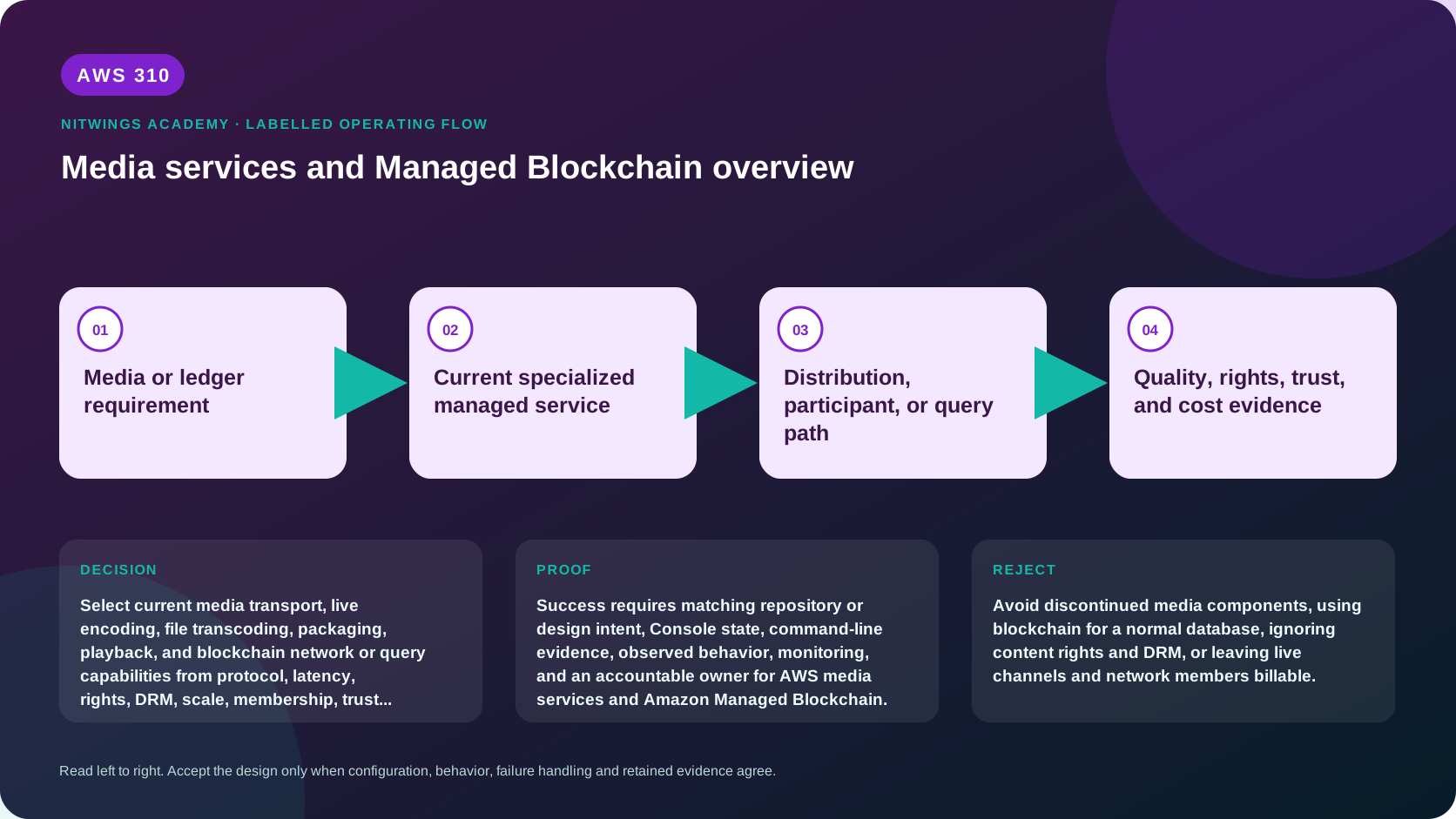
Why this lesson matters
Media systems transform and deliver large time-sensitive audio/video streams. Blockchain systems coordinate a ledger among parties that may not trust one operator. Both are specialized: familiar EC2, S3, databases, and queues remain part of the design, but protocol, timing, rights, consensus, and cost can dominate.
Using the wrong media component produces black frames, drift, buffering, incompatible captions, missing ad markers, or unplayable DRM. Using blockchain for a normal application database creates slower writes, difficult privacy/deletion behavior, irreversible mistakes, and unnecessary multi-party governance.
The service history matters. Amazon Elastic Transcoder and AWS Elemental MediaStore ended support on November 13, 2025. File transcoding now uses MediaConvert; live origin choices use S3 for simpler patterns or MediaPackage where packaging, protection, failover, and low-latency behavior justify it. Old diagrams that still send new workloads to Transcoder or MediaStore are wrong.
What you will be able to do
By the end, you can:
- explain container, codec, bitrate, frame rate, resolution, GOP, transcoding, packaging, origin, CDN, DRM, captions, and ad markers;
- select MediaConnect, MediaLive, MediaPackage, MediaConvert, MediaTailor, IVS, Kinesis Video Streams, S3, and CloudFront by workflow;
- trace live and file-based media from contribution through playback;
- design redundancy, latency, quality, rights, observability, and cost controls;
- explain ledger, block, hash, transaction, consensus, member, peer, channel, chaincode, node, finality, gas, and private key;
- distinguish AMB Access for private/public blockchain nodes from AMB Query;
- reject blockchain when a governed database or signed append-only log is sufficient;
- diagnose media and ledger failures from evidence; and
- produce two defensible specialized-service decisions.
Before you start
- Use synthetic media that you own. Do not ingest copyrighted broadcasts, personal video, private keys, wallet seed phrases, or production chaincode.
- The default T0 path is read-only architecture. Live channels, MediaConnect flows, packaging endpoints, blockchain members, and peer nodes can accrue cost continuously.
- A T1 build needs a media rights owner or blockchain governance owner, budget alarm, exact resource list, stop time, and deletion procedure.
- Redact stream endpoints, entitlement secrets, DRM details, wallet addresses tied to people, node endpoints, member IDs, and account IDs.
mkdir -p "$HOME/aws310-evidence"
cd "$HOME/aws310-evidence"
export AWS_DEFAULT_REGION="ap-south-1"
aws sts get-caller-identity --query Arn --output text
1. Learn the media pipeline
A container such as MP4 or MPEG-TS holds encoded streams and metadata. A codec such as AVC/H.264, HEVC/H.265, or AV1 compresses video. Audio has its own codec. Transcoding decodes and re-encodes to another representation. Packaging segments encoded media and creates manifests such as HLS or DASH without necessarily re-encoding.
An adaptive bitrate ladder contains multiple resolution/bitrate renditions. The player measures conditions and switches at aligned segment boundaries. Keyframes and GOP structure must align across renditions. More renditions improve device/network fit but add processing, storage, and CDN cost.
live contribution
  -> MediaConnect transport (when managed reliable contribution is needed)
  -> MediaLive encode
  -> MediaPackage package/origin/DRM
  -> CloudFront CDN
  -> players

file in S3
  -> MediaConvert transcode/package
  -> S3 origin
  -> CloudFront
  -> players
Captions, audio languages, timecode, aspect ratio, color/HDR metadata, SCTE-35 ad markers, DRM keys, thumbnails, and content rights must survive the workflow. “Video plays” is only the first test.
2. Select each media service
| Requirement | Primary direction | Boundary |
|---|---|---|
| Reliable live video contribution between locations/cloud | AWS Elemental MediaConnect | Transport, entitlement, protocol, and flow cost; not encoding |
| Encode live source into output renditions | AWS Elemental MediaLive | Running channels and inputs; design input/output redundancy |
| Package/protect/originate live or VOD streams | AWS Elemental MediaPackage | Packaging/origin/DRM; CDN remains separate |
| Transcode stored files | AWS Elemental MediaConvert | Job-based file processing; use instead of ended Elastic Transcoder |
| Server-side personalized ad insertion | AWS Elemental MediaTailor | Ad decision, tracking, slate, and manifest manipulation |
| Low-latency interactive managed streaming | Amazon IVS | Channel/stage/chat choices differ from broadcast workflow |
| Camera/device video ingestion, storage, WebRTC | Kinesis Video Streams | Device media and signaling use cases, not general broadcast encoding |
| Simple durable file or live-origin pattern | Amazon S3 | Validate latency and workflow; MediaStore is unavailable |
| Global cache and delivery | Amazon CloudFront | Cache/origin/player behavior; it does not encode |
MediaLive Standard-class channels can use redundant pipelines; Single-pipeline is cheaper but reduces resilience. Input type, source redundancy, pipeline locking, output groups, destinations, and downstream expectations must match. Stopping a channel stops channel processing charges but related inputs, reservations, packaging, storage, and logs may remain.
MediaPackage v2 endpoints and channel groups use modern workflow constructs that differ from v1. Do not copy identifiers or APIs across versions. DRM commonly uses SPEKE integration with an external key provider; protect key exchange and test authorization failure, key rotation, and player compatibility.
MediaConvert jobs define inputs, selectors, output groups, renditions, captions, audio, acceleration, queue, and destination. Job completion proves files were produced, not perceptual quality. Inspect with a media analyzer and play representative devices.
3. Design media resilience and quality
Define the latency budget:
capture + contribution + encode + package/segment + CDN + player bufferReducing segment and buffer duration lowers delay but can increase request rate and rebuffer risk. Measure glass-to-glass latency with synchronized clocks, not service metrics alone.
For live availability, use independent source encoders/paths where required, dual MediaConnect flows or outputs, MediaLive redundant inputs/pipelines, MediaPackage input redundancy, Regional strategy, and CDN origin failover according to service support. Redundancy that shares one power source, circuit, encoder, or DNS dependency is not independent.
Monitor:
- input loss, black/frozen frames, audio silence, and timecode;
- encode errors, dropped frames, active input, and pipeline health;
- manifest freshness, segment availability, origin latency/errors;
- CDN hit ratio, origin load, 4xx/5xx, bytes, and geography;
- player startup, rebuffer ratio, fatal errors, bitrate switches, and completion;
- caption/audio/DRM/ad-marker correctness; and
- cost per delivered viewing hour.
Synthetic probes should fetch manifests, segments, and keys from approved locations and decode samples. Player telemetry is essential because a healthy origin can still produce poor user experience.
4. Secure content and control cost
Grant media service roles exact S3, KMS, logging, and destination permissions. Separate contribution credentials, MediaConnect entitlements, playback authorization, DRM license, and administrator access. Encrypt transport where supported, protect origins behind CloudFront, sign URLs/cookies where required, and enforce geographic or rights windows as policy demands.
DRM is not the same as encryption at rest. Watermarking, signed playback, license policy, and forensic response solve different problems. Logs and thumbnails can themselves contain protected or personal content.
Cost drivers include channel/input/output hours, MediaConnect flow/output/transfer, MediaPackage ingest/origin requests/egress, MediaConvert normalized minutes and features, ad insertion, IVS participant/viewer time, Kinesis video ingest/storage/consumption, S3, CloudFront requests/transfer, DRM, monitoring, and reserved commitments. Model live 24x7, event-only, and peak-audience cases.
5. Decide whether blockchain is justified
A blockchain is a replicated ledger in which transactions are ordered and cryptographically linked. It is useful when multiple independent organizations need a shared state and cannot simply appoint one trusted database operator. It does not make input true, private, free, fast, or legally valid.
Ask:
- Are there multiple independent writers?
- Do they lack a mutually trusted operator?
- Must each verify shared history?
- Is append-oriented, difficult-to-delete data acceptable?
- Can governance define membership, code changes, disputes, keys, and exit?
- Do throughput, latency, privacy, and cost fit?
If one organization controls all writers, use a database with IAM, audit logs, signatures, immutability controls, and backups. If public verifiability is needed but writes are centralized, consider signed statements or anchoring hashes without placing sensitive records on-chain.
Never put secrets, large documents, personal records, or mutable truth directly on a ledger. Store governed data off-chain and write minimal identifiers/hashes only after analyzing correlation, dictionary attacks, retention, and deletion law. A hash of predictable personal data can still leak information.
6. Understand Amazon Managed Blockchain
AMB has different capabilities:
- AMB Access Hyperledger Fabric manages private permissioned Fabric network infrastructure. Networks contain members; members run peer nodes; channels isolate ledgers; chaincode implements transaction logic; ordering establishes transaction order.
- AMB Access public networks provides managed access to supported public blockchain nodes such as Ethereum according to current Region/network offerings.
- AMB Query retrieves current and historical data from supported public chains through APIs, avoiding a self-managed indexing fleet for supported queries.
In Fabric, the network creator is not an all-powerful owner. Members join through proposals and voting according to network governance. A network continues while members remain and cannot be deleted until the last member leaves. Each member pays for membership, peer nodes, storage, and data written according to edition and pricing.
Applications connect privately to Fabric through required VPC endpoints and private DNS. Fabric identities and certificates authorize network actions in addition to AWS IAM control-plane permissions. Channels provide logical data separation but membership, chaincode, private-data collections, and endorsement policy must be designed together.
A transaction proposal is simulated/endorsed, submitted for ordering, assembled into blocks, validated against policy/version state, and committed by peers. Submission does not always equal final valid commit. Applications must inspect transaction IDs and validation status, handle duplicate requests, and reconcile peers.
For public chains, the application owns wallet/private-key security, signing, nonce, gas/fees, confirmation depth, chain reorganization handling, smart-contract risk, and address screening. AMB node access does not custody keys or guarantee economic finality. Never place a seed phrase in code, a Lambda variable, or a support ticket.
7. Read-only inventory
aws mediaconnect list-flows --max-results 20 --output table
aws medialive list-channels --max-results 20 --output table
aws mediapackagev2 list-channel-groups --max-results 20 --output table
aws mediaconvert list-jobs --max-results 20 --output table

aws managedblockchain list-networks --max-results 20 --output table
aws managedblockchain list-accessors --max-results 20 --output table
MediaConvert uses an account-specific endpoint discovered by the CLI/SDK. AMB public access/query resources use separate APIs and inventory patterns. Empty output can mean wrong account/Region, permissions, API generation, or no resources.
8. Diagnose from evidence
| Symptom | Evidence | Response |
|---|---|---|
| Live input disappears | source encoder, protocol stats, flow/input state, active pipeline | Fail over to proven independent source and repair contribution path. |
| Player buffers | manifest/segment age, origin/CDN latency, player bandwidth, ladder | Find contribution, encode, origin, CDN, or client bottleneck before adding bitrate. |
| Audio/captions drift | timestamps, selectors, frame rate, segment boundaries, player | Correct timing/mapping and validate whole ladder. |
| DRM playback denied | SPEKE/key-provider logs, key ID, token, policy, player | Preserve rights controls; repair authorization or compatibility. |
| MediaConvert job fails | job error, input probe, role/KMS/S3, codec/settings | Correct exact input/access/settings and rerun idempotently. |
| Fabric proposal endorsed but transaction invalid | endorsement, MVCC/version conflict, commit status | Read commit validation and retry business operation safely if permitted. |
| Fabric client cannot connect | endpoint/private DNS/SG, certificates, member/peer state | Trace AWS network and Fabric identity separately. |
| Public-chain transaction stuck | nonce, fee, mempool, node response, chain state | Follow chain-specific replacement/cancel policy; never duplicate blindly. |
| AMB Query result surprises | network, finality/height, address/token, timestamp semantics | Verify against chain height and independent evidence. |
9. Complete two architecture decisions
Media scenario
Design a 24x7 live sports channel plus VOD highlights. Include contribution, two-pipeline encode, ABR ladder, captions/audio, SCTE-35 ads, packaging, DRM, CDN, playback authorization, quality telemetry, source/pipeline/origin failure, rights windows, archive, file-transcode workflow, and cost per viewing hour. Explicitly reject Elastic Transcoder and MediaStore.
Ledger scenario
Three independent logistics companies need shared custody events while shipment documents contain personal/commercial data. Compare a central Aurora ledger-style schema with signed audit records, Fabric on AMB, and a public-chain hash anchor. Define trust assumptions, writers, endorsement, channels/private data, off-chain records, key custody, correction, retention/deletion, onboarding, disputes, member exit, throughput, recovery, and cost.
Inject source encoder loss, stale manifest, expired DRM token, incorrect caption mapping, compromised Fabric user certificate, conflicting custody updates, peer loss, and leaked public-chain signing key. Show containment, recovery, and permanent correction.
Cost and cleanup
Stop live channels and flows promptly, but verify packaging endpoints, inputs, outputs, reservations, S3, CloudFront, DRM, and logs separately. Delete only exact owned resources in dependency order and preserve required media.
For Fabric, delete peer nodes before a member, and leave/delete the member only under consortium approval. The last member deletion removes the network; that is a governance event, not routine cleanup. Revoke client identities and remove endpoints, logs, off-chain data, and KMS grants according to policy. Public-chain transactions cannot be deleted.
Practical submission
Submit: media glossary; service decision table; live/VOD diagrams; latency and ABR model; rights/DRM plan; resilience and player observability; media cost; blockchain rejection test; AMB capability map; Fabric transaction/governance design; off-chain privacy plan; public-key custody/finality plan; nine diagnostics; eight failure reports; cleanup; and two ADRs.
Knowledge check
- Transcoding versus packaging? Re-encoding essence versus segmenting/manifests, often without re-encode.
- Why align GOPs? Players switch ABR renditions at aligned boundaries.
- What replaced Elastic Transcoder? MediaConvert for current file-based transcoding.
- Why is MediaStore absent? Support ended November 13, 2025.
- When reject blockchain? A trusted operator/database meets the requirement without multi-party consensus.
- Does a ledger prove input truth? No; it preserves submitted state, including bad input.
- AMB Access versus Query? Managed network/node access versus indexed public-chain query APIs.
- Why keep data off-chain? Privacy, size, mutability, correction, and deletion requirements.
Lesson acceptance
Pass when the media path proves protocol, timing, quality, redundancy, rights, player outcome, and cost, and the ledger path proves a real multi-party trust need, governance, key ownership, finality, privacy, correction, and exit. Fail if it selects ended media services, treats CloudFront as an encoder, calls infrastructure health playback proof, uses blockchain as a generic database, stores sensitive documents on-chain, or leaves live channels/members billable.