
AWS 334: Timed scenario-based practice exams
Why this lesson matters
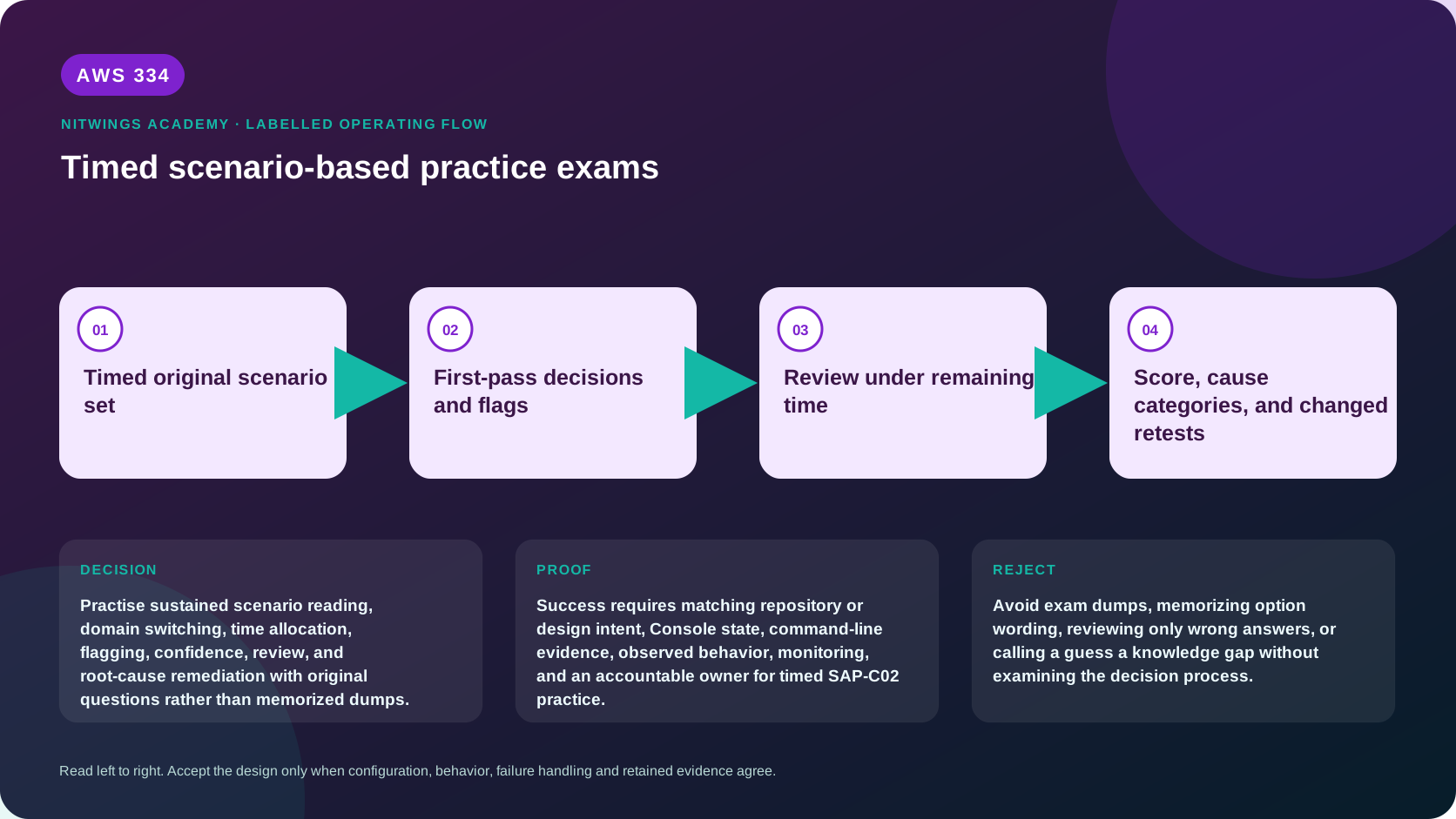
Knowing architecture when relaxed is different from applying it for three hours across long, changing scenarios. Timed practice tests sustained attention, requirement extraction, decision scope, elimination, confidence calibration, flagging, and review. Its value comes from diagnosis and changed retests, not the raw score.
As of this review, SAP-C02 uses 75 multiple-choice or multiple-response questions in 180 minutes and is scheduled to transition to SAP-C03 in November 2026. Verify the official certification page before booking and align practice with the exam version you will take.
Learning outcomes
By the end, you can:
- create valid original practice sets matching the blueprint without using dumps;
- simulate the exam environment and time pressure;
- use first-pass, flag, and review strategies consistently;
- measure domain/task coverage, confidence, time, and answer changes;
- distinguish knowledge gaps from reasoning and pacing failures;
- remediate with first-party sources, diagrams, labs, and changed questions;
- determine readiness from repeated evidence rather than one score;
- build a final pre-exam plan and exam-day operating routine.
1. Ethical and valid practice
Use AWS official sample/practice material and independently written scenarios. Never collect, buy, reproduce, or share recalled live questions or dumps. Dumps violate exam integrity and produce brittle memorization.
A useful original scenario has:
- a plausible business and technical context;
- enough facts to select one best answer or stated number of responses;
- explicit hard constraints and optimization wording;
- several technically plausible options;
- one defensible key grounded in current official documentation;
- rationales for correct and incorrect options;
- domain/task and skill tags;
- independent review for ambiguity.
Do not copy names/numbers from live recollections. Change context, demand, recovery, and organizational constraints in retests so the learner must reason again.
2. Blueprint and set construction
Use the SAP-C02 weights as a planning baseline, while accepting that scenarios cross domains:
| Domain | Blueprint weight | Approximate focus in a 75-question simulation |
|---|---|---|
| Organizational Complexity | 26% | 19-20 |
| New Solutions | 29% | 21-22 |
| Continuous Improvement | 25% | 18-19 |
| Migration and Modernization | 20% | 15 |
Approximate counts are practice design aids, not a claim about the exact live form. Cover each task statement, major service family, Well-Architected trade-offs, and cross-domain combinations. Mix multiple-choice and multiple-response items.
Create an item-review table:
| Check | Reviewer question |
|---|---|
| Currency | Are services/features current for the practice date? |
| Sufficiency | Does the stem contain enough information? |
| Uniqueness | Is the keyed answer clearly best under stated constraints? |
| Plausibility | Are distractors realistic without trick wording? |
| Scope | Does the question ask one clear decision? |
| Source | Can the rationale cite current first-party documentation? |
| Leakage | Is it independently written and free of recalled exam content? |
3. Baseline before full simulation
First run a 20-question mixed diagnostic without notes. Capture answer, confidence, time, and reason. This reveals whether the learner is ready for full-length practice or needs targeted study first.
Do not delay all testing until “fully ready.” Retrieval and scenario practice expose misconceptions. But repeated full exams without remediation waste good questions and rehearse bad habits.
4. Simulate exam conditions
For a full simulation:
- use one uninterrupted 180-minute block;
- use 75 reviewed original/official questions;
- close notes, documentation, messaging, and unrelated devices;
- use the same language and accessibility accommodations planned for the exam;
- allow only interface behaviors available in the delivery method;
- record start/end, pauses, technical interruptions, and environmental deviations;
- do not view explanations until the timed session ends.
If health or approved accommodations require a different setup, practice that setup. The goal is valid rehearsal, not avoidable hardship.
5. Time strategy
The arithmetic average is 2.4 minutes per question. Use checkpoints rather than forcing equal time:
Question 25: about 60 minutes used
Question 50: about 120 minutes used
Question 75: preserve remaining time for review
These are starting guides. Multiple-response and long scenarios can take longer; short high-confidence items repay time. If a question exceeds its useful budget, make the best requirements-led choice, flag it, and continue.
Read final ask, then scenario, then options. Record a first-pass answer. Avoid leaving unanswered questions. Confirm the delivery interface's navigation and flag behavior using official practice before exam day.
6. Confidence and flagging
Use three levels:
- High: requirements and service semantics clearly determine selection.
- Medium: two plausible options remain; one trade-off decides.
- Low: an important fact or interpretation is uncertain.
Flag low confidence and selected medium-confidence items, not every difficult-looking question. A long flag list makes review impossible.
During review, state a concrete reason before changing: missed constraint, misread number of selections, corrected scope, recalled verified service behavior, or newly recognized contradiction. Do not change answers because they “feel too easy.”
7. Capture attempt data
For each item store:
set and item ID
domain and task
question type and required selections
first answer and final answer
correct answer after submission
first-pass confidence
time spent and flagged status
constraint and question modifier
rejection reason for each distractor
answer changed? why?
error category
official source and remediation
changed-retest result/date
Do not expose answer keys during timing. Store copyrighted official-practice content only according to its permitted access; the learner ledger can reference item IDs and concepts.
8. Score beyond percentage
Calculate:
- raw accuracy overall and by domain/task;
- high/medium/low confidence accuracy;
- calibration: were high-confidence answers actually more accurate?;
- time distribution and slowest items;
- first-pass versus final accuracy;
- beneficial and harmful answer changes;
- multiple-choice versus multiple-response accuracy;
- error-category frequency;
- repeat performance on changed retests.
Do not infer the AWS scaled exam score from a homemade raw percentage. Unscored items, forms, and scoring processes are not reproduced by local practice. Use trends and competency gates.
9. Root-cause categories
| Category | Diagnostic question | Remediation |
|---|---|---|
| Knowledge | Did I misunderstand a service/control? | Read official docs, contrast alternatives, verify in safe lab |
| Requirement | Did I miss a hard phrase or modifier? | Rewrite constraint ledger before options |
| Scope | Did I solve the wrong account/Region/layer? | Draw control/data and ownership boundary |
| Trade-off | Did I pick possible instead of best? | Compare survivors against requested optimization |
| Distractor | Why was the wrong option attractive? | Record violated requirement and pattern |
| Assumption | Did I invent scale, budget, or capability? | Separate stated from inferred facts |
| Multiple-response | Did one selected item invalidate the set? | Test each item and combined architecture |
| Time/attention | Did rushing or fixation cause the miss? | Adjust checkpoints, flag rule, and reading routine |
Review incorrect answers, correct guesses, low-confidence correct answers, and harmful answer changes. High-confidence mistakes are priority because they expose a confident misconception.
10. Remediation methods
Match remediation to cause:
- create two-column service/feature contrasts;
- draw packet, identity, data, or recovery flow;
- build a small safe lab and test success/failure;
- read the exact official section and summarize behavior in your own words;
- write an ADR comparing viable options;
- teach the scenario aloud without options;
- create a changed retest with different services and constraints;
- practice a five-question timed micro-set for pacing.
Do not immediately repeat the same item. Recognition can masquerade as mastery. Retest the underlying decision with changed wording and values after a delay.
11. Two-exam cycle
Simulation A
Use the full process. Spend the next study block analyzing every weak/uncertain item. Build a ranked remediation backlog and complete evidence-based corrections.
Simulation B
Use a different reviewed set after remediation. Compare not only score but confidence calibration, time, error causes, multiple-response performance, and harmful changes.
If score rises but high-confidence errors persist, readiness is not proven. If one domain improves while another has insufficient coverage, add targeted scenarios before another full simulation.
12. Readiness gate
Define readiness before seeing scores. A defensible gate can require:
- two separate full-length sets completed under valid conditions;
- stable target performance across sets rather than one spike;
- no major domain/task left untested;
- no repeated high-confidence misconception;
- full completion within time with reserved review;
- accurate selection count for multiple-response questions;
- improving confidence calibration;
- changed retests passed with explanation;
- official exam version/date and logistics verified.
Choose the numerical target with instructor policy and risk tolerance. Do not present a local raw score as an AWS guaranteed pass threshold.
13. Exam-day operating plan
Before exam day verify identity, appointment, timezone, testing location/system, allowed items, accommodations, current exam code, and check-in rules from official sources. For online proctoring, run the required system test and prepare the room. Do not rely on old course screenshots.
During the exam:
- read number-of-selections instructions;
- apply the same requirements-first method;
- monitor checkpoints without panic;
- flag selectively;
- answer every item;
- review for evidence-based changes;
- protect confidentiality after the exam.
14. Guided assessment workshop
Produce:
- current exam-version verification record;
- blueprint/task coverage matrix;
- 20-question diagnostic results;
- two independently reviewed 75-question set manifests;
- item-quality review evidence;
- simulation environment checklist;
- time/checkpoint plan;
- confidence and flagging rules;
- Simulation A attempt ledger;
- domain/task analysis;
- confidence-calibration analysis;
- timing and answer-change analysis;
- root-cause backlog;
- first-party remediation notes/labs;
- changed-retest results;
- Simulation B attempt ledger and comparison;
- readiness decision with gaps;
- exam-day logistics and operating plan.
Cost and cleanup
This lesson creates no AWS resources. Official paid practice products or exam booking require the learner's own approval. Local original-question files and results should not include live exam content or secrets.
Knowledge check
- Why is raw score insufficient? It hides coverage, confidence, timing, guesses, and error causes.
- Why not repeat the same missed question immediately? Recognition can imitate understanding.
- Which correct answers need review? Guesses and low-confidence answers.
- What justifies changing an answer? A concrete corrected fact, scope, or constraint.
- Can a homemade percentage predict the scaled score? No; use it as trend evidence, not a guarantee.
Lesson acceptance
Submit all 18 artifacts. Two full simulations must use different ethical sets under documented conditions; analysis must cover domain/task, confidence, time, answer changes, and cause; remediation must use first-party evidence and changed retests; readiness must remain conditional on current official exam-version verification.