AWS 381: Platform engineering templates with CloudFormation Git sync and CI/CD
Why this lesson matters
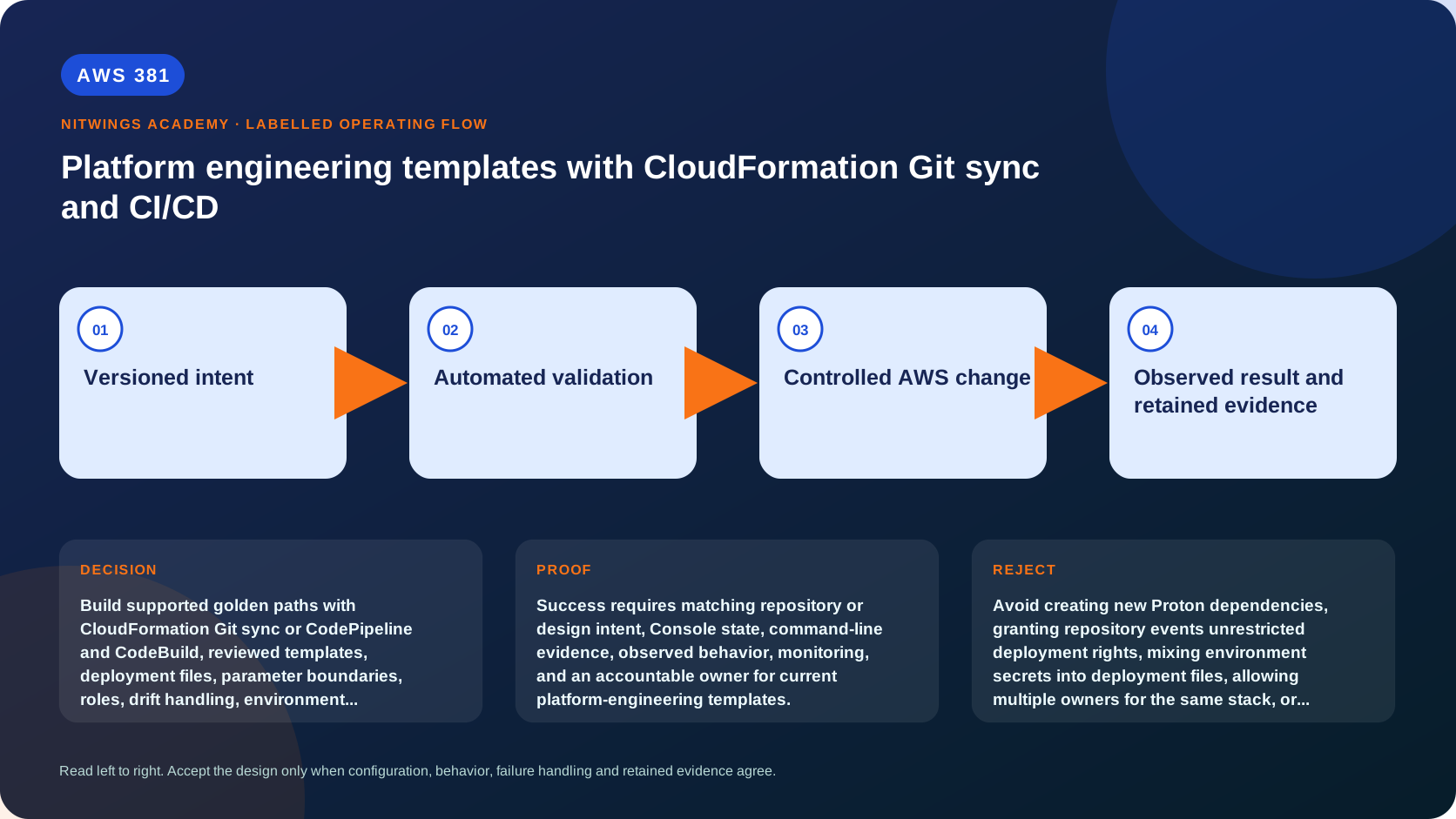
Platform engineering gives application teams supported golden paths with safe defaults, automation, evidence, documentation, and an escape process. CloudFormation Git sync can map repository template/deployment files to stacks; CI/CD adds richer gates and orchestration. Neither model removes product ownership or runtime operations.
Golden path and delivery choices
| Approach | Strength | Limitation |
|---|---|---|
| Git sync | Direct repository-to-stack synchronization and status | Automatic update path needs external validation/governance design |
| CI/CD pipeline | Explicit lint/test/policy/change/approval stages | More components, roles, cost and maintenance |
| Service Catalog | Discoverable governed self-service lifecycle | Product/version/portfolio administration |
| CDK/SAM library | Higher-level reusable developer constructs | Generated-resource and dependency governance |
| Raw template repository | Maximum transparency/flexibility | Consumers assemble lifecycle and controls |
A golden path is a maintained product: defined consumers, outcomes, security and resilience defaults, version/SLO, documentation, examples, telemetry, support, cost, deprecation, and feedback. It should accelerate common cases without making exceptions impossible or invisible.
CloudFormation Git sync
Git sync monitors a repository branch for a template file and stack deployment file containing stack parameters. A connection authorizes access and a synchronization role permits CloudFormation operations. Supported repository providers, Regions, stack states, pull-request comments, and exact configuration must be checked for the target environment.
Protect branch and connection installation, require reviews, sign/trace commits, scan both template and deployment file, and prevent secrets in parameters. Record repository/branch/path, commit ID, sync configuration, role, stack, deployment-file hash, sync event, provisioning status, change details, and runtime health. A repository commit is not proof of successful provisioning.
Automatic sync can make merge the deployment approval. Use it where branch controls and blast radius justify that behavior. For production or multi-stack releases needing change-set approval, integration tests, waves, or coordinated rollback, use a governed pipeline. Do not attach Git sync and another writer to the same stack without one explicit authority.
Platform ownership and promotion
Separate platform template source, environment configuration, workload code, and runtime data. Define interfaces through typed parameters/outputs and avoid exposing secrets. Version templates semantically, publish compatibility and migration, retain prior known-good artifacts, and measure adoption plus upgrade age.
Promotion must identify the same reviewed template/artifacts across development, test, and production, with versioned environment configuration. Gates include syntax/lint, unit/assertion, policy/security, secret/dependency, change set/diff, cost/quota, integration, resilience, approval, canary/wave, alarm/bake, and evidence retention. Emergency changes must feed back into source and resolve drift.
Measure lead time to first successful use, deployment success, rollback/recovery time, upgrade age, support load, security findings, exception rate, and developer satisfaction. Raw adoption can reward forced use of a poor path. Give teams a documented exception route with risk owner and expiry, then use repeated exceptions as product feedback. Platform teams remain responsible for version communication and safe migration.
AWS Proton is not the assumed destination for a new platform design; assess current service lifecycle and migrate existing templates/environments deliberately rather than copying outdated patterns. Preserve ownership, deployment history, parameters, secrets, roles, and running resources through migration.
Read-only inspection and workshop
aws codestar-connections list-connections --region ap-south-1
aws codestar-connections list-sync-configurations --sync-type CFN_STACK_SYNC --region ap-south-1
aws cloudformation describe-stacks --stack-name STACK --region ap-south-1
aws cloudformation describe-stack-events --stack-name STACK --region ap-south-1
aws cloudformation detect-stack-drift --stack-name STACK --region ap-south-1
Design a golden path for a stateless API with private networking, compute, data store, IAM, encryption, logs/traces, alarms, backup, budgets/tags, deployment, and runbook. Provide Git-sync and CI/CD variants, state which environment uses each, and define repository layout, deployment files, role trust, change gates, version contract, exception process, and deprecation.
Inject 16 failures: connection revoked, wrong branch/path, malformed deployment file, secret committed, role denial, unsupported stack state, sync succeeds but app fails, two writers, stale environment parameter, destructive change, quota, policy waiver expired, integration false positive, partial regional promotion, drift after emergency, and deprecated version still consumed. Preserve source-to-runtime evidence and owner response.
Cost and acceptance
Price delivery services, build minutes, connections, artifacts/KMS, logs/metrics, test environments, target resources, support, migration, and retained versions. This lesson creates nothing.
Submit platform product contract, choice table, repository/deployment-file examples, trust map, complete gate flow, promotion manifest, support/SLO, exception and drift process, migration/deprecation, sixteen failures, cost, and adoption metrics. Pass requires a single writer, no secret in Git, exact source-to-stack traceability, runtime verification, and lifecycle ownership beyond initial provisioning.