
AWS 387: Automated backup, restore validation, and recovery-environment provisioning
Why this lesson matters
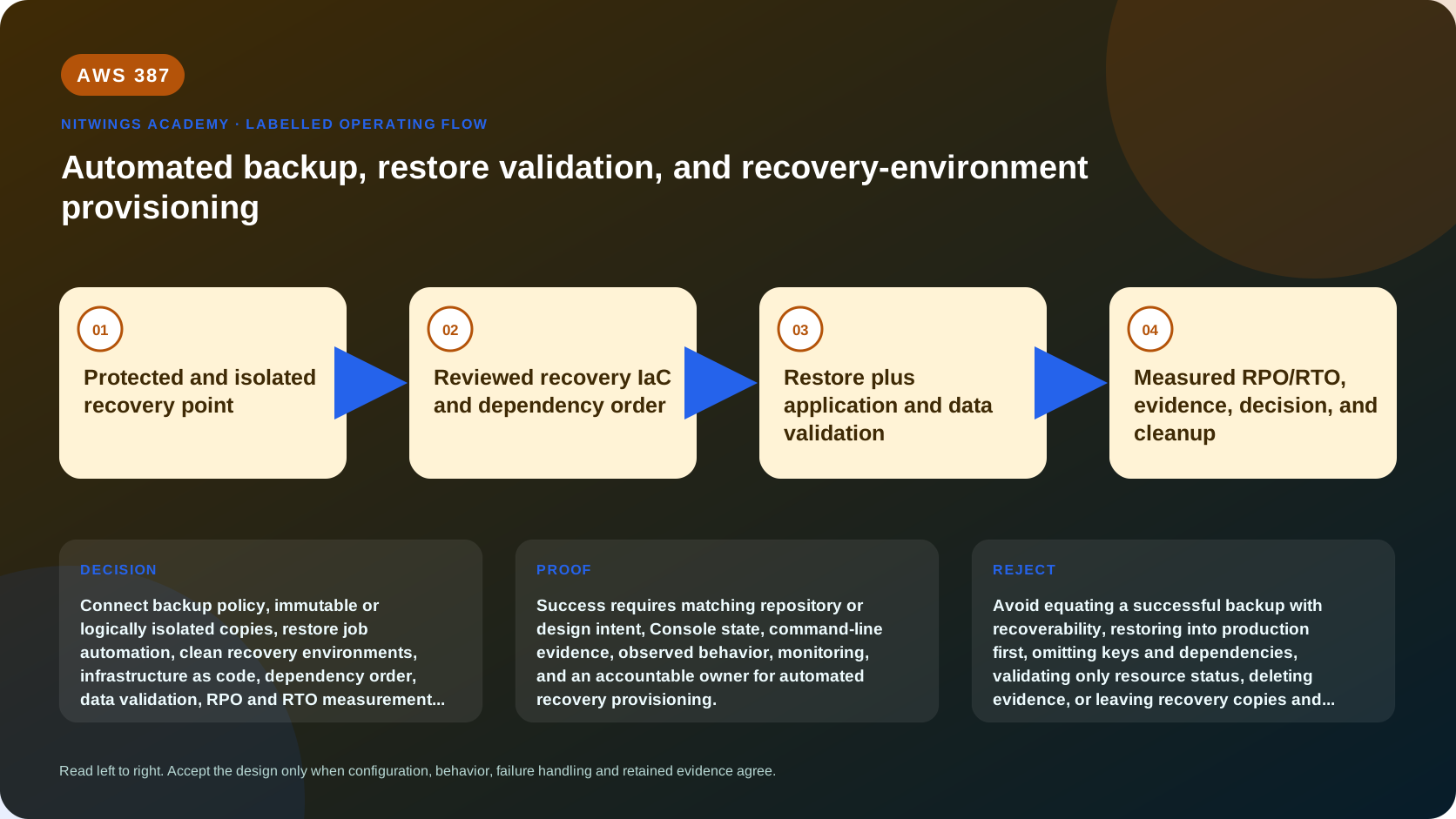
A successful backup job proves a recovery point was written, not that an application can recover. Production readiness requires protected copies, known dependencies, automated restore into a clean environment, data and application validation, measured RPO/RTO, credentials and traffic recovery, evidence, and safe teardown.
Recovery chain
| Stage | Required proof | Frequent gap |
|---|---|---|
| Protect | Resource covered by correct plan/rule | Wrong tag/account/Region |
| Isolate | Copy resists source credential compromise | Same role/key/control plane can delete it |
| Select | Recovery point meets incident time and integrity | Latest point contains corruption |
| Provision | Clean network/IAM/compute/config available | Circular dependency on failed Region/account |
| Restore | Job completes with correct metadata | Restored resource is unreachable/unusable |
| Validate | Data, application, security and user tests | Row count alone hides corruption |
| Cut over | DNS/routing/session and writes controlled | Split brain or stale clients |
| Teardown | Evidence kept, test resources removed | Snapshots/ENIs/keys continue billing |
RPO is measured data loss between incident boundary and usable recovery point. RTO begins at the agreed incident/recovery trigger and ends only when the defined business service is usable at accepted capacity, security, and data quality. Tool job durations are components, not the whole objective.
Backup and isolation design
Inventory every state source: databases, block/file/object storage, queues/streams, identity/configuration, secrets/certificates/keys, DNS, container/image/artifact, SaaS/external systems, and application-consistent transaction boundaries. Define owner, frequency, retention, lifecycle, vault/account/Region, encryption key, legal hold, copy lag, restore metadata, and validation.
AWS Backup vault lock and logically air-gapped vault capabilities have exact modes, retention, account-sharing, and recovery behavior. Evaluate current service support. Separate backup administration, restore operator, source workload, and security/audit roles. Protect KMS keys and recovery credentials independently. A vault is not isolated if the same compromised identity can alter plan, delete copies, disable keys, and approve restores.
Application consistency may require database-native snapshots, quiesce hooks, transaction/log sequence, coordinated multi-resource point, or replay. Crash-consistent volume copies can be insufficient for distributed state. Keep multiple generations to avoid restoring corruption or ransomware-encrypted data.
The recovery catalog must connect each recovery point to resource identity, application version, schema, transaction/log position, dependency set, encryption key, account/Region, copy status, malware/integrity signal, retention expiry, and legal constraints. Test that operators can discover an older clean point during source-account compromise without relying on the failed application database or undocumented personal knowledge.
Automated restore testing
AWS Backup restore testing can schedule eligible recovery-point selection and invoke restores, but application validation and complete environment orchestration remain the owner’s job. Build a workflow triggered by schedule or recovery request: allocate isolated account/VPC, deploy IaC baseline, select point, restore in dependency order, rotate/attach test-only credentials, start services, run validations, export evidence, quarantine failures, and clean up.
Validate checksums/schema, database integrity, referential/business invariants, point-in-time/log continuity, malware/security posture, encryption and least privilege, application startup, read/write transactions, dependency behavior, performance/capacity, monitoring/backup re-enrollment, and user journey. Prevent the recovered environment from sending production email, payment, webhooks, or outbound jobs.
Make the workflow restartable. Persist every step and idempotency token outside the recovering workload, distinguish retryable from terminal errors, and verify that a retry cannot restore a second conflicting database or repeat traffic cutover. Require approval before writes or DNS changes, while allowing routine isolated restore tests to run automatically. Expire temporary credentials and quarantine failed recovered data for investigation.
aws backup list-recovery-points-by-backup-vault --backup-vault-name VAULT --region ap-south-1
aws backup list-restore-jobs --by-status COMPLETED --region ap-south-1
aws backup get-restore-job-metadata --recovery-point-arn RECOVERY_POINT --region ap-south-1
aws backup list-restore-testing-plans --region ap-south-1
aws backup list-restore-testing-selections --restore-testing-plan-name PLAN --region ap-south-1
Workshop and failure game day
Design recovery for a three-tier API with Aurora, S3, EFS, secrets, KMS, ECR, DNS, and external payment integration. Target RPO 15 minutes and RTO 2 hours. Produce dependency order, clean-room IaC, recovery-point selection algorithm, isolated validation, write/cutover/failback policy, timing budget, evidence ledger, and teardown.
Inject 18 cases: plan tag misses resource, backup job partial, copy lag, recovery point corrupted, vault access deny, key disabled, restore metadata incomplete, subnet IP shortage, secret unavailable, wrong database log point, schema incompatible, recovered jobs contact production, DNS TTL, split writes, validation false positive, restore exceeds RTO, evidence lost, and cleanup leaves snapshots/ENIs. State detection, alternative point, authorization, data consequence, measured RPO/RTO, and prevention.
Cost and acceptance
Price backup/copy storage, restore/testing jobs, cross-Region transfer, KMS, temporary compute/database/network, logs/scans, retained evidence, and cleanup lag. This lesson creates nothing.
Submit inventory/plan matrix, trust/isolation model, automated state machine, dependency graph, validation suite, RPO/RTO timeline, cutover/failback, eighteen failures, cost, and cleanup proof. Pass requires an actually usable restored application, independent authorization, measured objectives, no production side effects, and no orphaned recovery resource.