
AWS 422: DOP-C02 timed scenario set
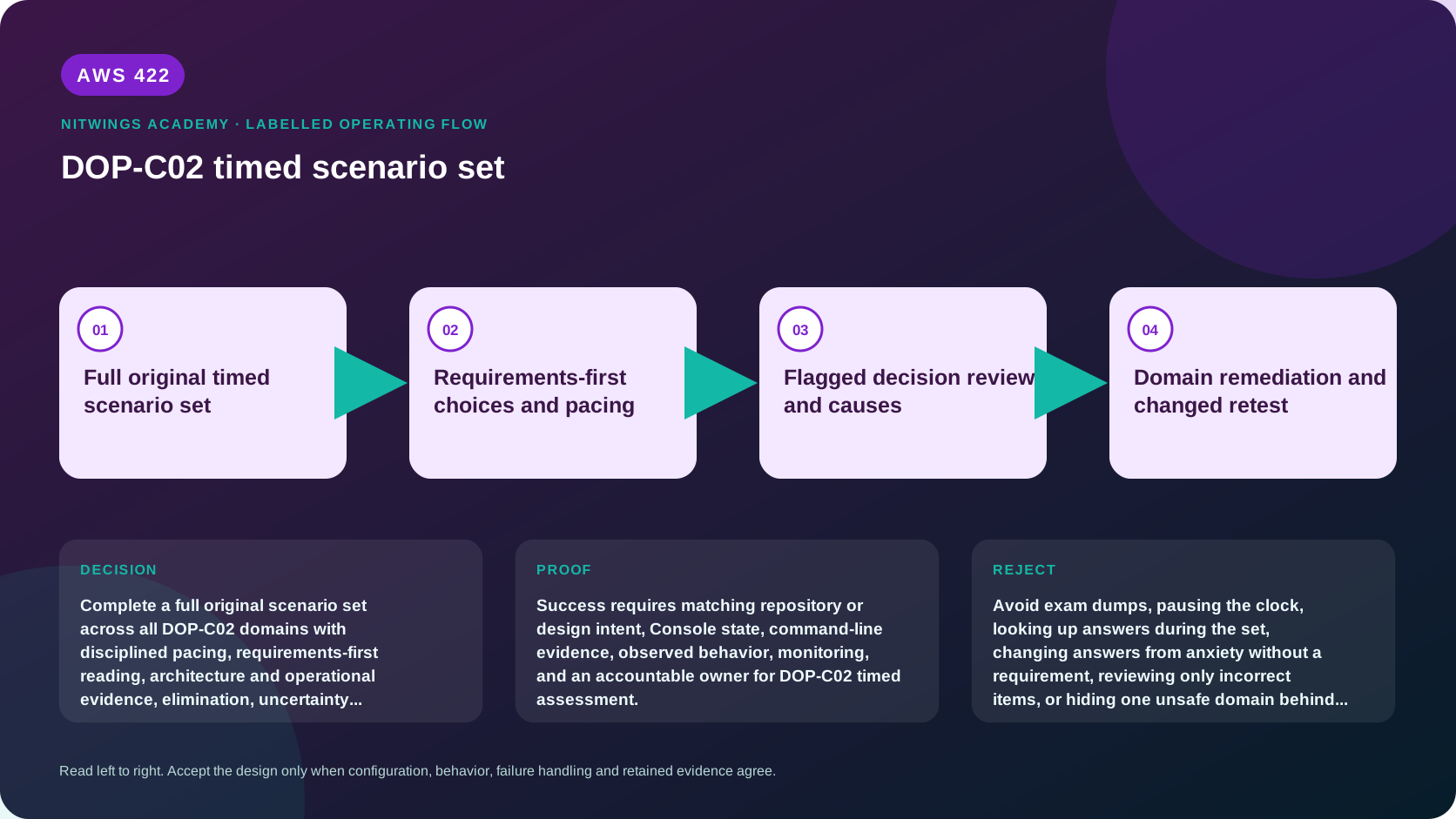
Current exam context and integrity
The current AWS overview lists 180 minutes and 75 multiple-choice or multiple-response questions. Verify scheduling, language, identification, delivery and accommodation details on official pages because logistics can change. This lesson contains original scenarios, not recalled exam content or dumps.
Domain weights are SDLC Automation 22%, Configuration Management/IaC 17%, Resilient Cloud Solutions 15%, Monitoring/Logging 15%, Incident/Event Response 14%, and Security/Compliance 17%. The exam is compensatory overall, but this course requires balanced competence because production systems expose weak domains.
Timed method
Run 60 original questions in 150 minutes, reserve 25 minutes for flagged review and five minutes for submission checks, approximating the real pace while leaving time for this exercise's written evidence. For each scenario underline the required outcome, constraints, current state and optimization word such as least operational effort, most secure, fastest recovery or lowest cost.
| Pass | Action | Time guide |
|---|---|---|
| First | Answer clear items; eliminate impossible options | 90 minutes |
| Second | Solve calculations/dependency/policy cases | 60 minutes |
| Review | Recheck flagged assumptions and multi-response count | 25 minutes |
| Submit | Ensure every response and confidence mark recorded | 5 minutes |
Do not add unstated requirements or ignore explicit ones. Prefer mechanisms that satisfy all constraints and remove undifferentiated operations, but reject managed services when their semantics cannot satisfy data, identity, failure or timing needs. In multi-response questions evaluate the complete set, not each choice independently.
Scenario set blueprint
The supplied set has ten questions per domain. Build or use the facilitator packet with four plausible choices, one best answer or stated response count, explanation for every option, official source and earlier lesson mapping. Distribution:
- SDLC: cross-account pipeline, source triggers, deterministic builds, artifact promotion, tests, approval, blue/green/canary, rollback and multi-Region release.
- IaC/configuration: change sets, replacement/deletion, nested stacks/modules, CDK context/assets/bootstrap, StackSets, drift/import, configuration rollout and emergency reconciliation.
- Resilience: RTO/RPO selection, backup/restore, multi-AZ/Region, Auto Scaling/ELB, queues, database compatibility, capacity/quota and game days.
- Monitoring/logging: SLI/SLO/error budget, metrics/logs/traces, cardinality, alarms/composites/anomaly/no-data, cross-account telemetry, retention/query and evidence correlation.
- Incident/event: EventBridge/SNS/SQS/Step Functions routing, Health fields, idempotent remediation, incident roles, containment, communications, verification and post-incident action.
- Security/compliance: temporary identity, PassRole/trust/SCP, KMS/resource policy, Secrets rotation, ECR/Lambda signing, Inspector, Config, Security Hub and CloudTrail integrity.
Mandatory challenge cases
At least 18 questions use these traps: Allow in SCP mistaken for grant; service-linked role assumed restricted; resource policy considered without KMS key; OIDC subject wildcard; PassRole confused with AssumeRole; tag mistaken for digest; Warn mistaken for Enforce; scan failure mistaken for zero findings; Config NOT_APPLICABLE treated compliant; CloudTrail validation enabled but never run; Health delivery Region used as affected Region; Step Functions callback token logged; EventBridge duplicate triggers two repairs; alarm component health replaces SLI; RPO confused with RTO; rollback ignores target writes/schema; cross-Region replication mistaken for failover; and lifecycle cleanup deletes rollback evidence.
Five quantitative items require units: error-budget consumption, queue drain, Auto Scaling/deployment capacity, RPO/RTO timeline and StackSet failure/concurrency. Five evidence items provide logs/policies/events where the most familiar service is not the answer. Five design items require the option with the fewest correlated dependencies.
Answer-review discipline
For every wrong or low-confidence answer record domain/task, selected/expected option, missed requirement, false assumption, AWS semantic rule, why each distractor fails, source, mapped lesson and changed practice case. Classify the root cause as knowledge, requirements reading, architecture reasoning, calculation, time pressure or confidence error.
Do not merely reread the explanation. Redraw the data/identity/failure path, run a policy or calculation variant, and explain aloud in two minutes. Retest with changed names/numbers after at least one study interval. An answer memorized from the same wording is not remediation.
Scoring gates
Score overall, each domain, high-confidence errors and changed retests. Course readiness requires at least 85% overall, 75% in every domain, all safety-critical cases correct, no more than two high-confidence errors, complete explanations and at least 85% on changed retests. This threshold is a course readiness standard, not a prediction of AWS's scaled exam score.
If a domain fails, return to its checkpoint and named lessons. If timing fails with accuracy high, practice requirement extraction and flag discipline. If confidence calibration fails, require evidence before choosing. Take a second independently worded set rather than repeating until memory inflates performance.
Exam-day and submission checklist
Confirm appointment/time zone, accepted identification, system test or travel, workspace rules, accommodations and current AWS candidate policy from official sources. Sleep and pacing are operational controls; do not replace them with last-minute dumps. During the exam answer every item, monitor time, flag uncertainty and avoid changing evidence-backed answers from anxiety alone.
Submit response sheet, timing log, confidence, domain scores, root-cause/remediation ledger, changed retest and logistics checklist. Pass requires all scoring gates and academic integrity.