
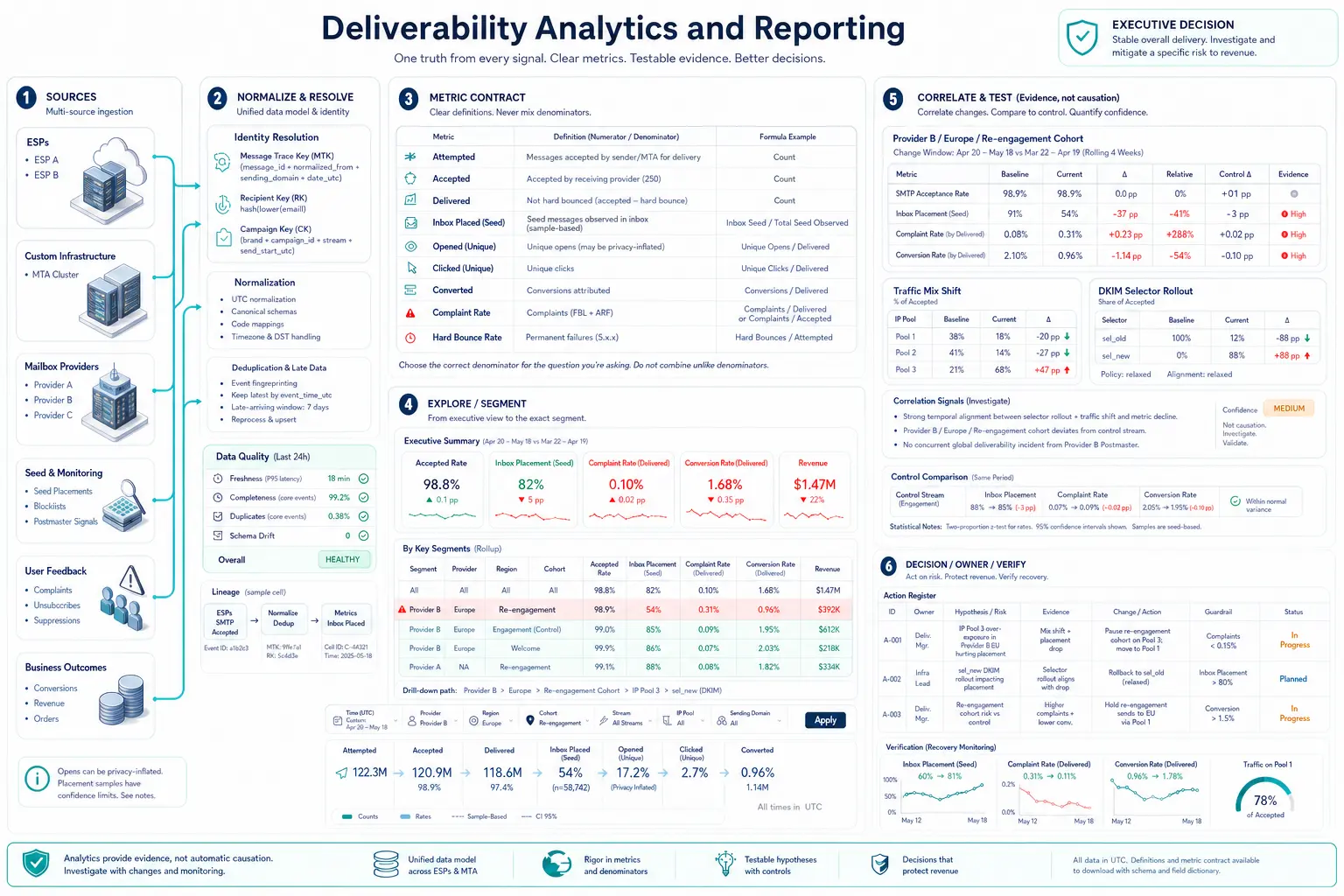
Build reporting that changes the next decision
A useful deliverability view connects provider outcomes with the sender, traffic stream, audience, infrastructure, and change that produced them. NitWings brings ESP metrics, MTA logs, DMARC reports, Postmaster data, SNDS, blocklists, complaints, and engagement history into one operating model.
The work begins with definitions and ownership. A dashboard cannot help if delivery, bounce, complaint, placement, and engagement fields mean different things in each source.
What the work covers
Campaign and ISP analytics
Delivery, hard and soft bounces, opens, clicks, click-to-open rate, unsubscribes, complaints, placement, deferrals, and rejection patterns by campaign, segment, stream, and provider.
IP and domain health
Authentication, reputation, blocklists, complaints, engagement, traffic changes, provider signals, and historical baselines for each sending identity and pool.
Engagement cohorts
Active, semi-active, inactive, re-engagement, and risk cohorts tied to frequency, complaint, bounce, placement, and retention decisions.
Automated client reporting
Scheduled reports, custom dashboards, risk summaries, supporting evidence, open actions, owners, and recommendations written for the audience receiving them.
Unified Deliverability API
A documented API layer for normalized metrics, authentication state, reputation signals, scores, alerts, and evidence that other systems can query or automate.
Historical data warehouse
Long-term storage for campaign, provider, reputation, authentication, engagement, and incident data with stable identifiers, retention rules, and analysis-ready history.
Scoring and anomaly detection
Transparent risk models, baselines, thresholds, persistence windows, and alerts that show what changed without treating one blended score as the whole diagnosis.
Action and ownership
Every important view identifies the affected stream, evidence, priority, likely owner, first safe check, and validation required before the alert can close.
Deliverables
Outputs can include a source inventory, metric dictionary, data model, dashboard blueprint, API contract, warehouse design, scheduled report templates, scoring logic, alert rules, ownership map, and implementation plan.