
AWS 094: EC2 Fleet and Spot Fleet
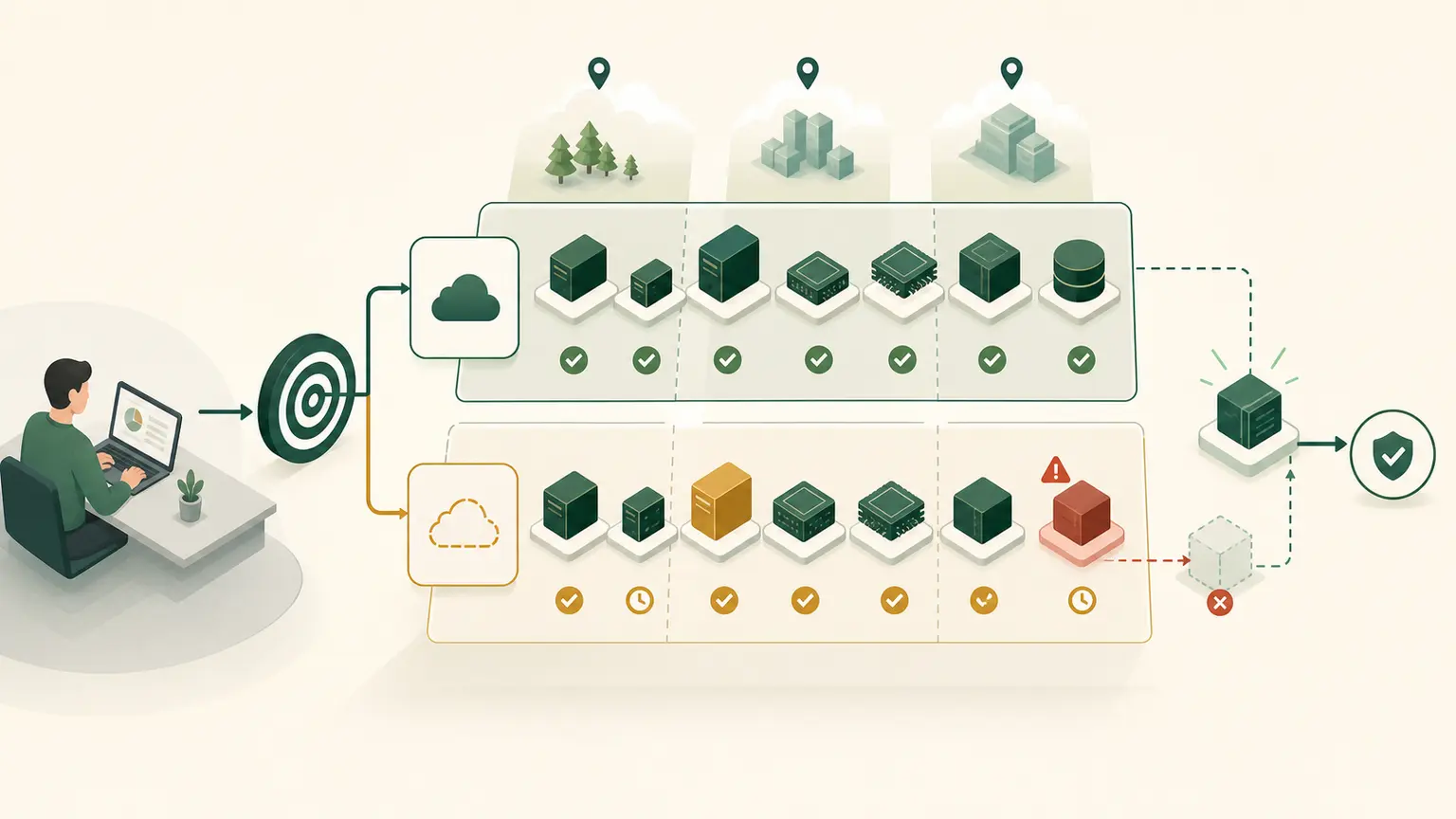
The real problem
A team recognizes the name EC2 Fleet and Spot Fleet but has not connected the feature to a real requirement, identity boundary, network or data path, failure mode, price dimension, and cleanup owner. A plausible configuration could still fail the workload.
Final outcome
The learner will produce a requirement-led artifact for EC2 Fleet and Spot Fleet, inspect the matching AWS control plane in the Management Console, run a matching CloudShell or AWS CLI query, interpret the output, diagnose one failure, defend one architecture choice, and prove cleanup or approved retained state.
The practical outcome is not a command transcript. It must show what was expected, what happened, what the result proves, what it does not prove, and which evidence would change the decision.
Learning objectives
By the end of this lesson, the learner can:
- explain ec2 fleet launches a capacity mix;
- explain capacity pools are type plus az;
- explain allocation strategy controls selection;
- explain fleet type controls lifecycle;
- explain weights represent workload units;
- connect control-plane state to the real data, network, identity, or application behavior;
- identify cost and cleanup ownership before any optional mutation;
- troubleshoot from evidence without opening broad access or adding broad permissions.
Relationship model
Requirement
   |
   v
Identity and policy -> AWS configuration -> network or data path -> workload behavior
        |                    |                      |                    |
        +--------------------+----------------------+--------------------+
                                      |
                                      v
                         monitoring, cost, recovery, cleanup
Use this model to separate an AWS object that exists from a result that actually works. Every arrow is a verification boundary.
Prerequisites, permissions, Region, and safety
- Learning baseline: This sequence assumes practical Linux knowledge but no prior cloud-computing or AWS knowledge. Cloud, networking, security, data, automation, and architecture concepts must come from completed earlier lessons. If a prerequisite checkpoint is incomplete, return to its linked lesson before continuing.
- Confirm a non-root caller with
aws sts get-caller-identityand keep the account number private. - Use
ap-south-1unless this lesson explicitly names a second Region. - Confirm the intended profile and Region with
aws configure listbefore interpreting an empty result. - Use read-only List, Get, and Describe permissions for the named services. Design exercises run locally and require no resource-creation permission.
- This is a no-create lesson. Console and CLI work is read-only, and every design artifact is created locally.
- Never publish account IDs, public addresses, ARNs containing private account data, session IDs, presigned URLs, object data, credentials, or KMS material.
- Do not use root, world-open SSH or RDP, disabled TLS verification, unowned resources, or irreversible retention controls in a training exercise.
Core model
| Concept | What the learner must understand |
|---|---|
| EC2 Fleet launches a capacity mix | A fleet uses a launch template plus overrides to request target capacity across instance types, Availability Zones, subnets, and On-Demand or Spot options. |
| Capacity pools are type plus AZ | Every instance type in every Availability Zone is a separate Spot capacity pool. Diversifying requirements gives the fleet more places to fulfill capacity. |
| Allocation strategy controls selection | For Spot, price-capacity-optimized balances interruption likelihood and price and is the current recommended direction for many workloads. Capacity-optimized focuses on available capacity. |
| Fleet type controls lifecycle | Instant requests capacity immediately, request fulfills desired capacity without maintaining it, and maintain attempts to preserve target capacity. Validate current API behavior for each type. |
| Weights represent workload units | A large instance can contribute more units than a small instance. Target capacity can represent instances, vCPU, memory, or application-specific weighted capacity. |
| Spot Fleet is legacy | AWS states that Spot Fleet uses a legacy API with no planned investment and recommends Auto Scaling or EC2 Fleet for new designs. |
How it works
AWS recommends EC2 Auto Scaling for most fleets that need lifecycle management, health replacement, scaling, and load-balancer integration. Use EC2 Fleet when launching a mixed fleet while managing more lifecycle behavior yourself.
Read the result in layers:
- Scope: account, Region, VPC, bucket, AZ, endpoint, principal, object version, or resource ARN.
- Control plane: the requested configuration exists and reached an expected state.
- Behavior: the request, connection, health check, replication, restore, or application result meets the requirement.
- Operations: monitoring, failure owner, cost, retention, rollback, and cleanup are known.
Control-plane success is necessary but not sufficient. A resource can be available while policy, routing, DNS, health, data, or application behavior remains wrong.
Architecture decision table
| Requirement | Preferred direction | Why |
|---|---|---|
| Application needs scaling and unhealthy-instance replacement | Auto Scaling group with mixed instances | It manages desired capacity, health, scaling, and load-balancer integration. |
| One API call needs an immediate diverse capacity mix | Instant EC2 Fleet | The request can combine instance choices and purchase options. |
| Spot workload wants lower interruption risk | Many pools plus price-capacity-optimized | Selection uses price and capacity signals instead of cheapest pool only. |
| Existing design proposes new Spot Fleet | Choose Auto Scaling or EC2 Fleet | Spot Fleet is a legacy API with no planned investment. |
Professional questions normally contain several valid services. State the requirement that selects one option, why the nearest alternative fails it, and what changed requirement would reverse the choice.
AWS Management Console guided practice
Before opening a service page, write the expected account, Region, starting state, and evidence. Do not choose Create, Save, Purchase, Lock, or Delete unless the lesson explicitly authorizes the live track.
- Open EC2 Auto Scaling groups and inspect Mixed instances policy, instance requirements, On-Demand base, Spot percentage, and allocation strategies.
- Use this console workflow for managed fleet lifecycle. AWS does not provide a console creation workflow for EC2 Fleet itself.
- Use the CLI exercise to inspect or create EC2 Fleet only after preparing a launch template and approved capacity limits.
For each step, capture the field name and value in text. A screenshot may support the record but does not replace the explanation. Console labels can evolve, so use the service search and current documentation if a navigation label differs.
CloudShell and AWS CLI practice
CloudShell is the default browser-based command environment taught in AWS 028. AWS 029 and AWS 030 cover local CLI installation and authentication. This lesson therefore does not assume that an unconfigured local shell is ready.
Start every session with:
export AWS_DEFAULT_REGION="ap-south-1"
aws sts get-caller-identity --query Arn --output text
aws configure list
Redact the account portion of the ARN before sharing. Then perform the topic query:
Inspect fleet type, target capacity, state, allocation strategies, and errors.
aws ec2 describe-fleets --query 'Fleets[].{Fleet:FleetId,Type:Type,State:FleetState,Target:TargetCapacitySpecification,SpotStrategy:SpotOptions.AllocationStrategy,OnDemandStrategy:OnDemandOptions.AllocationStrategy}' --output json
aws ec2 describe-fleet-history --fleet-id fleet-0123456789abcdef0 --start-time 2026-07-30T00:00:00Z
Expected interpretation:
Unfulfilled capacity needs pool-level evidence. Review invalid configuration, quota, price, and insufficient-capacity events rather than repeatedly requesting one type.
Replace every replace-with-... sample value before running its command, and use only an explicitly owned resource. Explain each option first. These queries are read-only; a successful response does not authorize a later create or delete operation.
Practical work
Create p05-fleet-plan.md. Design a diversified EC2 Fleet or Auto Scaling mixed-instances policy with attribute-based instance selection, On-Demand base, Spot percentage, capacity-optimized allocation, interruption handling, maximum price and capacity boundaries, launch template, and replacement ownership. Note that EC2 Fleet creation is CLI/API-based and that Spot Fleet is a legacy API. Do not request capacity.
The evidence package must contain:
- the problem and final requirement in the learner's own words;
- caller type and Region with private identifiers redacted;
- exact planned values, ownership, and cost class;
- one Console observation and matching CLI or API evidence;
- one behavior result or supplied data-plane record;
- one denied, failed, or counterexample result and evidence-led diagnosis;
- one architecture choice plus the rejected alternative;
- cleanup proof or explicit retained-state owner, expiry, and next lesson.
Verification standard
Use expected state before observed state. Record timestamps in UTC and preserve the original failure before changing anything. A passing submission answers all four questions:
- What exact requirement was tested?
- Which evidence proves the AWS configuration?
- Which evidence proves the workload behavior?
- What remains unproven or requires later monitoring?
If AWS returns no rows, verify account, Region, permission, filters, pagination, resource type, and deletion state before concluding that nothing exists.
Common failures and troubleshooting
| Symptom | Evidence first | Likely boundary | Smallest safe response |
|---|---|---|---|
| object appears missing | caller, Region, filters, pagination, tags | scope or read permission | align scope before creating a duplicate |
| state remains pending or unavailable | service state, events, dependencies, quotas | dependency or capacity | correct the named dependency and wait with a bound |
| AccessDenied | principal, action, resource, explicit-deny context | identity, resource, endpoint, organization, or KMS policy | change only the proven policy layer |
| configuration exists but behavior fails | route, DNS, security, listener, health, logs, object version | data path or application | test the next boundary and change one control |
| bill is higher than expected | hours, bytes, requests, AZs, addresses, retention | cost model or retained resource | stop optional work and reconcile the ledger |
| cleanup is blocked | dependency inventory and owning service | deletion order or immutable state | remove owned dependants in reviewed reverse order |
Do not troubleshoot by attaching administrator access, opening administration ports to the internet, disabling encryption, retrying uncontrolled creation, deleting unknown resources, or weakening retention.
Cost, cleanup, and retained state
No AWS resource is created. Close CloudShell and remove or redact downloaded evidence.
Cleanup evidence requires terminal state and an after-inventory. Search related ENIs, public IPv4 addresses, EBS volumes and snapshots, load balancers, target groups, Auto Scaling instances, endpoints, logs, S3 versions and delete markers, backup recovery points, and global IAM roles when they apply. Billing data can lag, so schedule a later review.
Architecture and certification decisions
- Certification coverage: SAA-C03; SOA-C03; SAP-C02; DOP-C02.
- Exam mapping: SAA D2-D4.
- Explain service scope, failure boundary, consistency, recovery, security, operations, and price rather than matching a keyword.
- Treat availability and durability, encryption and authorization, routing and filtering, health and lifecycle, backup and replication, and discount and capacity as separate concepts.
- Do not reproduce protected certification questions.
Knowledge check
- What defines a Spot capacity pool?
Expected direction: One instance type in one Availability Zone.
- Which service is normally preferred for managed fleet lifecycle?
Expected direction: Amazon EC2 Auto Scaling.
- Why use weighted capacity?
Expected direction: Different instance sizes can contribute proportional application capacity toward one target.
- Is Spot Fleet the preferred new fleet API?
Expected direction: No. AWS describes it as legacy and recommends Auto Scaling or EC2 Fleet.
Completion gate and assessment
| Area | Points | Passing evidence |
|---|---|---|
| Requirement and model | 15 | Correct scope, terminology, and final outcome |
| Console evidence | 15 | Current path and interpreted fields |
| CLI or API evidence | 15 | Scoped command, expected result, and limitations |
| Behavior or decision exercise | 20 | Reproducible result or defensible architecture reasoning |
| Troubleshooting | 15 | Original symptom, hypothesis, one change, retest, rollback |
| Security and cost | 10 | Least privilege, data protection, current price dimensions |
| Cleanup and handoff | 10 | Terminal-state proof or approved retained-state record |
Pass at 80 out of 100 with no critical safety failure. A missing practical artifact, unexplained output, unsafe access, destructive action outside the owned scope, unplanned billed resource, or false cleanup claim requires remediation and a changed retest.