
AWS 176: Amazon GuardDuty
Why this lesson matters
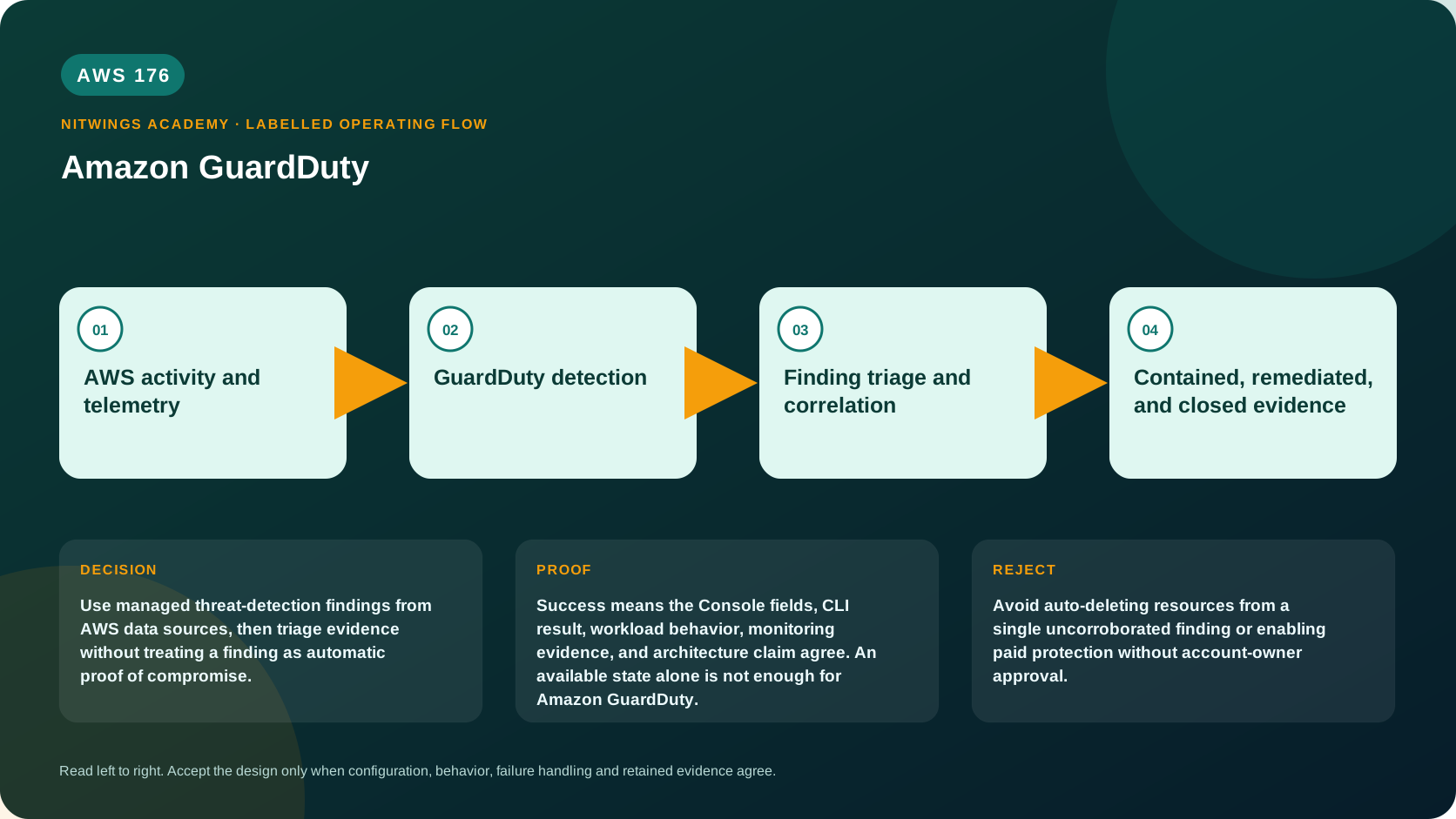
Use managed threat-detection findings from AWS data sources, then triage evidence without treating a finding as automatic proof of compromise.
What you will be able to do
By the end, you can:
- explain amazon guardduty in plain language;
- locate the current service controls in the AWS Management Console;
- run the matching CloudShell or AWS CLI queries and explain every important field;
- draw the identity, network, data, failure, and monitoring path;
- choose the service from requirements and reject it when those requirements are absent;
- diagnose a failed or misleading result from evidence;
- state the cost owner and prove cleanup or a no-create result.
Before you start
- Use a personal AWS account only when its owner has approved the lesson. Do not use the root user for daily work.
- CloudShell is the default command environment. AWS028 explains CloudShell; AWS029 and AWS030 explain local AWS CLI installation and profiles.
- The course example Region is
ap-south-1. Global services and services with a required control Region are called out in their commands. - Run
aws sts get-caller-identityprivately. Redact the account number before sharing evidence. - Never paste access keys, passwords, secret values, private object data, presigned URLs, or full account-specific ARNs into a submission.
- This is a no-create lesson. Every Console action and AWS CLI command is read-only. Create the practical artifact locally.
- Console wording can change. Use the Console service search if a menu label has moved, then confirm the current field in the official documentation.
The core model
| Question | What it means in this lesson |
|---|---|
| Purpose | Use managed threat-detection findings from AWS data sources, then triage evidence without treating a finding as automatic proof of compromise. |
| Scope and boundary | The learner must identify the account and Region scope, resource boundary, identity path, data or network path, failure behavior, observability, and cleanup ownership for Amazon GuardDuty. |
| Evidence of success | Success means the Console fields, CLI result, workload behavior, monitoring evidence, and architecture claim agree. An available state alone is not enough for Amazon GuardDuty. |
| Cost model | Requests, running capacity, storage, logs, data transfer, retained state, and optional features must be priced for the exact design. |
| Safe rejection rule | Avoid auto-deleting resources from a single uncorroborated finding or enabling paid protection without account-owner approval. |
How the request flows
+------------------------------+
|  AWS activity and telemetry  |
+------------------------------+
               |
               v
+-----------------------+
|  GuardDuty detection  |
+-----------------------+
           |
           v
+----------------------------------+
|  Finding triage and correlation  |
+----------------------------------+
                 |
                 v
+----------------------------------------------+
|  Contained, remediated, and closed evidence  |
+----------------------------------------------+
Understand what GuardDuty actually does
GuardDuty is a regional threat-detection service. It analyzes AWS control-plane and workload telemetry and produces findings; it is not a firewall, vulnerability scanner, SIEM, antivirus replacement or automatic incident responder. Foundational analysis covers sources such as CloudTrail management events, VPC flow activity and DNS logs available to the service without requiring you to create duplicate log buckets. Protection plans add resource-specific telemetry and cost.
| Capability | Detects or analyzes | Important boundary |
|---|---|---|
| Foundational protection | suspicious IAM, EC2 network/DNS and account behavior | A finding is evidence to investigate, not proof of compromise. |
| S3 Protection | S3 data-plane events and suspicious object access | Separate from Macie sensitive-content discovery. |
| EKS Protection | Kubernetes audit activity | Separate from runtime monitoring inside workloads. |
| Runtime Monitoring | runtime events for supported EC2, EKS and ECS/Fargate workloads | Requires coverage/agent management and must be checked per resource. |
| Malware Protection | supported EC2/EBS, S3 or AWS Backup scanning workflows | Availability, initiation model and charges differ by plan. |
| RDS Protection | suspicious login behavior for supported databases | It does not patch database vulnerabilities. |
| Lambda Protection | Lambda network activity, including service-generated network telemetry | It does not scan function packages for CVEs; Inspector does that. |
Current finding families also include attack-sequence/extended detection and other protection-specific findings. Do not memorize a frozen list: read the finding type, resource, service evidence, action, actor, severity and timestamps.
Organization and response architecture
Enable GuardDuty in every required Region, designate an Organizations delegated administrator, define member auto-enablement and protection-plan policy, then verify coverage rather than assuming organization membership means protection. Findings stay regional unless exported/aggregated through the designed operations path.
Send findings through EventBridge to a controlled response workflow such as Security Hub, ticketing, notification, Step Functions or a containment Lambda. Start automation with notification or reversible actions. Preserve evidence before isolating an instance, disabling a key or changing credentials. Suppression rules reduce expected noise; they must not hide unresolved risk. Trusted IP and threat lists affect selected detections and require owner/review dates.
Severity is a starting point. Prioritize business criticality, internet exposure, privilege, blast radius, repeated behavior and corroborating CloudTrail/flow/runtime evidence. Sample findings prove plumbing without creating an attack, but they do not prove each telemetry source has coverage.
Cost and coverage evidence
Protection plans have separate usage dimensions and trial behavior. Enabling GuardDuty can automatically enable several plans, while runtime and some malware plans require separate choices. Before organization rollout, estimate regional CloudTrail event volume, S3 events, flow/DNS activity, database capacity, Lambda network activity, runtime vCPU and malware scanning. Use the GuardDuty usage statistics and current pricing - not “30-day trial” - as production cost evidence.
Architecture decision table
| Situation | Direction | Reason |
|---|---|---|
| Requirement matches | Use GuardDuty as a managed detection signal in an incident process. | Select only after scope, behavior, security, recovery, operations, and price evidence agree. |
| Requirement does not match | Avoid auto-deleting resources from a single uncorroborated finding or enabling paid protection without account-owner approval. | Rejecting an attractive service is a valid architecture result. |
| No create permission or cost approval | Use supplied evidence and local design work | Learning does not depend on creating an hourly resource. |
| Existing resource is unknown or unowned | Inspect only, then stop | Never change or delete a resource merely because it resembles a course example. |
AWS Management Console, step by step
Sign in with the normal non-root learning identity. Write the expected starting state before opening the service.
- Use the Console service search and open GuardDuty, Summary, Findings, Accounts, and Protection plans; confirm the account and Region before reading the page.
- Inspect the supplied or owned resource's status, configuration, permissions, networking, encryption, monitoring, tags, and dependencies without changing it.
- Open the related metrics, logs, events, or history view and record one timestamped signal that would prove or disprove the expected behavior.
- Return to the resource list, clear filters, and record the final inventory. On the read-only track, do not choose Create, Save, or Delete.
CloudShell and AWS CLI, step by step
Start with a known caller and Region:
export AWS_DEFAULT_REGION="ap-south-1"
aws sts get-caller-identity --query Arn --output text
aws configure list
Redact the account part of the ARN in shared evidence. Now run the topic queries:
aws guardduty list-detectors --output table
DETECTOR_ID='replace-with-detector-id'
aws guardduty list-findings --detector-id "$DETECTOR_ID" --finding-criteria '{"Criterion":{"service.archived":{"Eq":["false"]}}}' --max-results 20 --output table
Expected interpretation
A finding includes type, severity, resource, action, service evidence, timestamps, and occurrence count. Triage must correlate it with CloudTrail, network, workload, identity, and owner context.
Practical work
Triage a supplied unauthorized-access finding. Record severity, affected resource, observed action, first and last seen, evidence sources, containment owner, false-positive test, remediation, and closure condition.
Diagnose this topic from its own evidence
- No findings does not prove safety. Check detector status, Region, member relationship, plan configuration, coverage status and telemetry eligibility.
- A finding that disappears may be archived or suppressed; inspect finding ID, service archived state and suppression rules.
- Runtime gaps require resource-level coverage status, agent mode, OS/platform support, VPC endpoint/network path and tag exclusions.
- EventBridge delivery failures require rule pattern, event bus, target role/resource policy, retry/DLQ and target logs.
- During triage, record finding ID/type, first/last seen, count, actor, resource, remote endpoint, action and every containment change.
Cost and cleanup
Requests, running capacity, storage, logs, data transfer, retained state, and optional features must be priced for the exact design.
Knowledge check
- What operational purpose is this lesson solving?
Expected direction: Use managed threat-detection findings from AWS data sources, then triage evidence without treating a finding as automatic proof of compromise.
- Which scope or ownership boundary must be proved first?
Expected direction: The learner must identify the account and Region scope, resource boundary, identity path, data or network path, failure behavior, observability, and cleanup ownership for Amazon GuardDuty.
- What evidence is strong enough to accept the result?
Expected direction: Success means the Console fields, CLI result, workload behavior, monitoring evidence, and architecture claim agree. An available state alone is not enough for Amazon GuardDuty.
- Which tempting design or shortcut must be rejected?
Expected direction: Avoid auto-deleting resources from a single uncorroborated finding or enabling paid protection without account-owner approval.
- Which cost dimensions and retained resources need an owner?
Expected direction: Requests, running capacity, storage, logs, data transfer, retained state, and optional features must be priced for the exact design.
Lesson acceptance
- Distinguish GuardDuty detection from Inspector vulnerability scanning, Macie data discovery, Security Hub aggregation and firewall enforcement.
- Map each enabled protection plan to data source, resource coverage, cost owner and response owner.
- Explain regional and organization administration boundaries and prove member/coverage state.
- Triage a supplied finding without treating severity or
ARCHIVEDas closure. - Design a reversible EventBridge response path with evidence retention and failure handling.