
AWS 191: AWS pricing and cost estimation
Why this lesson matters
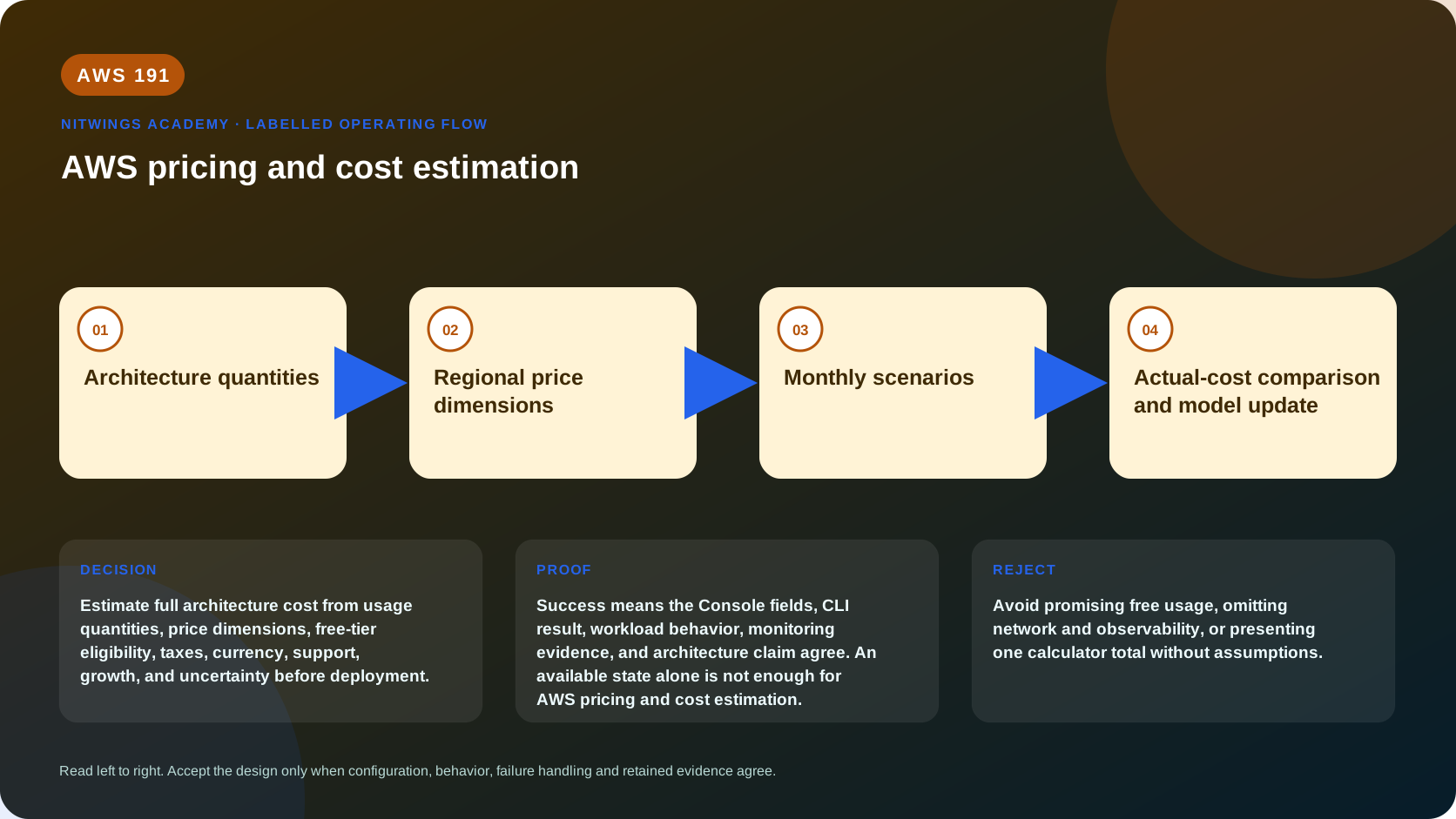
Estimate full architecture cost from usage quantities, price dimensions, free-tier eligibility, taxes, currency, support, growth, and uncertainty before deployment.
What you will be able to do
By the end, you can:
- explain aws pricing and cost estimation in plain language;
- locate the current service controls in the AWS Management Console;
- run the matching CloudShell or AWS CLI queries and explain every important field;
- draw the identity, network, data, failure, and monitoring path;
- choose the service from requirements and reject it when those requirements are absent;
- diagnose a failed or misleading result from evidence;
- state the cost owner and prove cleanup or a no-create result.
Before you start
- Use a personal AWS account only when its owner has approved the lesson. Do not use the root user for daily work.
- CloudShell is the default command environment. AWS028 explains CloudShell; AWS029 and AWS030 explain local AWS CLI installation and profiles.
- The course example Region is
ap-south-1. Global services and services with a required control Region are called out in their commands. - Run
aws sts get-caller-identityprivately. Redact the account number before sharing evidence. - Never paste access keys, passwords, secret values, private object data, presigned URLs, or full account-specific ARNs into a submission.
- This is a no-create lesson. Every Console action and AWS CLI command is read-only. Create the practical artifact locally.
- Console wording can change. Use the Console service search if a menu label has moved, then confirm the current field in the official documentation.
The core model
| Question | What it means in this lesson |
|---|---|
| Purpose | Estimate full architecture cost from usage quantities, price dimensions, free-tier eligibility, taxes, currency, support, growth, and uncertainty before deployment. |
| Scope and boundary | The learner must identify the account and Region scope, resource boundary, identity path, data or network path, failure behavior, observability, and cleanup ownership for AWS pricing and cost estimation. |
| Evidence of success | Success means the Console fields, CLI result, workload behavior, monitoring evidence, and architecture claim agree. An available state alone is not enough for AWS pricing and cost estimation. |
| Cost model | Requests, running capacity, storage, logs, data transfer, retained state, and optional features must be priced for the exact design. |
| Safe rejection rule | Avoid promising free usage, omitting network and observability, or presenting one calculator total without assumptions. |
How the request flows
+---------------------------+
|  Architecture quantities  |
+---------------------------+
             |
             v
+-----------------------------+
|  Regional price dimensions  |
+-----------------------------+
              |
              v
+----------------------+
|  Monthly scenarios   |
+----------------------+
           |
           v
+-------------------------------------------+
|  Actual-cost comparison and model update  |
+-------------------------------------------+
Build estimates from workload drivers
An estimate is a model, not a quote or budget control. Start with business volume and architecture: users, requests/second, payload bytes, retention, read/write mix, concurrency, availability target, Regions, environments and growth. Convert those drivers into billable dimensions using the current AWS Pricing Calculator and service pricing pages.
| Cost family | Dimensions learners must model |
|---|---|
| Compute | runtime hours/seconds, vCPU/memory, instance family/size, OS/license, tenancy, scaling floor/peak and purchase model |
| Storage | provisioned GB, average GB-month, storage class/tier, IOPS/throughput, requests, retrieval, early deletion and snapshots/backups |
| Database | instance/ACU/capacity hours, storage/IO, backup beyond allowance, replicas, proxy, requests and data transfer |
| Network | internet egress, inter-Region, cross-AZ, NAT processing plus egress, PrivateLink endpoints, acceleration and CDN origin/viewer paths |
| Serverless/integration | requests, duration, memory/CPU, provisioned concurrency, state transitions, messages, payload chunks and log ingestion |
| Operations/security | metrics, logs ingestion/storage/query, traces, Config items, security telemetry/scans, KMS keys/requests and support |
Free Tier and service allowances are pricing conditions, not architecture. Verify account eligibility, dates, Region and exclusions; model steady-state cost without assuming a temporary credit.
Estimation workflow
- Draw the request and data path, including failure/DR and observability paths.
- Create low, expected and peak demand scenarios with units and source for every assumption.
- Calculate per-service quantities before entering prices; keep formula and unit conversions visible.
- Include dev/test/staging, backups, logs, security, data transfer, support, tax/currency assumptions and DR standby.
- Compare architecture options on total cost and business outcome, not one unit price.
- Add uncertainty/sensitivity: identify which 10% driver change moves cost most.
- Record calculator export/link, price date and exclusions; obtain owner approval.
- After deployment, compare estimate with tagged actual/forecast cost and recalibrate.
Example: monthly internet egress is not simply requests × average response if CloudFront serves a cache-hit portion. Split viewer bytes, origin-fetch bytes, misses, invalidations and regional transfer. Likewise NAT cost has hourly and per-GB components, while the downstream service may also charge transfer or requests.
Normalize before comparing
Use the same availability, performance, durability, operational staffing and license assumptions. A smaller single-AZ database is not a fair alternative to a Multi-AZ requirement. Compare cost per business transaction, active user, tenant or GB processed so growth can be explained.
Separate amortized versus unblended/net cost perspectives when comparing commitments later. Do not subtract an RI or Savings Plan discount from usage that is not eligible or from a commitment that will be underutilized.
Architecture decision table
| Situation | Direction | Reason |
|---|---|---|
| Requirement matches | Use estimates as reviewed hypotheses tied to units and architecture paths. | Select only after scope, behavior, security, recovery, operations, and price evidence agree. |
| Requirement does not match | Avoid promising free usage, omitting network and observability, or presenting one calculator total without assumptions. | Rejecting an attractive service is a valid architecture result. |
| No create permission or cost approval | Use supplied evidence and local design work | Learning does not depend on creating an hourly resource. |
| Existing resource is unknown or unowned | Inspect only, then stop | Never change or delete a resource merely because it resembles a course example. |
AWS Management Console, step by step
Sign in with the normal non-root learning identity. Write the expected starting state before opening the service.
- Use the Console service search and open AWS Pricing Calculator and Billing pricing pages; confirm the account and Region before reading the page.
- Inspect the supplied or owned resource's status, configuration, permissions, networking, encryption, monitoring, tags, and dependencies without changing it.
- Open the related metrics, logs, events, or history view and record one timestamped signal that would prove or disprove the expected behavior.
- Return to the resource list, clear filters, and record the final inventory. On the read-only track, do not choose Create, Save, or Delete.
CloudShell and AWS CLI, step by step
Start with a known caller and Region:
export AWS_DEFAULT_REGION="ap-south-1"
aws sts get-caller-identity --query Arn --output text
aws configure list
Redact the account part of the ARN in shared evidence. Now run the topic queries:
aws pricing describe-services --region us-east-1 --max-results 20 --query 'Services[].{Code:ServiceCode,Attributes:AttributeNames}' --output table
aws pricing get-attribute-values --region us-east-1 --service-code AmazonEC2 --attribute-name instanceType --max-results 20 --output table
Expected interpretation
The Price List API exposes catalog dimensions in supported endpoints; it does not calculate the architecture, discounts, data path, taxes, or final bill for the learner.
Practical work
Build a monthly estimate for P05 with low, expected, and peak cases. Include hours, requests, GB-month, IOPS, transfer by path, public IPv4, NAT, load balancing, logs, backups, KMS, support, and 20 percent uncertainty.
Diagnose this topic from its own evidence
- Estimate far below bill: compare Region, quantity units, hours/month, scaling floor, storage requests/IO, logs, backup and transfer path.
- Calculator and invoice differ: check price date, tax/credits, commitment allocation, account sharing, rounding and actual architecture drift.
- Serverless surprise: inspect duration percentile, memory, retries, provisioned concurrency, payload/request multiplication and log volume.
- Network surprise: trace each hop and direction across AZ, NAT, endpoint, Region, CDN and internet boundaries.
- Estimate has one number: add scenario ranges, assumption owners and sensitivity before approval.
Cost and cleanup
Requests, running capacity, storage, logs, data transfer, retained state, and optional features must be priced for the exact design.
Knowledge check
- What operational purpose is this lesson solving?
Expected direction: Estimate full architecture cost from usage quantities, price dimensions, free-tier eligibility, taxes, currency, support, growth, and uncertainty before deployment.
- Which scope or ownership boundary must be proved first?
Expected direction: The learner must identify the account and Region scope, resource boundary, identity path, data or network path, failure behavior, observability, and cleanup ownership for AWS pricing and cost estimation.
- What evidence is strong enough to accept the result?
Expected direction: Success means the Console fields, CLI result, workload behavior, monitoring evidence, and architecture claim agree. An available state alone is not enough for AWS pricing and cost estimation.
- Which tempting design or shortcut must be rejected?
Expected direction: Avoid promising free usage, omitting network and observability, or presenting one calculator total without assumptions.
- Which cost dimensions and retained resources need an owner?
Expected direction: Requests, running capacity, storage, logs, data transfer, retained state, and optional features must be priced for the exact design.
Lesson acceptance
- Produce a versioned estimate with low/expected/peak workload drivers and visible unit formulas.
- Include compute, storage, database, network, operations, security, support and DR dimensions.
- Trace network charges from an end-to-end byte path.
- Compare two architectures at equal nonfunctional requirements and normalized business units.
- Define post-deployment estimate-versus-actual review and largest sensitivity risks.