
AWS 219: CloudFormation templates and stacks
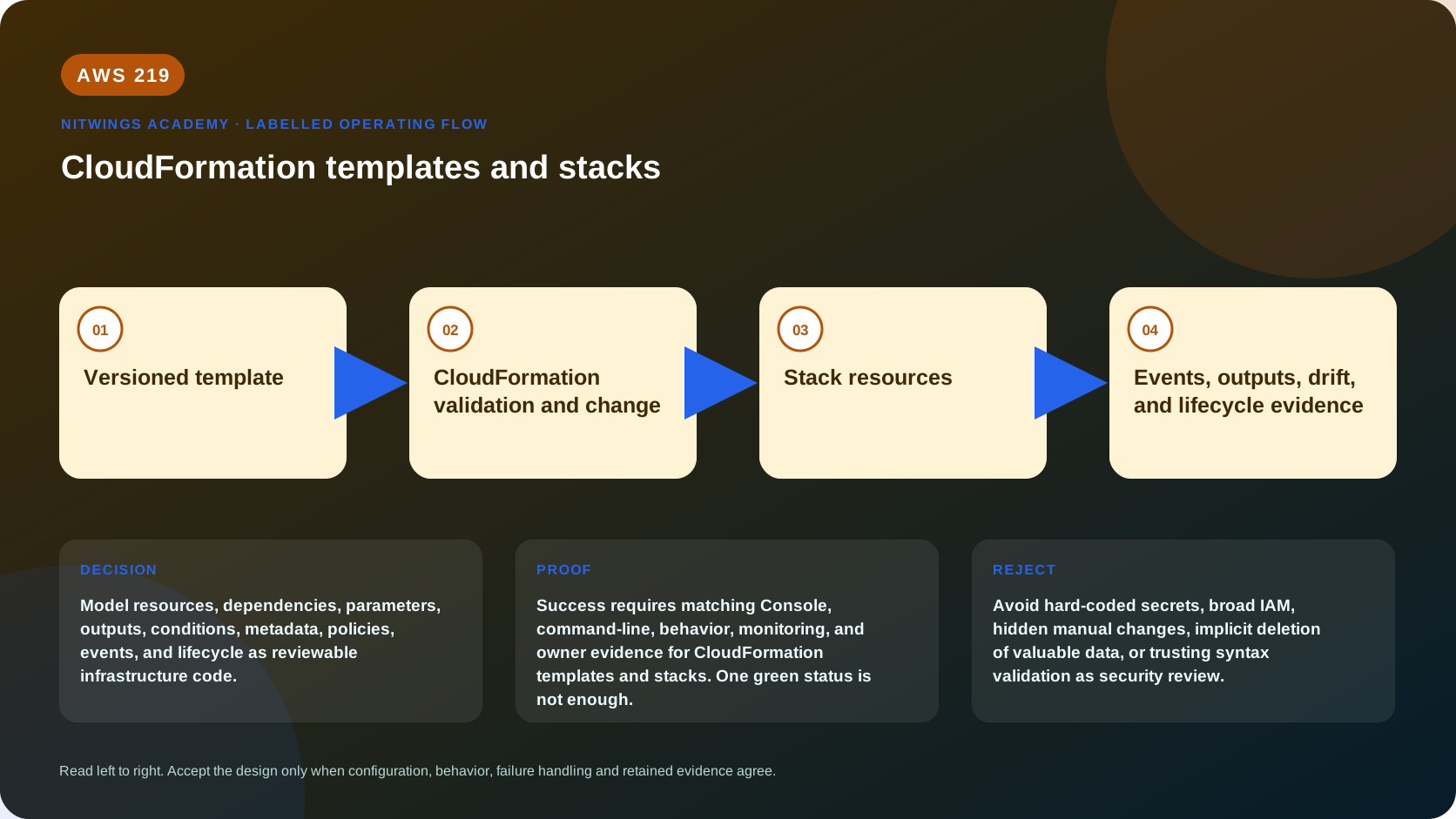
Why this lesson matters
Clicking in a console records a result; a CloudFormation template records an intended system. CloudFormation resolves references into a dependency graph, calls AWS service APIs, records events, and attempts rollback when an operation fails. It does not make an unsafe design safe, protect every data resource automatically, or eliminate the need to understand replacement and deletion.
What you will be able to do
By the end, you can:
- distinguish template, stack, stack instance, logical ID and physical ID;
- explain every top-level template section and the resource dependency graph;
- predict create, update, replacement, rollback and deletion behavior;
- distinguish
DeletionPolicy,UpdateReplacePolicy, termination protection and stack policy; - read stack events from the first failed resource rather than the final generic status;
- explain execution-role and caller permissions plus IAM capability acknowledgements;
- validate the P11 template locally and through AWS without deploying it;
- identify retained resources that survive stack deletion.
Before you start
- This lesson is no-create. Download and inspect the P11 template and runbook.
- Use a normal federated/role identity, never root. Confirm account and
ap-south-1. - Do not place passwords, tokens or private data in templates, parameter defaults, outputs, metadata or command history.
- YAML parsing and
validate-templateare necessary but not sufficient security or deployment tests. - The P11 data resources intentionally use retention policies. That design prevents accidental stack deletion from erasing data but creates a separate cleanup responsibility.
The core objects
| Object | Meaning |
|---|---|
| Template | Versioned JSON/YAML desired-state document. It is not a running environment. |
| Stack | Regional CloudFormation operation boundary containing resources, parameters, outputs, events and status. |
| Logical ID | Stable template key such as ArtifactBucket; references use it. |
| Physical ID | Actual service identifier such as a generated ARN/name. It can change during replacement. |
| Change set | Proposed API-level resource actions for a template/parameter update; it is not executed automatically unless requested. |
| Stack event | Time-ordered evidence for one resource operation and its reason. |
| Drift result | Comparison of supported declared properties with current values; it is not a compliance verdict. |
CloudFormation is Regional, although a template can create resources whose service scope is global or account-wide. A stack name is not ownership proof: verify account, Region, stack ID, tags and outputs.
Template anatomy
| Section | Purpose | P11 example |
|---|---|---|
AWSTemplateFormatVersion | Template language version | 2010-09-09; it is not the template's release date |
Description | Human purpose | safe learning scope |
Metadata | Optional tooling/UI information | never a secret store |
Parameters | Deployment-time input contract | environment, retention, alarm choice |
Rules | Parameter validation involving multiple values | not required by P11 |
Mappings | Static lookup tables | not required by P11 |
Conditions | Decide whether resources/properties exist | optional alarm |
Transform | Macro such as SAM; transforms template before deployment | absent, so no macro review boundary |
Resources | Required desired-state resource declarations | bucket, log group, optional alarm |
Outputs | Non-secret stack interface values | physical names/ARN and condition result |
A template's file order is not deployment order. Ref, GetAtt, and many Sub references create implicit graph edges. Use DependsOn only for a real dependency CloudFormation cannot infer; unnecessary explicit edges reduce parallelism and can hide a design smell.
Lifecycle and data safety
template + parameters + identity
              |
              v
      dependency graph / API calls
              |
       +------+------+
       |             |
   success       first failure
       |             |
       v             v
CREATE_COMPLETE   rollback attempt
       |
template/property update
       |
in-place modify OR replacement
       |
old physical resource governed by UpdateReplacePolicyDeletionPolicyapplies when a resource is removed from the template or its stack is deleted.UpdateReplacePolicyapplies to the old physical resource when an update replaces it.Retainremoves the resource from CloudFormation's management but leaves it and its bill/data ownership behind.Snapshotis supported only by resource types that implement it.- Termination protection blocks stack deletion; it does not block resource updates or deletion caused by an update.
- A stack policy protects selected resources from updates; it is not an IAM policy and does not protect out-of-band service API changes.
- Rollback is best effort. A failed rollback can require
continue-update-rollback, resource repair or explicit resources-to-skip; skipped resources leave template/actual state inconsistency to reconcile.
Read each property in the CloudFormation resource specification for update behavior: No interruption, Some interruptions, or Replacement. Never infer replacement risk from the property name.
Identity and permission path
Without a CloudFormation service role, CloudFormation operates using a temporary session based on the initiating identity. With a service role, CloudFormation uses that role for stack operations and continues using it for future operations. The operator needs permission to call CloudFormation and, where applicable, pass the exact role; the execution role needs only the service actions required by the template.
CAPABILITY_IAM and CAPABILITY_NAMED_IAM are explicit acknowledgements for templates that create IAM resources. They do not grant permission or make broad policies safe. CAPABILITY_AUTO_EXPAND acknowledges macros without reviewing an expanded change set. P11 creates no IAM resource and needs no capability flag.
Inspect P11 locally
curl -sS -o template.yaml \
  http://xupdate.nitwings.com/downloads/aws-academy/p11-cloudformation-automation/template.yaml
test -s template.yaml
rg -n '^(Parameters|Conditions|Resources|Outputs):|DeletionPolicy|UpdateReplacePolicy|!Ref|!GetAtt|!Sub|!If' template.yaml
Build a table for each logical resource: type, physical-name rule, dependencies, sensitive properties, replacement-sensitive properties, deletion behavior, cost dimensions and owner. P11 has an implicit alarm-to-log-group edge because the alarm dimension uses !Ref ApplicationLogGroup; the bucket has no dependency on the log group.
AWS semantic validation without creation
export AWS_DEFAULT_REGION="ap-south-1"
aws sts get-caller-identity --query Arn --output text
aws cloudformation validate-template \
  --template-body file://template.yaml --output json
aws cloudformation get-template-summary \
  --template-body file://template.yaml --output json
aws cloudformation list-stacks \
  --stack-status-filter CREATE_COMPLETE UPDATE_COMPLETE ROLLBACK_COMPLETE \
  --query 'StackSummaries[].{Name:StackName,Status:StackStatus,Deleted:DeletionTime}' \
  --output table
validate-template sends the body to AWS and checks template syntax/structure. It does not call every target service, prove unique names, quotas, permissions, cost, policy quality, runtime behavior or deletion safety. get-template-summary exposes declared parameters, resource types and required capabilities without creating a stack.
Read stack evidence in the Console
Open CloudFormation > Stacks, confirm Region, and choose only an owned or instructor-supplied stack:
- Stack info: stack ID, status, role, termination protection and timestamps.
- Parameters: effective values, remembering that
NoEchomasking is not complete secret protection. - Resources: map logical to physical IDs and status reasons.
- Events: read oldest-to-newest around failure; find the first
*_FAILED, not only rollback noise. - Outputs: treat every value as visible, non-secret interface data.
- Template: distinguish original and processed template when transforms are used.
- Change sets/Drift: absence of a pending change or detected drift does not prove compliance.
Failure diagnosis
| Symptom | Prove first | Correct response |
|---|---|---|
AlreadyExists | exact physical name, account/Region and ownership | choose deterministic unique naming, import when supported, or remove conflicting owned resource |
AccessDenied | failed logical resource, API action, execution role and policies | add only the required action/resource/condition; do not attach AdministratorAccess |
| Dependency failed | earliest failed event and graph | repair root resource; downstream cancellations are symptoms |
| Update proposes replacement | resource specification and data migration/retention plan | stop until backup, cutover and rollback are approved |
| Delete completes but resource remains | resource's deletion policy and recorded physical ID | reconcile retained resource explicitly |
ROLLBACK_FAILED | event reason and externally changed/missing resource | repair dependency, continue rollback carefully, then detect drift |
Cost and cleanup
CloudFormation itself generally does not add a charge for ordinary AWS resource management, but provisioned resources and some extensions/features can. P11's bucket storage/requests/KMS requests, log ingestion/storage/query, alarm and data transfer remain service costs. Validation creates none of these.
This lesson does not deploy P11, so cleanup removes only the downloaded local copy if no longer needed. If an instructor authorizes later deployment, follow the runbook: capture outputs before deleting the stack, then separately empty/delete all retained bucket versions and delete the retained log group with owner approval.
Knowledge check
- Why is template order not resource order?
CloudFormation builds a graph from references and explicit dependencies.
- What survives P11 stack deletion?
The bucket and log group because both use DeletionPolicy: Retain.
- What controls an old resource during replacement?
UpdateReplacePolicy.
- Does
CAPABILITY_NAMED_IAMgrant IAM access?
No; it acknowledges named IAM creation while normal authorization still applies.
- Why is a successful validation not deployment proof?
It does not prove target API permissions, quotas, uniqueness, runtime behavior, security or cleanup.
Lesson acceptance
- Template sections, logical/physical IDs and the dependency graph are explained from P11.
- Create/update/replacement/delete and rollback paths are distinguished.
- Both retention policies and their separate cleanup obligations are identified.
- Caller, service-role and capability boundaries are stated correctly.
- Local inspection plus
validate-template/get-template-summaryevidence is captured without creation. - At least three failure cases are diagnosed from the first failed event and exact logical resource.