
AWS 249: SOA-C03 timed scenario set
Purpose and exam-format truth
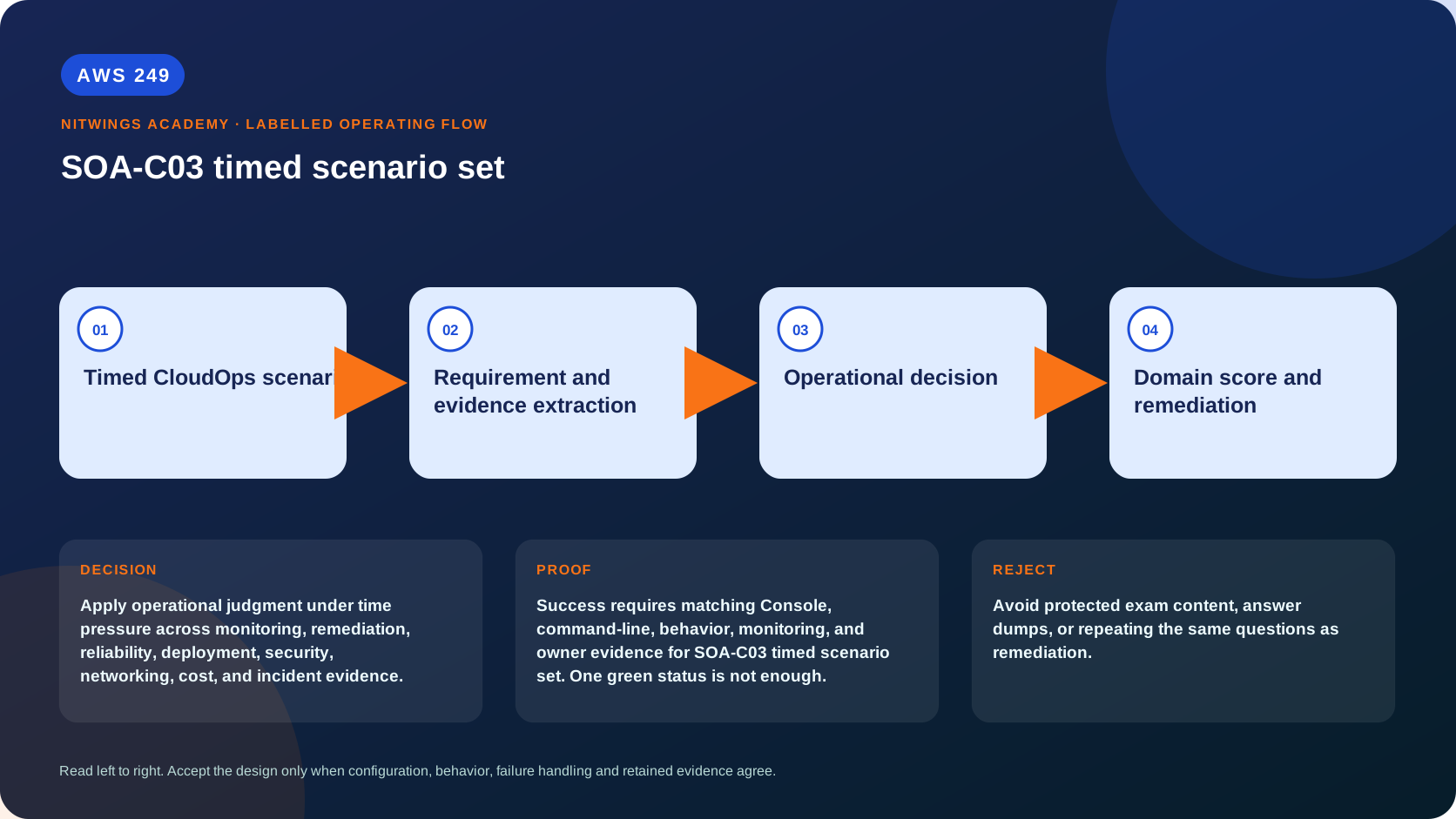
This is the first full-length timed synthesis after the practical checkpoints and independent capstone. It measures whether you can extract requirements, eliminate plausible distractors, and make safe CloudOps decisions under sustained time pressure.
As of this review, AWS Certified CloudOps Engineer – Associate (SOA-C03) has 65 multiple-choice or multiple-response questions and a 130-minute duration. The exam guide says 50 questions affect the score and 15 are unscored; the unscored questions are not identified. AWS reports a scaled score from 100–1,000 with a minimum passing score of 720 and uses compensatory scoring across domains.
This course set contains 65 original questions and scores all of them transparently. A raw course percentage cannot be converted into AWS’s scaled score. The stricter course domain gates diagnose readiness; they do not predict an official result.
Blueprint distribution
| Domain | Official weight | Course questions |
|---|---|---|
| 1 Monitoring, logging, analysis, remediation, performance | 22% | 1–14 (14) |
| 2 Reliability and business continuity | 22% | 15–28 (14) |
| 3 Deployment, provisioning, automation | 22% | 29–42 (14) |
| 4 Security and compliance | 16% | 43–53 (11) |
| 5 Networking and content delivery | 18% | 54–65 (12) |
The integer distribution approximates the official weights and totals 65. It does not imply that an official form uses these exact counts because unscored items are mixed and forms can vary.
Assessment pack
Download the AWS249 timed SOA-C03 pack. It contains:
SOA_C03_TIMED_SET.md- 65 original questions;TIMED_ANSWER_SHEET.md- response, flag, confidence, and timing record;ANSWER_RATIONALES.md- answers, deciding evidence, and distractor direction;REMEDIATION_AND_RETEST.md- error taxonomy, lesson mapping, changed-retest template.
Keep the rationales closed until the timer ends. These materials contain no protected exam content and must not be represented as official AWS questions.
Timed protocol
- Use a quiet 130-minute block and one continuous timer.
- No course notes, web search, AI, console, CLI, or answer key.
- Record start/end UTC and planned checkpoints: question 22 by minute 43, 44 by minute 87, 65 by minute 120, leaving ten minutes.
- Read the final sentence first: identify one answer versus “Choose TWO/THREE.”
- Extract workload, current state, required outcome, constraints, and optimization phrase.
- Eliminate options that solve another layer, violate a constraint, widen access/blast radius, or lack verification.
- Choose the best complete answer, flag uncertainty, and continue. Do not spend five minutes protecting one point.
- There is no penalty for guessing on the real exam; leave no item blank here.
- During review, check response count first, then flagged evidence - not every answer from scratch.
How to read scenario wording
“Most operationally efficient” usually favors managed, repeatable, low-toil control that still satisfies safety. “Lowest cost” does not permit violating RTO, security, or durability. “Immediate” may ask containment, not durable remediation. “Best first step” usually asks for the safest discriminating evidence before mutation. “Highly available” is not synonymous with backup, and “encrypted” does not prove authorization or recoverability.
For each option ask:
- Does it meet every explicit requirement?
- Does it operate at the failing layer?
- Does it preserve least privilege and data?
- Does it account for account, Region, identity, state, and failure mode?
- Can the result be verified and rolled back?
- Is the cost/operations burden justified?
Multiple-response method
Treat “Choose TWO/THREE” as one indivisible scored opportunity. Build a requirement matrix rather than selecting individually attractive facts. If one selected response contradicts the architecture, the whole course item is wrong - mirroring the official guide’s statement that each multiple-response question is one scored opportunity.
Do not infer hidden combinations such as “A implies B.” Select exactly the requested count. During review, confirm that the chosen responses are complementary and jointly sufficient.
Scoring
Score one point per item; multiple-response earns one point only for the complete exact set.
Course readiness levels:
- Ready gate: at least 52/65 (80%), Domain 1 ≥11/14, Domain 2 ≥11/14, Domain 3 ≥11/14, Domain 4 ≥8/11, Domain 5 ≥9/12, no critical safety misconception, and at least 80% of high-confidence answers correct.
- Near-ready: 46–51 overall with no domain below 65%; complete targeted remediation and a fresh changed set before scheduling.
- Not ready yet: 45 or fewer, any domain below 65%, or a critical safety pattern; return to mapped labs and practical evidence.
These are local instructional thresholds, not AWS scaled-score equivalents.
Review every miss and lucky guess
Grade only after the timed sheet is locked. Review wrong answers plus correct low-confidence guesses. For each:
- identify the exact deciding requirement/evidence;
- state why the selected distractor fails this scenario;
- state a changed condition that would make it correct;
- label the error: concept, scope, evidence, wording, safety, or time management;
- map to the source lesson and an official page;
- perform one practical/read-only interpretation where possible;
- answer a newly changed scenario after a delay.
Repeated questions are memory tests, not remediation. The changed retest must alter service state, constraint, failure layer, or optimization goal.
Safety misconceptions that override score
A high raw score is not readiness if the learner repeatedly chooses:
- public
0.0.0.0/0access or administrator privilege as troubleshooting; - deletion/reboot/failover before target, evidence, and rollback are verified;
- disabling encryption, logging, backups, SCPs, or key controls to make a task pass;
- backup completion as restore proof;
- API success as customer success;
- unlimited concurrency/retry or non-idempotent event remediation;
- secret values in logs, templates, user data, tags, or submissions;
- production mutation for assessment evidence.
Each requires targeted practical remediation even when the total passes.
Exam-day operational plan
Before scheduling, verify current official exam page, identification/testing requirements, language/accommodation options, and environment rules. Do not rely on old SOA-C02 materials: SOA-C03 has five domains, includes containers and newer operational capabilities, and uses the CloudOps Engineer name.
On the day, use a pacing strategy rehearsed here, distinguish multiple-response count, flag and move, leave no answer blank, and do not try to identify the 15 unscored questions. Treat all 65 seriously.
Cost, privacy, and cleanup
This lesson is local and creates no AWS resources. Record no real credentials, account IDs, secret values, private customer data, or protected exam content. The final artifact is the answer sheet, score analysis, and remediation/retest evidence. Retain or delete it according to the learner’s privacy policy.
Acceptance evidence
Submit the locked timed sheet with UTC/time checkpoints, 65 responses, flags/confidence, overall and domain scores, high-confidence accuracy, every correction, source/lab mapping, changed retests, safety review, and signed no-create/protected-content statement. Passing AWS246–AWS249 is required before the final readiness review in AWS250.