
AWS 250: SOA-C03 final readiness review
Purpose
This gate answers two different questions:
- Is the learner ready to attempt the current AWS Certified CloudOps Engineer – Associate (SOA-C03) exam?
- Can the learner operate AWS workloads safely enough to progress toward professional architect material?
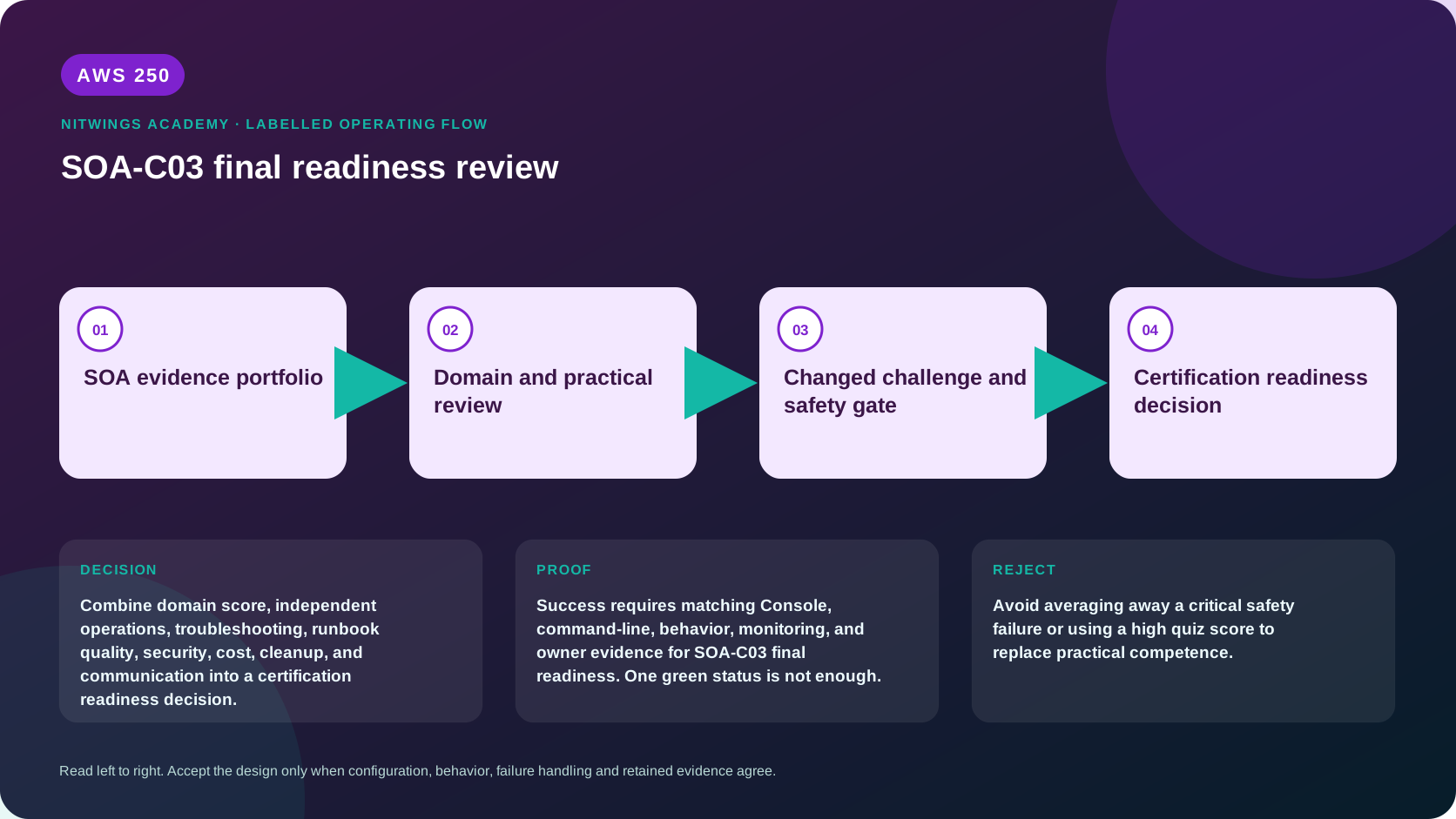
A timed score alone cannot prove the second. The review combines domain knowledge, unfamiliar evidence interpretation, independent incident performance, change safety, runbook quality, communication, cost awareness, and cleanup. It cannot average away a critical safety failure.
Required review pack
Download the AWS250 final-readiness pack. It contains:
FINAL_READINESS_DOSSIER.md- portfolio evidence inventory and decision record;CHANGED_ORAL_CHALLENGES.md- ten fresh cross-domain prompts;UNKNOWN_EVIDENCE_AND_FAULT.md- one unknown CLI/log interpretation and small supplied fault;ASSESSOR_DECISION_RUBRIC.md- scoring anchors, safety vetoes, and decision rules.
The learner opens the dossier first. The assessor holds the challenge, evidence, and rubric until the portfolio is locked. Challenges are original course material, not protected exam content.
Evidence prerequisites
The dossier must link to actual artifacts, not claims:
| Evidence | Minimum gate |
|---|---|
| AWS246 Domain 1 checkpoint | scenarios ≥24/30, practical ≥24/30, each task ≥8/10, no safety miss |
| AWS247 Domains 2–5 checkpoint | scenarios ≥26/32, practical ≥40/50, each domain ≥6/8 and case ≥8/10 |
| AWS248 independent capstone | ≥80/100, at least half each category, no automatic fail, runbook/RCA/cleanup complete |
| AWS249 timed set | ≥52/65 and domain thresholds, high-confidence accuracy ≥80%, no safety pattern |
| Remediation evidence | every wrong/low-confidence item corrected and changed-retested |
| Resource hygiene | no-create statement or verified owned-resource/billing inventory |
Missing evidence is not zero points to average away; it is an incomplete prerequisite. If an earlier artifact was invalidated by answer-key exposure or unsupported claims, repeat it with changed material.
Portfolio defense
The learner has 15 minutes to present:
- architecture/request path and operational ownership;
- one metric/log/trace/change correlation where initial hypothesis was wrong;
- one restore test with measured RTO/RPO and integrity proof;
- one IaC failure traced to the first causal event;
- one effective-permission denial across policy layers;
- one packet path traced in both directions;
- one safe automation with idempotency, rollback/compensation, and concurrency limits;
- one cost surprise and resulting design change;
- one cleanup inventory and evidence-retention decision;
- three remaining weaknesses and a dated plan.
The assessor asks “what does this prove, what does it not prove, and what would falsify your conclusion?” Screenshots without source/scope/time do not satisfy evidence.
Changed oral challenges
The learner receives ten conditions not copied from the earlier question sets. For each, respond in no more than three minutes:
- clarify requirements and scope;
- state the most likely and dangerous alternative hypothesis;
- request the next discriminating read-only evidence;
- choose or reject an operation;
- state rollback, customer/security verification, and cost effect.
Scoring rewards the reasoning chain, not service-name speed. An honest “insufficient evidence; next I would inspect…” is stronger than an invented diagnosis.
Unknown evidence interpretation
The pack contains mixed CloudFormation, Auto Scaling, target-health, Flow Log, and IAM evidence. The learner must:
- normalize account/Region/resource/time;
- separate primary failure from rollback/consequence noise;
- identify at least one green signal that is insufficient;
- rank two hypotheses and reject one tempting unsafe fix;
- write the next exact read-only query;
- propose a bounded change only if evidence supports it.
No console access is required. CLI literacy means interpreting fields and boundaries, not memorizing every option.
Small supplied fault
The assessor reveals a configuration fragment with one operational defect. The learner has 15 minutes to diagnose, write a source-controlled correction, define safe deployment/rollback, and list acceptance tests. The exercise is simulated; no AWS mutation occurs.
The fault changes between attempts. A repeat learner must not receive the same values, symptoms, or answer path.
Readiness dimensions
| Dimension | Ready behavior |
|---|---|
| knowledge | explains mechanisms and rejects close distractors |
| evidence | scopes source/time/identity and seeks contradiction |
| operations | prioritizes impact, contains safely, verifies customer outcomes |
| automation | guard clauses, least privilege, idempotency, finite waits, rollback |
| security/data | negative tests, encryption/secret handling, no broad bypass |
| reliability | distinguishes HA/backup/DR and proves restore/RTO/RPO |
| deployment | owner source, change review, immutable versions, drift handling |
| networking | DNS and bidirectional packet path, stateful/stateless controls |
| cost | identifies charge dimensions and optimizes without violating requirements |
| communication | concise facts/uncertainty/decision/next update |
| cleanup | verifies final resources, billing risk, and evidence retention |
Safety veto
Any of these blocks “Ready” until a changed practical retest passes:
- public broad ingress/egress or administrator/root access as routine troubleshooting;
- destructive or irreversible action without exact target, approval, backup/rollback, and stop condition;
- disabling encryption, logging, governance, backup protection, or certificate validation to get success;
- exposing secrets or protected/customer data;
- claiming backup, network, deployment, or API success as end-to-end recovery;
- non-idempotent or unbounded automated mutation;
- production/shared-account mutation for assessment;
- fabricated evidence or concealed uncertainty.
Decision outcomes
Ready
All prerequisites pass, final review score is at least 80/100, every dimension is at least competent, no safety veto applies, and the learner can independently explain corrections. “Ready” means evidence supports scheduling the current exam; it does not guarantee a pass.
Targeted remediation
Portfolio is substantially complete, score is 65–79 or one/two bounded dimensions are weak, and no unresolved integrity/safety violation exists. Create a 7–21 day plan with practical tasks, owners/dates, acceptance evidence, and a fresh partial review. Do not merely reread.
Not ready yet
Missing prerequisites, score below 65, three or more weak domains, dependence on hints for core diagnosis, or any unresolved safety veto. Return to mapped lessons/labs and repeat the independent capstone/timed set with changed material.
Transition toward architect expertise
Passing AWS250 confirms the CloudOps foundation; it does not make the learner an architect yet. AWS251 begins enterprise identity and governance for the Solutions Architect Professional phase. Carry forward operational proof: professional architecture must be deployable, observable, recoverable, secure, cost-owned, and supportable - not merely diagrammed.
Current certification facts and scheduling check
Before scheduling, re-open the official page. At this review the format is 65 multiple-choice/multiple-response questions in 130 minutes; the guide identifies 50 scored and 15 unidentified unscored questions, a 100–1,000 scaled score, and 720 minimum. Availability, languages, price, policies, and accommodations can change. The course thresholds are not a conversion to that scale.
Cost, privacy, and cleanup
The final review creates no resources. Redact IDs, ARNs, IPs where sensitive, customer records, secrets, tokens, presigned URLs, and confidential incident details. Retain only evidence needed for learning/audit under a named owner and expiry. Verify no temporary lab resources, roles, policies, keys, endpoints, NAT gateways, load balancers, backups, logs, or alarms remain outside approved ownership.
Acceptance evidence
Submit the signed dossier with artifact links/hashes, prerequisite results, remediation closure, portfolio defense notes, ten oral scores, unknown-evidence response, supplied-fault correction, safety review, dimension ratings, final decision, reviewer rationale, and - unless Ready - a dated remediation/review plan.