CTR vs CTOR: Calculate and Diagnose Email Engagement
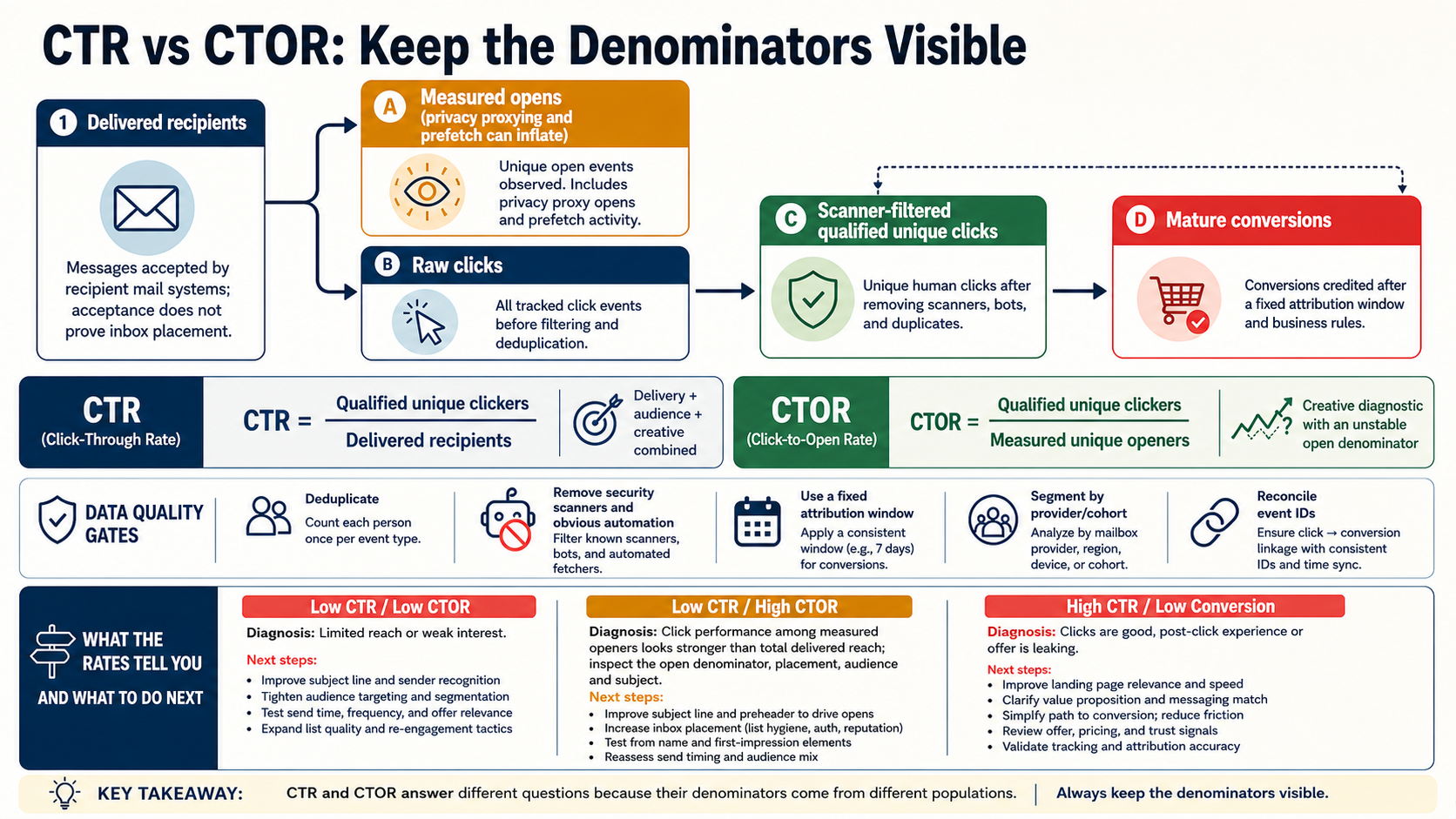
CTR and CTOR use the same click event with different denominators. Click-through rate usually asks how many delivered recipients clicked, while click-to-open rate asks how many measured openers clicked. That difference makes CTR a broader campaign diagnostic and CTOR a conditional ratio dependent on open measurement. Neither metric proves content quality, inbox placement or business impact. Definitions, deduplication, privacy fetching, scanner clicks and client mix must be visible before comparison.
Publish the exact formulas before showing a rate
| Metric | Example recipient formula | Question |
|---|---|---|
| CTR | Unique qualified clickers / delivered recipients | How many delivered recipients clicked? |
| CTOR | Unique qualified clickers / measured unique openers | How many measured openers clicked? |
| Click-to-conversion | Qualified converters / qualified clickers | Did the destination complete the action? |
| Conversion rate | Qualified converters / assigned eligible recipients | Did the treatment population convert? |
Some platforms use sent or accepted instead of delivered and some count total events. Name numerator and denominator every time.
Calculate one example without losing counts
assigned eligible recipients = 10,500
attempted recipients         = 10,200
delivered recipients         = 10,000
measured unique openers      = 4,000
qualified unique clickers    = 500
qualified converters         = 80

CTR  = 500 / 10,000 = 5.0%
CTOR = 500 / 4,000  = 12.5%
delivered conversion = 80 / 10,000 = 0.8%
The rates cannot explain causality by themselves. Preserve raw counts, exclusions, maturity and event definitions.
Distinguish unique people from total events
One person can click several links or the same link many times. Total clicks answer an interaction-volume question; unique clickers answer a recipient-reach question. CTOR usually uses unique clickers and unique openers, but the reporting contract must say so. Deduplicate at person, address or account according to the decision.
Forwarding and shared mailboxes weaken the assumption that the clicker equals the sent recipient. Keep message, recipient and browser or account identity separate where possible and appropriate.
Define delivered from terminal SMTP state
Attempted recipients can be accepted, permanently rejected, remain temporarily deferred or expire. “Delivered” commonly means remote SMTP acceptance, not inbox placement and not human receipt. Do not count a queued recipient as delivered before terminal acceptance. Do not subtract complaints or unsubscribes after delivery from the denominator.
Segment acceptance and queue behavior by receiving organization, route and campaign. A CTR decline caused by provider rejection is not a body-copy diagnosis.
Understand why the CTOR denominator is unstable
Remote-image requests can be blocked, cached or prefetched. Apple Mail Privacy Protection prevents senders from learning Mail activity by downloading remote content in the background. Other clients and security systems also alter measurement. A measured opener is therefore not a clean set of humans who read.
Client mix can change CTOR even when clicks remain constant. If measured openers inflate, CTOR falls mechanically; if images are blocked, the clicker may not appear in the open denominator, producing impossible-looking reports unless processing rules force an open.
Filter automated and unsafe click interpretations
| Evidence | Interpretation |
|---|---|
| Near-instant clicks across every link | Likely security inspection |
| Known scanner network or user agent | Classifier input, not sole proof |
| Browser session plus meaningful dwell | Stronger qualified interaction |
| Authenticated downstream action | Strong business evidence |
| Forwarded message click | Interest exists but identity uncertain |
Version classification and retain unknowns. Do not use a click as consent, purchase or personal identity by itself.
Use CTR and CTOR as clues, not verdicts
| Observed pattern | Possible causes | Next evidence |
|---|---|---|
| CTR down, CTOR stable | Fewer measured opens, delivery or audience change | Assignment, provider and client mix |
| CTR stable, CTOR down | Open inflation or denominator shift | Privacy/client classification |
| Both down | Audience, offer, transport, content or destination | Boundary funnel |
| Clicks up, conversion down | Scanner traffic or landing-page mismatch | Qualified sessions and site health |
Subject lines cannot be diagnosed from CTOR alone.
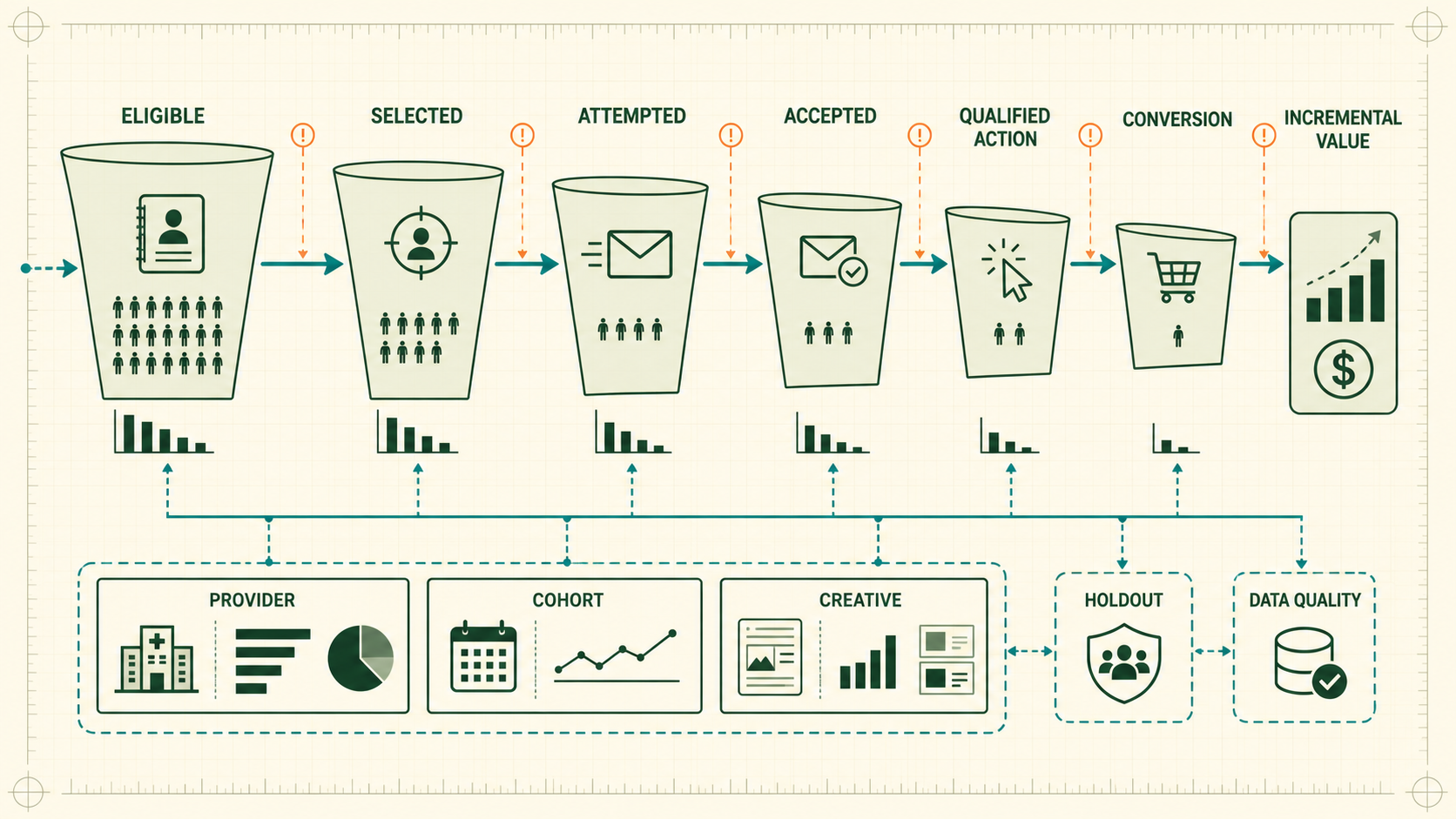
Build a boundary-first campaign funnel
eligible -> assigned -> attempted -> accepted
accepted -> measured open or qualified click
qualified click -> destination session -> conversion
conversion -> settled or retained value

complaint and unsubscribe remain safety outcomes
Reconcile counts at each boundary. A broken redirect, site outage or conversion-tag change can lower business outcomes while CTR remains normal. A tracking outage can lower CTR while actual conversions remain stable.
Segment transport before engagement
Compare assigned, attempted, accepted, deferred, rejected and expired recipients by receiving organization. Preserve complete SMTP replies and queue age. If one provider’s acceptance changes, aggregate CTR and CTOR inherit a different audience mix.
Seeds and panels can support placement hypotheses but are not population rates. Do not divide clicks by an inferred inbox count unless the methodology and coverage support that metric. Keep provider evidence and engagement analytics joined by stable message and campaign identifiers.
Control audience and lifecycle mix
A campaign to recent purchasers will behave differently from a win-back cohort. Compare acquisition source, permission age, lifecycle state, frequency exposure and declared interests. Use preplanned segments with minimum counts and uncertainty rather than searching until one high CTOR appears.
When comparing campaigns over time, annotate audience, provider, client, offer, day, season and metric-definition changes. A trend chart does not isolate a creative cause.
Analyze links and message hierarchy
Break qualified clicks by link purpose, position and destination while avoiding false precision. A navigation link, primary CTA, preference link and support link represent different intents. Total-click CTR can be dominated by repeated utility clicks. Use a content map that labels each link’s decision job.
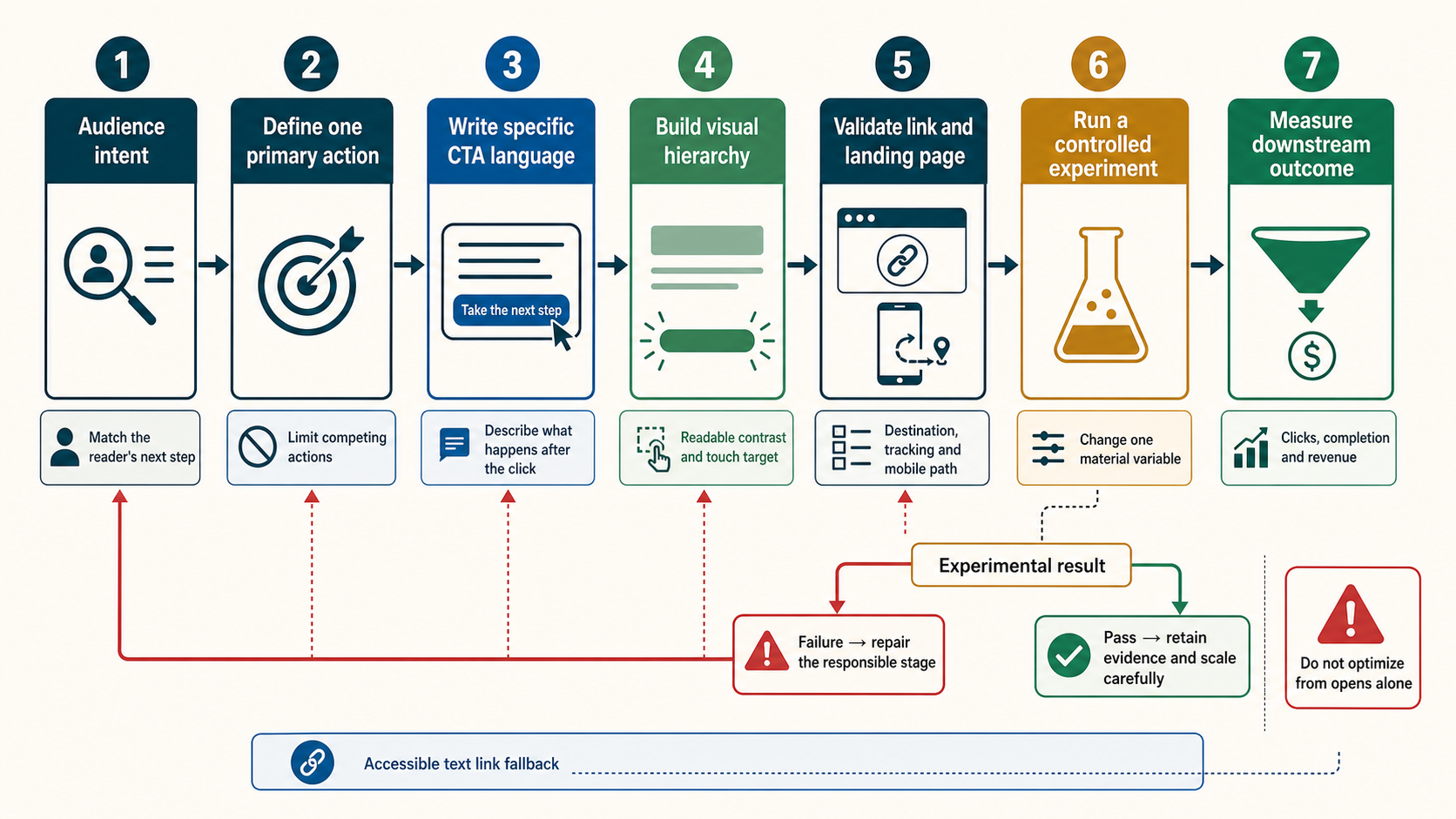
Review message-to-page alignment, accessibility and mobile use. If people click but cannot complete the destination, changing button color is unlikely to solve the main problem.
Connect clicks to mature business outcomes
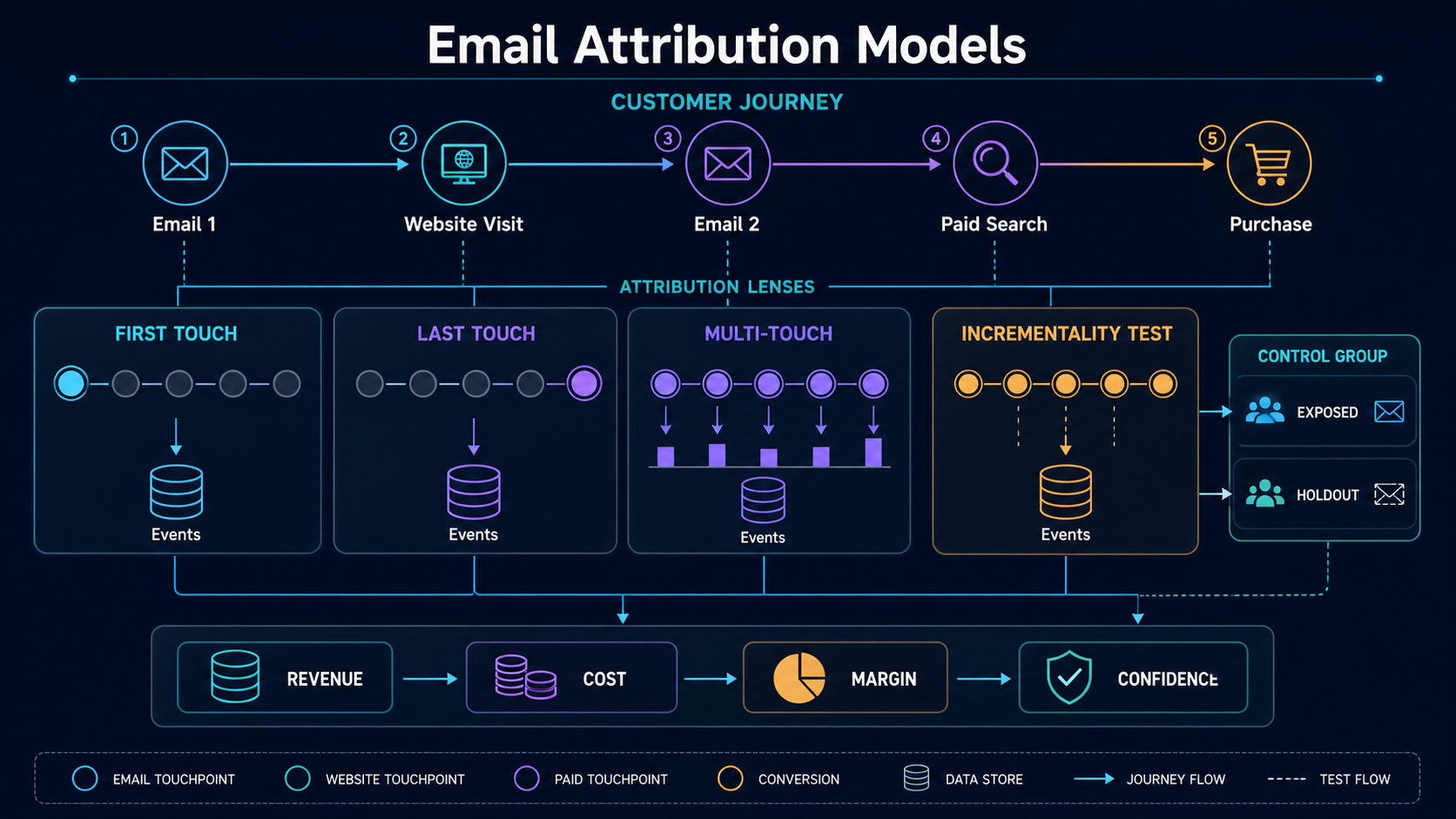
Define conversion, identity, attribution window, order deduplication, refunds, cancellations, net value and maturity. Click-to-conversion can diagnose the post-click path; eligible or assigned conversion is better for treatment impact. Keep attribution credit separate from incremental lift.
A high CTR with low conversion can indicate curiosity without fit, a broken page, offer conditions, bot clicks or identity loss. Inspect each boundary rather than declaring “weak CTA.”
Design tests around the business decision
Randomize eligible subjects, preserve assignment and define one primary outcome, guardrails, sample plan and maturity before launch. Check sample-ratio mismatch. If subject, body and destination change together, the experiment tests a package, not a single element.
Use intention-to-treat for causal decisions, including recipients not delivered because treatment may affect size or filtering. Operational diagnostics can separately show accepted-recipient behavior. Repeated peeking and many metrics require a valid sequential or multiple-testing plan.
Know when CTOR can still be useful
CTOR can describe a campaign within a stable measurement environment, especially as one diagnostic among client-classified metrics. It may help compare body treatments when assignment, audience, subject, client mix, open collection and click filtering are controlled. Even then, qualified clicks and downstream outcomes deserve priority.
Do not use CTOR as a universal content-quality score across providers, ESPs or years. Publish measured-opener coverage and classifier version beside the rate.
Design a transparent engagement dashboard
- Assignment, eligibility and exclusions with counts.
- Attempted, accepted, deferred, rejected and expired by provider.
- Measured opens by privacy and client classification.
- Raw and qualified unique clickers plus unknowns.
- CTR and CTOR with visible formulas and denominators.
- Qualified sessions, conversion, refunds and mature value.
- Complaints and unsubscribes with documented denominators.
- Metric, classifier, campaign and data-watermark versions.
Allow users to move from rate to underlying counts and sampled event histories.
Worked case: CTOR falls after Apple client mix changes
A newsletter keeps 600 qualified unique clickers and 10,000 delivered recipients, so CTR remains 6%. Measured opens rise from 3,000 to 5,000 after the audience shifts toward privacy-prefetching clients. CTOR falls from 20% to 12% even though qualified clicks do not change.
The team initially plans a body redesign, but client-classified reporting shows the denominator shift. Conversion and complaint remain stable. The correct action is to annotate the measurement change and avoid treating CTOR as evidence of weaker content. A later body test uses qualified click and conversion as primary outcomes.
This arithmetic is why rate interpretation must begin with counts and collection behavior.
Investigate engagement anomalies in order
- Confirm pipeline freshness and metric version.
- Reconcile eligible, assigned and variant counts.
- Check provider transport and queue states.
- Check client and privacy-open mix.
- Inspect scanner classification and link tracking.
- Validate destination and conversion collection.
- Review audience, offer and release changes.
Pause harmful traffic when complaint or content safety changes. Otherwise preserve experiments while diagnosing. Do not migrate sending infrastructure because an analytics pixel failed.
Maintain a metric dictionary and restatement log
For CTR, CTOR and related outcomes, store name, numerator, denominator, unit, event types, deduplication, time basis, maturity, classifier, owner and limitations. A definition change creates a version and trend annotation. Preserve raw events so derived metrics can be reproduced.
If late data, refund, identity or classifier correction restates a result, keep the original and revised publication with reason. Record whether the decision changed. Restrict recipient-level analytics and use aggregate outputs where possible.
CTR versus CTOR analysis checklist
- Formulas and raw counts are visible.
- Unique recipients and total events are separated.
- Delivered means terminal SMTP acceptance, not inbox placement.
- Open limitations and client mix are documented.
- Clicks are classified for scanners and unknowns.
- Provider and audience shifts are checked first.
- Link purpose and destination health are visible.
- Conversion identity, window and maturity are defined.
- Experiments preserve assignment and uncertainty.
- Metric versions and restatements remain auditable.
CTR and CTOR are useful only when the denominator tells the truth about what was actually observed.
Build reproducible CTR and CTOR queries
Start from an immutable assignment or recipient-send table, then left join terminal delivery, classified interaction and business outcome at the correct grain. Pre-aggregate one-to-many events before joining so repeated opens, clicks and orders do not multiply recipients. Preserve unmatched and unknown states.
SELECT variant,
 COUNT(DISTINCT delivered_recipient) AS delivered,
 COUNT(DISTINCT measured_opener) AS measured_openers,
 COUNT(DISTINCT qualified_clicker) AS clickers
FROM point_in_time_recipient_outcomes
WHERE campaign_id = :campaign AND maturity_at <= :watermark
GROUP BY variant;
The illustrative query requires documented identity, delivery and classifier rules. Code review should reject inner joins that drop nonclickers, post-treatment filters that change assignment or total-event numerators divided by unique-recipient denominators.
Report uncertainty and practical thresholds
A difference between 5.0% and 5.1% CTR can be noise or operationally irrelevant depending on sample and value. Report counts, absolute and relative difference, interval or other planned uncertainty measure, and the minimum effect that would change the decision. Do not use a universal significance rule without the experimental design.
CTOR inherits uncertainty from both clicks and measured opens, plus systematic privacy bias that a confidence interval does not remove. A precise estimate of a biased denominator remains misleading. Treat client-classified CTOR as descriptive unless assumptions support comparison.
For many variants, links and segments, predefine a hierarchy or multiple-testing approach. Exploratory findings create hypotheses; they are not automatically rollout evidence.
Avoid Simpson’s paradox in blended engagement rates
Aggregate CTR can rise even when every provider or cohort declines if the campaign mix shifts toward a naturally high-click group. Conversely, a larger low-engagement but valuable service cohort can lower the total without a treatment problem. Retain provider, acquisition source, lifecycle state and client mix in the analysis plan.
| Dimension | Why it changes interpretation |
|---|---|
| Provider | Transport and feedback coverage differ |
| Client | Open collection and rendering differ |
| Lifecycle | Intent and message job differ |
| Source | Expectation and quality differ |
| Region | Language, time and offer differ |
Use standardized or experimental comparisons rather than one blended rate when mix materially changes.
Create engagement data quality controls
Monitor assignment coverage, duplicate recipient keys, terminal delivery completeness, event lag, click redirect status, classifier unknown rate, conversion join coverage and late restatements. Reconcile provider and ESP counts without forcing equality when definitions differ. Alert on discontinuities after SDK, ESP, domain or analytics releases.
Keep raw events immutable and derived tables versioned. A click classifier update should produce a new result version and annotated trend break. Do not rewrite every historical campaign invisibly. Sample raw message IDs and destination sessions to test classification precision and false negatives under appropriate access controls.
When data is incomplete, label the report provisional or unavailable. Filling missing opens or clicks with zero creates a false performance conclusion.
Translate CTR and CTOR into an operational decision
Lead with population, message purpose, assignment, primary business outcome and mature conclusion. Then show delivery boundary, qualified CTR, measured-open coverage, CTOR limitation, conversion and safety. State which metric changed because of client mix, tracking or provider behavior.
A useful conclusion might say: “Qualified CTR was unchanged; measured openers increased with privacy-prefetching clients, mechanically lowering CTOR; mature conversion and complaints were stable, so no body redesign is approved.” This maps evidence to action without pretending the ratio measures content quality directly.
Name owners and next evidence date for transport, data, creative or destination defects. Archive the report code, metric versions and decision so the next campaign does not restart the same debate.
Preserve event sequence and terminal timing
Open, click, conversion and complaint events can arrive late or out of order. Store occurred and ingested time plus message, recipient and provider identifiers. A click before an observed open can be legitimate when images are blocked, and should not be “fixed” by inventing a human open unless the platform explicitly reports a derived event.
Define terminal delivery and maturity windows. Reconcile retries to one recipient state and prevent a delayed bounce from creating a second population. For conversions, keep order time, settlement, refund and report close separate. Publish data watermarks so a provisional rate is not compared with a mature campaign.
Late events can restate CTR, CTOR or conversion. Preserve the prior report, reason and decision rather than silently changing executive history.
Analyze link purpose without inflating certainty
Map each destination to a purpose such as primary action, education, navigation, support, preference or unsubscribe. Report qualified unique recipients by purpose and retain total events separately. Repeated clicks on several links from one scanner must not become several interested customers.
| Pattern | Possible diagnosis | Check |
|---|---|---|
| Primary CTA low, navigation high | Offer mismatch or exploration | Page paths and audience fit |
| Every link clicked instantly | Scanner | Classifier and downstream session |
| Support link high | Confusion or service need | Ticket reasons and message clarity |
| Clicks high, page events absent | Redirect or analytics defect | HTTP logs and site status |
Close the analysis with a reproducible decision
When the outcome window matures, freeze the data watermark and reconcile assignment through settled value and safety. Record whether CTR and CTOR were primary, diagnostic or unavailable. Explain privacy-open and scanner coverage and list material data-quality exceptions.
Choose scale, hold, retest or stop. Assign fixes to transport, audience, content, destination or measurement owners instead of writing a generic “improve engagement” action. Preserve report code, input snapshot, classifier, metric dictionary and conclusion.
At the next review, verify that the approved change actually ran. A metric program creates value only when evidence changes an operating decision and the outcome of that change is checked.
Final CTR and CTOR report approval
The analyst and operational owner should sign the campaign population, assignment unit, delivery terminal state, click classifier, open-privacy treatment, identity and maturity. Verify formulas from underlying counts and sample raw events at each boundary. State whether CTOR is comparable, descriptive only or unavailable.
Attach provider transport, audience mix, destination status, conversion reconciliation, uncertainty and negative outcomes. If data is provisional, name the missing source and next close date. Do not release a creative winner when the evidence instead identifies a provider, tracking or site defect.
Archive code, watermarks and the final decision. Future reports must reference the same metric version or disclose the change.
Retain engagement evidence proportionately
Raw opens, IP addresses, user agents and click paths can be personal data. Limit collection to the documented measurement and security purpose, restrict access and define retention. Analysts usually need pseudonymous recipient keys and aggregates, not message content and full customer profiles.
Apply deletion and consent changes to derived tables and exports under policy. Preserve only governed aggregate and experiment evidence needed to reproduce the decision. A longer retention period does not repair a biased open denominator.
Retire obsolete engagement definitions
Remove deprecated metrics from active dashboards, scheduled exports and executive scorecards after publishing the replacement and trend break. Keep governed historical definitions for reproduction. Training and campaign briefs should point to the current dictionary so CTOR is not reused as an unexplained universal quality score.