Email A/B Testing: A Practical Experimentation Guide
An email A/B test is useful only when the two groups differ in a deliberate way and the result can change a real decision. Sending two subject lines and picking the larger open-rate number is easy. Building an experiment that survives timing effects, audience imbalance, privacy-distorted opens and repeated testing takes more discipline.
What email A/B testing actually measures
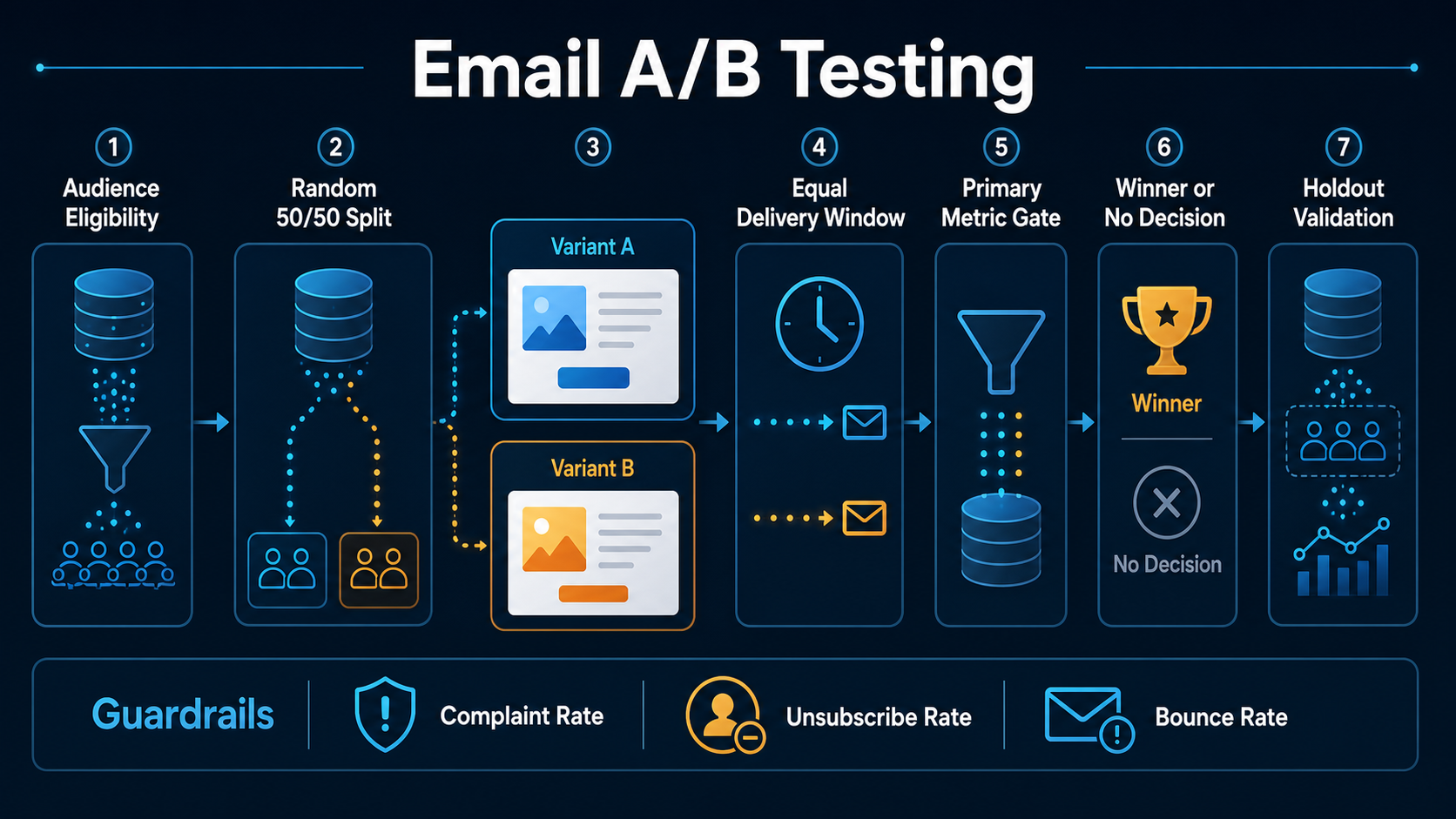
A/B testing randomly assigns eligible recipients to a control and a variant, holds other material conditions steady, and compares a preselected outcome. Random assignment matters because it distributes known and unknown differences across both groups. A split based on geography, signup date or “first half of the list” is a comparison, but it is not a clean randomized experiment.
The unit of assignment also matters. A subscriber should not receive both subject-line variants in the same test. For account-based campaigns, assigning whole accounts can prevent colleagues in one company from receiving contradictory offers. Write down the hypothesis, unit, eligibility window, primary metric and stopping rule before sending. That short record stops the team from changing the question after seeing early results.
What to test in an email campaign
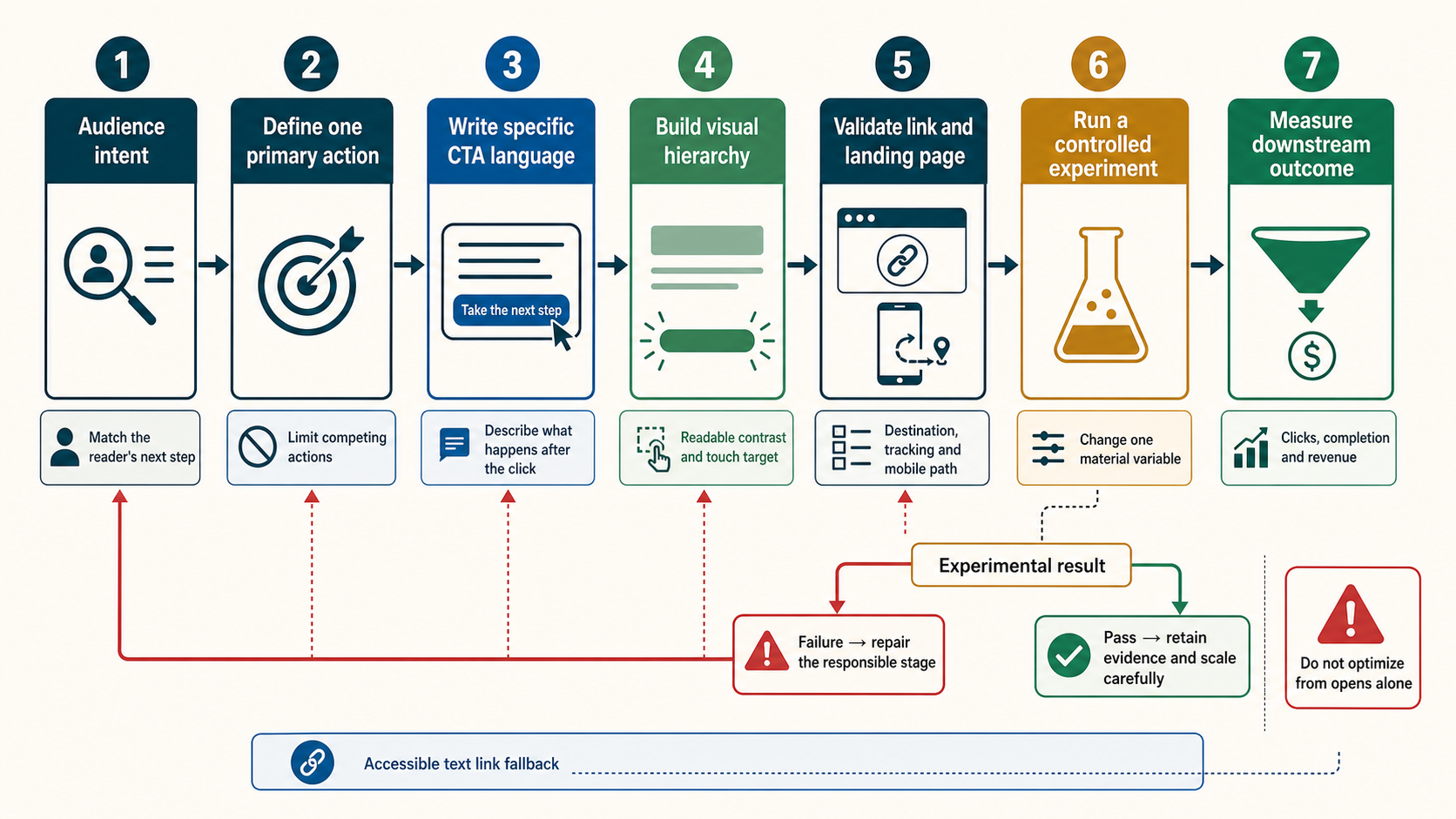
Email teams can test a subject line, visible From name, preview text, first-line hook, body copy, CTA wording, CTA placement, offer, layout, personalization rule or send time. Select one major variable for a diagnostic test. If the subject, offer and design all change together, the result can identify a winning package but cannot explain which component caused the difference.
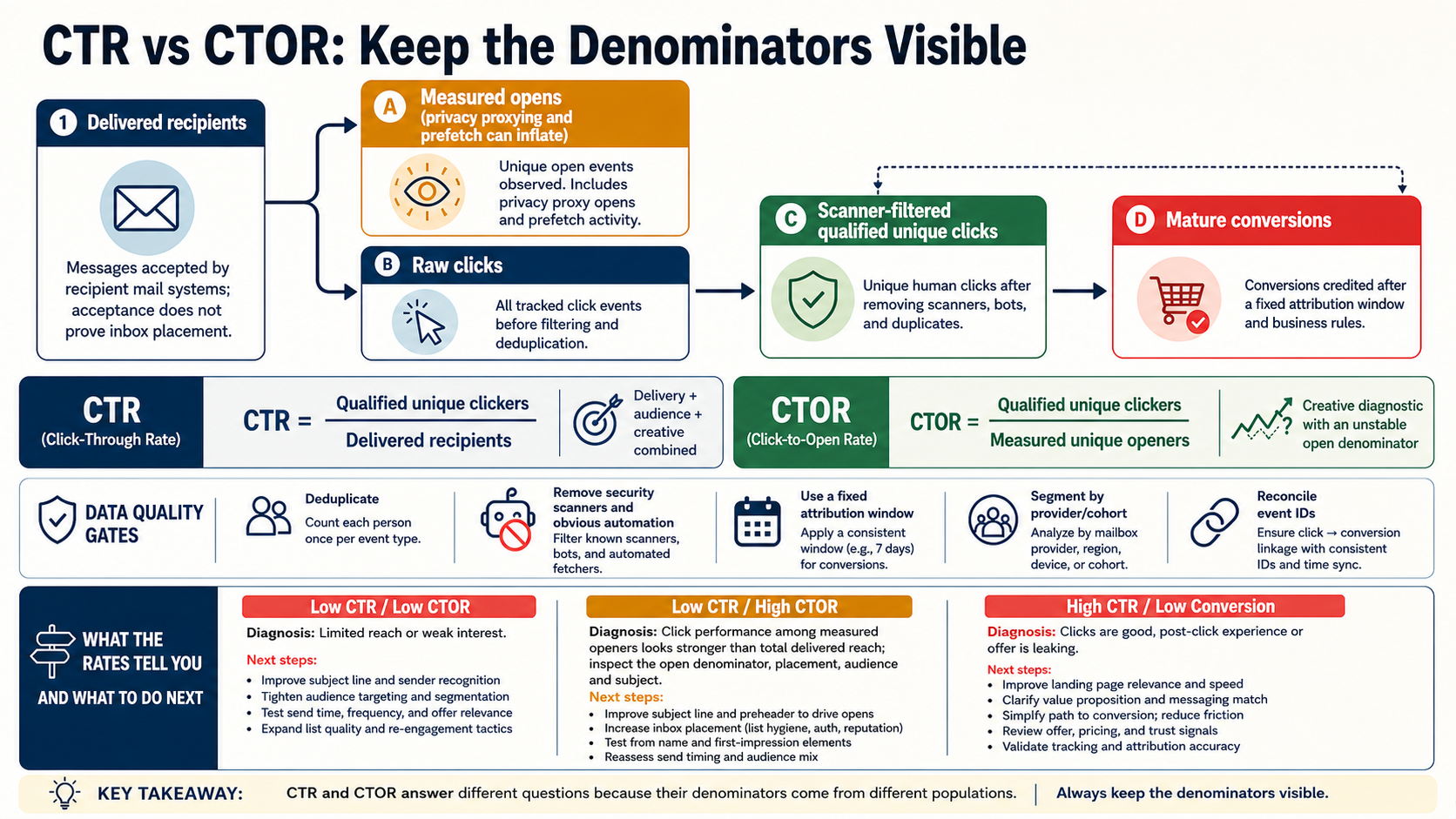
Match the outcome to the tested element. Opens may be a directional diagnostic for subject lines, but image proxies and prefetching make them unreliable as a universal decision metric. Unique clicks, qualified sessions, conversions, contribution margin and revenue per delivered recipient are stronger when they sit closer to the business question. Complaints, unsubscribes and bounces remain safety guardrails.
Email platforms make split tests look simpler than they are. A small segment may show a dramatic percentage difference that disappears when the winner reaches the remainder. A test is also biased when one version is sent earlier, receives a different mailbox mix, or is stopped as soon as it leads. “No decision” is a valid result: the observed data did not justify a winner.
How to run a reliable email A/B test
- Write a falsifiable hypothesis. State the audience, intended change and business outcome. “A shorter subject line will increase completed trials among new subscribers” is testable; “Version B is better” is not.
- Freeze eligibility. Define consent, geography, lifecycle stage, recent contact and suppression rules before randomization. Record the eligible count so later filters cannot quietly reshape the sample.
- Select one primary metric. Use one decision metric and name diagnostic metrics separately. Define numerator, denominator, conversion window, deduplication and refund treatment in advance.
- Randomize and check balance. Assign with a stable random key. Compare group size, mailbox mix, engagement recency and customer value; large imbalances indicate an implementation problem.
- Hold delivery conditions steady. Send both variants during the same practical window using the same authenticated stream, throttling policy and landing-page availability. Change the intended variable only.
- Respect the stopping rule. Wait for the declared sample or observation window. Do not repeatedly peek and stop at the first attractive result unless the statistical method was designed for sequential testing.
- Apply guardrails before declaring a winner. A conversion lift does not excuse a material increase in complaints, unsubscribes, bounces or misleading expectations. Review absolute counts as well as rates.
- Validate the rollout. For high-impact changes, retain a small holdout or repeat the test in another cohort. Monitor whether the effect persists when season, audience and scale change.
Choose the metric for the email element being tested
| Test question | Best primary measure | Important guardrail |
|---|---|---|
| Does a subject line create useful interest? | Unique click rate or qualified session rate | Complaint and unsubscribe rate; opens are diagnostic |
| Does a CTA improve action? | Conversion rate per delivered message | Landing-page error rate and revenue per recipient |
| Does a new offer improve economics? | Incremental contribution margin | Refunds, support contacts and long-term retention |
| Does send time improve response? | Conversion within a fixed observation window | Mailbox mix, local time and overlapping campaigns |
| Does a layout improve usability? | Unique clicks on the intended action | Rendering failures, accessibility and total message weight |
Worked email subject-line test
A subscription business wants to test whether a benefit-led renewal subject line outperforms a deadline-led version. It freezes a cohort of active customers whose renewal date is seven to ten days away, removes recent complainers and randomly assigns at the customer level. The primary metric is completed renewal within five days of delivery. Unique clicks are diagnostic; complaints and unsubscribes are guardrails.
Version B earns more opens, but the two groups have nearly identical renewal and click results. The correct decision is not to announce a winning subject line. The team records “no decision,” retains the clearer version, and investigates whether the landing page or offer is the limiting step. This prevents a noisy proxy metric from becoming a permanent campaign rule.
Email A/B test data to retain
Keep an experiment record that another analyst can reproduce. The record should survive a platform migration and should not depend on a screenshot.
- Assignment evidence: experiment ID, recipient or account key, assigned variant, assignment time and eligibility version.
- Exposure evidence: message ID, send attempt, delivery status, campaign version and actual delivery time.
- Outcome evidence: unique clicks, qualified events, conversions, value, refunds and the fixed attribution window.
- Safety evidence: complaints, unsubscribes, hard bounces, temporary deferrals and negative customer contacts by variant.
- Decision evidence: planned sample, analysis method, uncertainty interval, decision owner and rollout or no-decision note.
Email testing mistakes that create false winners
- Testing several major changes together: a new subject, layout and offer may move the result, but the test cannot say which change caused it.
- Using machine-inflated opens as ground truth: treat opens as a directional diagnostic where privacy proxying or prefetching is significant.
- Sending the winner to a different population: a result from active customers may not transfer to dormant prospects or another mailbox mix.
- Running overlapping experiments without coordination: simultaneous offer, frequency and subject tests can contaminate one another.
- Optimizing a proxy while harming the business: more clicks can coexist with fewer purchases, lower margin or more complaints.
Email A/B testing checklist
- Document the decision the test will change and appoint its owner.
- Freeze eligibility and suppression logic before random assignment.
- Choose one primary outcome plus operational and customer guardrails.
- Define the assignment unit, attribution window and deduplication rules.
- QA both variants, links, tracking, fallback content and landing pages.
- Send variants under equivalent time, infrastructure and throttling conditions.
- Allow a legitimate “no decision” result and retain the complete test record.
- Validate material winners at rollout scale and monitor longer-term effects.
Choose an email variable that answers one decision
Start by naming the decision owner and the change they are prepared to make. A subject-line test should not quietly become a verdict on the offer, and a send-time test should not use different creative. The following catalog keeps the treatment and outcome connected.
| Email element | Example hypothesis | Primary outcome | Hold constant |
|---|---|---|---|
| Subject line | A benefit-led promise produces more qualified visits than deadline language | Qualified sessions or conversion per delivered recipient | From name, preview text, content, audience and delivery window |
| Preview text | A concrete supporting detail improves useful interest | Unique click or conversion rate | Subject, body, offer and send time |
| Visible From name | A recognized service identity improves response without increasing complaints | Qualified response with complaint guardrail | Domain, subject, content and audience |
| CTA | Task-specific wording reduces hesitation | Landing-page completion per delivered recipient | Offer, layout, destination and audience |
| Offer | An added-service offer creates more contribution margin than a discount | Incremental contribution margin | Creative hierarchy, audience and fulfillment window |
| Send time | Recipient-local morning delivery improves completed action | Conversion inside a fixed window | Message, audience eligibility and infrastructure |
When a complete creative package must be compared, label it a package test. It can select a package but cannot attribute the result to one component. That distinction prevents the next campaign from mixing the losing subject with the winning offer and assuming the evidence still applies.
Plan sample size, effect and stopping before sending
A test needs enough eligible recipients to distinguish a useful effect from ordinary variation. “Ten percent lift” is incomplete unless the baseline and metric are named: moving conversion from 1.0% to 1.1% is a different sample problem from moving it from 10% to 11%, even though both are described as a ten-percent relative lift.
| Planning field | Meaning | Email implementation |
|---|---|---|
| Baseline rate | Expected control outcome for a comparable cohort | Use recent clean campaigns with the same denominator and window |
| Minimum detectable effect | Smallest change worth acting on | Tie it to profit, risk or operational cost rather than vanity |
| Significance level | Planned tolerance for a false-positive declaration | Set before results and adjust when many variants or metrics are tested |
| Power | Chance of detecting the planned effect when it exists | Use a qualified calculator or analyst for the selected method |
| Observation window | Time allowed for the outcome to mature | Cover realistic purchase delay, refunds and late events |
Do not send to an arbitrary small test slice and promote the leading version after an hour. If the eligible population cannot support the planned effect, choose a larger recurring experiment, a more sensitive but meaningful metric, or an explicit exploratory result. Do not manufacture certainty by changing the threshold after seeing the data.
Hypothesis: benefit-led subject increases trial activation
Assignment unit: subscriber_id
Eligible cohort: consented new trials, day 2, no suppression
Primary metric: activated_trial / delivered_recipient
Guardrails: complaint, unsubscribe, hard bounce
Observation window: 5 complete days after delivery
Stopping rule: analyze once after planned sample matures
Decision: ship A, ship B, or no decision
Randomize recipients without contaminating the test
Generate assignment from a stable recipient or account key and the experiment identifier. The same person must remain in the same variant when a queue retries, a campaign is resumed or events are replayed. For account-based programs, randomizing the whole account may be safer than sending colleagues conflicting prices or policy messages.
| Risk | How it biases the test | Control |
|---|---|---|
| Time-separated variants | Provider load, news and customer context differ | Interleave or send in the same practical window |
| Randomization after a mutable filter | Late data changes variant composition | Freeze eligibility version and assignment before queueing |
| Household or account crossover | Related recipients see both treatments | Cluster assignment at the relevant decision unit |
| Overlapping campaigns | Another offer changes the outcome | Use mutual-exclusion rules or record factorial exposure |
| Unequal mailbox distribution | Provider effects resemble creative effects | Check balance and stratify only when designed in advance |
Balance checks are implementation diagnostics, not a license to keep rerandomizing until the groups look favorable. Record group size, provider, engagement recency, geography and customer value. Large unexpected differences may expose a broken hash, exclusion applied to only one branch or duplicate-recipient handling.
Build an event ledger that can reproduce the result
An ESP dashboard is useful for daily work, but a durable test needs recipient-level assignment and event evidence. Keep the assignment separate from delivery and outcome tables. This prevents a later resend, duplicate webhook or attribution change from rewriting history.
experiment_assignment: experiment_id, assignment_unit, variant, assigned_at
message_delivery: experiment_id, assignment_unit, message_id, accepted_at
business_outcome: assignment_unit, outcome_type, outcome_at, value
safety_event: assignment_unit, complaint_at, unsubscribe_at, bounce_class
Deduplicate provider webhooks with their source event ID. Keep machine-prefetched clicks or known security-scanner activity out of the human-click metric while retaining the raw event for audit. Use the same currency, refund and tax treatment for both variants. If identity resolution changes during the test, freeze the original analysis mapping and document the sensitivity.
Read the result without creating a false winner
Report the control and variant numerator, denominator, absolute difference, relative difference and uncertainty interval. A result can be statistically detectable but commercially irrelevant, or commercially promising but too uncertain for a permanent rollout. The decision table should show both.
| Result pattern | Interpretation | Decision |
|---|---|---|
| Primary outcome improves and guardrails remain stable | Evidence supports the variant for this population and period | Roll out with monitoring or validate in another cohort |
| Proxy improves but conversion does not | Message created attention without useful action | Do not call a business winner; inspect message match |
| Outcome improves and complaints worsen | Short-term gain carries recipient and reputation cost | Reject or redesign the treatment |
| Interval includes meaningful win and loss | Test is inconclusive | Record no decision; do not select by the point estimate |
| Effect appears only in an unplanned subgroup | Exploratory finding with multiple-testing risk | Form a new hypothesis and retest |
Do not choose one metric after another until something is significant. If several variants, providers or outcomes are decision-critical, plan the multiplicity method with an analyst. Preserve the full analysis, including an unpopular no-decision outcome.
Operate email experiments safely at platform scale
A multi-tenant sender needs controls that prevent experiments from breaking compliance or infrastructure. Each experiment should reference an approved From identity, authenticated route, suppression policy, one-click unsubscribe behavior where required, rate plan and rollback owner.
- Do not test whether omitting authentication or unsubscribe improves a metric.
- Do not include complaint-suppressed or unsubscribed recipients in either branch.
- Do not let one branch use a colder IP, different DKIM domain or different retry policy.
- Stop for a severe customer-safety or compliance event even when the statistical stopping rule has not matured.
- Version the template, personalization rules and landing destination used by every branch.
- Record a final decision and retire abandoned variants from automation.
Experiments produce organizational value when their evidence is searchable. Maintain a registry by audience, variable, outcome, date and decision. A later team can see that a subject-line result from active subscribers does not automatically apply to a re-engagement cohort.
Choose A/B, holdout, factorial or adaptive testing deliberately
| Design | Best use | Important limitation |
|---|---|---|
| Two-cell randomized A/B | One controlled treatment difference | Cannot separate several simultaneous creative changes |
| Persistent holdout | Incremental program or lifecycle impact | Needs contamination control across other journeys |
| Factorial design | Estimate main effects and selected interactions | Sample and analysis requirements grow rapidly |
| Cluster randomized test | Account, household or organization-level treatments | Effective sample is driven by clusters, not recipients |
| Multi-armed bandit | Allocate more traffic while learning under a defined reward | Harder inference, delayed outcomes and unstable populations |
| Quasi-experiment | When randomization is impossible | Requires explicit assumptions and stronger confounding analysis |
Most email decisions should begin with a simple randomized A/B test. Use a persistent holdout when the question is whether the program itself causes value. Do not call a geographic or before/after comparison randomized. Adaptive allocation is not a shortcut around power, instrumentation or guardrails.
Work a sample-size example before reserving traffic
Suppose renewal conversion is normally 4.0% and a one percentage-point absolute improvement to 5.0% is the smallest change worth shipping. Planning needs the control proportion, alternative proportion, significance level, desired power, allocation ratio and sidedness. The common normal-approximation planning formula for equal groups is:
n_per_variant ≈
  [ z(1-alpha/2) * sqrt(2*p_bar*(1-p_bar))
    + z(power) * sqrt(pA*(1-pA)+pB*(1-pB)) ]^2
  / (pB-pA)^2

pA = 0.040
pB = 0.050
p_bar = (pA+pB)/2
Using a two-sided 5% significance level and 80% power produces roughly 6,700 recipients per variant before allowance for ineligible, undelivered or missing-outcome records. This is a planning approximation, not a universal calculator result. Rare outcomes, cluster assignment, unequal allocation, sequential methods and repeated measures require a suitable method or statistician.
Choose the minimum detectable effect from economics. If a 0.1 percentage-point improvement cannot recover the engineering and campaign cost, powering a huge test for it is waste. Conversely, an underpowered test does not become evidence because the point estimate looks large.
Detect sample-ratio mismatch before reading performance
If allocation was intended to be 50/50, the observed assigned counts should be compatible with that design. A material sample-ratio mismatch (SRM) can reveal a broken hash, variant-specific filtering, queue failure, suppression applied after assignment to only one branch, or missing event ingestion. Do not proceed directly to conversion analysis.
expected_A = assigned_total * 0.50
expected_B = assigned_total * 0.50

observed:
  A = 52,840
  B = 47,160

investigate assignment, eligibility, queueing and telemetry
before testing the business outcome| Comparison | What an imbalance may expose |
|---|---|
| Assigned | Randomization or eligibility implementation |
| Queued | Variant compilation or campaign submission |
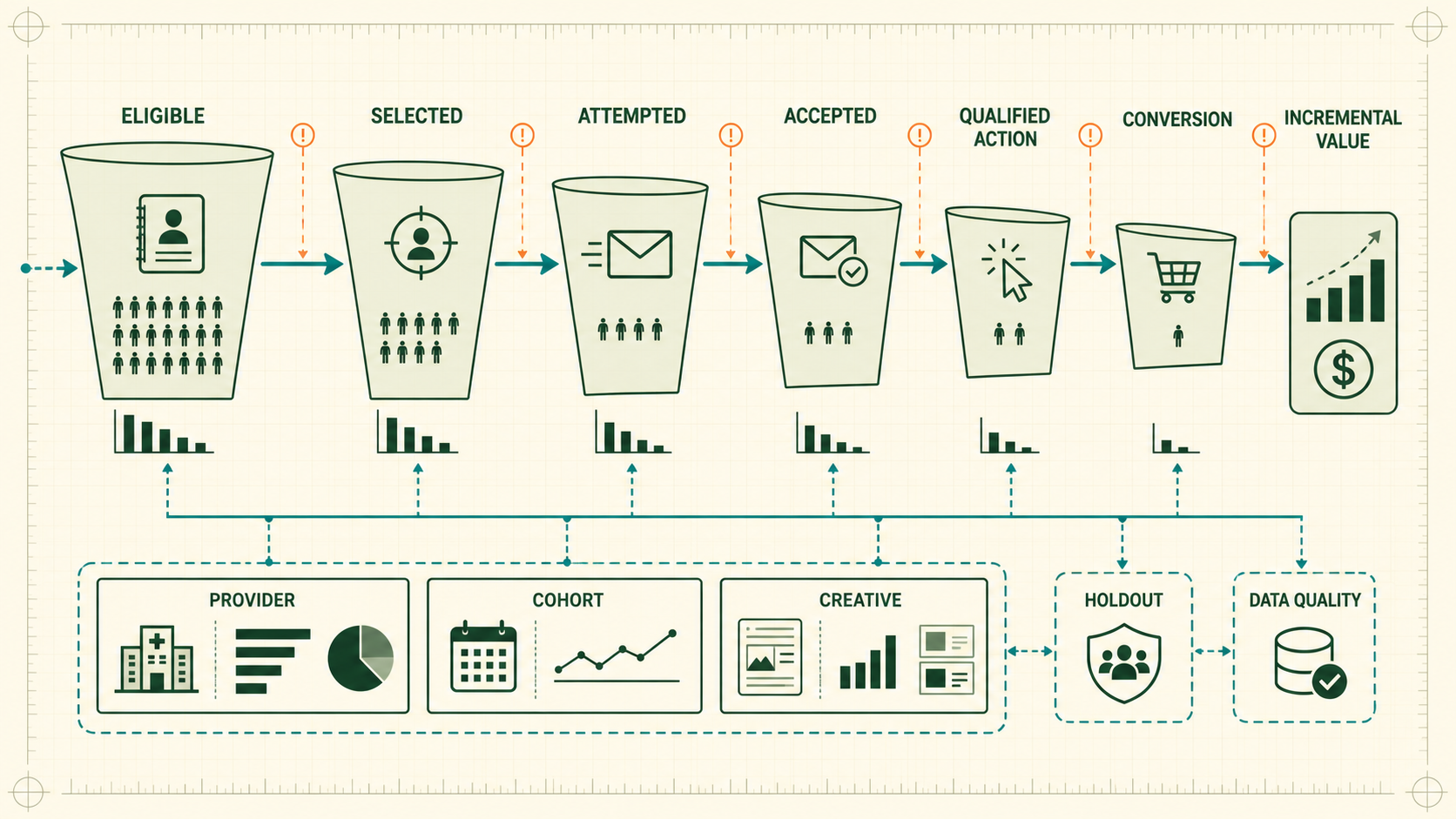
| Attempted | Queue routing, expiration or suppression timing |
| Accepted | Provider, content or infrastructure effect that is itself part of treatment exposure |
| Measured outcomes | Tracking loss or identity join failure |
Analyze according to the predeclared estimand. Removing bounced or undelivered recipients after randomization can create bias when treatment affects deliverability. Show intention-to-treat and transport diagnostics separately.
Control peeking, repeated tests and winner selection
Checking an ordinary fixed-horizon significance test every hour and stopping when it crosses a threshold inflates false positives. Either analyze once at the planned maturity point or use a sequential design whose boundaries account for repeated looks. Record every planned interim analysis, alpha-spending or Bayesian decision threshold before sending.
Multiplicity also appears when teams test ten subject lines, five outcomes, six providers and twenty subgroups, then report only the best result. Predeclare the primary comparison and metric. Adjust decision thresholds for planned multiple comparisons, and label post-hoc segments exploratory. A subgroup result should normally become a new experiment.
| Practice | Acceptable interpretation |
|---|---|
| One planned final analysis | Use the fixed-horizon method selected in advance |
| Planned sequential looks | Use the declared sequential stopping boundaries |
| Emergency safety stop | Stop for complaints, harm or compliance without claiming an efficacy winner |
| Unplanned early lead | Continue to maturity; do not publish a winner |
| Unexpected provider subgroup | Treat as diagnostic evidence and retest |
Model deliverability as part of treatment exposure
Creative can change message size, link domains, URL count, MIME shape, attachment behavior, complaint propensity and provider filtering. A variant that receives less SMTP acceptance or different placement has not experienced the same exposure. Do not “control away” that effect silently when it is caused by the treatment.
Stratify randomization by major mailbox organization only when planned and implemented correctly. Report assignment, attempt, acceptance, deferral, rejection, seed observation and business outcome by provider. Keep sending IP, DKIM domain, return path, throttling and send window equivalent unless infrastructure is the treatment.
If one variant triggers a provider-specific block, stop for safety, preserve complete replies and raw messages, and classify the incident. A higher conversion rate among the small subset that was accepted is not evidence that the blocked treatment wins.
Control carryover, frequency and overlapping journeys
A recipient’s outcome can be affected by earlier campaigns, simultaneous notifications and later retargeting. Create an experiment calendar and journey arbitration policy. For a subject-line test, equivalent prior contact may be enough. For a lifecycle or frequency test, use a longer washout and persistent assignment.
- Assign at account level when several users share the purchase decision.
- Prevent both variants from reaching aliases or duplicate identities tied to one person.
- Record every other email, push, SMS or paid-media exposure that can affect the primary outcome.
- Keep control recipients out of automations that deliver the same treatment through another route.
- Allow conversion, refund, renewal and churn windows to mature before closure.
Novelty effects can produce a short lift that disappears after repeated exposure. Repeat or extend high-impact tests before changing permanent lifecycle policy.
Write an experiment decision record that survives scrutiny
experiment_id: renewal_subject_2026_02
hypothesis_version: 3
assignment_unit: account_id
eligibility_snapshot: s3://.../sha256...
control: deadline-led subject
variant: benefit-led subject
primary_metric: renewed_accounts / assigned_accounts
guardrails: complaint, unsubscribe, gross_margin
planned_n_per_cell: 6800
analysis_at: 5 complete days after last delivery
result: no_decision
reason: interval includes minimum useful win and meaningful loss
owner: lifecycle-analytics
Keep the treatment artifact, assignment query, quality checks, metric SQL, analysis output, reviewer and final action together. Record null results. A searchable experiment registry prevents teams from rerunning the same weak idea and stops a winning result from being generalized to a different lifecycle, provider mix or business model without evidence.
Primary references
- NIST/SEMATECH e-Handbook: randomized experiment designs
- NIST/SEMATECH e-Handbook: sample sizes for proportions
- Apple: Mail Privacy Protection
- Google Analytics: campaign and conversion attribution