Email Attribution Models: Measuring Incremental Revenue
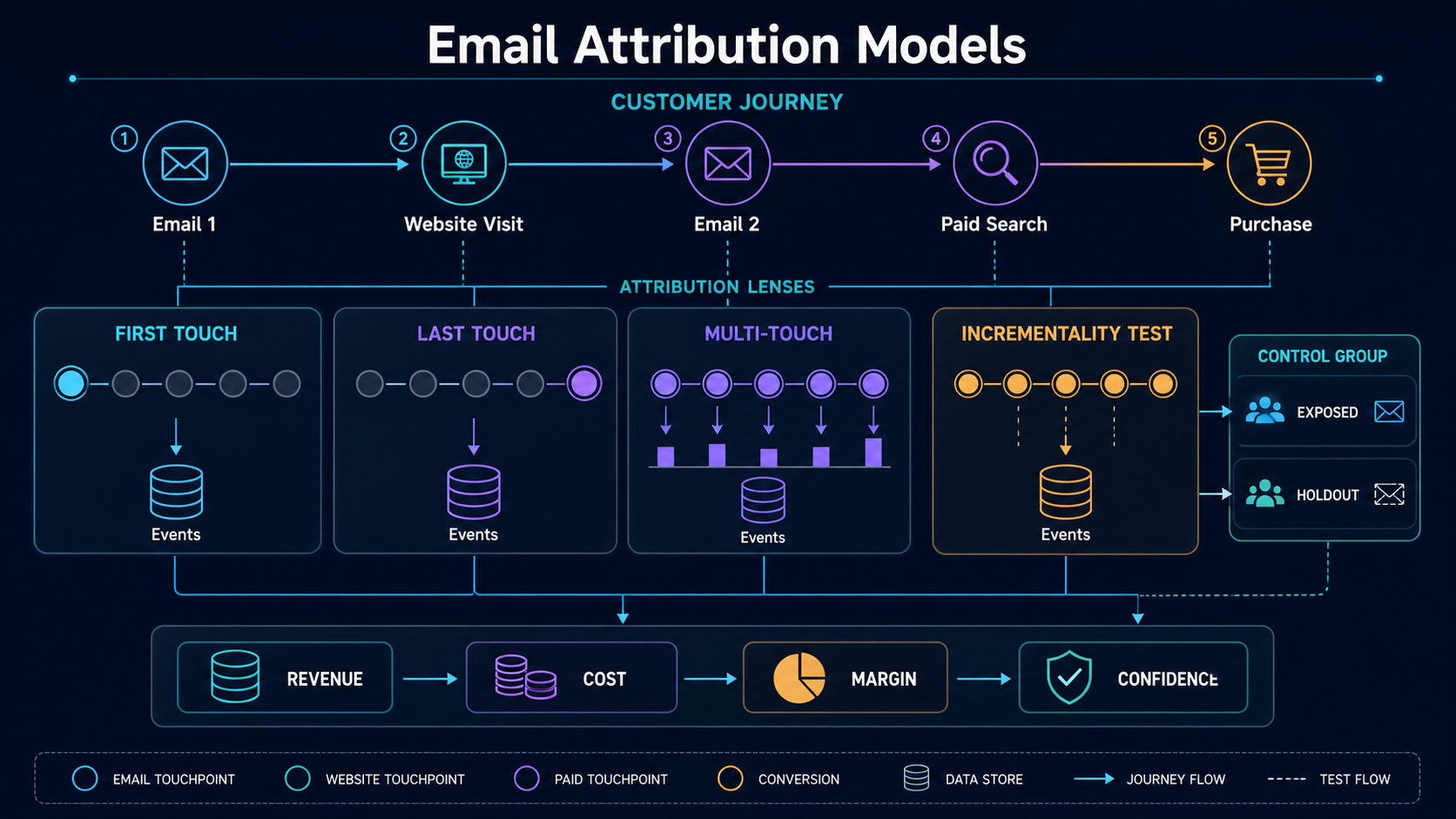
Attribution answers who receives credit for a conversion. Incrementality asks whether the conversion happened because the marketing exposure occurred. Those are not the same question. An email can deserve last-click credit and still add little incremental value if the customer was already returning to buy. Keep those conclusions separate in every report.
Attribution credit is not incremental impact
First-touch attribution credits the earliest recognized interaction; last-touch credits the final eligible interaction before conversion. Multi-touch methods divide credit across several contacts using a fixed or learned rule. These models organize reporting, but the weights are assumptions. They do not by themselves identify causal impact.
Incrementality compares outcomes for a randomly selected exposed group and an eligible holdout group. When assignment and interference are controlled, the difference estimates lift for that population and period. Attribution and incrementality can coexist: attribution explains recorded paths, while experiments calibrate how much of the reported value is actually created by the channel.
Where email attribution becomes misleading
Email identity is both an advantage and a trap. A known subscriber can often be connected across sends and site sessions, but shared devices, forwarded messages, privacy controls and account changes still create gaps. Click identifiers can be lost. A conversion window that is too short misses delayed action; one that is too long claims unrelated purchases.
Credit can also be duplicated across tools. The ESP, web analytics system and advertising platform may each report the full order. Finance sees one order, not three. Define a source of truth for transaction value, currency, refunds, tax and cost. Use consistent windows and deduplication keys before comparing channels.
Build an auditable email measurement pipeline
- Name the business decision. Decide whether the analysis will allocate budget, diagnose a journey, value a lifecycle program or estimate causal lift. The method should follow the decision.
- Define eligible touchpoints. Document which delivered messages, clicks, site sessions and offline contacts count, how bots are handled and whether transactional messages are excluded.
- Resolve identity carefully. Use consented account or customer identifiers where appropriate. Keep anonymous and known-state transitions explicit and avoid joining people on weak guesses.
- Set conversion and lookback rules. Choose the conversion event, deduplication key, timezone, value definition and maximum lookback. Apply the same rules across compared reports.
- Calculate descriptive models. Produce first-touch, last-touch and an agreed multi-touch view. Label the model and never present assigned credit as causal proof.
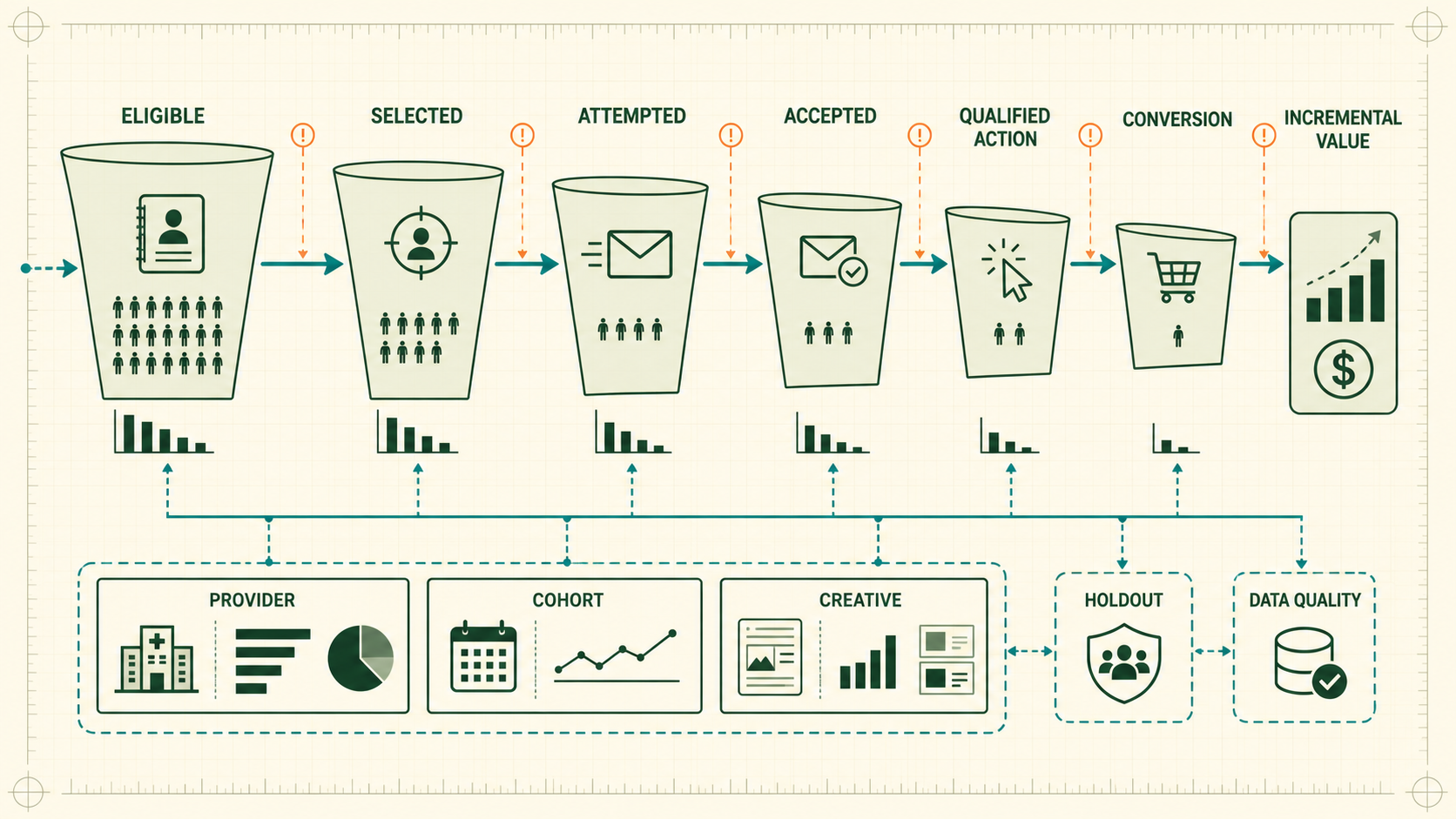
- Run holdouts where feasible. Randomize eligible subscribers before exposure, preserve the control condition and measure conversion, margin and negative outcomes for both groups.
- Reconcile to finance. Match unique order IDs, cancellations, refunds, discounts, cost of goods and channel cost. Explain the remaining gap instead of scaling numbers to fit.
- Report uncertainty and limits. Show cohort, period, identity coverage, sample size, interval or test method and material sources of missing or biased observation.
Choose the method that answers the business question
| Question | Suitable method | Important limitation |
|---|---|---|
| Which contact introduced known demand? | First-touch attribution | Early anonymous interactions may be missing |
| Which contact immediately preceded purchase? | Last-touch attribution | Overcredits closing contacts and brand navigation |
| How did recorded contacts participate? | Rule-based or modeled multi-touch | Weights reflect a model, not proof of causality |
| Did this email program create additional outcomes? | Randomized holdout or controlled experiment | Requires clean eligibility, assignment and sufficient power |
| What profit did the program create? | Incremental contribution margin | Needs reliable transaction cost, refund and holdout data |
Worked journey: email, paid search and a holdout
A customer receives a replenishment email, visits the site, later returns through paid search and purchases. Last-touch reporting assigns the order to paid search. First-touch within the selected window assigns it to email. A multi-touch model splits credit. All three describe the same observed path differently.
A standing randomized holdout provides the missing causal view. If exposed customers produce more contribution margin than comparable holdouts after accounting for unsubscribes and discounts, the program generated incremental value. The team can still use path attribution for journey diagnostics, but budget decisions use the experimentally calibrated lift rather than adding every platform’s credited revenue.
Data required for reproducible attribution
- Touchpoint ledger: message and campaign IDs, delivered time, click time, destination, identity state and automated-traffic classification.
- Transaction ledger: unique order or lead ID, value, currency, tax treatment, discount, refund, cancellation and contribution cost.
- Model configuration: attribution model, lookback window, channel eligibility, deduplication rule, timezone and code version.
- Experiment evidence: eligibility, assignment, exposure, holdout integrity, outcome window and confidence interval.
- Coverage: known versus anonymous journeys, unlinked conversions, consent constraints and the share reconciled to financial records.
Attribution errors that inflate email revenue
- Adding credited revenue across platforms: this counts the same conversion multiple times.
- Calling attribution incremental: assigning credit does not show what would have happened without the message.
- Optimizing clicks instead of profit: discounts may increase orders while reducing contribution margin.
- Changing windows between channels: inconsistent eligibility produces a comparison that reflects settings more than performance.
- Hiding identity gaps: deterministic matches cover only part of many journeys and should not be generalized without qualification.
Email attribution governance checklist
- Start with a written budget, journey or causal decision.
- Create one governed transaction source with unique conversion IDs.
- Document eligible email touchpoints and exclude bot or test activity.
- Use consistent lookback, timezone, value and refund rules.
- Label every reported model and keep attributed credit separate from lift.
- Maintain randomized holdouts for important recurring programs where practical.
- Reconcile value and cost to finance before claiming ROI.
- Report identity coverage, uncertainty and known measurement limitations.
Calculate common attribution models on the same journey
Consider one order worth $120 after three eligible touches: an email click, a paid-search click and a direct return. The order is counted once in finance; only its assigned credit changes.
| Model | Email credit | Paid-search credit | Direct credit |
|---|---|---|---|
| First touch | $120 | $0 | $0 |
| Last non-direct touch | $0 | $120 | $0 |
| Linear across three touches | $40 | $40 | $40 |
| Position based, 40/20/40 | $48 | $24 | $48 |
None of these rows proves that email created $120, $48 or $40. Each is a reporting rule applied to one observed path. Store the model name and version beside every attributed value so dashboards cannot silently compare unlike calculations.
Build an event ledger before assigning credit
Do not calculate attribution directly from an ESP summary. Create governed event tables with stable identifiers, UTC timestamps and a source record for each transformation.
email_touch(
  customer_id, message_id, campaign_id, delivered_at,
  clicked_at, destination_id, bot_classification
)
conversion(
  customer_id, order_id, ordered_at, currency,
  gross_value, discount, refund, variable_cost
)
experiment_assignment(
  experiment_id, customer_id, variant, assigned_at
)
Deduplicate conversions with the business transaction ID. Deduplicate clicks using the event source ID and documented human-activity rules. Keep delivery, click and conversion timestamps separate; a send attempt is not an exposure, and an automated security click is not reliable evidence of customer intent.
Define identity and lookback rules before querying
| Rule | Decision to document | Bias when omitted |
|---|---|---|
| Identity | Which consented account or customer key joins touchpoints to orders? | Shared devices and weak matching merge different people |
| Lookback | How far before conversion can a touch receive credit? | Long windows collect unrelated demand; short windows miss delayed action |
| Channel eligibility | Do deliveries, human clicks, transactional messages and direct visits count? | Channels receive credit under incompatible definitions |
| Value | Are tax, discount, refund and variable cost included? | Revenue is mistaken for contribution |
| Timezone | Which clock defines day and campaign boundaries? | Late-night events move between reporting periods |
Report the percentage of conversions that can be linked under the declared identity rule. Do not scale known journeys to all customers without explaining that inference.
Estimate lift with an eligible randomized holdout
Suppose 50,000 eligible customers are assigned before campaign exposure: 45,000 to treatment and 5,000 to holdout. Treatment produces 4,950 orders (11.0%); holdout produces 500 (10.0%). The observed absolute lift is 1 percentage point.
absolute lift       = 11.0% - 10.0% = 1.0 percentage point
relative lift       = (11.0% / 10.0%) - 1 = 10%
incremental orders  = 45,000 × 0.01 = 450
incremental margin  = incremental orders × contribution per order
incremental ROI     = (incremental margin - campaign cost) / campaign cost
The calculation still requires an uncertainty interval and a check that assignment, eligibility and exposure were implemented correctly. Include complaints, unsubscribes and discount cost as guardrails. If the interval includes both a material win and loss, record no decision rather than replacing the holdout result with attributed revenue.
Reconcile channel reporting to one financial total
Create a reconciliation table for each reporting period: unique orders in finance, orders linked to a known customer, orders eligible for attribution, attributed value by model, refunds received after the initial window and unexplained variance. The sum of assigned credit within one model must not exceed the governed conversion total unless the report explicitly uses fractional or modeled expansion.
Keep two headline views: descriptive attributed performance and experimentally estimated incremental performance. Marketing can use the first to understand recorded journeys and the second to make causal budget decisions. Combining them into one number makes neither view auditable.
Choose a model for a declared use, not because it favors email
| Method | Useful for | Major caution |
|---|---|---|
| First touch | Known journey introduction | Misses earlier anonymous demand and overcredits discovery |
| Last non-direct touch | Immediate path-to-conversion reporting | Overcredits closing interactions |
| Linear | Simple participation view | Equal weights have no causal basis |
| Time decay | Emphasizing recent eligible touches | Decay rate is an assumption |
| Position based | Highlighting introduction and closure | Selected weights still encode opinion |
| Learned or data-driven | Pattern estimation with sufficient governed data | Model behavior, drift and missing identities require validation |
| Randomized holdout | Estimating incremental impact | Needs power, clean assignment and controlled interference |
Run descriptive models side by side when stakeholders need to understand sensitivity. A decision that reverses under small model changes is not robust. Use experiments to calibrate recurring high-value programs instead of treating the most favorable attribution rule as truth.
Publish an attribution report that can be challenged
Each report should identify the eligible population, observation dates, conversion event, identity coverage, lookback window, attribution model, refund maturity and transaction source. Show orders and margin as counts and currency, not only percentages.
| Report block | Required fields |
|---|---|
| Population | Eligible customers, delivered recipients, exclusions and known-identity coverage |
| Journey | Touches by channel, matched conversions, unmatched conversions and model version |
| Economics | Gross value, discounts, refunds, variable cost, contribution and campaign cost |
| Experiment | Treatment/holdout counts, rates, absolute lift, interval, guardrails and decision |
| Limitations | Consent restrictions, missing events, bot filtering, late refunds and interference |
Retain the query or code revision and a frozen result extract. If a later identity rule or refund feed changes the number, publish a revision rather than silently overwriting the historical decision.
Separate attribution credit from causal incrementality
| Question | Method | Answer produced |
|---|---|---|
| Which tracked touchpoint receives reporting credit? | Rule-based or data-driven attribution | Allocated conversion/revenue credit under that model |
| What paths commonly precede conversion? | Journey/path analysis | Observed sequence and association |
| What happened because email was sent? | Randomized holdout or credible causal design | Incremental conversion, revenue or retention |
| How did total channel investment affect demand? | Marketing-mix or time-series model | Aggregate contribution under model assumptions |
Last-click and multi-touch allocation can be useful for reporting, but neither proves causality. High-intent customers may click email shortly before purchasing even when they would have purchased without it. Use attribution to describe credit and controlled experiments to estimate lift.
Build an immutable touchpoint and outcome ledger
touchpoint(
  person_or_account_key, event_id, event_time_utc,
  channel, campaign_id, message_id, creative_version,
  qualified_event_type, source_system, ingestion_time_utc
)
outcome(
  person_or_account_key, outcome_id, outcome_time_utc,
  outcome_type, gross_value, discount, refund, variable_cost,
  currency, source_system, reconciliation_version
)
experiment_assignment(
  experiment_id, assignment_unit, variant, assigned_at_utc
)
Keep event time distinct from ingestion time, deduplicate on stable source IDs and retain the definition version used to qualify clicks. Security scanners and privacy proxies contaminate email events; store raw events and a versioned classification rather than deleting inconvenient records.
State the identity assumptions behind every path
Cross-device and cross-channel paths require identity resolution. An authenticated account ID is stronger than a browser cookie; an email-address match can still merge shared or recycled mailboxes incorrectly. Record deterministic and probabilistic joins separately, their effective time and deletion behavior.
| Identity gap | Bias introduced | Reporting treatment |
|---|---|---|
| Cookie loss or consent denial | Earlier touchpoints disappear | Show coverage and do not invent a complete path |
| Cross-device conversion | Email click and purchase fail to join | Use authenticated identity where permitted |
| Shared account | Several people become one path | Assign/test at account level when that is the decision unit |
| Offline sale delay | Outcome arrives after reporting close | Use a maturity window and restatement policy |
| Duplicate CRM contacts | Touches and conversions double count | Resolve with governed survivorship rules |
Choose windows from decision latency, not platform defaults
A seven-day click window and a thirty-day click window answer different reporting questions. Define touch eligibility, conversion maturity, returns/cancellations and late-event restatement. For recurring subscriptions, distinguish initial order, retained renewal and lifetime value. For a long enterprise sale, account-level influence can span months and cannot be inferred from one recipient click.
eligible_touch:
  touch_time <= conversion_time
  AND conversion_time - touch_time <= lookback_window
  AND touch qualifies under metric_version

net_value:
  gross_revenue - discount - refunds - variable_fulfillment_cost
Publish the window next to every number. Never compare reports that use different event qualification or maturity rules without recalculating them consistently.
Use model comparison as sensitivity analysis
| Model | Useful view | Structural bias |
|---|---|---|
| First touch | Discovery source | Ignores later influence |
| Last non-direct click | Final tracked acquisition interaction | Overcredits closers and suppresses direct |
| Linear | Path participation | Assumes equal contribution |
| Time decay | Recent interaction emphasis | Decay rule is chosen, not discovered |
| Position based | Discovery and closing emphasis | Weights are arbitrary |
| Data driven | Modeled credit from observed paths | Depends on coverage, model and platform scope |
If budget decisions reverse when the rule changes, the conclusion is model-sensitive. That is a reason to run an incrementality test, not to select the model that favors email.
Calculate lift from a persistent eligible holdout
treatment_rate = treatment_converters / treatment_assigned
control_rate   = control_converters / control_assigned
absolute_lift  = treatment_rate - control_rate
relative_lift  = absolute_lift / control_rate
incremental_conversions = absolute_lift * treatment_eligible_population

incremental_margin =
  treatment_net_margin - expected_control_net_margin
Assign before delivery and preserve intention-to-treat. Complaints, bounces or treatment-caused filtering are part of program impact, not rows to remove after randomization. Prevent control recipients from receiving equivalent messages through another journey. Report uncertainty and guardrails, not only the point estimate.
Reconcile analytics credit to finance without forcing equality
Analytics may use event time, estimated identity and a lookback model. Finance may use settled transaction time, recognized revenue, refunds, tax and currency conversion. Create a reconciliation bridge rather than editing one system until totals match.
| Reconciliation step | Evidence |
|---|---|
| Transaction coverage | Outcome IDs present in analytics and order system |
| Value definition | Gross, net, margin, refund and cancellation treatment |
| Time basis | Event, order, settlement and reporting-close timestamps |
| Currency | Source currency and versioned exchange rate |
| Identity | Matched, unmatched and multiply matched outcomes |
| Restatement | Late events and finalization schedule |
Attributed revenue is a model output. Incremental margin and finance-recognized revenue are separate measures and should remain labeled.
Worked example: attributed revenue rises while lift falls
A win-back campaign reports $240,000 of last-click revenue from 100,000 eligible accounts. The campaign team assumes all of it was caused by email. A persistent randomized design assigned 90,000 accounts to treatment and 10,000 to control. Treatment produced 4,680 purchases (5.20%); control produced 500 purchases (5.00%).
absolute_lift = 5.20% - 5.00% = 0.20 percentage points
incremental_purchases_at_observed_scale =
  90,000 * 0.002 = 180

if net margin per incremental purchase = $32:
incremental_margin ≈ 180 * $32 = $5,760
The attributed revenue remains useful for path reporting, but it is not the incremental business value. The uncertainty interval may still include no lift, so the correct decision could be to repeat or stop. A large attributed number can coexist with small causal impact because high-propensity customers click messages before purchases they would have made anyway.
Version the model and prevent silent restatement
- Publish the touchpoint qualification, identity coverage, lookback and outcome-maturity rules.
- Record when the platform changes its available attribution models or default.
- Do not compare a data-driven report with a last-click historical baseline without recalculation.
- Freeze budget decisions for a defined close period, then restate late refunds or offline outcomes visibly.
- Keep holdout lift, attributed credit and finance revenue in separate columns.
- Audit UTM reuse, redirect loss and CRM campaign mapping before blaming the model.
Google Analytics currently offers data-driven, paid-and-organic last click and Google paid-channels last click in its attribution reporting. Product availability can change. Store the report configuration and extraction time rather than describing a platform model as permanent.
Approve changes through analytics, finance and channel owners. Re-run a fixed historical sample through the new implementation and explain every material difference by path eligibility, identity, window, model or value treatment. If the difference cannot be reconciled, do not switch the production decision report merely because the new total looks more favorable.
Primary references
- Google Analytics: attribution models and reporting
- Google Analytics: traffic-source dimension scopes
- Google Ads: conversion lift methodology overview
- NIST/SEMATECH: randomized experiment designs