Email Blocklists: Monitoring, Diagnosis and Delisting
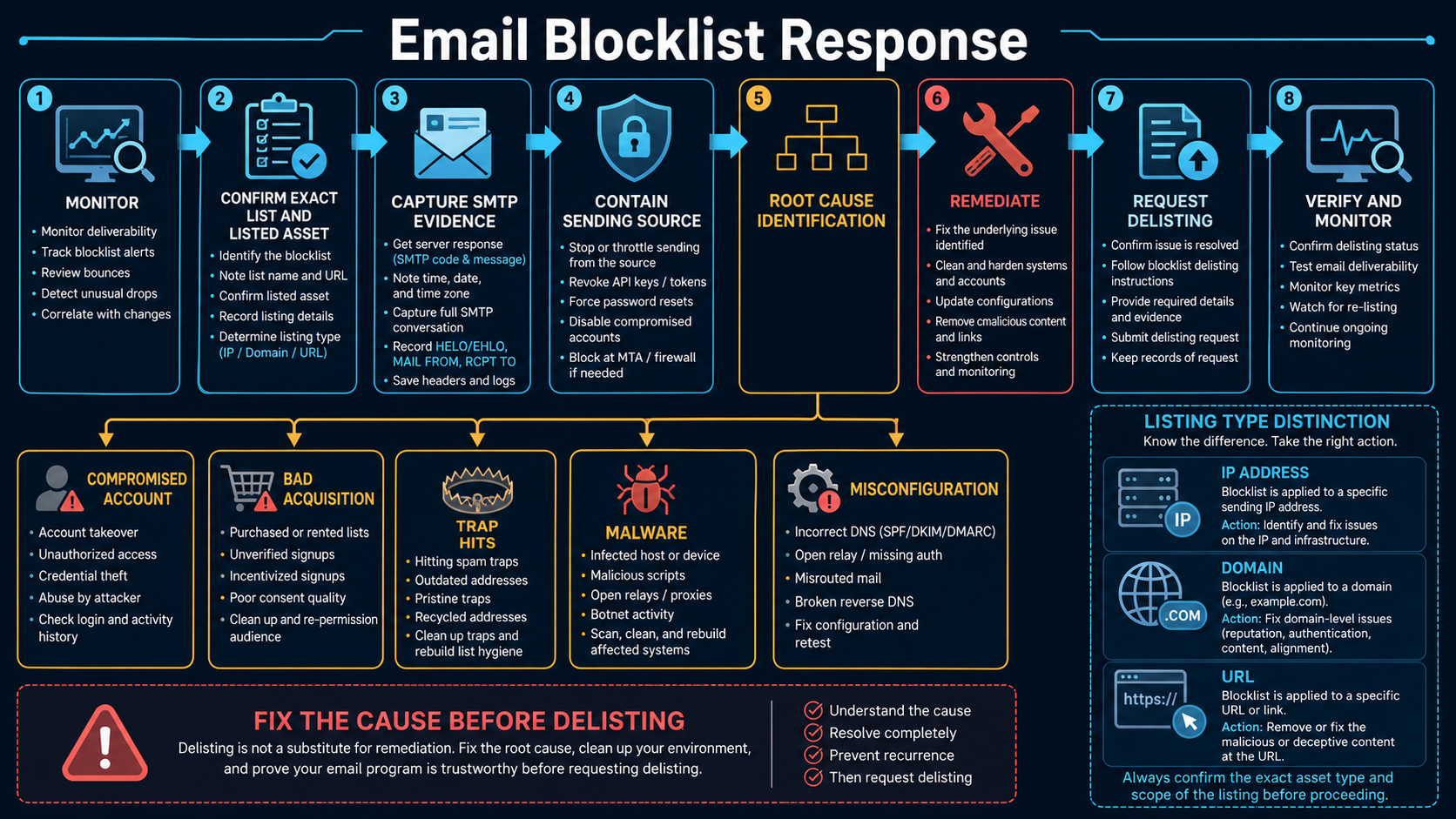
A blocklist alert is not a diagnosis. Some lists are widely used in mail filtering, others have little measurable influence, and a listing may identify an IP address, a domain or a URL rather than the visible From domain. The useful response begins by proving which asset is listed and whether recipient systems are actually rejecting or filtering mail because of it.
What an email blocklist listing actually identifies
An email blocklist publishes reputation or policy data that receiving systems may query during connection, message or content evaluation. IP lists can describe a sending host, dynamic range, compromised system or policy classification. Domain and URL lists can describe identities or destinations observed in abusive content. Each operator defines its own evidence, scope, expiration and removal process.
A listing does not create one universal delivery outcome. Receivers decide whether and how to use it. Capture complete SMTP replies, affected recipient domains, timestamps, sending IPs, envelope identities, DKIM domains and message URLs. Then consult the named list directly. A generic multi-list checker is useful for discovery, but its summary must not replace the list operator’s current record and instructions.
Why delisting before remediation fails
Teams often rush to submit a removal request while the compromised account, purchased list, infected host or open relay continues sending. That approach can lead to a denied request or immediate relisting. Delisting is the last incident step, not the first.
Another mistake is changing infrastructure before understanding scope. Moving traffic to a clean IP can spread the same abuse and damage another reputation. Suppressing every subscriber can also destroy legitimate service while leaving the actual source untouched. Contain the smallest proven stream, credential, customer, host or content source, and preserve enough evidence to explain the incident.
Investigate and remediate a blocklist incident
- Confirm the exact record. Query the named operator directly and record list name, lookup key, category, first-seen time, explanatory text and removal method. Distinguish IP, domain and URL scope.
- Prove recipient impact. Search SMTP logs for replies that name the list or its lookup URL. Compare rejection and deferral patterns by mailbox provider and avoid attributing unrelated filtering to the alert.
- Freeze evidence. Retain queue IDs, message IDs, authenticated account, API key, source application, envelope sender, DKIM domain, destination, template and URLs for the affected window.
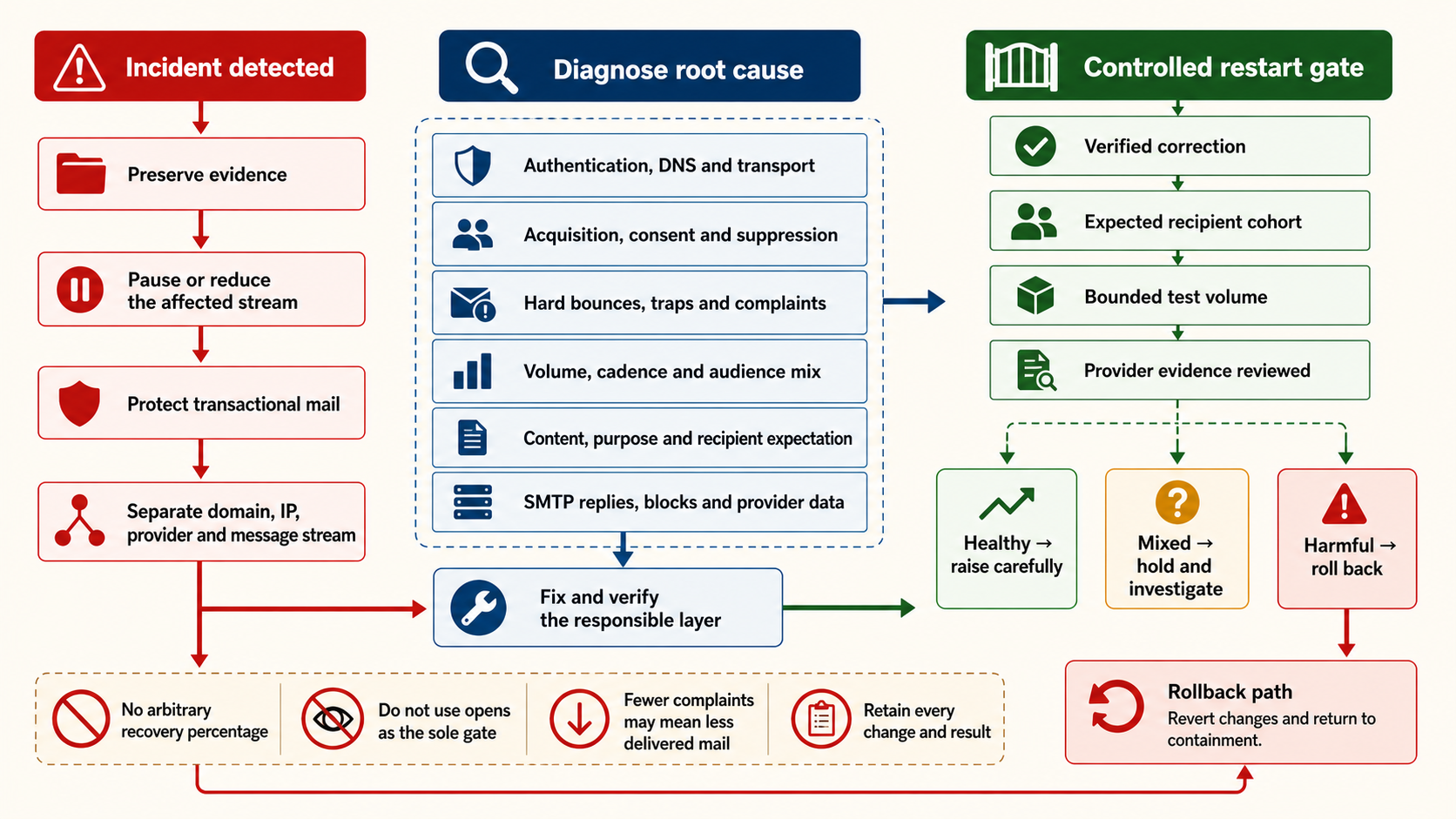
- Contain the source. Pause or throttle the smallest identified stream. Revoke compromised credentials, disable abusive tenants, isolate malware and stop acquisition sources that lack permission evidence.
- Find the root cause. Review account access, relay controls, content changes, recipient provenance, trap-risk cohorts, bounce handling, unsubscribe enforcement and infrastructure changes.
- Remediate and prevent recurrence. Clean systems, rotate secrets, correct relay policy, suppress invalid recipients, remove abusive URLs, repair authentication and add monitoring or approval controls.
- Follow the operator process. Read the current listing page and supply factual remediation evidence. Do not pay unrelated third parties or repeatedly submit vague requests.
- Verify recovery. Confirm the listing state at the authoritative source, test representative delivery, watch SMTP codes and reputation signals, and investigate any relisting immediately.
Prioritize listings by proven recipient impact
| Evidence | Interpretation | Action |
|---|---|---|
| SMTP reply explicitly names the list | Direct recipient impact is proven | Prioritize containment and operator-specific remediation |
| Checker reports a listing but SMTP behavior is normal | Impact is not yet established | Inspect the authoritative record and monitor without disruptive migration |
| One customer or credential created the traffic | Scoped abuse incident | Disable that source and preserve unaffected streams |
| Multiple IPs show the same bad acquisition cohort | Data-process failure | Stop the cohort and repair consent and source governance |
| Listing cleared but reappears | Cause remains or traffic resumed too early | Reopen the incident and audit recurrence controls |
Worked incident: an imported cohort triggers rejection
A promotional stream begins receiving policy rejections from several corporate gateways. The full replies name an IP list. Logs show that almost all affected traffic came from one imported partner cohort added the previous day. The same cohort produces hard bounces and no verifiable consent records.
Operations pauses that cohort rather than moving the campaign to another IP. It saves the import record, removes the recipients, audits the partner feed and adds an ingestion gate requiring source, notice and timestamp evidence. After abusive traffic stops, the team follows the list operator’s removal process and monitors the original IP. The fix addresses the acquisition path, so the listing does not simply follow the mail to new infrastructure.
Evidence required for diagnosis and delisting
- Listing evidence: operator, list, listed asset, category, authoritative lookup response, first and last observation and removal state.
- SMTP evidence: recipient provider, MX, remote IP, full reply, enhanced code, queue ID, attempt count and final disposition.
- Source evidence: tenant, user, API key, application, acquisition cohort, consent record, template, URL and authentication identities.
- Containment evidence: action, scope, owner, approval time, traffic reduction and any customer or service impact.
- Recovery evidence: remediation tasks, authoritative delisting check, complaint and bounce trends, provider telemetry and relisting alerts.
Blocklist response mistakes that spread the incident
- Delisting before remediation: removal does not repair a compromised account, unsafe import or infected host.
- Treating every list equally: confirm real recipient use and impact before making a disruptive infrastructure change.
- Rotating IPs to evade reputation: this spreads abuse and hides the evidence needed for durable correction.
- Searching for individual traps: trap operators do not reveal them; repair acquisition and hygiene at the source cohort.
- Losing the full reply: a dashboard category without the remote text, time and MX cannot support precise diagnosis.
Blocklist incident and recovery checklist
- Identify the exact list and listed IP, domain or URL.
- Verify the record at the list operator’s authoritative service.
- Capture full SMTP replies and affected provider distribution.
- Trace traffic to account, credential, application, cohort and content.
- Contain the smallest proven source without moving abuse elsewhere.
- Complete root-cause remediation and recurrence controls.
- Use only the current operator removal process.
- Verify delivery and monitor the original assets for relisting.
Identify what is listed before changing mail flow
| Listing scope | Typical lookup key | Evidence to correlate |
|---|---|---|
| IPv4 or IPv6 address | Outbound connection IP | HELO, reverse DNS, stream, tenant, SMTP replies and traffic window |
| IP range or ASN policy | Network allocation | Hosting classification, compromised neighbors and provider ownership |
| Domain | DKIM, envelope, visible From or redirect domain | Authentication identity, registration, campaigns and abuse history |
| URL or hostname | Link or image host appearing in content | Redirect chain, landing page, compromised site and template |
| Policy list | Dynamic/residential or non-mail range | Whether the address should send direct-to-MX mail at all |
Record the list operator, exact list, key, category and authoritative response. Similar names can represent different zones with different meanings. A checker that reports “listed” without the zone and lookup key is insufficient for an incident decision.
Verify an IPv4 DNSBL result without misreading it
Many IP blocklists expose DNS query zones. Reverse the IPv4 octets and query the operator’s documented zone. Use the zone specified by that operator; the placeholder below is not a real service.
# For 192.0.2.45, reverse the octets
dig +short 45.2.0.192.dnsbl.operator.example A
dig +short 45.2.0.192.dnsbl.operator.example TXT
An A response commonly indicates a listing and may encode a category, while TXT may provide explanatory text. Meanings are operator-specific. NXDOMAIN can mean “not listed” for that zone, but a timeout or resolver failure is not the same result. IPv6, domain and URL lists use different lookup construction; follow current operator documentation rather than adapting the IPv4 pattern.
Confirm the same asset through the operator’s official lookup page before remediation. Never automate removal requests from a multi-list checker result alone.
Prove whether receiving systems use the listing
2026-08-29T10:14:22Z mx=mx.receiver.example
local_ip=192.0.2.45 command="end of DATA"
reply="550 5.7.1 Message rejected; sending IP listed at ..."
queue_id=AB12CD34 stream=marketing tenant=customer-42
Preserve the complete remote response, not only the numeric code. Group occurrences by receiver, MX, local IP, stream and time. A listing that is explicitly named in rejections has proven transport impact. A listing seen only in a monitoring tool may still matter, but the response should be proportionate to evidence.
| Finding | Priority | Action |
|---|---|---|
| Named in widespread 5xx replies | High | Contain source, remediate and follow operator process |
| Named in 4xx deferrals | High but queue-aware | Control retry pressure and repair before queue expiry |
| Listed with no observed recipient impact | Investigate | Confirm authority and monitor; avoid disruptive migration |
| Unknown checker with no authoritative record | Low | Do not pay or reconfigure infrastructure based on the claim |
Trace a listing to the smallest causal source
| Symptom | Likely investigation | Containment |
|---|---|---|
| Sudden volume from one API key | Credential compromise or automation defect | Revoke key and pause that application |
| High bounce and complaint rate from one import | Purchased, scraped or unverified partner data | Quarantine the cohort and its ingestion route |
| Unexpected content or URLs | Compromised account, template or website | Disable source, remove content and rotate access |
| Mail relayed without authentication | Open relay or trusted-network error | Close relay path and review logs for abuse window |
| Same problem follows traffic across IPs | Program, identity or data cause | Stop migration and remediate the source |
Preserve unaffected transactional or customer traffic when safe. Broad shutdowns can create unnecessary harm, but leaving a proven abusive source active to protect volume will make delisting less credible.
Submit a factual delisting request after remediation
Use only the current form or process published by the list operator. A useful request is short, specific and verifiable.
Listed asset: 192.0.2.45
Detection window: 2026-08-28 13:10–14:05 UTC
Root cause: compromised API credential for tenant customer-42
Containment: credential revoked at 14:12 UTC; tenant stream stopped
Remediation: access rotated, source host isolated, key scope reduced
Prevention: anomaly limit and approval added for new credentials
Validation: no unauthorized traffic since 14:12 UTC; logs retained
Contact: [email protected]
Do not claim the issue is fixed merely because traffic stopped for a few minutes. Verify the control, monitor the original asset and be prepared to answer operator questions. If the listing expires automatically, remediation and recurrence monitoring are still required.
Monitor authoritative lists without turning alerts into outages
Inventory every active outbound IP and sending, DKIM, return-path and tracking domain. Query only lists relevant to the organization and within each operator’s published automation terms. Record the first observation, last observation, lookup key and authoritative response.
Deduplicate repeated alerts and enrich them with the asset owner, stream, recent volume, SMTP impact and change history. A monitoring system should open an investigation, not automatically rotate an IP, pause all mail or submit removal forms. Keep retired assets in a bounded watch period so unexpected reuse or compromise is detected.
Identify exactly what is listed and whether the receiver uses it
“We are blocklisted” is incomplete. The listed object may be an IPv4 address, IPv6 range, return-path domain, DKIM domain, visible From domain, hostname or URI found in message content. A receiving system can use that data to reject, score, quarantine or do nothing. Confirm the authoritative list, exact object, first-seen time, category and removal instructions before changing production traffic.
| Evidence | Question answered | Common mistake |
|---|---|---|
| Authoritative lookup | Is the object currently listed and why? | Trusting an aggregate checker cache |
| SMTP rejection | Which receiver cited which policy? | Assuming every deferral is caused by the listing |
| Campaign and queue logs | Which traffic preceded the event? | Changing IP before preserving evidence |
| Provider telemetry | Is private reputation also degraded? | Expecting delisting to repair private reputation |
Some lists are widely used; others are informational. Measure impact with actual enhanced replies and acceptance changes. Never pay an unaffiliated removal service or expose credentials to a copied form.
Query a DNS blocklist correctly and confirm at the authority
# Illustrative IPv4 DNSBL query: reverse the octets
dig +short 4.3.2.1.example-dnsbl.test A
dig +short 4.3.2.1.example-dnsbl.test TXT

# Preserve receiver evidence first
grep -E "(4[245][0-9]|5[0-9][0-9]) " /var/log/maillog
Replace the demonstration zone with the operator’s documented query zone. Returned loopback values often encode categories, but meanings are list-specific. IPv6 queries use reversed hexadecimal nibbles and are easy to construct incorrectly. Prefer the operator’s lookup for confirmation and terms.
DNS answers can be cached and public resolvers can be blocked or rate-limited. Save UTC time, resolver, returned A/TXT values, authoritative result and the outbound address observed by the recipient. NAT, ESP routing or a shared pool can make the application’s apparent IP different from the connecting MTA.
Treat a listing as a symptom and find the causal traffic
| Pattern | Likely investigation | Containment |
|---|---|---|
| Sudden unplanned volume | Stolen API key, compromised account or open relay | Revoke credential and preserve security logs |
| One import followed by complaints or traps | Purchased, scraped, stale or unverifiable data | Quarantine source and provenance |
| URI listing across several IPs | Compromised redirect, tracking or landing domain | Disable abusive content and repair security |
| Shared IP listed | Pool tenant or provider control failure | Escalate with evidence; do not claim sole control |
| Repeated listing after removal | Root cause remains active | Stop the delisting cycle and audit all paths |
Build a timeline from queue IDs, credentials, tenant, campaign, envelope sender, signing domain, links, acquisition batch and recipients. Inspect infrastructure compromise before assuming marketing caused the event.
Submit a delisting request that demonstrates control
Follow only authoritative instructions. A useful request identifies the object, explains control, states the root cause, gives UTC containment and remediation times, and describes recurrence prevention. Do not argue that the list is wrong while logs show unresolved traffic. Do not submit duplicate tickets.
Listed object: 192.0.2.25
Detected: 2026-08-29 08:12 UTC
Contained: 2026-08-29 08:31 UTC
Root cause: exposed API credential used by unauthorized automation
Remediation: credential revoked; tenant disabled; keys rotated;
             outbound anomaly limit and source alert enabled
Verification: no unauthorized queue entries after 08:31 UTC
This is a case structure, not text to copy. Include only supported facts and keep customer data out of public forms. If the operator specifies automatic expiry, comply while ensuring traffic remains clean.
Verify recovery without confusing removal and reputation repair
After the authority shows clear, query through appropriate resolvers after TTL expiry and watch the SMTP replies that cited the list. Receivers may cache data, apply local copies or maintain separate private reputation. Queue recovery can create a burst, so control retries and provider-specific rates.
- Confirm the exact object is absent at the authoritative source.
- Verify the abusive source remains disabled and credentials remain rotated.
- Watch complaints, hard bounces, unknown-user rates and trap indicators.
- Compare acceptance and deferral by receiving organization.
- Retain the incident and add recurrence alerts.
Close only when causal control is fixed, authoritative removal is confirmed, affected networks recover and an observation period shows no recurrence.
Prove the listing affected delivery before assigning causality
Build a receiver-by-hour series for accepted, temporarily deferred and permanently rejected recipients. Mark the listing first-seen time, causal traffic, containment, removal and cache-expiry observations. Compare affected receivers with networks that do not cite the list and with another clean stream where possible. This avoids attributing an unrelated campaign, authentication or rate-control problem to a public listing.
impact_rate = cited_listing_rejections / attempted_recipients
acceptance_rate = accepted_recipients / attempted_recipients

segment by receiving organization, outbound IP,
stream, hour UTC and enhanced SMTP reply
A receiver may cite a policy URL without using the public list as its only decision. Preserve the complete response rather than extracting one domain from it. If acceptance remains poor after authoritative removal, investigate private reputation, complaints, authentication, recipient quality and retry behavior. Delisting removes one signal; it does not erase the conduct that produced it.
For a shared ESP route, request the provider’s incident timeline and the connecting IP used for your messages. Do not submit removal for address space you cannot prove you control. The provider may need to contain another tenant while keeping your domain evidence stable.
Keep an evidence package suitable for recurrence analysis
Retain the original authoritative result, DNS answers, SMTP samples, affected object inventory, traffic timeline, security findings, containment approval, removal correspondence and recovery metrics. Redact recipient data and secrets, but do not keep only screenshots without timestamps or query context. Link the incident to changes in credentials, forms, imports, routing and content domains.
At a scheduled review, test whether the new control would have stopped the same traffic. An alert that merely reports another listing is detection, not prevention. Strong prevention may be a credential sending cap, tenant anomaly rule, import quarantine, relay restriction, source lineage requirement or durable suppression control, depending on the root cause.
Primary references
- Spamhaus: blocklist removal guidance
- Spamhaus: spam traps, fix the problem not the symptom
- Google email sender guidelines