Email Spam Traps: Types, Diagnosis and Prevention
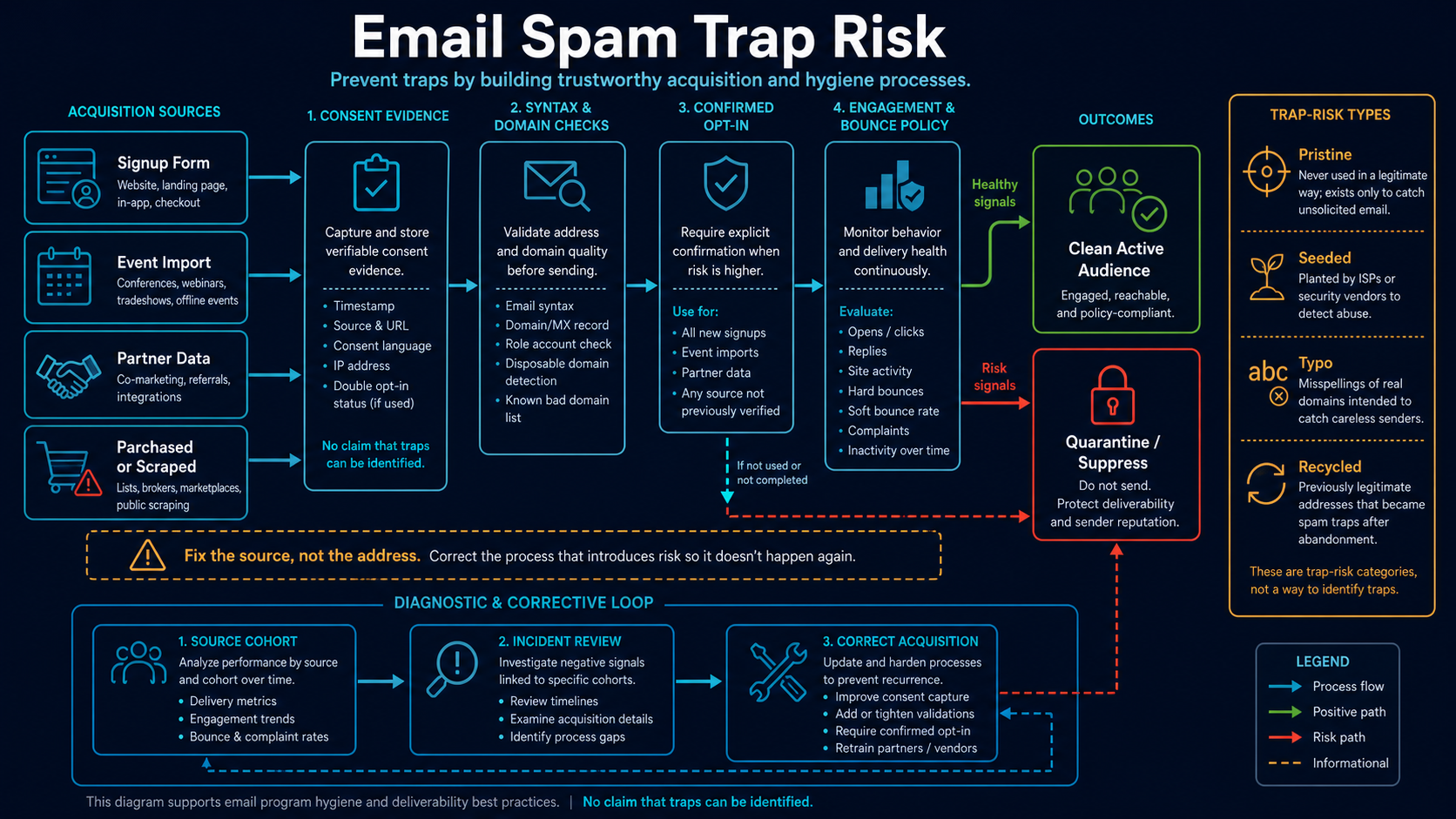
A spam-trap signal is evidence of a data-process problem, not an invitation to hunt for a secret address. Trap operators intentionally protect the identities of their addresses. Removing one suspected recipient while leaving the acquisition source, stale cohort or missing suppression rule unchanged only hides the symptom until the next incident. Correct the system instead.
What spam-trap signals reveal about address collection
Pristine traps were not used by ordinary subscribers and commonly indicate scraping, buying or other collection without permission. Seeded traps are placed where address harvesters or unsafe data suppliers may collect them. Typo traps resemble common domains and can indicate inadequate capture checks. Recycled addresses were once legitimate but later became trap signals after abandonment, making long-term inactivity and re-permission policy important.
These categories help explain risk; they do not provide a reliable method to identify individual traps. A sender should analyze the cohort, source, age, consent record and sending behavior associated with the incident. Desired, authenticated mail to a current permissioned audience is the durable preventive control.
Why validation cannot certify permission or remove trap risk
List validation can detect syntax, nonexistent domains and some risky patterns, but it cannot certify that an address belongs to a consenting person or is not a trap. A technically deliverable address can still be unlawfully collected, mistyped, abandoned or inappropriate for the promised program.
Incidents often expose weak data lineage. A database may store the address but not the form, notice, timestamp, IP, partner, event or confirmation evidence. Without that history, operators cannot distinguish a legitimate active subscriber from an imported record. Build provenance at capture time rather than trying to reconstruct it after reputation falls. Preserve that evidence across CRM, ESP and warehouse migrations.
Investigate a spam-trap signal by source and cohort
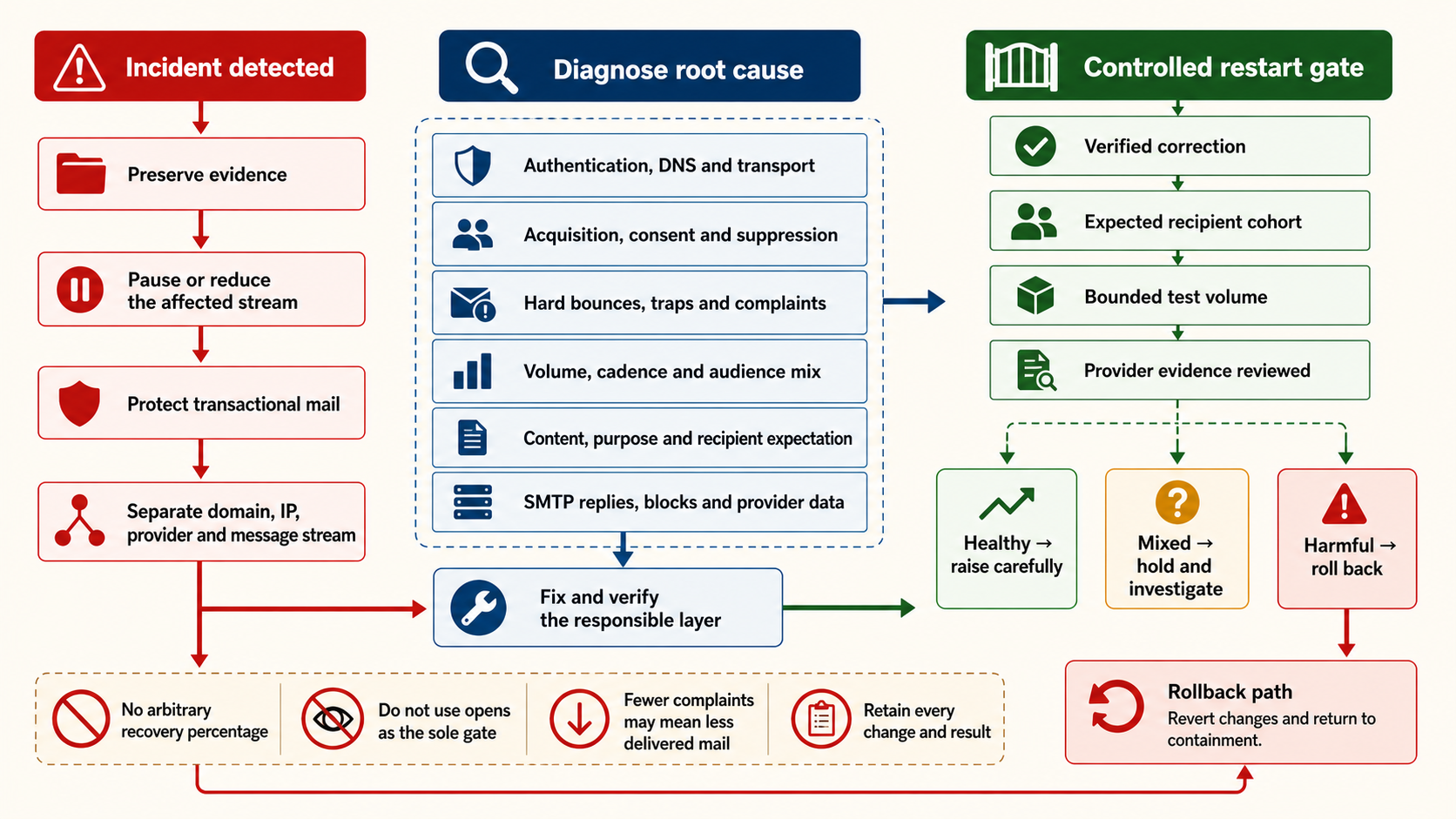
- Stop the affected source. Pause the smallest cohort, import, tenant or form associated with the signal. Do not rotate it onto another IP or domain.
- Preserve lineage. Export source, acquisition date, consent text, confirmation state, engagement, bounces, complaints, campaigns and transformations for the incident cohort.
- Classify probable process failure. Look for purchased or scraped data, partner feeds, event imports, typo acceptance, missing confirmation, reactivated suppressions or very old inactive records.
- Compare clean cohorts. Contrast trap-associated timing with known first-party confirmed subscribers while controlling for campaign and infrastructure changes.
- Repair acquisition. Remove unsafe suppliers, add form controls, record consent evidence, prevent role or malformed inputs where appropriate and make expectations explicit.
- Repair lifecycle policy. Process bounces and complaints immediately, honor unsubscribe scope and apply a defensible inactivity and sunset policy.
- Rebuild cautiously. Resume with current, well-documented and engaged subscribers. Monitor provider telemetry and SMTP outcomes before widening eligibility.
- Audit recurrence. Test every ingestion route and create alerts for source-level bounce, complaint, inactivity and unknown-provenance changes.
Map trap-risk evidence to corrective controls
| Finding | What it suggests | Corrective control |
|---|---|---|
| Addresses came from scraping or purchased data | No reliable permission | Stop and permanently reject the source |
| Recent form cohort has domain typos | Capture quality failure | Add correction prompts and confirmation; do not silently alter addresses |
| Very old unengaged cohort is implicated | Recycled-address risk | Apply sunset and require fresh permission before marketing |
| Partner records lack notice and timestamp | Unverifiable provenance | Quarantine the feed and renegotiate evidence requirements |
| One suspected address is identified | Symptom only | Do not rely on trap hunting; repair the whole causal cohort |
Worked incident: reactivating an old unverified population
A sender sees a trap-related reputation warning after reactivating records that have not received mail for several years. The addresses originated from several systems, and many lack the original consent notice. The team cannot prove that an individual address is a trap, but the timing and cohort are clear.
It suppresses the reactivated population, retains evidence and keeps recent confirmed subscribers running. Records without current permission remain out of marketing. The sender implements source lineage, inactivity states and a controlled re-permission route through channels where contact is permitted. Recovery comes from changing the lifecycle process, not guessing which addresses belong to a trap network.
Acquisition and lifecycle evidence to retain
- Acquisition: source system, form or partner, landing URL, timestamp, notice version, IP, confirmation and program scope.
- Address state: syntax, domain, first seen, last engagement, hard bounce, complaint, unsubscribe and suppression history.
- Cohort risk: unknown provenance, partner, import batch, age, inactivity, typo patterns and changes in send eligibility.
- Incident correlation: IP, domain, campaign, template, time, recipient cohort and provider or blocklist evidence.
- Recovery: resumed cohort, volume stages, bounces, complaints, SMTP responses and sustained absence of recurrence signals.
Spam-trap response mistakes that hide the cause
- Buying a trap-removal list: trap owners do not publish identities and suppression alone does not fix collection.
- Calling validation permission: mailbox checks cannot prove consent or expected content.
- Sending a “confirmation” email to unpermissioned data: a marketing send cannot retroactively create valid permission.
- Reactivating old suppressions: status and scope must survive migrations and vendor changes.
- Changing IPs during investigation: moving the cohort spreads risk and destroys comparison evidence.
Spam-trap prevention and recovery checklist
- Pause the smallest implicated source or cohort.
- Preserve consent, source, age and engagement lineage.
- Reject scraped, purchased and unverifiable data.
- Add capture validation without silently guessing corrections.
- Use confirmation where source risk or regulation warrants it.
- Process hard bounces, complaints and unsubscribes promptly.
- Apply an evidence-based inactivity and sunset policy.
- Resume only documented, wanted cohorts and monitor recurrence.
Use trap categories as process clues, not recipient labels
| Category | Process risk it may indicate | What it does not reveal |
|---|---|---|
| Pristine or purpose-created | Scraping, purchase, fabrication or unsafe supplier | The complete unsafe cohort |
| Seeded | Addresses collected from locations not intended for subscription | Which supplier or scraper acted without other lineage |
| Recycled | Very old data, missing inactivity policy or restored suppression | A universal safe inactivity duration |
| Typo-risk address/domain | Capture mistakes and weak confirmation controls | That every typo-looking address is a trap |
Terminology varies between operators and vendors. Use the category supplied by the authoritative signal, preserve its wording, and focus on the acquisition or lifecycle control it exposes.
Prevent risky addresses at every acquisition path
| Acquisition path | Required controls | Evidence retained |
|---|---|---|
| First-party web form | Syntax/domain feedback, clear notice, abuse control and confirmation where appropriate | Form, notice version, timestamp, source and confirmation event |
| Checkout/account | Separate service need from marketing choice | Purpose, preference and account identity |
| Partner feed | Contracted notice, scope, provenance and rejection rights | Partner, original capture data and import batch |
| Event/offline entry | Explicit expectation and accurate transcription | Event, collector, notice and confirmation state |
| Migration | Preserve suppressions and consent scope | Source state, reason, time and transformation log |
Never silently “correct” an address and mail the guessed destination. Ask the person to confirm the correction through the capture experience.
Diagnose the cohort without attempting to identify a trap
Compare the incident window with clean traffic using source, import batch, acquisition age, confirmation state, last meaningful engagement and campaign eligibility. The goal is to find the smallest policy failure that explains the timing.
SELECT source, import_batch, confirmation_state,
       age_bucket, COUNT(*) AS recipients,
       SUM(hard_bounce) AS hard_bounces,
       SUM(complaint) AS complaints
FROM send_evidence
WHERE sent_at BETWEEN :incident_start AND :incident_end
GROUP BY source, import_batch, confirmation_state, age_bucket;
This illustrative query does not reveal trap addresses. It identifies cohorts with changed exposure or poor provenance. Protect recipient data, use authorized access and retain the query version with the incident record.
Understand what list validation can and cannot do
| Validation result | Safe use | Unsafe conclusion |
|---|---|---|
| Syntax valid | Address has plausible structure | A person owns it or consented |
| Domain accepts mail | Domain/MX is reachable at test time | The individual mailbox is wanted or safe |
| Risky/unknown | Route for review under documented policy | The address is definitely a trap |
| Deliverable prediction | One input to capture QA | Permission, relevance or long-term activity is proven |
Validation is not a substitute for consent evidence, confirmation, bounce processing, complaint suppression or sunset policy.
Recover by restoring trustworthy eligibility
- Contain: stop the implicated source, import or stale segment without moving it to another route.
- Preserve: retain lineage, consent, suppression and sending evidence.
- Remediate: remove unsafe sources, restore suppressions and fix capture/lifecycle controls.
- Define clean eligibility: current first-party permission, valid state and recent meaningful relationship.
- Resume gradually: send expected mail to the clean cohort while monitoring provider and SMTP signals.
- Expand only with evidence: do not reintroduce unknown-provenance or chronically inactive records.
- Audit recurrence: monitor source-level changes and preserve policy through system migrations.
Absence of another reported trap signal for a few days is not proof that the problem is solved. Recovery is the sustained operation of corrected data controls.
Store suppression and permission as durable states
recipient_state(
  address_hash, marketing_status, status_reason,
  scope, source_system, effective_at, policy_version
)
consent_event(
  customer_id, program, action, notice_version,
  source, occurred_at, confirmation_state
)
Keep complaint, unsubscribe, hard-bounce and inactivity reasons distinct even when all exclude a campaign recipient. Preserve scope and timestamps during CRM or ESP migrations. A later import must not overwrite a stronger suppression merely because an incoming row says active.
When a person signs up again through a valid current process, append the new permission event and keep the state transition auditable rather than deleting historical evidence.
Monitor source quality before a trap incident
| Source metric | Why it matters |
|---|---|
| Unknown-provenance percentage | Shows records that cannot support a permission decision |
| Confirmation completion | Exposes capture errors and expectation |
| Hard bounces on first send | Highlights stale or fabricated acquisition |
| Complaints on first campaign | Tests whether notice matched the mail |
| Long-inactive eligibility | Exposes recycled-address and relevance risk |
| Suppression overwrite attempts | Detects unsafe migrations and imports |
Use sample size and historical range before alerting. The scorecard should quarantine a risky source for review, not label individual addresses as traps.
Treat trap evidence as authoritative for risk but incomplete for diagnosis
A trap operator or provider may disclose a category, count, time range or affected IP while protecting the recipient identity. That supports containment, not naming one record. Providers use different definitions and windows, so never merge every trap value into one precise rate.
| Evidence | Safe conclusion | Unsafe conclusion |
|---|---|---|
| IP activity in a period | A route process needs investigation | Every sender on the IP is bad |
| Recycled-risk indication | Age, inactivity and suppression need review | A specific inactive address is the trap |
| Blocklist category cites traps | Repair acquisition/lifecycle controls | Buy a secret removal list |
| No trap field | The field may be unavailable | There were zero traps |
Microsoft removed SNDS trap-hit counts in July 2026. Keep that product change separate from program health.
Use cohort differences to locate the broken process
SELECT source, import_batch, confirmation_state,
       age_bucket, COUNT(*) AS exposed
FROM recipient_lineage
JOIN send_event USING (recipient_id)
WHERE send_event.sent_at BETWEEN :start AND :end
GROUP BY source, import_batch, confirmation_state, age_bucket;
This is an investigation pattern, not trap identification. Compare implicated traffic with recent first-party confirmed cohorts under the same campaign and route. Look for a newly enabled import, restored suppression, partner feed, typo-heavy form, old segment or unauthorized credential. Preserve the query, data version and UTC boundaries.
Do not remove one guessed address and declare success. The unit of remediation is the acquisition or lifecycle rule that admitted the risky cohort.
Separate acquisition failures from recycled-address exposure
| Timing | Likely gap | Evidence |
|---|---|---|
| First send after external import | Permission/provenance | Supplier, notice, confirmation and first-send bounces |
| Records reactivated after years | Sunset/recycled risk | Last send, human action and suppression history |
| New signups with domain typos | Capture quality or automated abuse | Form telemetry and confirmation |
| Sudden unplanned traffic | Credential compromise | API key, tenant, template and login evidence |
No universal inactivity duration guarantees safety. Define eligibility by relationship, complaint/bounce history, meaningful human action and legal basis. Privacy-proxied opens are weak evidence for extending an old address indefinitely.
Contain the smallest defensible cohort without mailing it again
Pause the import, source, tenant or stale segment that changed at the incident boundary. Keep recent verified traffic separate only when evidence supports it. Do not send a “are you a trap?” or re-permission message to data lacking current permission. Use another channel only when the relationship and rules allow it.
- Freeze source and eligibility transformations.
- Stop journeys and secondary ESPs from continuing the cohort.
- Carry complaint, bounce and unsubscribe suppressions everywhere.
- Revoke suspicious credentials and inspect unauthorized content.
- Document why each resumed cohort has current expectation.
Deleting guessed addresses destroys evidence and leaves the process defect intact.
Require independent evidence before expanding again
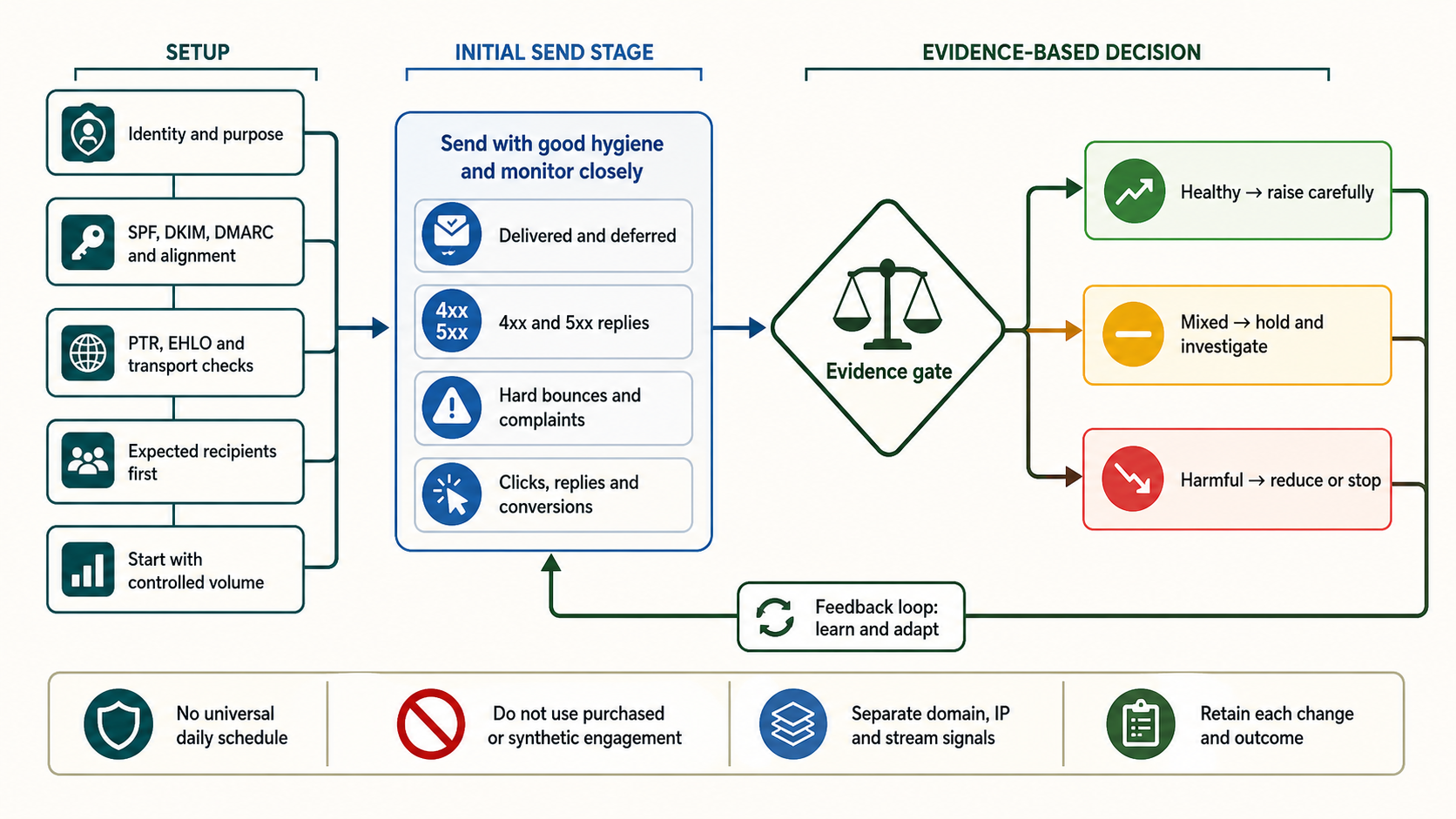
Start with recent first-party permission and stable expected cadence. Compare SMTP acceptance, unknown-user responses, complaints, blocklist status and provider telemetry with clean historical baselines. Expand one cohort dimension at a time. A quiet period without a reported trap is not proof because observation may be delayed or unavailable.
| Gate | Evidence |
|---|---|
| Source corrected | Unsafe supplier removed or capture defect deployed |
| Suppression durable | All routes reject complaint, bounce and unsubscribe states |
| Clean cohort stable | Provider and recipient signals remain expected |
| No route evasion | Problem cohort was not moved elsewhere |
| Recurrence monitored | Source alerts and named owner remain active |
Retain the incident as a test case for the next CRM, ESP or warehouse migration.
Prevent reintroduction with a durable eligibility state machine
captured -> pending_confirmation -> marketable
marketable -> inactive_review -> sunset_suppressed
marketable -> complaint_suppressed
marketable -> hard_bounce_suppressed
any_suppressed_state -X-> active_by_import

only a new valid permission event may create a reviewed transition
An import should never set active=true without comparing the existing stronger state. Store status reason, scope, effective time, source system and policy version. Complaint and hard-bounce suppressions may have different operational meanings, but both must survive platform migration. Hashing or changing case does not create a new recipient.
Test the state machine with records that unsubscribe in one ESP, complain through a feedback loop, hard bounce, become inactive and later appear in a CRM import. The expected result must be deterministic. Keep service-message eligibility separate from marketing permission so a necessary receipt does not silently reactivate promotions.
Source monitoring should track first-send bounces, confirmation completion, complaint rate, unknown provenance, suppression overwrite attempts and long-inactive eligibility. These metrics expose a weakening process before a protected trap signal appears.
Audit every path that can create or reactivate a marketable address
| Path | Failure test | Required evidence |
|---|---|---|
| Signup form | Typo, bot submission, duplicate and notice mismatch | Notice version, time, source and confirmation |
| Checkout/account | Service address silently enrolled in promotions | Separate marketing choice and scope |
| Partner/API | Missing original provenance or suppression overwrite | Contracted fields, batch and rejection log |
| Offline/event | Transcription error and unclear expectation | Collector, event, notice and confirmation state |
| Warehouse/CRM sync | Old status wins over newer suppression | Event time, precedence and transformation version |
Trace a sample record end to end from capture to campaign eligibility. A policy document is not enough if implementation drops the source or overwrites state. Test failure behavior: when confirmation delivery bounces, when a partner omits consent fields, when an unsubscribe arrives during an import, and when the same address exists under several customer IDs.
Do not use role-account rejection as a universal trap control. Some role addresses are legitimate and expected in business workflows. Base eligibility on the program and permission evidence, while applying additional review where the address type creates operational risk.
The output of the audit is a map of accountable ingestion routes, precedence rules, evidence gaps and controls. Close or quarantine any route that cannot demonstrate how a recipient became eligible.
Worked incident: a dormant cohort returns through a CRM migration
A CRM migration maps every contact with a nonempty email address to marketable, overwriting inactivity and unsubscribe states from the former ESP. Two days later, provider telemetry and a blocklist report indicate trap risk on one promotional IP. The campaign itself was ordinary; the eligibility population changed.
Operators stop the migrated cohort, preserve both databases and compare source state, acquisition age, last human action and suppression reason. Recent confirmed subscribers continue only after confirming they were not affected by the transformation. The migration rule is corrected so stronger suppression wins, historical reasons are retained and reactivation requires a new valid permission event.
Recovery uses current first-party cohorts, controlled volume and several independent signals. The team does not buy a trap-cleaning list, send confirmation mail to the dormant records or move them to another IP. A regression test containing unsubscribed, complained, bounced and long-inactive records is added to every future migration release.
Make prevention observable
Assign owners to every acquisition path, suppression store and eligibility transformation. Alert when provenance disappears, old cohorts become eligible, first-send bounces rise or an import attempts to overwrite a stronger state. Review the alert with actual records and release versions so the control detects process regression before a protected signal exposes it.
Primary references
- Spamhaus: spam traps, fix the problem not the symptom
- M3AAWG Sender Best Common Practices
- Google email sender guidelines