Bulk Sender Requirements for Gmail, Yahoo and Outlook
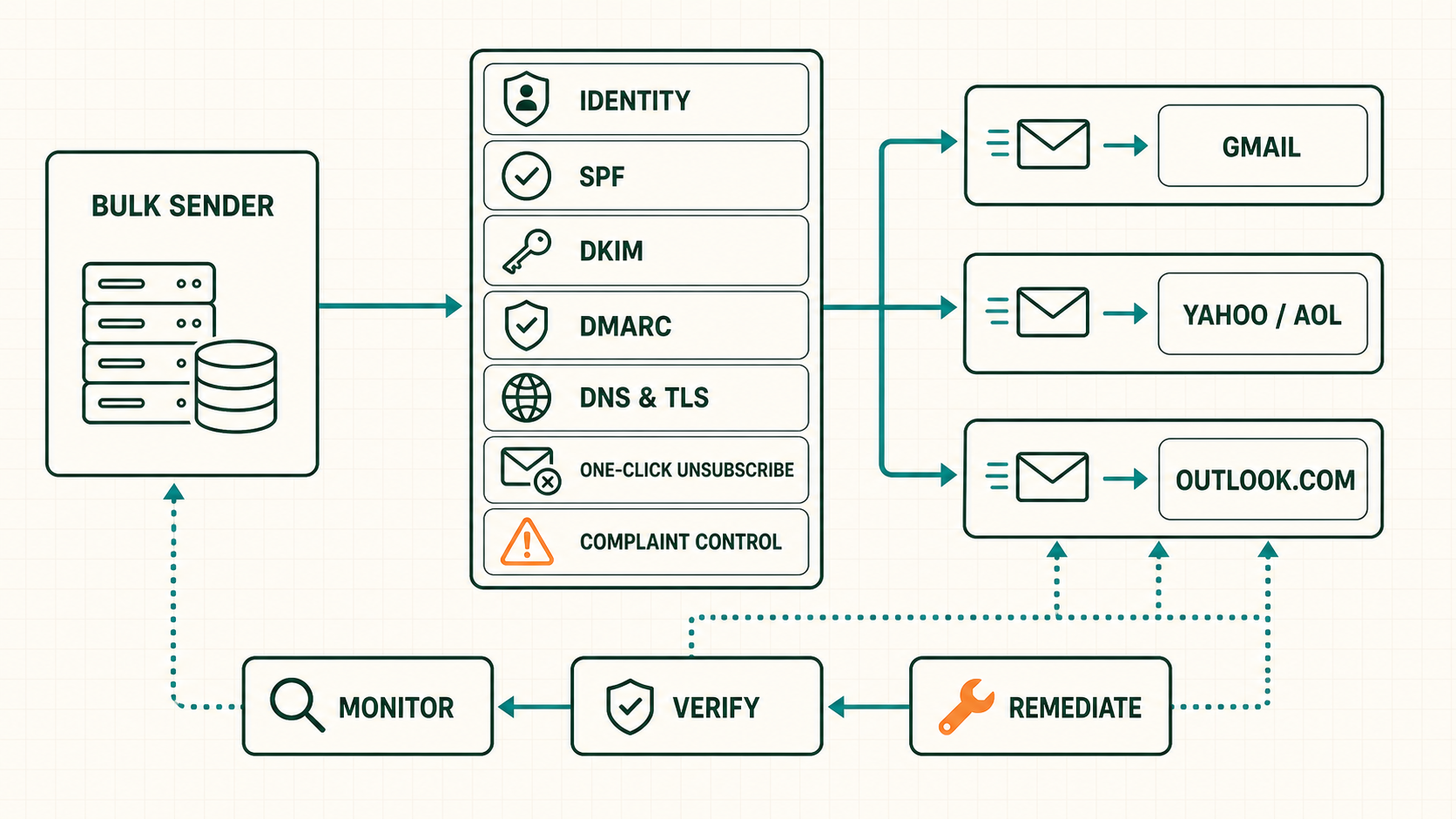
Bulk-sender compliance is not a one-time DNS project. It is a production control system covering identity, transport, permission, unsubscribe, complaints, traffic shape and evidence. Gmail, Yahoo/AOL and Outlook.com publish different scopes and enforcement language, but a sender should operate one strong baseline and then test each provider-specific requirement against the domains, IPs and streams used in production.
Know which traffic and recipients are in scope
Google treats senders near or above 5,000 messages in a day to personal Gmail accounts from the same primary domain as bulk senders, and the classification is effectively durable. Microsoft applies its high-volume rules to senders exceeding 5,000 messages per day to Outlook.com consumer services. Yahoo describes bulk senders through Sender Hub and applies requirements across Yahoo-hosted consumer mail, including AOL.
Measure by receiving organization, not only the visible recipient domain, because several domains can share an MX platform. Keep daily counts by receiver, RFC 5322 From domain, DKIM domain, return-path domain, sending IP and stream. This inventory establishes which controls apply and who owns them.
Build one enforceable sender baseline
| Control | Production standard | Evidence |
|---|---|---|
| SPF | Authorize every envelope-sender route without lookup overflow | DNS result and received header |
| DKIM | Sign with an aligned domain and protected keys | Verification and selector inventory |
| DMARC | Publish a valid policy and achieve alignment | Aggregate reports and samples |
| Transport | Forward/reverse DNS, TLS and valid MIME | DNS, TLS and SMTP probes |
| Permission | Send wanted mail to a consented audience | Consent and suppression trail |
Verify authentication on the received artifact
Publishing records is not proof of alignment. SPF evaluates the envelope identity, DKIM authenticates a signing domain, and DMARC requires a passing SPF or DKIM domain aligned with the visible From domain. Forwarding can break SPF, making stable aligned DKIM important. Test after the ESP, CRM, gateway, link rewriter and footer service have modified the message.
From: [email protected]
Return-Path: [email protected]
DKIM-Signature: ... d=example.com; s=mail2026;

Authentication-Results: mx.receiver.example;
 spf=pass smtp.mailfrom=bounces.example.com;
 dkim=pass header.d=example.com;
 dmarc=pass header.from=example.com
A vendor-domain signature may pass DKIM yet fail DMARC alignment. Record every selector, key age, service and rotation owner.
Implement RFC 8058 one-click unsubscribe
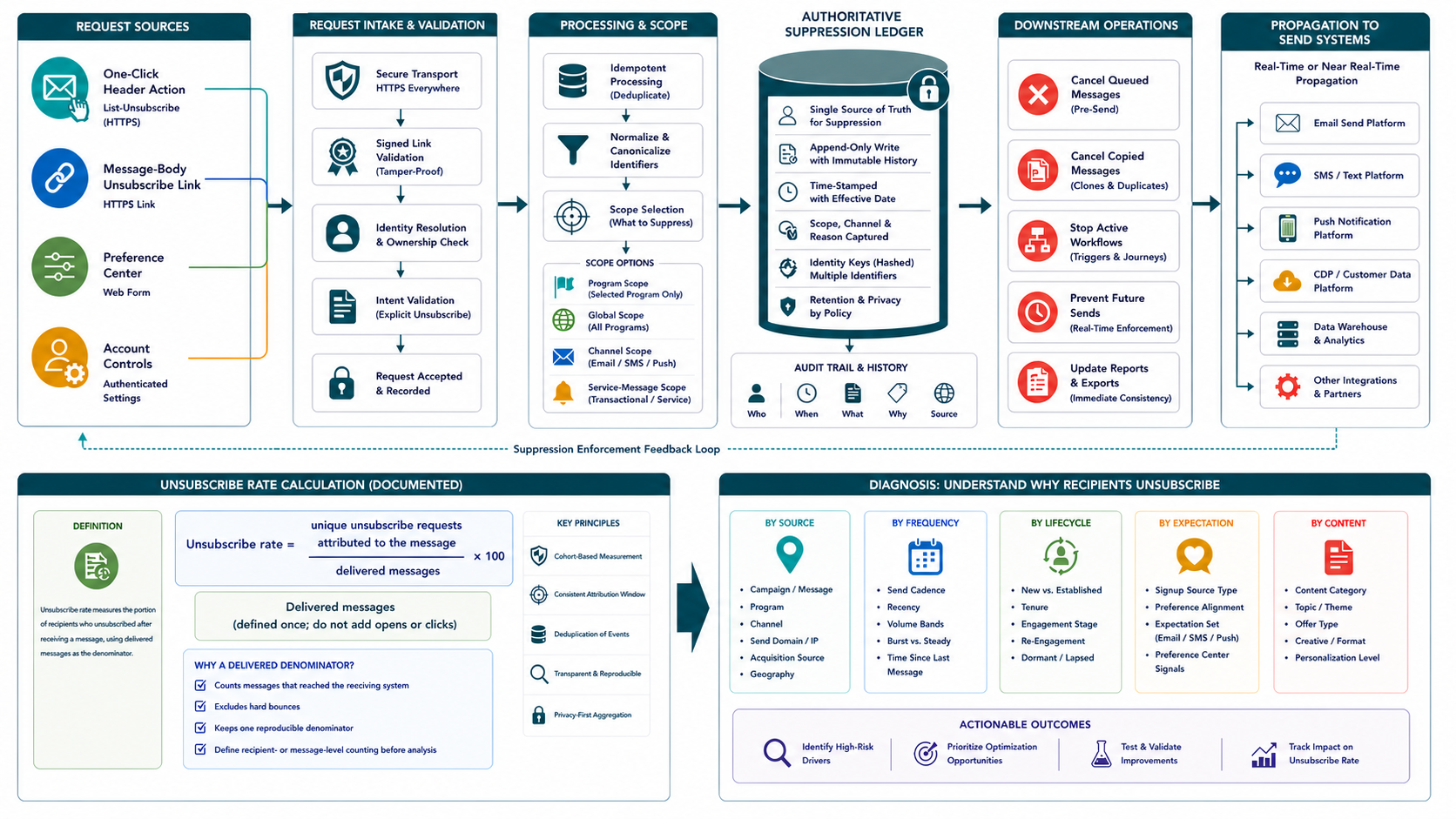
Applicable marketing and subscribed mail needs a visible unsubscribe link. Gmail and Yahoo also require standards-based one-click for bulk messages in scope. Use both headers:
List-Unsubscribe: <https://unsubscribe.example.com/u/opaque-token>
List-Unsubscribe-Post: List-Unsubscribe=One-Click
The HTTPS endpoint must accept the POST without login or confirmation. Use an opaque, unguessable token rather than exposing an address. Propagate suppression promptly to every sending platform within scope. A mailto link alone is not RFC 8058 one-click, and the body link remains necessary for people.
Separate universal and provider-specific controls
| Provider | Scope | Operational focus |
|---|---|---|
| Gmail | Personal Gmail recipients; primary-domain bulk classification | SPF, DKIM, DMARC, PTR, TLS, one-click and low spam |
| Yahoo/AOL | Yahoo consumer ecosystem | Authentication, easy unsubscribe, complaints and wanted traffic |
| Outlook.com | Consumer Outlook, Hotmail and Live above stated volume | SPF, DKIM, DMARC pass/alignment; failures can receive 550 5.7.515 |
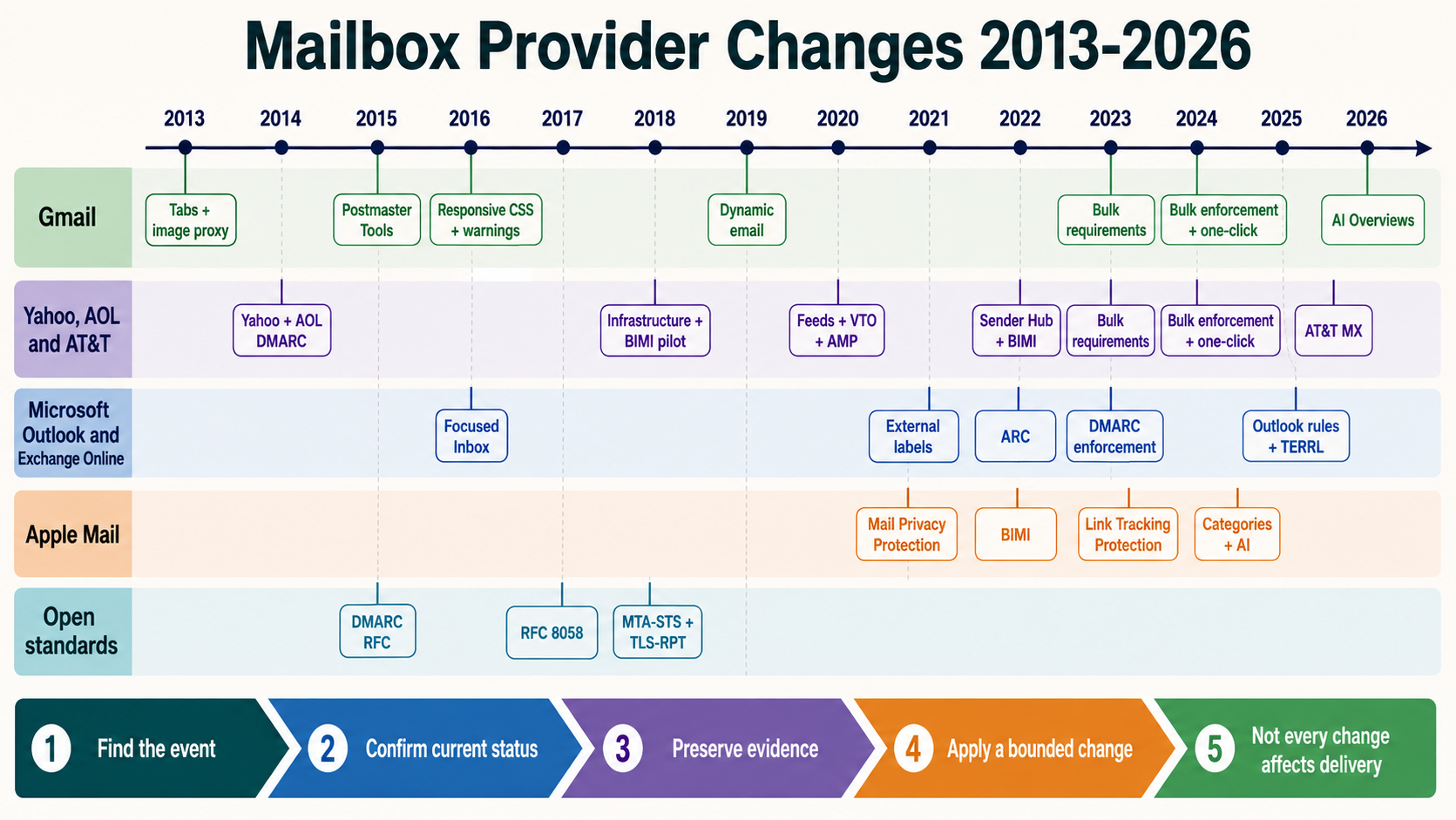
Store each official policy URL, review date, owner and validation test. Provider requirements change; a copied checklist without ownership becomes stale.
Operate below complaint enforcement boundaries
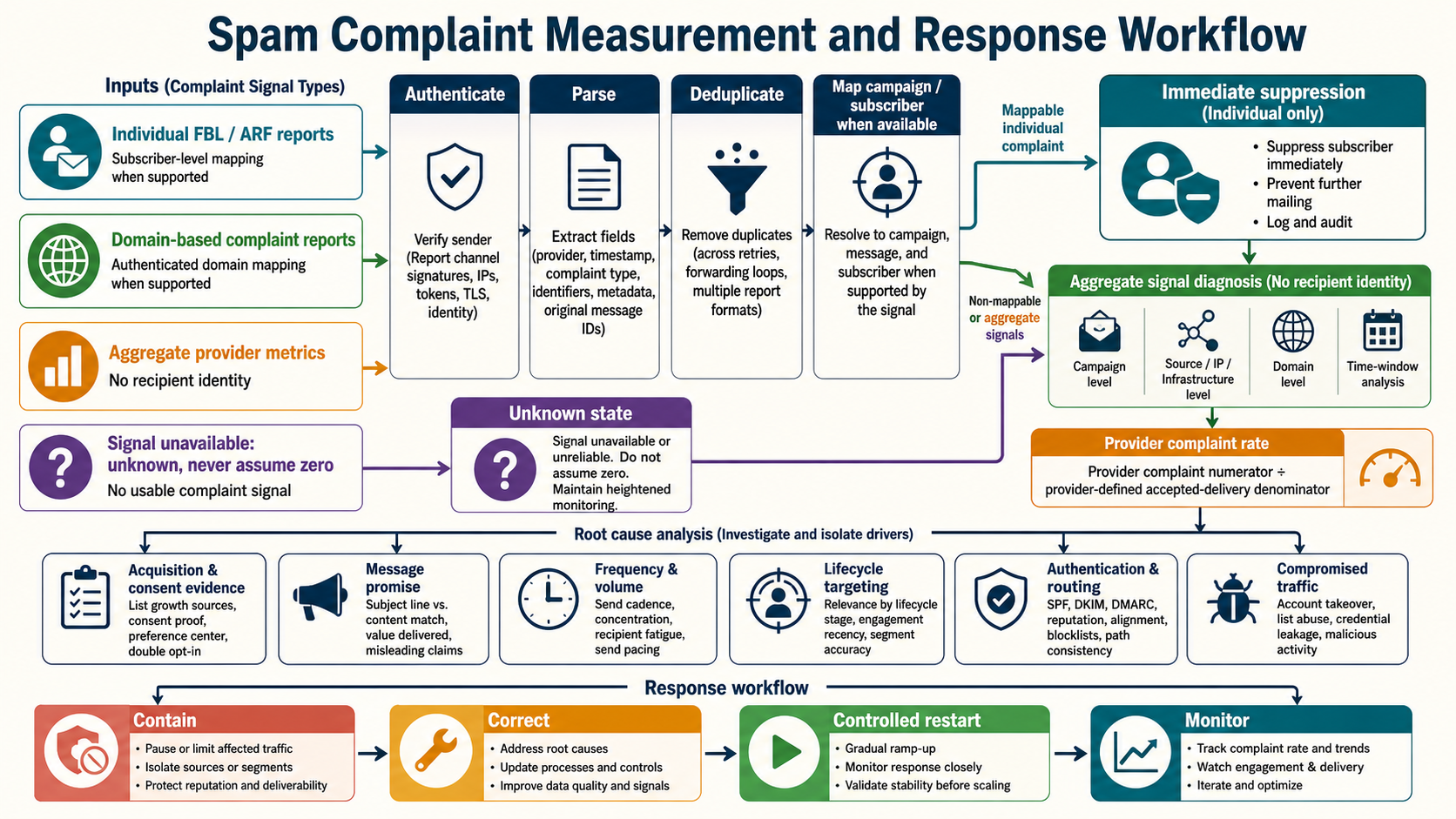
Google recommends user-reported spam below 0.1% and avoiding 0.3% or higher. Treat those figures as an outer warning boundary, not a target. Provider dashboards can use different denominators and delays, so an ESP complaint percentage may not match Postmaster Tools.
Segment by provider, acquisition source, form version, campaign and inactivity. Stop the implicated cohort before reducing all volume blindly. Register Yahoo complaint feedback and Microsoft JMRP where eligible, suppress complaints immediately and investigate how the address entered the audience.
Create a provider evidence dashboard
- Google: spam, domain/IP reputation, authentication, encryption and delivery errors.
- Yahoo: complaint feedback, SMTP replies and support cases.
- Microsoft: SNDS, JMRP and complete Outlook SMTP replies.
- Internal: selected, attempted, accepted, deferred, rejected, complained, unsubscribed and converted.
Retain numerator, denominator, timezone and reporting delay. Alert by receiving organization and stream; a blended total can hide a serious provider problem.
Run a release gate after every route change
- Resolve SPF, DKIM, DMARC, MX, A/AAAA and PTR independently.
- Send through the exact production route to controlled provider accounts.
- Inspect raw headers for pass and alignment.
- POST one-click with a test token and verify suppression propagation.
- Verify the visible unsubscribe and transactional separation.
- Ramp by provider while watching queues, replies and complaints.
Repeat after changing ESP, CDN, DKIM selector, return path, link domain, IP or CRM integration.
Handle an enforcement incident with evidence
Freeze risky audience and volume changes, preserve a failing raw message and collect complete SMTP replies. Determine whether the boundary is authentication, policy, rate, reputation or recipient validity. Repair that cause, then resume with a controlled cohort and stable traffic instead of repeatedly retrying rejected recipients.
Record receiver, first-seen time, affected identity, response samples, queue age, recent changes, mitigation and recovery criteria. Contact support after the evidence is coherent; support cannot repair misaligned DKIM or unwanted acquisition.
Bulk sender production checklist
- Inventory every From, DKIM, return-path and link domain.
- Count traffic by receiver and primary sending domain.
- Pass SPF/DKIM and verify DMARC alignment in received mail.
- Maintain PTR, forward DNS, TLS and valid messages.
- Implement RFC 8058 one-click plus visible unsubscribe.
- Propagate complaints and unsubscribes to durable suppression.
- Remain well below complaint warning thresholds.
- Review dashboards, queues and full SMTP replies daily.
- Re-run tests after every identity or route change.
Maintain a current provider scope and enforcement register
| Provider ecosystem | Counting/identity boundary | Operations evidence |
|---|---|---|
| Gmail consumer | Bulk classification is associated with traffic from the same primary domain to personal Gmail accounts | Postmaster Tools, received authentication and Gmail SMTP replies |
| Yahoo and AOL consumer | Sender Hub requirements and complaint feedback apply across Yahoo-hosted consumer mail | CFL reports, Sender Hub guidance and complete replies |
| Outlook.com consumer | High-volume requirements apply to the Outlook.com consumer ecosystem under Microsoft’s published scope | SNDS, JMRP, received authentication and Microsoft replies |
Do not reduce these policies to one permanent threshold table. Providers can change scope, enforcement and documentation. Store the official URL, date reviewed, affected domain/stream inventory, owner and a production validation test. Count recipient traffic by receiving organization and identity, not only by the visible address suffix.
Operate the strongest practical baseline across all commercial streams. Provider-specific differences remain important for troubleshooting, but weaker treatment for a network that has not announced the same rule creates future migration and reputation risk.
Map every identity before testing compliance
visible From:        [email protected]
envelope/return:     [email protected]
DKIM signing:        d=example.com; s=marketing2026
tracking links:      click.example.com
outbound host/IP:    mta1.example.net / 192.0.2.25
feedback identifiers: campaign, tenant, message, recipient token
Build this map for each ESP account, MTA route, brand and message stream. SPF authenticates the envelope domain, DKIM authenticates its d= domain, and DMARC requires a passing aligned identity with the visible From domain. A vendor signature can pass DKIM without aligning. PTR and HELO belong to the connecting infrastructure and must be stable and valid.
Inventory selectors, key length/algorithm, DNS owner, rotation date and old-key overlap. Test after link rewriting, footer insertion, MIME generation and gateways because the received artifact is what providers evaluate. Preserve raw messages at Gmail, Yahoo and Outlook test accounts.
Use DMARC reports to find unauthorized and misaligned routes
Publish one valid DMARC record at the correct organizational or subdomain boundary and collect aggregate reports under current RFC behavior. Normalize source IP, disposition, SPF/DKIM results and identifier alignment. Reconcile authorized sources to the sending inventory. A high pass percentage can hide a low-volume forgotten CRM or malicious source, so retain source-level rows.
| Finding | Investigation | Action |
|---|---|---|
| DKIM passes but is unaligned | Vendor d= domain | Configure customer-aligned signing |
| SPF fails after forwarding | Final-hop envelope identity | Rely on robust aligned DKIM; do not over-authorize SPF |
| Unknown IP passes SPF | Broad include or shared vendor | Narrow authorization and identify tenant control |
| Both aligned mechanisms fail | Received artifact and DNS at send time | Stop affected route until corrected |
Policy enforcement protects the domain only when legitimate sources are correctly aligned and reports are reviewed. Do not claim that p=none alone satisfies every provider or that moving directly to rejection fixes a broken legitimate path.
Test RFC 8058 one-click as a production API
curl -i -X POST \
  -H "Content-Type: application/x-www-form-urlencoded" \
  --data "List-Unsubscribe=One-Click" \
  "https://unsubscribe.example.com/u/opaque-test-token"
Use an authorized test token. The endpoint must accept the POST without login, cookie, redirect through an interactive preference center or confirmation page. The token should be opaque, scoped, expiring where appropriate and resistant to guessing. Do not place the clear recipient address in the URL. Apply rate limits and log outcome without exposing the token.
Verify that suppression reaches every marketing platform and cancels queued journeys. Test idempotent repeated POST, expired token, malformed token and an unsubscribe arriving between selection and dispatch. Keep a visible body unsubscribe suitable for people; one-click headers do not replace it.
| Test | Expected result |
|---|---|
| Valid POST | Successful response and durable scoped suppression |
| Repeated POST | Safe idempotent success |
| GET by scanner | No unintended unsubscribe merely from link prefetch |
| Queued campaign | Recipient removed before send |
Operate complaint prevention below published warning boundaries
A provider threshold is an enforcement boundary, not a target. Build internal warning levels well below it and require enough volume for interpretation. Use the provider’s own metric for provider decisions, while retaining internal accepted/delivered denominators. Gmail Postmaster spam rate, Yahoo feedback complaints, Microsoft JMRP and an ESP dashboard are not interchangeable.
Map every complaint to message, stream, acquisition source, consent age, frequency and template. Suppress promptly across the appropriate marketing scope. Then correct expectation, targeting or capture. A recipient-level suppression is necessary but not sufficient when a whole partner source produces complaints.
Alert on provider-hour and cohort rates as well as daily domain totals. A brief campaign burst can be severe yet disappear in a blended monthly number. Treat missing provider data as unknown, and monitor ingestion health so a broken feedback mailbox does not look like zero complaints.
Control volume and connections from live receiver feedback
Build provider-specific queues with recipients attempted, accepted, deferred, rejected, retry count, oldest age, connection reuse and concurrency. Maintain stable wanted volume where practical. Sudden domain/IP/volume/content changes create ambiguous evidence and can trigger dynamic controls even when a static checklist passes.
if temporary_policy_deferral_rate rises:
    reduce concurrency for affected receiver
    lengthen retry with jitter
    preserve full replies
    inspect complaint, cohort and identity changes
else if permanent authentication rejection:
    hold affected route
    correct authentication before new attempts
Do not publish a universal concurrent-connection or messages-per-connection number for providers that do not currently guarantee one. Use documented current limits when available and observed SMTP feedback. Reusing connections responsibly reduces overhead, but recipient and message limits can be dynamic.
Separate critical transactional mail from promotions using identities, routes and policies that match purpose and blast radius. Separation does not exempt either stream from authentication or security.
Diagnose provider enforcement at the first failing boundary
- Preserve the complete SMTP response, receiving MX, UTC time, outbound IP, queue ID and recipient domain.
- Inspect a received or rejected production artifact for SPF, DKIM and DMARC alignment.
- Check current DNS through authoritative and public resolvers.
- Compare provider-specific volume, complaints, deferrals and recent identity/route releases.
- Pause the smallest causal route, credential, campaign or cohort.
- Correct one root cause and verify with controlled accounts.
- Resume gradually under provider-specific queue monitoring.
Microsoft may return published policy codes such as 550 5.7.515 for high-volume requirement failures, but always preserve and interpret the full live response. Gmail and Yahoo also provide current error guidance. A code copied from an older list can be incomplete.
Contact support with coherent evidence after sender-side defects and harmful traffic are contained. Include representative responses and identities, not recipient lists or secrets.
Make compliance a repeatable release gate
Run automated DNS checks, send controlled production-route messages to provider accounts, parse received authentication, validate MIME, exercise one-click and reconcile suppression. Check complaint/feed ingestion, queue segmentation, PTR/HELO/TLS and provider dashboards. Store artifact hashes, DNS answers, selector and route version with the release.
Repeat after an ESP migration, new From domain, DKIM rotation, return-path change, link-domain change, MTA/IP allocation, CRM integration or unsubscribe service release. Define stop conditions before deployment. Authentication variance, one-click failure, unexpected deferrals or suppression mismatch should block expansion.
Assign owners by control: DNS/identity, MTA/routing, audience/consent, unsubscribe, feedback ingestion and provider incident response. Quarterly policy review is not enough by itself; current official requirements must also be checked before material sender changes.
Treat permission and list quality as compliance controls
Authentication proves identity; it does not prove recipients asked for the message. Keep capture source, notice version, timestamp, program scope, confirmation state and suppression history. Quarantine imports that cannot supply provenance. Separate service mail from marketing choice and never use a purchase, account creation or an address supplied for support as automatic permission for unrelated promotions.
Process hard bounces, complaints and unsubscribes across every sending route. Apply an inactivity policy based on meaningful relationship evidence rather than privacy-distorted opens. Do not buy, scrape or append addresses. Provider requirements explicitly reinforce wanted mail because authentication combined with unwanted volume still harms recipients and reputation.
| Risk | Preventive evidence |
|---|---|
| Partner acquisition | Original notice, scope and source-level outcomes |
| Old records | Last relationship event and sunset state |
| Form abuse/typos | Capture controls and confirmation where appropriate |
| Migration | Suppression precedence and reconciliation tests |
Test authentication failures before production finds them
Create controlled fixtures for an unauthorized source IP, missing DKIM signature, changed signed body, unavailable selector, aligned and unaligned passing domains, malformed DMARC record and duplicate From header. The release pipeline should identify the expected failure and prevent the affected route from scaling.
fixture: vendor_dkim_pass_unaligned
From: brand.example
DKIM d=: vendor.example
SPF mailfrom: vendor.example
expected: DKIM pass; SPF may pass; DMARC fail for brand.example
Query DNS at authoritative servers and public resolvers, then inspect the final received Authentication-Results. Cache timing matters during selector or SPF releases, so publish keys before use and keep former selectors available through message and queue delay. Do not add broad SPF includes merely to make a fixture pass; authorize only real envelope senders and stay within evaluation limits.
Keep a provider-ready evidence package
For every sending stream, retain owner, purpose, receiver volume, From/DKIM/return-path identities, IP/PTR/HELO, authentication samples, one-click test, visible unsubscribe, complaint sources, suppression reconciliation and last provider-policy review. Link the evidence to the exact deployment version. A spreadsheet updated manually after incidents is not enough.
Run a monthly operational review and a pre-release review for material changes. The monthly review focuses on provider drift, complaints, queue behavior, unauthorized sources and stale ownership. The release review proves the new artifact. Record exceptions with expiry; no exception may override unsubscribe or complaint suppression.
When requirements change, assess affected streams and publish a migration plan with dates and validation. Avoid claiming permanent compliance. The defensible statement is that the named production identities passed the current tests on the recorded date and remain under monitoring.
Worked incident: aligned DKIM disappears on one production route
Outlook begins rejecting a high-volume promotional stream with a policy response while Gmail Postmaster shows a simultaneous authentication decline. DNS appears correct and test messages from the ESP user interface pass. Queue evidence shows failures only for campaigns submitted through a CRM integration.
Operators preserve one failed artifact and find that the CRM route passes through a footer gateway after DKIM signing. The gateway rewrites MIME encoding, invalidating the aligned signature. SPF passes for the ESP return path but its domain is not aligned with the visible From, so DMARC fails. The UI test bypassed the gateway and was not representative.
The team holds the affected route, changes signing to occur after the final mutation, publishes and verifies the selector, and tests the exact CRM path at Gmail, Yahoo and Outlook accounts. It does not move the campaign to another IP. A bounded current-permission cohort resumes first while Microsoft replies and provider authentication evidence are monitored.
The permanent control records path-specific fixtures and blocks deployment when a final received artifact loses aligned authentication. This incident demonstrates why DNS screenshots and a single ESP test cannot prove bulk-sender compliance.
Keep compliance evidence current
Repeat route-level authentication, unsubscribe and suppression tests on a fixed schedule as well as after releases. Alert when an expected selector, feedback feed, provider dashboard or test account becomes unavailable. Missing evidence is unknown, not compliant.
Primary references
- Google email sender guidelines
- Yahoo Sender Hub best practices
- Microsoft high-volume sender requirements
- RFC 8058