Mailbox Provider Changes Timeline: Gmail, Yahoo, Outlook and Apple Mail
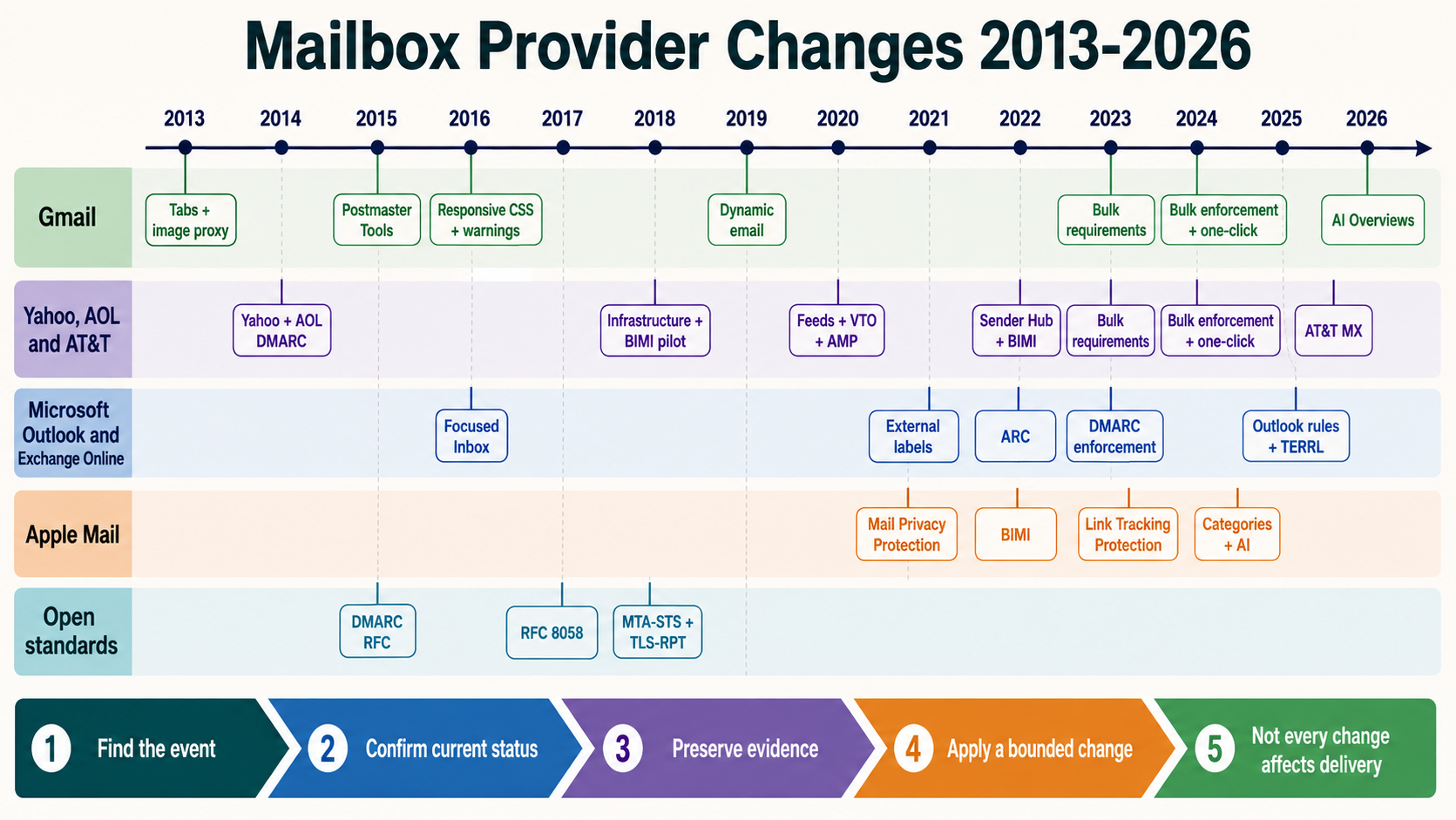
Mailbox-provider changes rarely affect only one number on a dashboard. A new authentication rule can change SMTP acceptance. A category or summary can change visibility after delivery. A privacy control can change measurement without changing placement. An infrastructure migration can move the gateway while the recipient address remains the same. This timeline connects 65 verified Gmail, Yahoo, AOL, AT&T, Microsoft, Apple Mail and open-standard milestones from 2013 through 2026. Each entry opens a standalone technical guide covering the dated event, affected scope, deliverability consequences, marketer advantages and risks, operational actions, current status and primary evidence.
How to use this mailbox-provider timeline
Start with the date when an incident, design decision or measurement break occurred. Open the linked event guide, confirm its provider scope and compare the historical launch behavior with the current-status section. Do not apply a Gmail threshold to Yahoo, interpret a user-interface feature as an SMTP rule, or treat authentication as an inbox guarantee.
For a present incident, preserve the exact recipient domain, UTC timestamp, sending IP, RFC 5321 MailFrom, RFC 5322 From, DKIM domain and selector, provider response, final headers and campaign or stream identity. Then locate the first layer where the affected message differs from a known-good control.
Read every change at the correct system layer
| Layer | Examples in this history | What the evidence can prove | What it cannot prove alone |
|---|---|---|---|
| Transport and routing | MX consolidation, TLS policy, tenant recipient limits | Connection target, encryption state, acceptance, deferral or rejection | Inbox placement, reading or conversion |
| Authentication and identity | SPF, DKIM, DMARC, ARC and BIMI | Identity authorization, integrity, alignment and eligible brand evidence | Universal trust, allowlisting or guaranteed logo display |
| Filtering and categorization | Neural filtering, Focused Inbox, Primary and Promotions | Observed treatment in a defined provider account or aggregate provider signal | A permanent category or the outcome for every recipient |
| Mailbox presentation | Annotations, package cards, checkmarks, summaries and AI Inbox | Conditional recipient-side presentation on a supported surface | A traditional open or sender-controlled position |
| Feedback and measurement | Postmaster dashboards, CFLs, privacy protection and provider feeds | A defined provider or client signal with a named population and delay | A complete causal explanation without sender and business evidence |
| Consent and subscription control | RFC 8058, one-click enforcement and subscription hubs | A request path and, with sender evidence, effective suppression | Permission quality before the request or automatic suppression across disconnected systems |
Six operating principles that survive provider changes
- Segment by actual receiving estate. Preserve recipient suffix and resolved MX. Shared infrastructure does not make every audience identical.
- Keep identities stable and aligned. Repair authorization and configuration on the existing legitimate identity before considering a domain or IP change.
- Name every denominator. Accepted, inbox-delivered, all delivered, eligible, opened and clicked populations are not interchangeable.
- Separate compliance from placement. Passing a sender requirement removes a defect. It does not require the provider to place mail in the inbox.
- Use one authoritative consent state. Provider controls, body links, customer service and preference centers must converge before the next covered send.
- Retain a controlled comparison. Change one bounded variable, keep a known-good cohort and wait for the complete provider and business observation window.
2013 mailbox-provider changes
Modern mailbox presentation began moving away from a single chronological inbox while proxy-based image retrieval changed what an open pixel revealed. These two shifts established a pattern that continues throughout the timeline: delivery, presentation and measurement must be diagnosed separately.
| Provider event | Provider | Change area | Technical guide |
|---|---|---|---|
| May 29, 2013 | Gmail | Inbox organization | Gmail Inbox Tabs in 2013: How Primary and Promotions Changed Email Visibility |
| December 12, 2013 | Gmail | Measurement/privacy | Gmail Image Proxy in 2013: What Automatic Image Loading Changed for Marketers |
2014 mailbox-provider changes
Authentication policy, provider diagnostics, adaptive filtering, transport indicators and responsive rendering became more visible to senders and recipients. The practical requirement was to connect a stable identity with evidence from the provider actually receiving the mail.
| Provider event | Provider | Change area | Technical guide |
|---|---|---|---|
| Early April 2014 | Yahoo Mail ecosystem / Yahoo.com | Authentication/DMARC | Yahoo DMARC Reject Policy in 2014: The Impact on Third-Party Sending |
| April 22, 2014 | Yahoo Mail ecosystem / AOL | Authentication/DMARC | AOL DMARC Reject Policy in 2014: Mailing List and ESP Consequences |
2015 mailbox-provider changes
Authentication policy, provider diagnostics, adaptive filtering, transport indicators and responsive rendering became more visible to senders and recipients. The practical requirement was to connect a stable identity with evidence from the provider actually receiving the mail.
| Provider event | Provider | Change area | Technical guide |
|---|---|---|---|
| March 2015 | Industry/IETF | Authentication | DMARC Became RFC 7489 in 2015: What the Standard Changed for Senders |
| July 9, 2015 | Gmail | Sender tooling | Gmail Postmaster Tools Launched in 2015: New Evidence for High-Volume Senders |
| July 9, 2015 | Gmail | Spam filtering | Gmail Neural-Network Spam Filtering in 2015: Personalized Classification Arrives |
2016 mailbox-provider changes
Authentication policy, provider diagnostics, adaptive filtering, transport indicators and responsive rendering became more visible to senders and recipients. The practical requirement was to connect a stable identity with evidence from the provider actually receiving the mail.
| Provider event | Provider | Change area | Technical guide |
|---|---|---|---|
| February 9, 2016 | Gmail | Authentication UX | Gmail TLS and Authentication Warning Icons in 2016: Trust Became Visible |
| March 28, 2016 | Yahoo Mail ecosystem | Authentication/DMARC | Yahoo Expanded DMARC Reject Policies in 2016: International Domain Impact |
| September 21, 2016 | Gmail | Rendering | Gmail Responsive CSS Support in 2016: What Changed for Email Rendering |
| October 14, 2016 | Outlook.com / Microsoft 365 | Inbox organization | Outlook Focused and Other Inbox in 2016: A New Visibility Layer |
2017 mailbox-provider changes
Open standards and converging provider infrastructure enabled safer one-click subscription controls, enforceable transport policy, interactive content, identity experiments and receiver-derived performance evidence. Each capability also added a new eligibility, security or data-quality boundary.
| Provider event | Provider | Change area | Technical guide |
|---|---|---|---|
| January 2017 | Industry/IETF | Unsubscribe | RFC 8058 One-Click Unsubscribe in 2017: The Standard Behind Modern Requirements |
2018 mailbox-provider changes
Open standards and converging provider infrastructure enabled safer one-click subscription controls, enforceable transport policy, interactive content, identity experiments and receiver-derived performance evidence. Each capability also added a new eligibility, security or data-quality boundary.
| Provider event | Provider | Change area | Technical guide |
|---|---|---|---|
| January 29, 2018 | Yahoo Mail ecosystem | Infrastructure | AOL and Yahoo MX Consolidation in 2018: The First Infrastructure Transition |
| February 8, 2018 | Yahoo Mail ecosystem | DMARC reporting/FBL | AOL Feedback and DMARC Reporting Moved to Yahoo in 2018 |
| March 20, 2018 | Yahoo Mail ecosystem | Measurement/privacy | Yahoo Mail Image Proxy in 2018: Measurement and Dynamic-Content Effects |
| March 27, 2018 | Yahoo Mail ecosystem | Brand identity | Yahoo BIMI Pilot in 2018: Early Provider-Controlled Brand Identity |
| April 25, 2018 | Gmail | Unsubscribe exposure | Gmail Unsubscribe Recommendations in 2018: Frequency and Engagement Pressure |
| December 2018 | Gmail | Promotions presentation | Gmail Promotions Annotations in 2018: Inbox-Level Offer Presentation |
| June 21, 2018 | Yahoo Mail ecosystem | Infrastructure/reputation | Yahoo and AOL Unified on OATH Mail Infrastructure in 2018 |
| September 2018 | Industry/IETF | Transport security | MTA-STS and TLS-RPT in 2018: Enforceable Transport Security and Reporting |
2019 mailbox-provider changes
Open standards and converging provider infrastructure enabled safer one-click subscription controls, enforceable transport policy, interactive content, identity experiments and receiver-derived performance evidence. Each capability also added a new eligibility, security or data-quality boundary.
| Provider event | Provider | Change area | Technical guide |
|---|---|---|---|
| February 19, 2019 | Yahoo Mail ecosystem | Unsubscribe | Yahoo and AOL Added One-Click Unsubscribe Support in 2019 |
| April 10, 2019 | Yahoo Mail ecosystem | Infrastructure | Yahoo Completed the AOL Mailbox Migration in 2019: One Delivery Ecosystem |
| July 2, 2019 | Gmail | Interactive email | Gmail Dynamic Email on the Web in 2019: AMP Actions Inside the Inbox |
| November 21, 2019 | Gmail | Interactive email | Gmail Dynamic Email Reached Mobile in 2019: Android and iOS Impact |
2020 mailbox-provider changes
Open standards and converging provider infrastructure enabled safer one-click subscription controls, enforceable transport policy, interactive content, identity experiments and receiver-derived performance evidence. Each capability also added a new eligibility, security or data-quality boundary.
| Provider event | Provider | Change area | Technical guide |
|---|---|---|---|
| February 18, 2020 | Yahoo Mail ecosystem | Sender analytics/privacy | Yahoo Deliverability and Performance Feeds in 2020: Provider-Derived Analytics |
| April 8, 2020 | Yahoo Mail ecosystem | Delivery timing | Yahoo View Time Optimization in 2020: Delivery Timing Moved Closer to Inbox Access |
| October 14, 2020 | Yahoo Mail ecosystem | Interactive email | Yahoo AMP for Email in 2020: Interactive Campaign Requirements and Risks |
2021 mailbox-provider changes
Privacy protection, external-origin labels, BIMI, structured commerce surfaces, mobile interactivity and centralized sender portals changed how recipients recognized and acted on messages. Sender-side open data became less suitable as the default measure of human attention.
| Provider event | Provider | Change area | Technical guide |
|---|---|---|---|
| April 2, 2021 | Microsoft 365 | Recipient trust | Microsoft 365 External Email Labels in 2021: New Recipient Trust Signals |
| June 7, 2021 | Apple Mail/iCloud | Measurement/privacy | Apple Announced Mail Privacy Protection in 2021: Open Measurement Changed |
| July 12, 2021 | Gmail | Brand identity | Gmail BIMI Support in 2021: DMARC-Enforced Brand Logos Arrive |
2022 mailbox-provider changes
Privacy protection, external-origin labels, BIMI, structured commerce surfaces, mobile interactivity and centralized sender portals changed how recipients recognized and acted on messages. Sender-side open data became less suitable as the default measure of human attention.
2023 mailbox-provider changes
Major providers converted authentication, complaint and unsubscribe practices into explicit bulk-sender requirements while mailbox clients expanded identity and AI-assisted presentation. Operators needed provider-specific compliance matrices and faster suppression evidence.
| Provider event | Provider | Change area | Technical guide |
|---|---|---|---|
| May 3, 2023 | Gmail | Brand identity | Gmail BIMI Verified Checkmarks in 2023: VMC-Based Brand Verification |
| May 16, 2023 | Gmail/Google Accounts | List hygiene | Google Inactive Account Deletion Policy in 2023: List-Hygiene Consequences |
| June 5, 2023 | Apple Mail | Attribution/privacy | Apple Link Tracking Protection in 2023: Attribution Parameters at Risk |
| July 19, 2023 | Outlook.com / Microsoft 365 | DMARC enforcement | Microsoft Strengthened DMARC Policy Handling in 2023 |
| October 3, 2023 | Gmail | Sender requirements | Gmail Announced Bulk Sender Requirements in 2023: The Compliance Baseline |
| October 3, 2023 | Yahoo Mail ecosystem | Sender requirements | Yahoo Announced Bulk Sender Requirements in 2023: All Hosted Domains Matter |
2024 mailbox-provider changes
Major providers converted authentication, complaint and unsubscribe practices into explicit bulk-sender requirements while mailbox clients expanded identity and AI-assisted presentation. Operators needed provider-specific compliance matrices and faster suppression evidence.
2025 mailbox-provider changes
Tenant-wide limits, direct authentication enforcement, gateway consolidation, centralized subscription management, relevance sorting, provider complaint denominators and generative inbox assistance made operational boundaries more explicit. Clear source facts and exact transport evidence matter more than attempts to manipulate interface behavior.
| Provider event | Provider | Change area | Technical guide |
|---|---|---|---|
| February 24, 2025 | Microsoft 365 | Outbound limits | Exchange Online External Recipient Limits in 2025: Bulk Sending Boundaries |
| April 2, 2025 | Outlook.com | Sender requirements | Outlook.com Announced Bulk Sender Requirements in 2025 |
| May 5, 2025 | Outlook.com | Enforcement | Outlook.com Bulk Sender Enforcement in 2025: Junk Placement Before Rejection |
| June 24, 2025 | Yahoo Mail ecosystem / AT&T | Mail routing | AT&T Consumer Mail Moved to Yahoo MX in 2025: Deliverability Ownership Changed |
| July 8, 2025 | Gmail | Subscription management | Gmail Manage Subscriptions in 2025: Frequency-Based Unsubscribe Visibility |
| September 11, 2025 | Gmail | Commerce UX | Gmail Purchases View in 2025: Transactional Email Outside the Standard Inbox |
| September 11, 2025 | Gmail | Promotions ranking | Gmail Most Relevant Promotions in 2025: Engagement-Based Promotional Ranking |
| October 27, 2025 | Yahoo Mail ecosystem | Sender analytics | Yahoo Sender Hub Insights in 2025: Provider Complaint and Delivery Trends |
2026 mailbox-provider changes
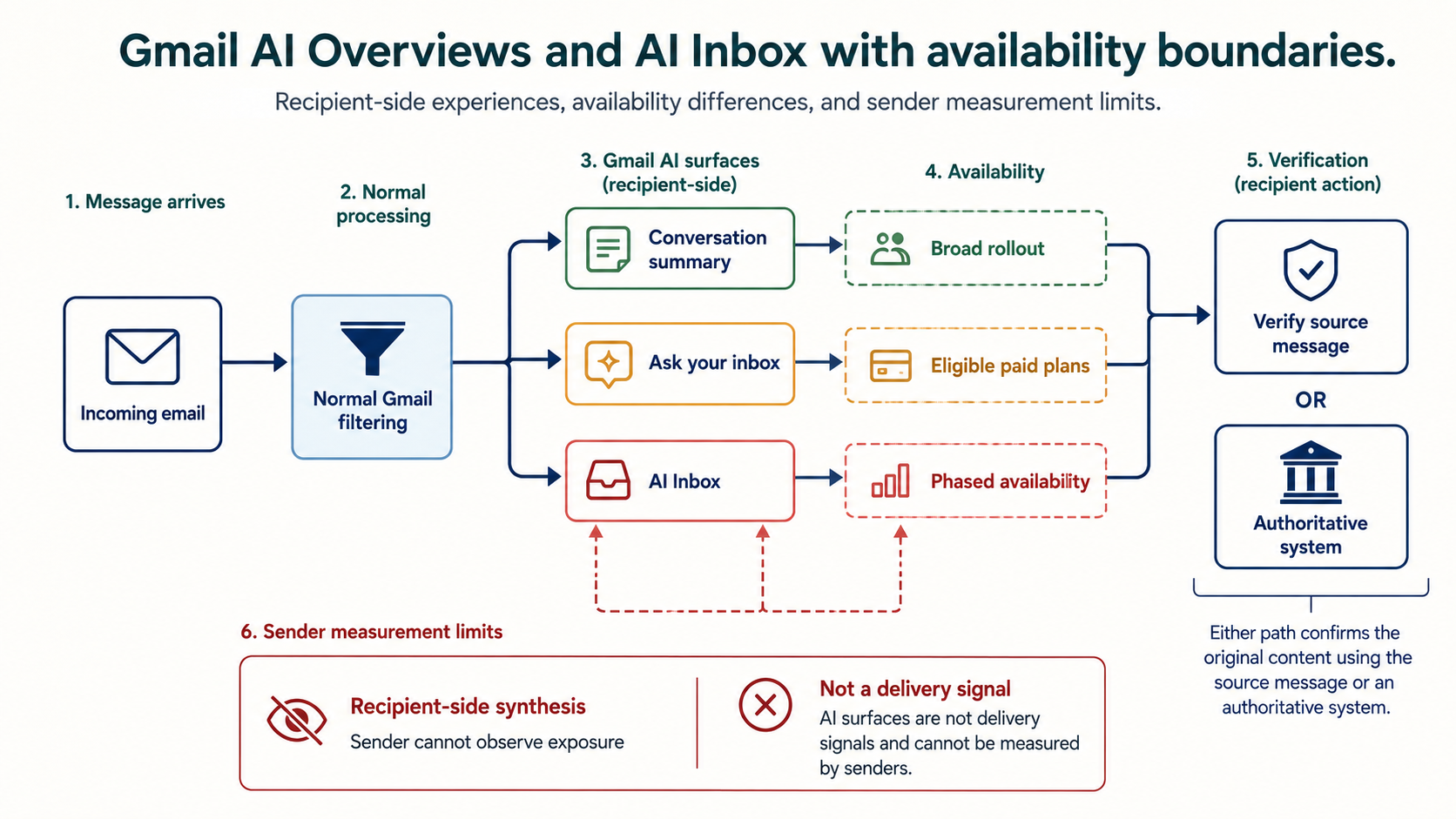
Tenant-wide limits, direct authentication enforcement, gateway consolidation, centralized subscription management, relevance sorting, provider complaint denominators and generative inbox assistance made operational boundaries more explicit. Clear source facts and exact transport evidence matter more than attempts to manipulate interface behavior.
| Provider event | Provider | Change area | Technical guide |
|---|---|---|---|
| January 8, 2026 | Gmail | AI visibility | Gmail AI Overviews and AI Inbox in 2026: Visibility Without a Traditional Open |
Follow one provider family through time
The chronological view is best for incident reconstruction. The provider tracks below are better for architecture reviews, quarterly policy checks and onboarding an operator who owns one receiving estate. A provider can revise launch behavior, expand scope, move a feature between clients or introduce a later enforcement phase, so the newest entry does not automatically replace every earlier operational lesson.
Gmail change track
Use this track for Gmail filtering, tabs, image handling, Postmaster evidence, responsive and dynamic content, BIMI, bulk requirements, subscription controls, commerce presentation, Promotions ordering and AI-assisted inbox surfaces. Personal Gmail accounts and managed Workspace accounts can have different feature or policy boundaries.
Yahoo, AOL and AT&T change track
Use this track for Yahoo-managed consumer domains, AOL consolidation, feedback-loop ownership, DMARC policy, image proxying, BIMI, AMP, subscription management, provider feeds, AT&T routing and Sender Hub Insights. Keep the visible recipient suffix even when the underlying infrastructure is shared.
Microsoft Outlook and Exchange Online change track
Use this track for Outlook.com consumer requirements and filtering, Microsoft 365 tenant controls, ARC, external labels, DMARC handling, High Volume Email and Exchange Online external-recipient limits. Outlook.com consumer delivery and an organization’s Exchange Online outbound service are different operating contexts.
Apple Mail change track
Use this track for client-side privacy, link handling, BIMI display, categories and Apple Intelligence. These entries mostly affect measurement or presentation after receipt and should not be misreported as Apple-operated SMTP acceptance rules for every mailbox account shown in Mail.
| Provider event | Provider | Change area | Technical guide |
|---|---|---|---|
| June 7, 2021 | Apple Mail/iCloud | Measurement/privacy | Apple Announced Mail Privacy Protection in 2021: Open Measurement Changed |
| September 2022 | Apple Mail/iCloud | Brand identity | Apple Mail Added BIMI in 2022: Verified Logos Across Apple Clients |
| June 5, 2023 | Apple Mail | Attribution/privacy | Apple Link Tracking Protection in 2023: Attribution Parameters at Risk |
| June 10, 2024 | Apple Mail | Inbox organization | Apple Mail Categories Announced in 2024: Primary, Transactions, Updates and Promotions |
| June 10, 2024 | Apple Mail | AI visibility | Apple Intelligence Mail Features in 2024: Priority Messages and AI Summaries |
Open standards change track
Use this track for standards that multiple providers can implement. Read the RFC requirement separately from any provider’s eligibility, user-interface and enforcement choices.
| Provider event | Provider | Change area | Technical guide |
|---|---|---|---|
| March 2015 | Industry/IETF | Authentication | DMARC Became RFC 7489 in 2015: What the Standard Changed for Senders |
| January 2017 | Industry/IETF | Unsubscribe | RFC 8058 One-Click Unsubscribe in 2017: The Standard Behind Modern Requirements |
| September 2018 | Industry/IETF | Transport security | MTA-STS and TLS-RPT in 2018: Enforceable Transport Security and Reporting |
Build an internal provider-change record
change_id: mbp-YYYY-NNN
provider_family: Gmail | Yahoo | Microsoft | Apple | Standard
event_date_utc: YYYY-MM-DD
affected_domains: [exact recipient suffixes]
affected_streams: [marketing, lifecycle, transactional, application]
identity_scope: [From domain, DKIM domain, envelope domain, IP pool]
system_layer: [transport, authentication, filtering, presentation, feedback]
source_url: https://official-provider.example/change
current_documentation_url: https://official-provider.example/current
measurement_break: yes | no | unknown
owner: named team and operator
required_action: tested bounded change
rollback_or_stop_condition: exact threshold
reviewed_at_utc: YYYY-MM-DDThh:mm:ssZ
Store the official launch source and the maintained current source separately. The launch source proves what was announced at the time. The maintained source governs present implementation. Record corrections and rollout changes without silently rewriting the historical event.
Provider-change incident workflow
Alert or business symptom
  -> isolate provider, recipient suffix, stream and time window
  -> preserve SMTP response, headers, DNS and sending identity
  -> identify first differing system layer
  -> check the relevant dated event and current provider documentation
  -> compare one affected message with one known-good control
  -> pause only the unsafe or failing cohort
  -> repair one bounded cause
  -> validate with controlled recipients and provider evidence
  -> restore volume in stages
  -> close only after the complete outcome window
A broad infrastructure change is not a diagnostic shortcut. Rotating IPs, From domains, DKIM identities, creative and cadence together destroys causal evidence and can spread a local defect into clean streams.
Treat measurement changes as versioned data contracts
Image proxies, privacy protection, provider dashboards, new complaint denominators, subscription views, summary cards and AI-assisted surfaces can change what a metric means without changing SMTP delivery. At every break, document the event definition, population, numerator, denominator, collection point, expected latency, privacy threshold and missing-data behavior.
Do not backfill incompatible definitions into one continuous chart. Mark the break, retain the earlier definition and add outcome signals such as qualified clicks, authenticated sessions, conversions, replies, support contacts, unsubscribe completion and complaints. Missing provider data is unknown until collection health and eligibility are confirmed.
Quarterly mailbox-provider review
- Recheck maintained Gmail, Yahoo Sender Hub, Microsoft Sender Support and Apple documentation.
- Inventory every active From domain, DKIM domain, selector, envelope domain, IP pool and sending vendor.
- Confirm DMARC aggregate coverage and investigate unauthorized or unexpectedly unaligned sources.
- Test RFC 8058 endpoints, durable consent writes, queued-send cancellation and post-request leakage.
- Verify postmaster and feedback-loop ownership, access, verified domains, report routing and collection heartbeats.
- Review provider-specific SMTP codes, retry behavior, concurrency, volume changes and suppressed-recipient handling.
- Separate transactional, lifecycle and promotional purpose while reconciling their combined contact pressure.
- Retest critical templates without images, enhanced schema, dynamic content or AI-assisted presentation.
- Expire temporary exceptions, obsolete DNS authorizations, unused selectors, credentials and support access.
- Record the evidence, owner, decision, stop threshold and next review date.
Verification and source policy
Every linked event guide uses a primary provider announcement, maintained provider documentation, an RFC or another first-party technical source. Where a launch date had only month precision, the guide says so. Where a provider revised rollout or enforcement, the current-status section records that revision. Publication dates are editorial dates within the event month and year; the event date shown inside each guide is the provider-history reference.
Provider policies continue to change. Use Gmail sender guidelines, Yahoo Sender Hub, Microsoft Sender Support, Apple Mail Support and the RFC Editor as current entry points. Preserve the exact page and access date used for a production decision.