Dedicated vs Shared IP for Email: Capacity and Reputation
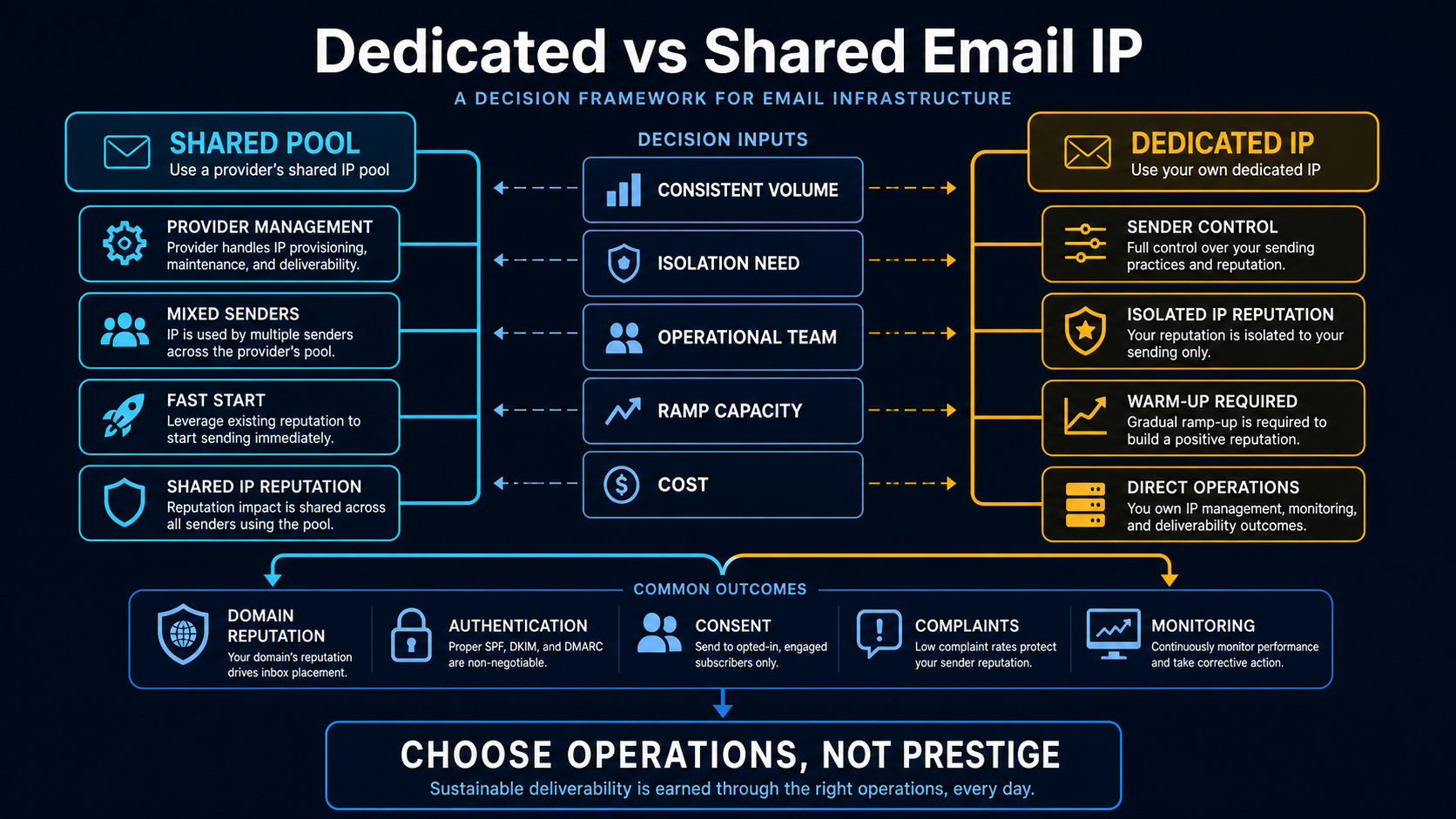
A dedicated IP is not an automatic upgrade, and a shared pool is not automatically low quality. The better model is the one your sending volume and operations team can sustain. Domain reputation, consent, complaints, authentication and audience response still matter in both models; changing the IP does not erase them.
What shared and dedicated email IP allocation means
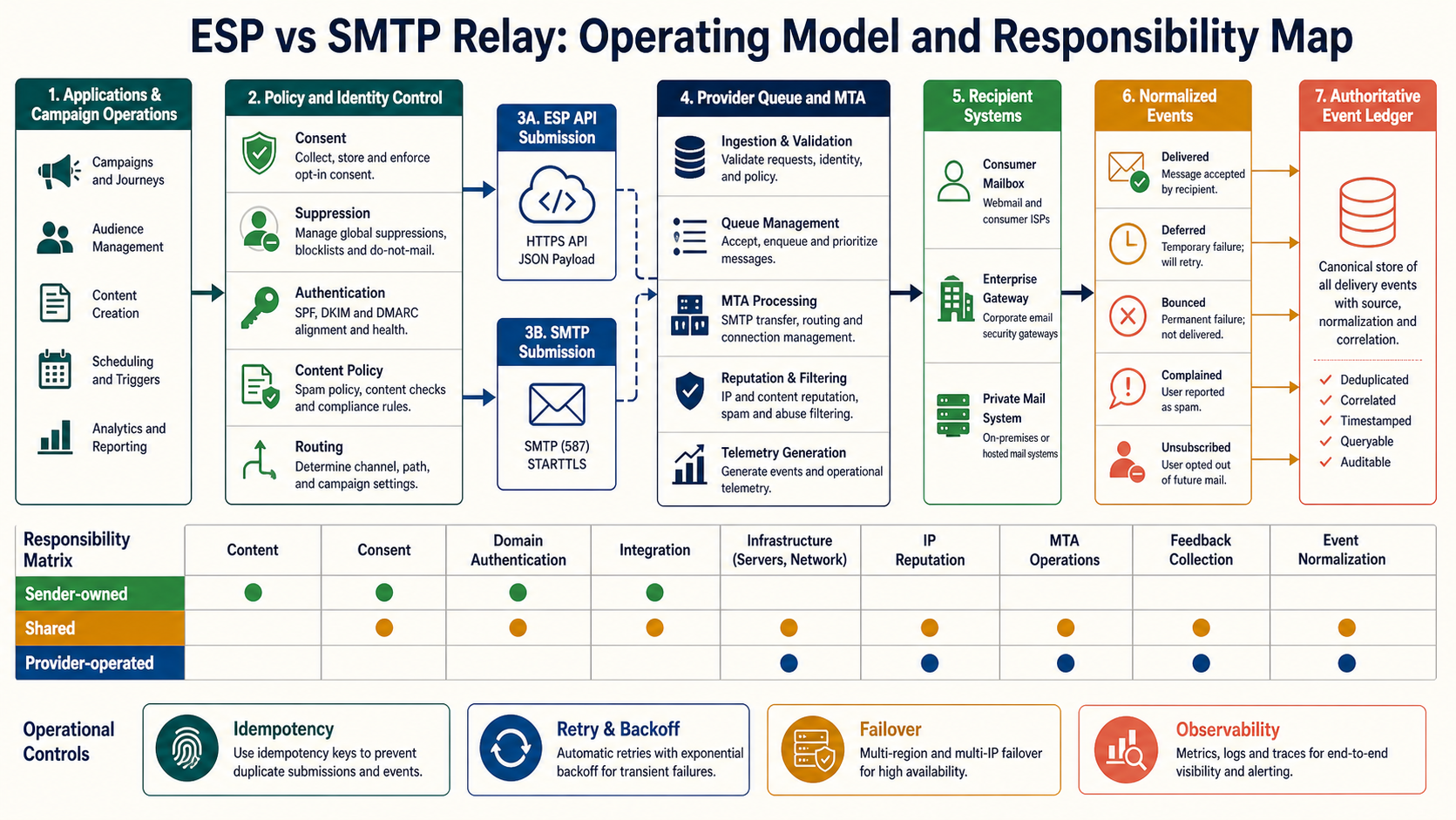
A shared IP pool carries traffic for multiple senders under provider controls. The provider manages routing, reputation distribution, capacity and much of the relationship with receiving networks. Good pools can give smaller or irregular senders stable infrastructure without requiring them to maintain enough continuous traffic for an independent IP history.
A dedicated IP carries one customer’s traffic or an intentionally isolated group controlled by that customer. It offers clearer IP-level accountability and stream isolation, but it also assigns the sender responsibility for ramp-up, traffic consistency, reverse DNS, monitoring, incident response and spare-capacity planning. “Dedicated” describes allocation, not quality.
Why an IP change rarely fixes a program problem
IP decisions often begin with a delivery problem that actually belongs to the domain, list or program. If complaints, unsafe acquisition or weak engagement caused the problem, moving to a dedicated IP reproduces it on a new address. Conversely, a sender with predictable high volume and distinct transactional risk may need isolation that a general shared pool cannot provide.
Mailbox providers combine several layers of evidence. Google explicitly notes that activity from senders on a shared IP can affect that IP’s reputation, while its quotas and reputation controls also include domain-level signals. Design streams around risk and recipient expectations, not merely organizational departments. Record the business reason for every allocation.
Choose an IP model from traffic and operating capacity
- Measure real traffic. Calculate daily and hourly recipients by mailbox provider, stream and season. Include quiet periods, peaks, retry traffic and expected growth.
- Classify message risk. Separate critical transactional mail, lifecycle messages and promotional programs where justified by consent, cadence and incident blast radius.
- Assess shared-pool governance. Ask how the provider vets customers, monitors abuse, isolates tenants, publishes authentication, handles blocklists and communicates incidents.
- Assess dedicated operations. Confirm reverse DNS, warm-up, adaptive throttling, complaint processing, provider telemetry, blocklist response, on-call ownership and backup design.
- Model ramp and continuity. A dedicated IP needs enough wanted traffic to establish and maintain a useful history. Plan gradual scaling and decide what happens during a long quiet period.
- Preserve identity continuity. Keep aligned DKIM and From domains, transparent subscriptions and stable streams. Do not change domain, IP, content and volume simultaneously.
- Pilot with a bounded stream. Move an engaged, well-understood cohort first. Compare SMTP replies, complaints, placement evidence and business outcomes with the prior path.
- Review the decision periodically. Volume, provider controls and program risk change. Retain the ability to consolidate, split or retire IPs without improvising during an incident.
Match the IP model to the sending condition
| Operating condition | Likely fit | Reason |
|---|---|---|
| Low or irregular wanted volume | Well-governed shared pool | Provider can maintain infrastructure history across customers |
| Consistent volume plus skilled operations | Dedicated IP may fit | Sender can own ramp, monitoring and incident response |
| Critical transactional stream needs blast-radius isolation | Separate governed stream or dedicated IP | Protects service mail from promotional incidents |
| Provider cannot explain pool governance | Neither accept blindly nor migrate blindly | Obtain evidence or select a provider with transparent controls |
| Current problems follow the domain across IPs | Program remediation | IP allocation is not the causal control |
Worked architecture: transactional and promotional streams
A retailer sends steady order mail every day but runs large promotional bursts only a few times per month. It initially asks for dedicated IPs for all traffic after one campaign receives deferrals. Investigation finds the deferrals coincide with a poorly targeted imported cohort and complaints, not shared-pool contamination.
The retailer fixes acquisition and suppression first. It keeps promotions in a monitored provider pool suited to variable traffic and isolates high-value transactional mail in a separately governed stream with stable volume. The architecture follows operational needs rather than using “dedicated” as a status label.
Capacity, reputation and infrastructure evidence to retain
- Capacity: recipients and bytes by provider, hour, stream, peak, retry class and season.
- Quality: consent source, active audience, hard bounces, complaints, unsubscribes and inactive-recipient exposure.
- Infrastructure: IP allocation, reverse DNS, HELO, SPF, DKIM, DMARC, TLS, connection policy and backup path.
- Provider evidence: pool admission, abuse controls, tenant isolation, incident communication and removal or migration process.
- Outcome: SMTP acceptance, deferrals, placement evidence, conversion and service impact before and after a controlled change.
IP allocation mistakes that damage reputation
- Buying isolation without staffing it: unmanaged dedicated IPs can deteriorate faster than a well-operated pool.
- Moving bad traffic: a new address does not cure complaints, traps, weak consent or irrelevant mail.
- Over-fragmenting volume: too many IPs can leave every stream sparse and difficult to baseline.
- Warming with unrepresentative mail: early traffic should match the future wanted stream and recipient distribution.
- Ignoring domains: DKIM, From and link reputations remain visible when the transport IP changes.
Dedicated or shared IP decision checklist
- Measure consistent and peak volume by receiving network.
- Classify streams by consent, purpose and blast radius.
- Document shared-pool governance and abuse response.
- Confirm staffing for dedicated-IP ramp and monitoring.
- Preserve aligned domains and stable message identities.
- Pilot one bounded engaged cohort before broad migration.
- Use adaptive throttling from actual SMTP responses.
- Review allocation, spare capacity and retirement plans regularly.
Use an operating scorecard rather than a universal volume threshold
| Question | Shared-pool signal | Dedicated-IP signal |
|---|---|---|
| Is wanted volume continuous? | Low, irregular or highly seasonal | Predictable enough to baseline and ramp responsibly |
| Can the team operate deliverability? | Provider supplies most controls and incident response | Named owners cover routing, monitoring and receiver incidents |
| Is isolation required? | Provider segmentation satisfies blast-radius needs | Critical stream needs explicit IP-level separation |
| Can traffic tolerate ramping? | Existing governed pool avoids a cold-IP transition | Migration can begin with engaged traffic and controlled volume |
| Is the sending pattern sparse? | Pooling may produce steadier history | Too many dedicated IPs would fragment the evidence |
Mailbox providers do not publish one reliable “messages per day” number that makes a dedicated IP correct. Provider mix, cadence, reputation history and operational competence matter. Record the evidence and revisit the decision when traffic changes.
Separate streams only when the risk boundary is real
Transactional, lifecycle and promotional mail can have different consent, cadence, urgency and incident consequences. Separation may use subdomains, DKIM identities, routing pools, rate policies and monitoring, not only IP addresses.
| Stream | Primary objective | Possible routing model |
|---|---|---|
| Password/security | Low-latency expected service | Highly governed isolated stream with redundant capacity |
| Order/receipt | Reliable transactional delivery | Stable shared or dedicated transactional path |
| Lifecycle | Expected customer guidance | Separate policy where cadence and audience differ materially |
| Promotion | Permissioned commercial engagement | Pool suited to variable volume and complaint risk |
Do not divide a small program into so many pools that each becomes intermittent. Keep aligned From and DKIM identities stable across a controlled migration so the effect of the IP change can be observed.
Ask a shared-pool provider how the pool is governed
- How are new customers and acquisition practices reviewed?
- Are transactional and promotional streams separated?
- How are complaint, hard-bounce, trap and anomaly thresholds enforced?
- Can one abusive tenant be isolated without moving every customer?
- Which feedback loops, Microsoft SNDS and provider dashboards are monitored?
- How are blocklist incidents communicated and remediated?
- Are DKIM, return-path and tracking domains customer-controlled?
- What evidence is available during a receiver-specific incident?
A provider that cannot explain pool controls is asking the customer to accept invisible shared risk. Conversely, a well-governed shared pool may be safer than an unmanaged dedicated IP.
Prepare the controls a dedicated IP actually requires
| Control | Required evidence |
|---|---|
| Identity | Stable PTR, forward confirmation where expected, HELO, SPF, aligned DKIM and DMARC |
| Capacity | Provider/hour volume, retry budget, peak headroom and redundant route |
| Ramp | Engaged cohort sequence, provider segmentation and rollback gates |
| Feedback | Complaints, hard bounces, unsubscribes and recipient suppression |
| Monitoring | SMTP replies, queues, SNDS/provider tools, blocklists and placement evidence |
| Incident ownership | On-call contacts, traffic controls, evidence retention and receiver escalation |
Provisioning the IP is the smallest part of the change. Do not begin until reverse DNS, authentication, throttling, feedback processing and incident ownership are tested.
Migrate with a bounded cohort and rollback gates
- Baseline the current route by receiving organization, stream, complaints, bounces and business outcome.
- Complete identity and DNS validation on the new path.
- Begin with current, wanted recipients whose engagement is well understood.
- Increase provider-specific volume only when SMTP and recipient signals remain stable.
- Keep the old route available for controlled rollback, not for moving harmful traffic.
- Stop expansion on unexplained deferrals, complaints, trap evidence or authentication variance.
- Retire unused IPs deliberately so they cannot remain exposed or be accidentally reused.
A migration should change one major infrastructure variable at a time. Simultaneously changing domain, content, acquisition and cadence makes the result impossible to attribute.
Model continuity and cost beyond the monthly IP fee
| Cost or risk | Shared pool | Dedicated IP |
|---|---|---|
| Staffing | Provider operates most network controls | Sender needs deliverability and on-call ownership |
| Quiet periods | Pool can retain activity across customers | History may become sparse and need cautious restart |
| Failover | Provider controls alternate routes | Sender plans spare capacity without surprising cold failover |
| Incident evidence | Depends on provider transparency | Clearer IP attribution with greater responsibility |
| Change management | Some routing is provider-managed | PTR, routing, ramp and retirement need governance |
Include engineering time, monitoring, on-call response, ramp opportunity cost and redundant capacity. A dedicated-IP add-on is not inexpensive when operating controls do not exist.
Retire dedicated IPs without leaving exposed infrastructure
Stop new assignments, drain or expire queued mail, remove the address from routing pools and update SPF only after confirming no authorized sender depends on it. Archive reverse DNS, HELO, ownership and incident history. Remove monitoring and provider authorization after a bounded watch period.
If the address returns to a cloud or ESP provider, assume it may be reassigned. Ensure no application, DNS record or allowlist continues to trust the old address, and document the date control ended.
Model volume by receiving organization, hour and stream
SELECT receiver_org, stream, date_trunc("hour", sent_at) AS hour_utc,
       COUNT(*) AS recipients, COUNT(DISTINCT campaign_id) AS campaigns
FROM outbound_recipient
WHERE sent_at >= :start AND sent_at < :end
GROUP BY receiver_org, stream, hour_utc;
Daily total is not enough for an IP decision. A sender can average high volume while sending almost everything in two monthly bursts. Another may maintain steady transactional traffic with a seasonal promotion. Model p50, p95 and peak-hour traffic, quiet periods, retry load, provider distribution and growth. Route count must follow this geometry and the team’s ability to operate each address.
Know which reputation layers an IP allocation does not isolate
| Identity or asset | Shared after an IP move? | Implication |
|---|---|---|
| Visible From domain | Yes, if unchanged | Complaints and recognition follow the program |
| DKIM domain | Yes, if unchanged | Domain reputation remains observable |
| Tracking/link domain | Yes, if unchanged | Unsafe URLs are not repaired by transport isolation |
| Audience/acquisition | Yes | Traps, complaints and low relevance move with data |
| Sending IP | No on a dedicated route | IP attribution is clearer but requires ownership |
Dedicated allocation creates an IP boundary, not a new sender identity. If the incident follows domain, links or audience across addresses, changing IPs is evasion rather than remediation.
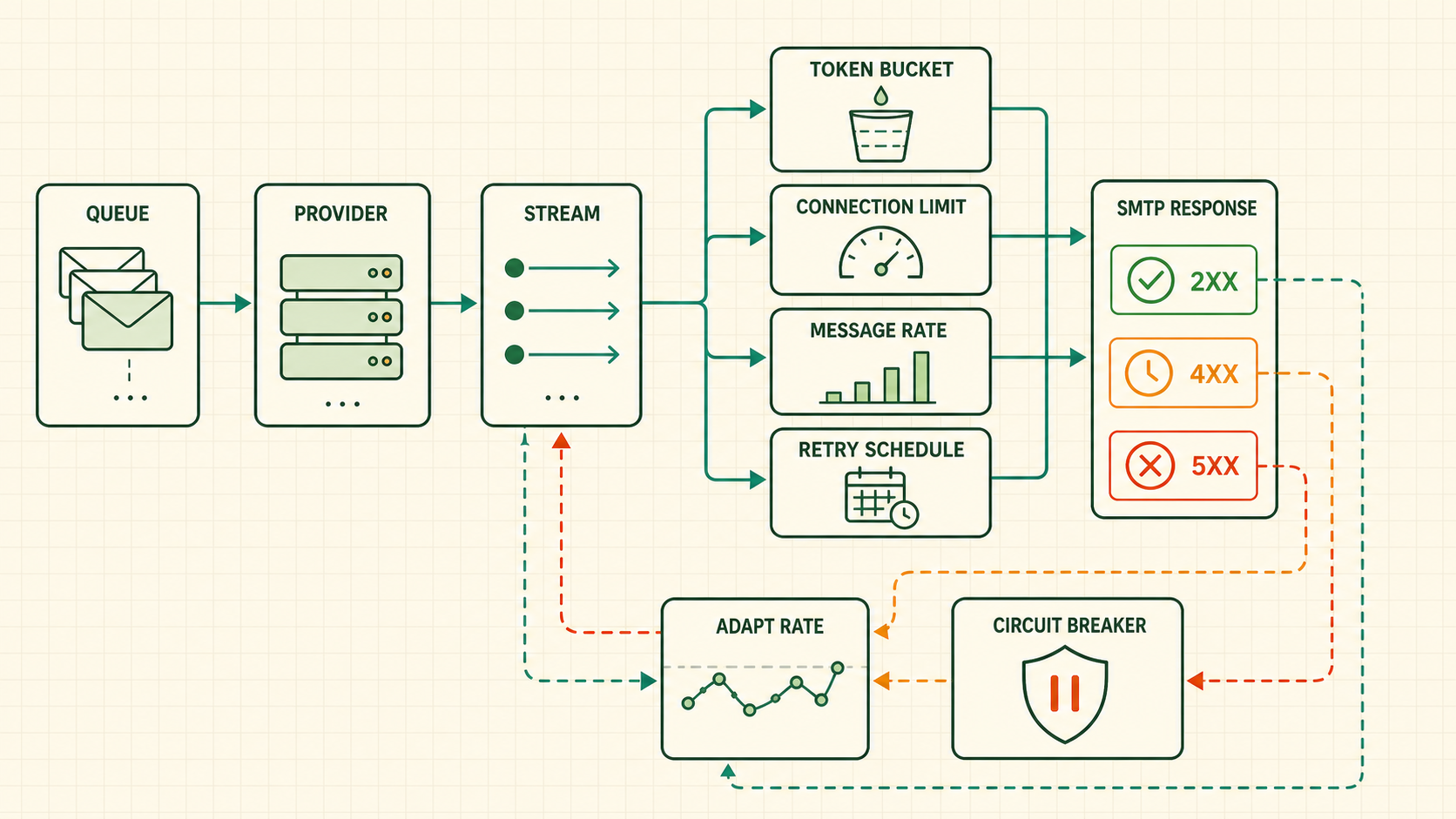
Calculate capacity without unnecessary parallel connections
required_recipient_rate = planned_recipients / send_window_seconds
effective_rate = accepted_recipients / connection_seconds
estimated_connections = required_recipient_rate / effective_rate

constrain by receiver feedback, retry budget, queue state,
provider-specific behavior and observed stable limits
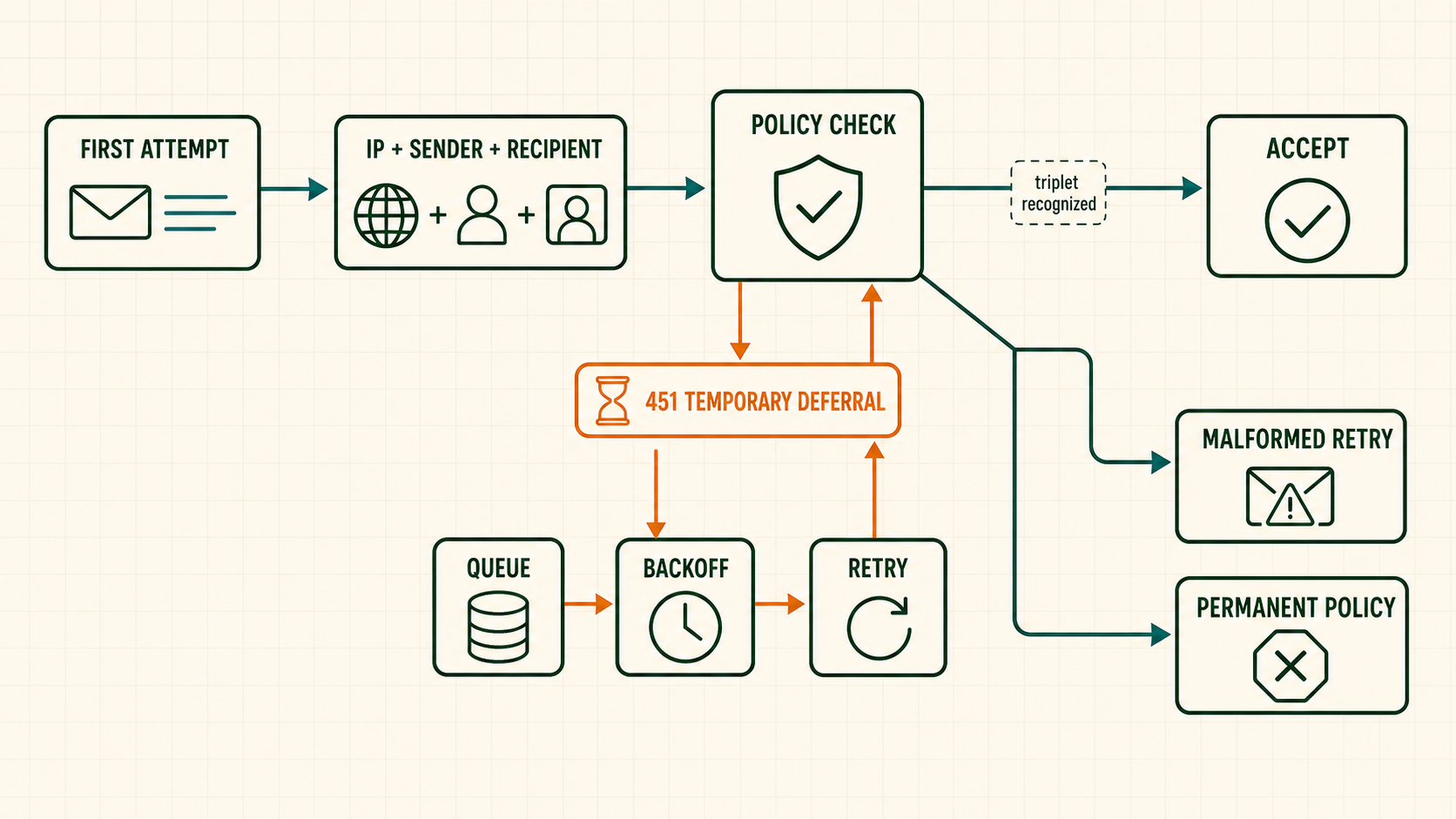
This is capacity planning, not permission to run at the maximum. Receiving networks use dynamic controls and may not publish fixed concurrency. Start below stable capacity, reuse connections responsibly, honor deferrals and apply jittered backoff. Split queues by receiving organization so one network’s pressure does not block all delivery.
Plan failover carefully. A cold standby receiving full production volume can appear as an unplanned sender. Exercise it with legitimate controlled traffic where policy permits, or use a conservative emergency ramp.
Compare total operating cost, not the IP add-on price
| Cost | Shared | Dedicated |
|---|---|---|
| MTA operation | Mostly provider-owned | Ownership must be explicit |
| Monitoring | Depends on provider visibility | Per-IP SNDS, blocklist, SMTP and queue controls |
| Warm-up | Existing pool absorbs variability | New route needs controlled volume and time |
| Incident response | Provider coordinates pool event | Sender diagnoses and communicates |
| Resilience | Provider-managed capacity | Standby routes, DNS, PTR and controlled failover |
Add staff time, on-call coverage, engineering changes and lost throughput during ramp. Dedicated can be correct, but the case must include operation rather than treating the monthly fee as total cost.
Use measurable gates for migration and rollback
Baseline acceptance, enhanced replies, queue delay, complaints, bounces and outcomes by receiving organization. Establish PTR, HELO, SPF, DKIM, DMARC, TLS and feedback ownership. Move a current, permissioned, representative cohort first. Do not warm only with artificially high engagers if final traffic is materially different.
- Stop expansion on authentication variance, unexpected complaints or persistent deferrals.
- Rollback moves clean traffic to a proven path; it never relocates the bad cohort.
- Change one major routing variable at a time.
- Retain old and new route evidence under identical UTC windows.
- Retire addresses from routing, authorization, DNS and monitoring deliberately.
Migration finishes only when normal/peak behavior, feedback, failover and incident ownership are proven.
Worked allocation: steady service mail and seasonal promotions
A platform sends 1.8 million receipts each day with predictable provider distribution. Promotions range from 100,000 recipients on ordinary days to 12 million during four annual events. Putting both streams on one set of dedicated IPs creates competing goals: enough addresses for the promotional peak fragments ordinary traffic, while sizing only for the daily baseline overloads the route during events.
The team gives service mail a separately governed identity and route with stable capacity and tested failover. Promotional mail uses a provider-managed pool designed for variable volume, strict tenant controls and provider-specific throttling. This is not automatically the only correct design; it follows the measured cadence and blast radius.
| Gate | Service stream | Promotion stream |
|---|---|---|
| Audience | Expected account event | Current permission and campaign eligibility |
| Peak plan | Redundant steady capacity | Event ramp and queue window |
| Failure response | Protect latency and service continuity | Pause causal cohort before rerouting |
| Measurement | Latency, acceptance, support impact | Complaints, placement, conversion and unsubscribes |
The decision is revisited when the promotional baseline becomes steady enough to justify a dedicated route or when the shared provider can no longer explain its pool controls.
Define when a shared-pool sender should request isolation
Isolation becomes defensible when wanted traffic is continuous, the provider can supply a stable dedicated route, the sender can operate feedback and incidents, and an actual blast-radius or attribution requirement is not met by the shared design. A single poor campaign or public listing is not sufficient evidence. First determine whether the cause belongs to the audience, domain, content, credential or another tenant.
Request historical pool evidence, migration controls and return options. Confirm whether dedicated means an exclusive egress IP at all destinations or only a logical pool that may fail over through shared infrastructure. Establish who controls PTR, HELO, authentication, throttling, SNDS/JMRP, feedback loops, blocklist requests and emergency routing.
If the sender later becomes too seasonal or sparse to sustain the route, consolidation can be the responsible action. Preserve stable sending domains and move a representative cohort gradually. Do not keep an underused dedicated IP merely because the label sounds more professional.
Write an allocation decision that can be reviewed later
Record current and peak recipients by receiving organization, cadence, stream purpose, shared-provider controls, dedicated operating owners, migration gates, failover behavior and estimated total cost. State the assumptions that would reverse the choice. Review after major volume, acquisition, provider or staffing change.
Include a diagram of From/DKIM/return-path domains and their egress pools. This exposes accidental mixing between transactional and promotional traffic and makes incident containment possible without guessing. An address inventory should include active, warming, standby, draining and retired states so unused IPs do not remain trusted or silently return to service.
Confirm the chosen route can be operated under pressure
Before approval, simulate a provider deferral, complaint surge, certificate failure, blocklist alert and unavailable primary route. Named operators must be able to identify affected traffic, slow it, preserve evidence and restore clean delivery without shifting harmful mail. If that response depends entirely on unavailable provider data or one person, the architecture is not ready regardless of IP label. Repeat this exercise after any routing or provider change.
Primary references
- Google email sender guidelines: shared IP addresses
- Yahoo Sender Best Practices
- Microsoft sender support