Shared Client IP Pool for Email Sending
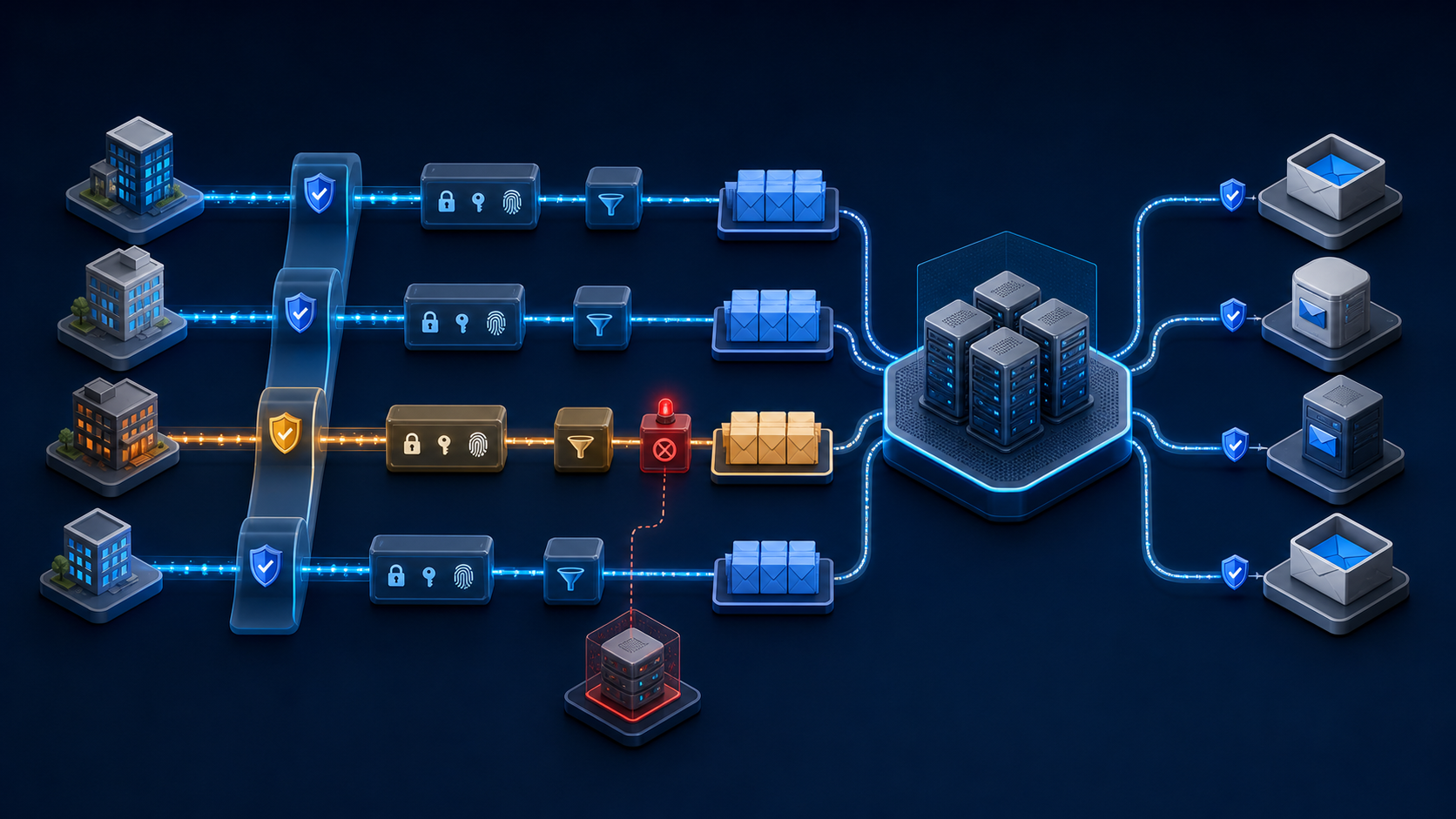
A shared client IP pool lets several approved senders use managed outbound email infrastructure without each sender operating a dedicated IP. It can provide steady traffic, established reputation, load distribution, and lower cost for small or irregular senders. It works only when tenant identity, permission, queues, traffic, feedback, and incidents remain separable.
This guide was technically reviewed on 12 August 2026 against current Gmail, Yahoo, Microsoft, M3AAWG, IETF, and Postfix guidance. Mailbox providers do not publish one universal safe volume or connection rate. Treat the example thresholds as conservative starting controls, measure by destination and tenant, and change them from evidence.
What a shared IP pool does
An outbound IP is shared when mail from more than one sender leaves through it. The IP develops a combined history, while each visible From domain, DKIM signing domain, return-path domain, link domain, message stream, and recipient cohort can develop separate reputations. A good platform therefore shares transport capacity but never erases tenant identity.
| Benefit | Why it helps | Required control |
|---|---|---|
| IP pool management | Traffic can be distributed across healthy, correctly configured IPs instead of overloading one route. | Deterministic assignment, provider-aware shaping, capacity headroom, and change records. |
| Established activity | A well-run pool may give an admitted low-volume sender access to a stable sending history. | Good neighbors, admission checks, ongoing scoring, and rapid quarantine. |
| Low or inconsistent volume | Several compatible senders can create steadier aggregate traffic than isolated, intermittent IPs. | Do not manufacture volume. Preserve natural demand and smooth avoidable bursts. |
| Warm infrastructure | Existing healthy IPs may not need a new-IP ramp for every tenant. | A new tenant, domain, content stream, or sudden volume increase still needs a controlled ramp. |
| Cost management | Shared capacity reduces the operational and commercial cost of dedicated IPs. | Capacity, abuse handling, telemetry, and recovery must be funded as pool services. |
| Reputation management | Multiple stable senders can support consistent IP activity. | Keep domain-level identity and metrics. Never hide a weak tenant in pooled averages. |
| Risk distribution | Compatible traffic can be spread across more than one healthy IP. | Segment by risk and stream. More IPs do not cure unwanted mail. |
Gmail states that activity from any sender on a shared IP affects all senders using it. That is the central operating constraint. Rotation alone does not minimize risk. Isolation, evidence, and fast containment do.
Choose shared or dedicated sending deliberately
| Signal | Shared pool | Dedicated IP or isolated pool |
|---|---|---|
| Volume | Low, intermittent, or insufficient to sustain an IP alone | Large and sufficiently consistent by destination |
| Program maturity | Approved sender with clear consent and modest history | Mature program needing independent change and reputation control |
| Traffic type | Compatible tenants and the same risk class | Critical transactional, regulated, user-generated, or materially different risk |
| Operations | Platform owns shaping, abuse, feedback, and recovery | Sender and platform can operate, warm, monitor, and recover dedicated capacity |
| Incident boundary | A tenant can be identified and quarantined immediately | Contract, compliance, or blast-radius requirements demand physical separation |
A dedicated IP is not automatically better. An underused or poorly managed dedicated IP can perform worse than a disciplined shared pool. Conversely, a shared pool is unsuitable when a tenant cannot expose its identity, provide permission evidence, suppress complaints, or accept platform controls.
Design the isolation model before onboarding
Define the smallest unit you can stop without stopping unrelated mail. A useful model is tenant, program, stream, domain, provider, pool, IP, and queue. Every accepted message should carry immutable identifiers for those units from submission through final event processing.
| Boundary | Identity or control | Why it matters |
|---|---|---|
| Tenant | Account ID, owner, contract, risk class, API credential | Attribution, suspension, audit, and billing |
| Program | Brand, lawful purpose, consent source, audience | Permission and expectation analysis |
| Stream | Transactional, marketing, alerts, user-generated, test | Separate urgency, complaints, retries, and reputation |
| Domain | Visible From, DKIM d=, envelope sender, link and tracking domains | Authentication, alignment, feedback, and brand reputation |
| Provider | Recipient MX family and response class | Destination-specific shaping and diagnostics |
| Transport | Pool, IP, EHLO, TLS policy, queue | Capacity and network reputation |
Do not assign a random IP on every retry. Stable, explainable assignment makes diagnosis possible. Hashing a tenant and stream into an eligible pool can be useful, but health and capacity overrides must be explicit and logged. A retry should normally stay within the approved reputation segment unless an incident controller authorizes evacuation.
Step 1: build a tenant admission gate
Collect and verify legal identity, business model, domains, website, privacy notice, sending purpose, message examples, expected volume by day and hour, recipient sources, age of permission, frequency, geographies, complaint and bounce history, current providers, suppression process, unsubscribe flow, user-generated content risk, affiliate use, and incident contacts. Confirm domain control through DNS or an equivalent high-confidence method.
Reject or hold onboarding when the sender cannot prove permission, uses purchased or scraped lists, obscures its identity, lacks working suppression, expects a sudden unexplained spike, or needs the platform to bypass a provider block. A commercial contract is not evidence that recipients requested the mail.
Step 2: prove consent and recipient expectations
Store the recipient, normalized address, acquisition source, form or contract version, timestamp, IP or authenticated actor where lawful, disclosed purpose, promised frequency, confirmation event, and subsequent preference changes. Keep a global suppression list and tenant or program suppressions. Apply suppressions before queue acceptance, not after delivery attempts begin.
Confirmed opt-in is especially valuable where signup abuse, typos, bots, or third-party referrals are common. Never silently convert a transactional relationship into marketing permission. Provide a visible unsubscribe link and RFC 8058 one-click unsubscribe for applicable marketing and subscribed mail, then honor it within the provider and legal deadline. Yahoo currently requires bulk senders to honor unsubscribes within two days.
Step 3: establish domain authentication and alignment
Each tenant should normally use a controlled visible From domain, aligned DKIM signing domain, and aligned envelope sender or return-path domain. Publish SPF for actual authorized senders, sign every stream with DKIM, and publish DMARC under current RFC 9989. Full DMARC participation expects both aligned SPF and aligned DKIM even though one aligned pass can produce a message-level DMARC pass.
; Illustrative records. Replace every example value and validate DNS ownership.
mail.example.com.       300 IN A   192.0.2.40
192.0.2.40              PTR        mail.example.com.
bounce.customer.example. 300 IN MX 10 bounces.platform.example.
s1._domainkey.customer.example. 300 IN TXT "v=DKIM1; k=rsa; p=PUBLIC_KEY"
_dmarc.customer.example. 300 IN TXT "v=DMARC1; p=none; rua=mailto:[email protected]"
The A and PTR relationship must be valid for each sending IP and EHLO identity. Use an approved DKIM key size and rotation process, protect private keys, and keep selector ownership per tenant or stream. A shared platform DKIM signature can support operations, but it must not replace aligned tenant identity.
dig +short A mail.example.com
dig +short -x 192.0.2.40
dig +short TXT s1._domainkey.customer.example
dig +short TXT _dmarc.customer.example

# Send a controlled test, then inspect the received Authentication-Results.
openssl s_client -starttls smtp -connect recipient-mx.example:25 -servername mail.example.com
The TLS command is a connectivity diagnostic, not permission to send a test through an unrelated server. Use a mailbox and destination you control or are authorized to test.
Step 4: segment pools by message function and risk
At minimum separate transactional mail from marketing. Consider separate segments for password and security notices, ordinary transactional messages, solicited marketing, user-generated mail, new tenants, internal tests, and recovery traffic. Yahoo specifically recommends segregating mail by function because IP and DKIM-domain reputation can affect delivery.
Do not over-segment until every pool becomes too small and intermittent to operate. Start with meaningful risk boundaries, then split when volume and evidence justify it. A pool catalogue should record purpose, eligible risk classes, IPs, EHLO names, providers, target capacity, emergency reserve, warm state, owners, and current health.
Step 5: make pool assignment deterministic
Evaluate admission state, stream, domain authentication, destination, current pool health, tenant limit, and incident flags before accepting a route. The result should include a reason code and policy version. Do not let a tenant select an arbitrary source IP or trusted pool through an unvalidated API field.
{
  "tenant_id": "t_1042",
  "program_id": "billing_receipts",
  "stream": "transactional",
  "from_domain": "customer.example",
  "dkim_domain": "customer.example",
  "recipient_provider": "gmail",
  "pool": "shared-transactional-a",
  "policy_version": "2026-08-12.1",
  "decision": "accept",
  "reason": "eligible_healthy_pool"
}
Store the decision with the message ID. When a message is retried, support can then explain which policy and health state selected the route.
Step 6: isolate credentials, queues, and MTA paths
Give each tenant or application a separate API key or SMTP credential with least privilege, rotation, expiration, source controls where practical, and immediate revocation. Bind the authenticated identity to allowed From domains and streams. Never trust a tenant-supplied tenant ID, envelope sender, DKIM selector, or pool name without server-side authorization.
Logical tags in one queue improve attribution but do not create a hard failure boundary. For high-risk or critical streams, use separate submission services, transports, processes or containers, spool directories, credentials, and capacity. Reserve enough transactional capacity that a marketing burst cannot consume all connections, memory, disk, or retry slots.
Postfix transport example
This simplified example shows sender-dependent transports with separate source IP and EHLO identities. It is not a complete multi-tenant platform. The submission layer must authenticate the tenant, authorize the envelope sender, add DKIM, and prevent sender spoofing before Postfix uses this map.
# /etc/postfix/main.cf
sender_dependent_default_transport_maps = hash:/etc/postfix/sender_transport

# /etc/postfix/sender_transport
@tenant-a.example    poola:
@tenant-b.example    poolb:

# /etc/postfix/master.cf
poola unix  -  -  n  -  -  smtp
  -o smtp_bind_address=192.0.2.40
  -o smtp_helo_name=mail-a.example.net
poolb unix  -  -  n  -  -  smtp
  -o smtp_bind_address=192.0.2.41
  -o smtp_helo_name=mail-b.example.net
sudo postfix check
sudo postmap /etc/postfix/sender_transport
postmap -q [email protected] hash:/etc/postfix/sender_transport
sudo postfix reload
postconf -n
postfix statusConfirm both source addresses exist locally, route correctly, have matching forward and reverse DNS, and are authorized by policy. Validate in a controlled environment before reload. For stronger queue isolation, use separate Postfix instances or equivalent MTA services rather than assuming two transports make one spool independent.
Step 7: warm new risk, not just new IPs
An active shared IP can already have history, but a new domain, new tenant, new list source, new content, or sharp volume increase is still new risk. Begin with recently active recipients who clearly expect the mail. Increase volume in measured steps only while authentication, delivery, deferrals, complaints, bounces, and unsubscribes remain healthy.
Do not use seed addresses, inactive recipients, or fabricated messages to create warmup volume. Keep normal content and cadence. If the sender cannot supply enough permissioned demand, accept a slower ramp. Gmail recommends steady sending, starting low, and increasing gradually while monitoring server responses and reputation.
Step 8: shape traffic by tenant and destination
Enforce at least messages per second, recipients per message, concurrent connections, messages per connection, daily volume, queue depth, retry rate, and maximum burst. Apply controls at tenant, stream, pool, IP, and provider levels. Destination controls should react to enhanced status codes and recent outcomes without allowing one provider slowdown to block every destination.
| Signal | Controlled response | Do not do |
|---|---|---|
| Provider 4xx deferrals increase | Reduce that destination's concurrency or rate, preserve retry semantics, inspect exact codes | Immediately rotate through every IP |
| 5xx invalid recipients | Classify permanent failures and suppress exact recipients | Retry permanent failures indefinitely |
| Tenant burst exceeds forecast | Throttle or hold that tenant and contact its owner | Consume reserved transactional capacity |
| Pool disk approaches limit | Stop low-priority acceptance, drain safely, add approved capacity | Delete the entire queue to free space |
| Complaint signal rises | Stop the implicated tenant, program, campaign, or cohort | Average it away across the pool |
Postfix exposes destination concurrency and rate-delay controls per transport. Select starting values from controlled tests and logs, not copied internet numbers. A rate delay can reduce throughput and increase queue age, so alert on both delivery quality and backlog.
Step 9: process bounces, complaints, and unsubscribes
Use a unique return path or VERP-like recipient token that maps every delivery status notification to tenant, program, campaign, message, and recipient without leaking unnecessary personal data. Parse SMTP replies and DSNs into permanent, temporary, policy, content, reputation, authentication, quota, and unknown classes. Retain the exact remote response for diagnosis.
Suppress hard-invalid recipients promptly. Apply a documented policy to repeated soft failures rather than treating every 4xx as permanent. Process Yahoo CFL and Microsoft JMRP complaints, Gmail Feedback-ID aggregates, and other available feedback. A complaint should suppress the recipient from the implicated marketing program immediately, subject to a clearly defined legal or critical-service exception.
Open rate is not a reliable safety control. Privacy protections, image blocking, automated scanners, and bot activity distort it. Use permission evidence, complaints, replies, unsubscribes, bounces, provider data, conversions, and carefully defined inactivity together.
Step 10: observe the pool without hiding noisy neighbors
Build dashboards at pool and tenant level, then slice by stream, domain, campaign, provider, IP, hour, recipient source, and message version. Use denominators consistently. A complaint rate calculated over accepted mail is not directly comparable with a provider rate calculated over inbox-delivered mail.
| Control plane | Minimum telemetry | Alert example |
|---|---|---|
| Admission | Approval, domains, risk class, forecast, reviewer, expiration | Unapproved domain or expired review sends |
| Authentication | SPF, DKIM, DMARC and alignment by domain/provider | Any material pass-rate fall from baseline |
| Queue | Accepted, active, deferred, oldest age, disk, retries by tenant/provider | Oldest age or tenant share breaches service objective |
| Delivery | 2xx, 4xx, 5xx, enhanced status, latency, provider response text | Destination-specific deferral change |
| Recipient quality | Hard and soft bounce, complaint, unsubscribe, unknown user, inactive cohort | Cohort departs from approved baseline |
| Reputation | Gmail Postmaster, Yahoo Sender Hub, Microsoft SNDS/JMRP, blocklists | New negative classification or feedback spike |
| Security | Credential use, source, send rate, template change, API errors | Impossible source, credential spike, or unauthorized From domain |
Provider dashboards can be delayed, sampled, or unavailable at low volume. SMTP responses and internal events are faster, but they are not complete reputation measurements. Correlate signals rather than granting one dashboard absolute authority.
Detect a noisy neighbor early
Compare every tenant with its approved baseline and compatible peers. Useful detectors include sudden volume acceleration, new recipient-source mix, authentication failure, unknown-user rise, complaint growth, unusual unsubscribe pattern, provider-specific deferral, concentration on old recipients, template or link-domain change, credential source change, trap evidence, and disproportionate queue use.
A pool aggregate can remain green while one small tenant is deteriorating. Conversely, a large clean tenant can dominate the denominator and conceal another program. Alert on absolute counts, rates, confidence intervals where useful, and change from baseline. Require minimum sample sizes but never ignore a severe event such as confirmed credential compromise or trap evidence.
Respond to blocklists and spam-trap evidence
First confirm the exact IP or domain, listing source, timestamp, affected pool, recent assignments, and evidence. Check whether it is an authoritative provider response, a public list that receivers actually use, or an unactionable scanner. Identify the tenant, acquisition source, compromised credential, open relay, or configuration failure before requesting removal.
A trap hit is an investigation trigger, not a universal proof of one cause. Review list acquisition, list age, address validation, recycled recipients, typographical domains, suppression history, and credential abuse. Do not send a confirmation campaign to a suspect list until the evidence and legal basis support that action.
Contain an incident without destroying evidence
- Declare an incident owner and timestamp.
- Stop new acceptance for the smallest confirmed unsafe boundary: credential, campaign, tenant, domain, stream, or pool.
- Preserve submission, policy, message, authentication, queue, delivery, feedback, and configuration evidence.
- Hold or drain attributed queued mail according to impact and legal requirements.
- Revoke or rotate compromised credentials and keys.
- Protect healthy transactional capacity without shifting suspect traffic.
- Notify tenant, security, compliance, and operations owners through the approved process.
- Verify containment from new acceptance, queue age, outbound rate, and provider signals.
postqueue -p
postqueue -j
postcat -q QUEUE_ID

# Hold or release one verified queue ID.
sudo postsuper -h QUEUE_ID
sudo postsuper -H QUEUE_ID

# Delete one verified, authorized queue ID only after evidence retention.
sudo postsuper -d QUEUE_IDpostsuper -d ALL deletes every queued message in the Postfix instance. Do not use it for one tenant or ordinary disk pressure. The blast radius includes healthy transactional mail and evidence. Prefer stopping new acceptance, identifying exact queue IDs from trusted attribution, holding the affected scope, exporting required evidence, obtaining authorization, deleting only verified IDs, and confirming queue and business state afterward.Evacuate a pool only with a clean cause and plan
Pool evacuation means moving eligible healthy traffic away from impaired infrastructure. It is not reputation laundering. Before moving anything, classify tenants and streams as healthy, suspect, or confirmed harmful; confirm replacement capacity and warm state; preserve provider-specific throttles; and record the assignment change.
Move the smallest healthy cohort first, observe authentication, source IP, latency, responses, complaints, and queue age, then continue in stages. Keep suspect traffic stopped or isolated. A rollback returns healthy traffic to the prior route only if that route is safe and capacity remains. If neither route is safe, controlled delay is better than spreading harm.
Graduate a tenant to dedicated capacity
Consider graduation when the tenant has sufficient sustained volume, stable consent and hygiene, mature operations, predictable provider distribution, a business need for independent reputation, or a compliance boundary. Require a capacity forecast, DNS and authentication plan, warmup schedule, reserve path, monitoring ownership, support coverage, and rollback criteria.
Warm the dedicated IP with the tenant's most expected traffic while leaving part of eligible volume on the shared pool. Do not move every recipient on day one. Track provider response and domain reputation because a new IP does not reset the domain's history. When complete, remove the tenant from shared eligibility and retain the old mapping for audit.
Troubleshooting commands and interpretation
# Identity and DNS
dig +short A mail-a.example.net
dig +short -x 192.0.2.40
dig +short TXT customer.example
dig +short TXT s1._domainkey.customer.example
dig +short TXT _dmarc.customer.example

# Postfix configuration and effective transport lookup
sudo postfix check
postconf -n
postconf -M
postmap -q [email protected] hash:/etc/postfix/sender_transport

# Queue and logs. Adapt the unit or log path to the distribution.
postqueue -p
postqueue -j
journalctl -u postfix --since "30 minutes ago"

# Network and TLS
ip -brief address
ip route get 198.51.100.25 from 192.0.2.40
ss -tnp
openssl s_client -starttls smtp -connect mx.example:25 -servername mail-a.example.net| Symptom | Check first | Likely safe action |
|---|---|---|
| Only one provider defers | Exact 4xx text, tenant and campaign mix, rate change, IP/domain status | Reduce affected destination rate, preserve retries, remove bad source |
| All providers fail authentication | Signing service, selector DNS, From and return-path alignment, recent deploy | Stop affected domain, roll back known change, verify controlled samples |
| One tenant fills the queue | Submission spike, forecast, recipient provider, retry class | Throttle tenant, reserve other streams, investigate source |
| Source IP differs from assignment | Route, NAT, bind address, failover, effective MTA config | Stop affected transport until PTR, SPF, EHLO, and route agree |
| Complaints rise after template change | Audience, frequency, From identity, subject, unsubscribe, cohort | Pause campaign, restore approved version if appropriate, suppress complaints |
| Public blocklist appears | Actual listing, evidence, receiver use, tenant attribution | Contain cause before any delisting request or traffic move |
Practical scenarios
Small SaaS sender with irregular receipts
Admit it to a transactional pool after domain control, aligned authentication, message review, and abuse contacts are complete. Set a tenant burst limit, preserve reserved capacity, and use a separate marketing stream if the company later launches newsletters. Irregular legitimate receipts do not justify synthetic warmup traffic.
Retail tenant launches an unplanned promotion
The forecast breach triggers a hold before queue saturation. Operations checks consent source, campaign approval, provider distribution, and pool capacity. If valid, release in shaped stages to engaged recipients. If the tenant uploaded purchased data, reject the campaign and keep the healthy pool unchanged.
Credential compromise sends user-generated spam
Revoke the credential, stop that tenant and stream, hold attributed queue items, preserve samples and logs, rotate secrets, review account access, and examine other credentials. Do not move the queued spam to a reserve IP. Re-enable only with the vulnerability fixed, verified clean traffic, strict initial limits, and enhanced monitoring.
Transactional pool receives provider deferrals
Separate affected provider queues from other destinations, inspect response codes and recent tenant composition, then reduce only the required rate. Protect password and security messages according to priority policy, but do not bypass provider requirements. Escalate with complete evidence only after authentication, complaints, DNS, and sending practices are compliant.
Set service objectives and automatic control states
A shared pool needs defined operating states, not an operator making a fresh decision for every graph. Use normal, watch, restricted, quarantined, and recovery states for each tenant and pool. State changes should be based on a documented combination of volume, authentication, SMTP outcomes, complaints, recipient quality, security events, and provider evidence. Record who or what changed the state, the evidence window, and the next review time.
| State | Acceptance and routing | Required evidence to leave |
|---|---|---|
| Normal | Approved forecast, ordinary limits, eligible pools | Continuous compliance with baseline and capacity objectives |
| Watch | Reduced burst allowance and closer sampling | Signal returns to baseline or investigation identifies a harmless cause |
| Restricted | Lower rate, engaged or critical cohorts only, no new stream | Root cause, corrected source, controlled tests, owner approval |
| Quarantined | No ordinary delivery; evidence and explicitly authorized tests only | Security and deliverability review, clean test evidence, re-entry plan |
| Recovery | Small staged volume with enhanced telemetry | Several planned observation windows pass before normal state |
Do not publish a universal complaint, bounce, or deferral number as an automatic truth for every program. Gmail and Yahoo publish requirements and recommendations, but their denominators and available feedback differ. Set an internal early-warning level below any published enforcement boundary, then add tenant-specific baselines and minimum counts. A single confirmed compromise should override a rate that looks statistically small.
Define service objectives for time to stop new acceptance, time to revoke a credential, complaint-processing latency, unsubscribe-processing latency, oldest transactional queue age, oldest marketing queue age, authentication success, feedback ingestion, dashboard freshness, and recovery approval. Test these objectives during exercises. A control that exists in documentation but cannot stop the correct tenant within minutes is not an effective isolation boundary.
Manage changes, capacity, and rollback
Treat pool membership, IP addresses, EHLO names, DNS, DKIM selectors, rate controls, MTA packages, routing maps, NAT, TLS policy, feedback endpoints, and suppression logic as controlled configuration. Every change needs an owner, reason, affected tenants and providers, before-state evidence, test plan, staged rollout, success criteria, rollback action, and post-change observation period.
Keep spare capacity that is already configured and understood. An unused cold IP is not an instant recovery pool, and a healthy production pool is not spare capacity for suspect traffic. Forecast ordinary peak, retries during provider deferral, maintenance loss, and one meaningful tenant burst. Reserve disk and queue capacity by service class so delayed promotional mail cannot prevent the acceptance of approved critical messages.
Before an MTA configuration change, save the effective configuration and the exact files being changed. Validate syntax, test lookup results, reload rather than restart when the software and change permit it, send controlled samples, and confirm the actual source IP, EHLO, authentication, TLS, response, event attribution, and feedback path. Roll back immediately when an acceptance criterion fails. Do not keep experimenting on all live traffic.
date -u
postconf -n > /root/postfix-effective-before.txt
sudo cp -a /etc/postfix/sender_transport /root/sender_transport.before
sudo postfix check

# After an approved edit:
sudo postmap /etc/postfix/sender_transport
postmap -q [email protected] hash:/etc/postfix/sender_transport
sudo postfix check
sudo postfix reload

# Rollback example after confirming the saved file and authorization:
sudo cp -a /root/sender_transport.before /etc/postfix/sender_transport
sudo postmap /etc/postfix/sender_transport
sudo postfix check
sudo postfix reload
The example backup contains routing information and is written under /root. Protect it and remove it according to change-record retention policy. Copying a stale map is unsafe when tenants or routes changed after the backup. Confirm timestamp, contents, owner approval, and intended blast radius before rollback, then verify active routing and representative delivery.
Production acceptance checklist
- Every tenant has verified identity, domain control, permission evidence, expected volume, risk class, and incident contacts.
- Every message is attributable to tenant, program, stream, domain, campaign, recipient source, provider, pool, IP, and policy decision.
- SPF, DKIM, DMARC, forward DNS, reverse DNS, EHLO, TLS, and RFC formatting pass controlled tests.
- Transactional, marketing, user-generated, evaluation, and recovery traffic have documented boundaries.
- Per-tenant and per-provider rate, concurrency, burst, daily volume, and queue controls are enforced server-side.
- Bounces, complaints, unsubscribes, and suppressions are processed with exact attribution and monitored latency.
- Gmail Postmaster Tools, Yahoo Sender Hub and CFL, Microsoft SNDS and JMRP, SMTP replies, and internal telemetry have owners.
- Noisy-neighbor alerts operate below the pool aggregate and cannot be hidden by a large healthy tenant.
- Incident procedures cover acceptance stop, queue hold, evidence, revocation, containment, evacuation, rollback, and re-entry.
- Dedicated-IP graduation is evidence-based and includes warmup, reserve capacity, monitoring, and rollback.
- Queue recovery and configuration rollback have been exercised without deleting unrelated mail.
For deeper authentication and provider monitoring, use the advanced email deliverability guide. For bounce classification and suppression ownership, use bounce handling for marketers. For the current sender-feedback and certification landscape, use IP and domain certification and allowlisting.
Official references
- Gmail email sender guidelines
- Gmail Postmaster Tools dashboards
- Yahoo Sender Hub requirements and best practices
- Yahoo Complaint Feedback Loop
- Microsoft Smart Network Data Services and JMRP
- Microsoft Outlook high-volume sender requirements
- M3AAWG Sender Best Common Practices
- RFC 9989: DMARC
- RFC 9990: DMARC aggregate reporting
- RFC 7208: SPF
- RFC 6376: DKIM
- RFC 8058: one-click unsubscribe
- Postfix postconf parameter reference
- Postfix multi-instance operation