Domain Reputation vs IP Reputation: Signals and Isolation
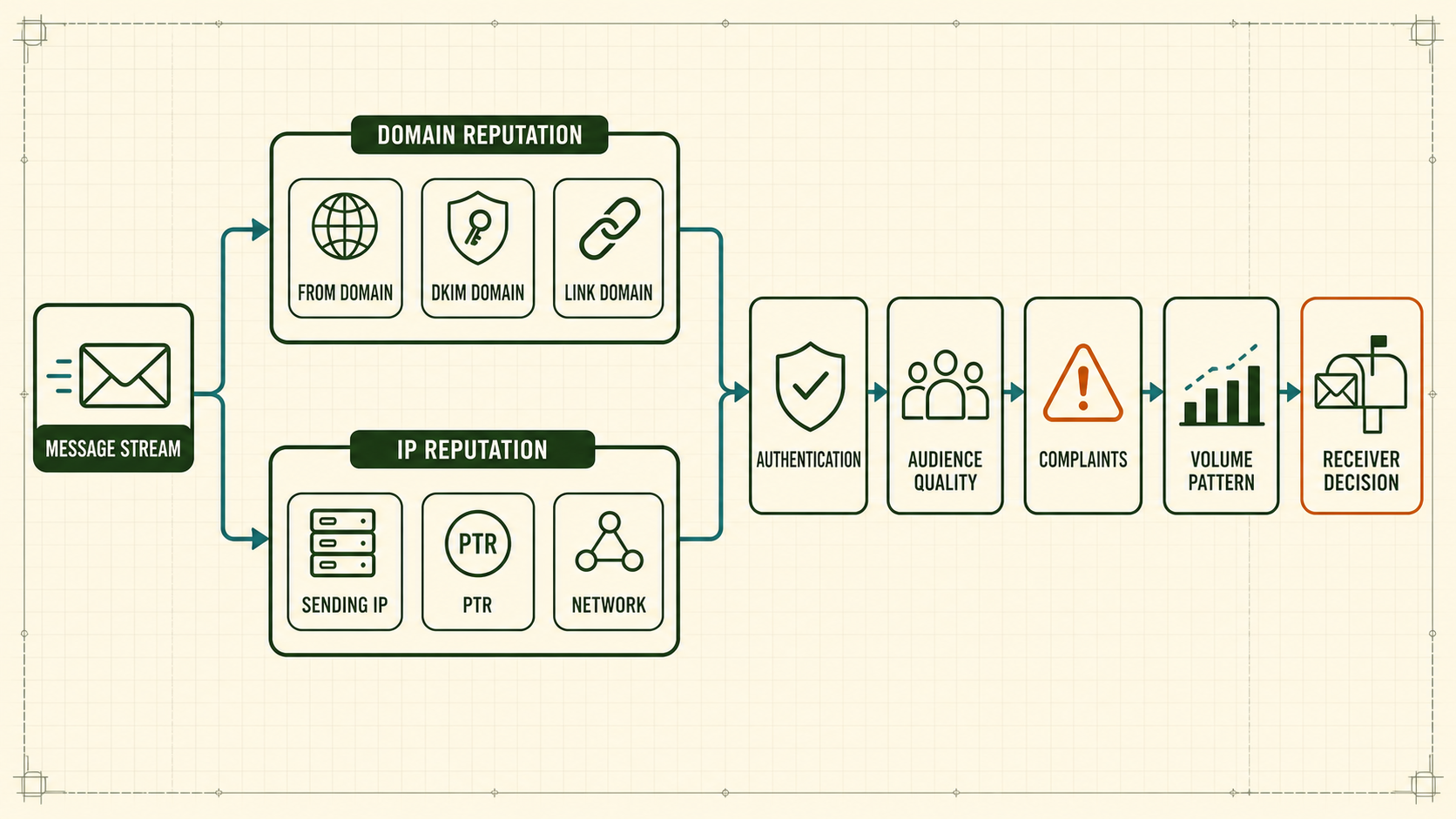
Mailbox providers evaluate more than one reputation surface. Sending IP behavior matters, but authenticated domains, visible From identity, return path, links, traffic patterns, complaints and recipient engagement also contribute to receiver decisions. No public universal score combines them. Diagnosis begins by mapping every identity on the received message and segmenting evidence by receiver, stream and infrastructure.
Map the identity graph
| Layer | Identifiers | Control |
|---|---|---|
| Visible identity | RFC 5322 From domain | DMARC policy and brand governance |
| Cryptographic identity | DKIM d= domain and selector | Signing, key rotation and alignment |
| Envelope identity | Return-path domain | SPF and bounce routing |
| Network identity | Sending IP, PTR, ASN | MTA route and provider |
| Content identity | Tracking and destination domains | Link ownership and redirect chain |
Save this graph per stream and vendor. A campaign can move IP while keeping domain reputation, or inherit a new link-domain problem while its IP remains stable.
Understand the practical difference
IP reputation reflects traffic associated with a network address: volume, recipient quality, complaints, traps, authentication context, rate behavior and history. Domain reputation can persist across IP changes and ties behavior to authenticated or visible identifiers. Receiver weighting is proprietary and can differ by provider.
A dedicated IP gives operational isolation but also requires enough stable wanted volume to build and maintain history. Shared pools supply established capacity but expose the IP layer to other tenants, while domain-level behavior remains attributable.
Segment before assigning blame
Compare accepted, deferred and rejected recipients by receiving organization, sending IP, From domain, DKIM domain, return path, link domain and stream. Overlay complaints, acquisition source, invalid recipients and volume changes. If one IP degrades across several domains, investigate infrastructure or pool behavior. If one domain degrades across several healthy IPs, investigate audience and domain-linked identity.
These are hypotheses, not mathematical proof. Confirm with provider telemetry, full SMTP replies, controlled headers and recent changes.
Operate shared and dedicated routes differently
| Situation | Risk | Required control |
|---|---|---|
| Shared IP | Other tenants affect network behavior | ESP pool policy, telemetry and exit criteria |
| Dedicated IP | Low or volatile volume creates weak history | Stable schedule, capacity and warm-up |
| Multiple brands on one IP | Operational incident crosses brands | Stream isolation and domain reporting |
| New domain on established IP | No trusted domain history | Permission-first controlled ramp |
Migrate identity without resetting everything at once
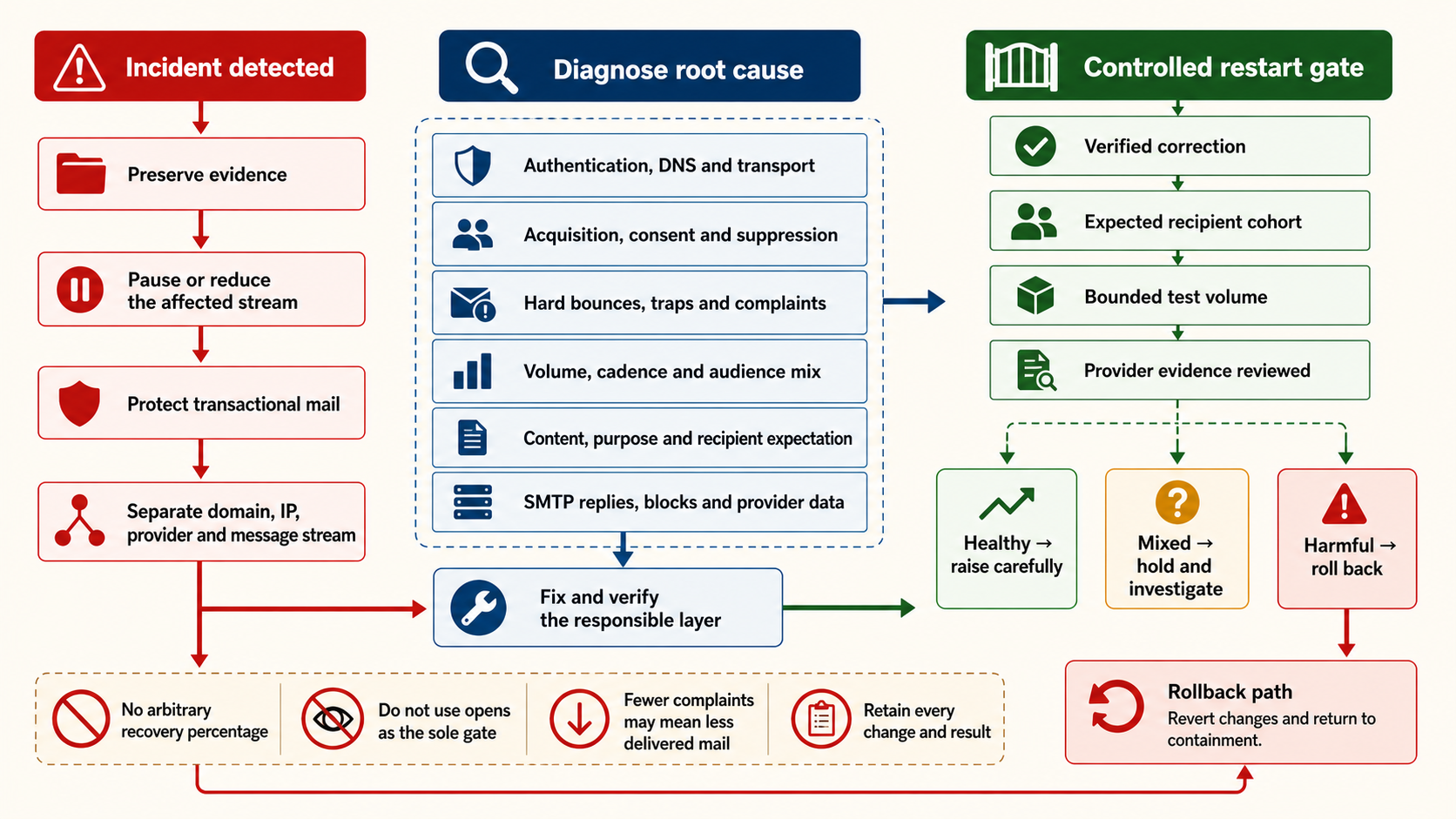
Inventory current SPF, DKIM, DMARC, PTR, TLS, return paths, links and provider registrations. Authenticate the new route, send controlled wanted traffic and keep volumes predictable. Avoid simultaneously changing IP, From domain, DKIM domain, link domain, audience and cadence; that destroys diagnostic comparability.
Maintain durable complaint and unsubscribe suppression across platforms. Monitor old and new paths until retries settle. Roll back based on acceptance, complaint and queue thresholds, not a vague reputation concern.
Avoid reputation shortcuts
- Rotating IPs or domains does not repair unwanted acquisition.
- A blocklist listing is one signal, not a universal inbox verdict.
- Passing authentication establishes identity; it does not establish wanted mail.
- A dedicated IP is not automatically better than a well-run shared pool.
- Warming volume without genuine engaged recipients trains poor behavior.
- One blended sender score cannot explain every provider.
Model reputation as several linked identities and behaviors
| Layer | Observed evidence | Typical owner |
|---|---|---|
| Connecting IP | Volume, rate, complaints, traps, replies, PTR/HELO | MTA/ESP operations |
| DKIM domain | Authenticated signer behavior across routes | Brand/security |
| Visible From domain | Recipient recognition, DMARC identity and complaints | Program owner |
| Return-path domain | SPF identity and bounce operations | Deliverability platform |
| Link/tracking domain | URL safety, redirect reputation and content association | Web/security |
| Audience/program | Consent, relevance, frequency and recipient response | Marketing/lifecycle |
Mailbox providers combine evidence differently and do not publish a universal score. An IP change isolates one layer; it does not erase domain, link or audience history.
Build a point-in-time identity and route inventory
sending_identity(
  stream, provider_account, outbound_ip, ptr, helo,
  from_domain, dkim_domain, selector,
  return_path_domain, tracking_domain,
  active_from_utc, active_to_utc, owner
)
Preserve effective dates. A DMARC report or complaint from last month must be joined to identities active then, not today’s configuration. Include shared/dedicated pool state, warm-up/retirement and tenant routing. Confirm identities from final received messages because vendor control panels can differ from actual production.
Use the inventory to explain blast radius: which streams share an IP, domain, selector or link service?
Diagnose IP-level pressure with transport evidence
IP evidence includes reverse/forward DNS, HELO stability, TLS, connection behavior, provider-specific acceptance/deferral/rejection, complaint/trap signals, blocklists and traffic consistency. Separate unique recipients from retry events. Group by receiving organization and hour because a global daily view can hide concentrated pressure.
| Pattern | Likely next check |
|---|---|
| All domains on one IP defer | IP/rate, compromise or pool incident |
| One domain fails across several IPs | Domain/audience/content identity |
| Shared IP changes suddenly | ESP tenant/pool evidence |
| New IP sparse at one provider | Controlled ramp and provider distribution |
A public blocklist listing can be a symptom, not the complete receiver decision. Preserve exact SMTP citations.
Diagnose domain reputation across infrastructure changes
Track visible From, DKIM and link domains separately. An aligned DKIM domain provides stable authenticated accountability when SPF breaks through forwarding. Recipient complaints and engagement can follow the recognizable From domain across IPs. Unsafe or compromised tracking links can affect messages sent from otherwise healthy infrastructure.
domain_daily(
  date_utc, domain_type, domain_name, stream,
  provider_org, attempted, accepted, deferred, rejected,
  complaints, qualified_actions, policy_version
)
Do not merge all subdomains automatically. Record organizational relationships and intentional stream separation. New subdomains are not a reputation reset; using many disposable variants can look evasive and weakens operational accountability.
Interpret shared and dedicated IPs without simple good/bad labels
| Condition | Shared-pool implication | Dedicated implication |
|---|---|---|
| Low/irregular wanted volume | Governed pool may provide stability | Sparse history and difficult baseline |
| Steady high volume | Provider controls still matter | Sender can own ramp and incidents |
| Other-tenant abuse | IP blast radius if pool governance fails | Not applicable, but own abuse remains |
| Unsafe audience | Harms domain and pool | Harms dedicated IP and domain |
| Critical stream isolation | Needs provider segmentation evidence | Clearer IP attribution with staffing cost |
Request pool admission, abuse and incident controls. Dedicated allocation is not certification and does not fix complaints.
Correlate changes across identity layers before assigning cause
Create a UTC timeline for volume, cohort, campaign, IP/pool, From/DKIM/return path/link release, authentication, provider replies and complaints. Compare unaffected controls. If delivery changes only at Microsoft on one IP, inspect that receiver/IP path. If it follows a domain across providers and IPs, investigate audience or identity.
hypothesis evidence matrix:
  H1 IP pressure: other domains on same IP also degrade
  H2 domain pressure: same domain degrades across IPs
  H3 audience: implicated cohort drives complaints/unknown users
  H4 technical: change begins at auth/route release

mark each supported, contradicted or unknown
Do not select the hypothesis that is easiest to change. Keep unknown when comparison evidence is unavailable.
Change IP or domain only through a controlled migration
- State the business/technical reason and causal evidence.
- Baseline provider-hour acceptance, complaints and outcomes.
- Complete PTR/HELO/SPF/DKIM/DMARC/TLS and feedback setup.
- Keep stable domains when testing an IP, or stable route when testing a domain.
- Move representative current-permission traffic gradually.
- Stop expansion on authentication, complaint or deferral variance.
- Retire old identities and credentials deliberately.
Changing IP, domain, content, audience and volume simultaneously makes the result uninterpretable. Never move a harmful cohort to escape filtering.
Handle authenticated abuse and infrastructure compromise
Passing authentication does not mean wanted mail. Compare MTA queue admission with approved application submissions. Unexpected volume, template, link or credential use can damage both IP and domain reputation while DMARC remains green.
| Finding | Containment |
|---|---|
| Stolen API key | Revoke, hold tenant, rotate and inspect queues |
| Open relay/misroute | Stop public relay, preserve logs and patch policy |
| Compromised link domain | Disable redirect/content and investigate web access |
| Unknown signer use | Rotate key/credential and validate selector inventory |
Recovery begins after attacker traffic is removed, not after changing IP.
Worked case: delivery follows the domain to a new dedicated IP
A retailer sees Gmail deferrals on a shared pool and purchases a dedicated IP. Initial engaged traffic accepts, but when the original imported cohort moves, complaints and deferrals return. The team concludes the shared pool was not the primary cause.
It stops the imported source, preserves consent/age evidence and keeps recent first-party subscribers running under controlled rate. From and DKIM domains remain stable, allowing comparison. Complaint and provider outcomes recover on the dedicated route only after the audience control changes.
The lesson is not that dedicated IPs fail. The IP provided clearer accountability, but the domain/audience behavior moved with the program. Infrastructure isolation and program remediation solve different problems.
Build a layered reputation operations view
- Provider-hour SMTP by IP, domain and stream.
- Authentication/alignment by route and selector.
- Complaints, hard bounces and source-level audience risk.
- Public blocklist evidence with receiver impact.
- Shared-pool/tenant and credential anomalies.
- Link-domain security and redirect changes.
- Identity inventory freshness and retirement state.
- Explicit unknown/missing provider data.
Do not calculate one blended reputation score. Each panel should support a specific containment or release decision.
Use provider telemetry at the layer it actually observes
Google Postmaster v2, Microsoft SNDS/JMRP, Yahoo complaint feedback and other provider tools have different scope, lag and denominators. Map each observation to the authenticated domain, IP or complaint population it supports. Missing data is unknown.
| Tool/evidence | Layer | Limitation |
|---|---|---|
| Postmaster v2 compliance/statistics | Authenticated Gmail domain traffic | No live v1 reputation-category dependency |
| SNDS | Authorized Microsoft-seen IP | Not domain/inbox certification |
| JMRP/Yahoo CFL | Recipient complaints | Participation and attribution coverage |
| SMTP replies | Specific transport attempt | Acceptance does not prove inbox |
Never blend these into one score without preserving each definition.
Keep authentication, authorization and reputation conclusions separate
SPF, DKIM and DMARC establish identity relationships. They are prerequisites for accountable bulk sending, but attackers can authenticate domains they control and compromised legitimate accounts can send aligned mail. Reputation reflects observed behavior and receiver policy over time.
authentication question: who is accountable for this message?
authorization question: did the business approve this traffic?
reputation question: how has this identity behaved for recipients/receivers?
placement question: where did a particular mailbox classify it?
A DMARC pass cannot certify list quality. Conversely, a temporary reputation problem should not be “fixed” by weakening authentication or rotating identities.
Separate streams where purpose and blast radius justify it
| Stream | Identity/control | Reason |
|---|---|---|
| Security/service | Stable governed subdomain/route | Latency and incident isolation |
| Receipts | Transactional identity and feedback | Expected account events |
| Lifecycle | Program-specific cadence/audience | Different consent and risk |
| Promotion | Commercial identity/pool | Variable volume and complaints |
Do not over-fragment small volume into sparse identities. Separation needs distinct owners, monitoring, suppression and failover, not merely extra subdomains.
Build identity baselines with volume context
For each IP/domain/stream/provider, keep median and expected ranges for recipients/hour, acceptance, deferral families, complaints, hard bounces and qualified outcomes. Compare like weekdays and seasonal events. Require minimum observations before declaring a category change.
deviation = current_provider_hour_metric
            - expected_range(identity, stream, weekday, volume_band)

alert only with:
  data_fresh AND sufficient_sample AND material_deviation
Annotate warm-up, pool migration, acquisition and content releases. A rate can rise because denominator collapses; show counts beside rates.
Run a layered reputation incident
- Preserve SMTP replies, provider data and final message identities.
- Find the earliest affected provider/IP/domain/stream/hour.
- Overlay campaign, cohort, credential and release changes.
- Test IP, domain, audience, technical and compromise hypotheses.
- Contain the smallest causal source without identity evasion.
- Correct permission, authentication, routing or security.
- Resume current wanted traffic gradually.
- Verify across independent transport, complaint and outcome signals.
Close only after delayed feedback windows mature and the causal control remains stable.
Retire IPs and domains without leaving trusted or exposed assets
Drain queues, stop new assignments, remove routing and credentials, update SPF after dependencies end, and archive PTR/HELO/selector history. Remove provider-tool authorization after an observation period. For domains, preserve DMARC/defensive controls according to security policy and ensure redirects/tracking endpoints cannot be reassigned.
Record the date control ended. Cloud/ESP IPs can be reassigned; no application or allowlist should continue trusting the old address. Retired DKIM private keys must be destroyed securely after verification overlap.
Use blocklist evidence without confusing it with reputation as a whole
Confirm the exact authoritative list, object, category and receiver citation. IP, domain and URI lists represent different layers. A listing can reveal compromise, traps, unwanted acquisition or shared-pool abuse, but delisting does not reset Gmail/Microsoft/Yahoo private decisions.
| After delisting | Still required |
|---|---|
| Authority shows clear | Verify cited SMTP responses recover |
| IP object removed | Check domain/audience/credential cause |
| Shared pool repaired | Confirm provider tenant containment |
| Queue resumes | Control backlog rate |
Layered reputation checklist
- Inventory IP, From, DKIM, return-path and link identities.
- Keep effective dates and owners.
- Baseline by provider/hour/stream.
- Correlate IP and domain changes with cohorts.
- Separate authentication from behavior.
- Contain compromised credentials and unsafe sources.
- Change one identity layer at a time.
- Retire assets and trust deliberately.
- Use multiple recovery signals.
Warm infrastructure without manufacturing a reputation reset
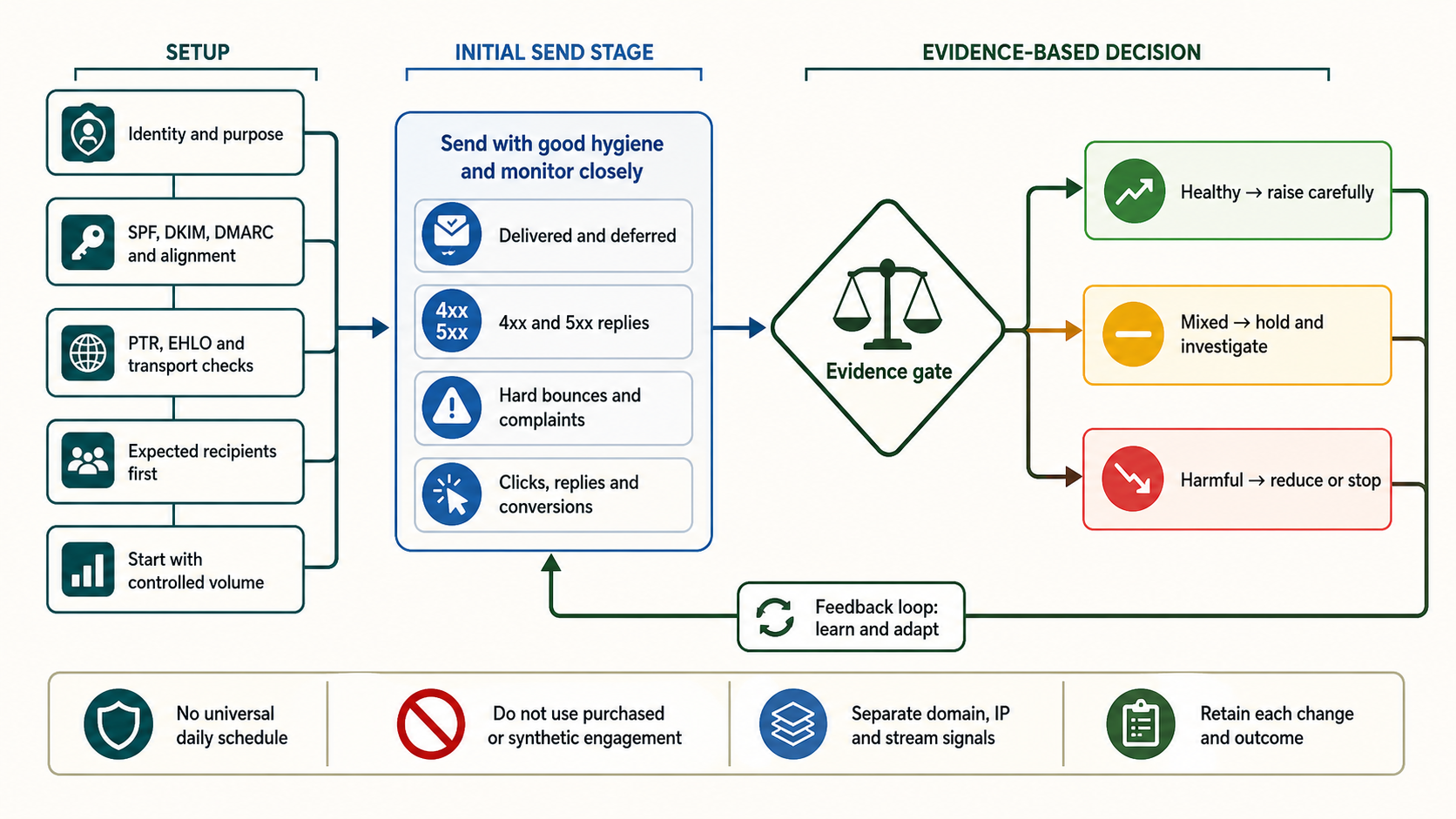
Begin with current wanted recipients and representative message streams. Expand by receiving organization only after stable authentication, SMTP and complaint evidence. Keep From/DKIM identity consistent with the future program; warming with unrelated ultra-engaged mail produces an unrepresentative history.
| Expansion gate | Hold condition |
|---|---|
| Aligned authentication on every route | Any unexplained failure |
| Provider acceptance/latency stable | Persistent policy deferrals |
| Current permission/source quality | Complaint, trap or unknown provenance |
| Feedback/queue ownership working | Missing telemetry or on-call gap |
After a long pause, failover or material stream change, restart conservatively even on a formerly used IP.
Use cross-layer scenarios to train incident diagnosis
| Scenario | Dominant evidence | Wrong shortcut |
|---|---|---|
| Shared IP listed, domain outcomes stable | Pool/receiver impact and provider containment | Move domain immediately |
| Domain complaints rise across IPs | Audience/source/frequency | Buy another dedicated IP |
| One tracking domain compromised | URL/security logs across streams | Change From only |
| One IP has unexpected aligned volume | Credential/MTA security | Assume authentication means approved |
| New domain has no provider data | Coverage and controlled ramp | Label reputation good |
Test infrastructure hypotheses with controlled traffic
Randomly or deterministically split a bounded homogeneous, permissioned cohort across current and proposed routes while holding From/DKIM, content and timing stable. Compare SMTP acceptance/deferral, complaints and business outcomes by receiver. Do not send one route on Monday and another during a weekend peak and call the difference IP reputation.
route_comparison(
  experiment_id, assignment_unit, route_id,
  receiver_org, from_domain, dkim_domain,
  attempted, accepted, deferred, rejected,
  complaints, qualified_outcome, window
)
Stop on safety signals. A route experiment cannot ethically test an unsafe list.
Run an identity-governance review
Quarterly and before major campaigns, reconcile active/standby/retired IPs, PTR/HELO, SPF, DKIM selectors, From/return-path/link domains, provider accounts and owners. Compare observed final messages and DMARC sources with inventory. Remove orphaned credentials and resolve unknown traffic.
Review separation rationale and volume sufficiency. Consolidate unused sparse identities when appropriate. Keep incident and change history so operators understand why a stream was isolated. Revalidate monitoring after ESP, DNS, CDN, tracking or CRM changes.
Worked case: one link domain harms several otherwise separate streams
A company separates promotions and lifecycle mail across different IPs and DKIM subdomains. Both streams begin receiving content-policy rejections at several providers. IP dashboards differ, but final messages share the same tracking redirect domain. Security logs reveal the redirect service was compromised and used for phishing.
The team disables the affected redirect, rotates access, reviews destinations and preserves SMTP/content evidence. It does not warm more IPs or rotate From domains. Controlled messages with a repaired governed link path recover across both streams while complaint and security monitoring remain active.
This case shows that infrastructure separation is incomplete when content assets remain shared. The identity inventory must include links, CDN and landing domains, not only SMTP records.
Keep causal boundaries in reputation reporting
Report observed facts such as “451 policy deferrals increased on IP A at Yahoo,” “complaints rose in source B,” or “domain D declined across two routes.” Avoid statements that a domain has a universal score. For every claim, name provider, identity, stream, window, numerator/denominator and comparison.
| Conclusion | Minimum evidence |
|---|---|
| IP-specific pressure | Other identities on IP and same domain on control IP |
| Domain-specific pressure | Same domain across routes/providers |
| Audience cause | Cohort/source complaints or recipient quality |
| Technical cause | Change timeline and reproducible auth/route failure |
Approve identity changes with evidence
Any new IP, From/DKIM/return-path/link domain or pool assignment needs purpose, owner, expected provider volume, authentication/security tests, monitoring, ramp, rollback and retirement plan. Save a final received artifact from each material route.
Emergency changes expire and receive post-incident review. Do not leave temporary domains, relaxed rate limits or shared credentials in production. Compare the change against the layered inventory and ensure support/deliverability teams know the new identities before launch.
Final review
Before declaring recovery, verify wanted volume remains stable across more than one provider reporting period, queues and replies return to baseline, complaints/source quality are corrected, authentication is unchanged and no traffic moved evasively. Record remaining unknowns and the next scheduled identity review.
Evidence retention
Retain representative raw messages, SMTP replies, identity snapshots, provider extracts, complaint/source analysis, security findings, corrective releases and recovery windows under controlled retention. Screenshots alone are insufficient because they omit query, domain, date and coverage context.
Record review date
Store the UTC review date, accountable owners and next identity-inventory audit.
Sign-off
Approve only with current evidence and accountable ownership.