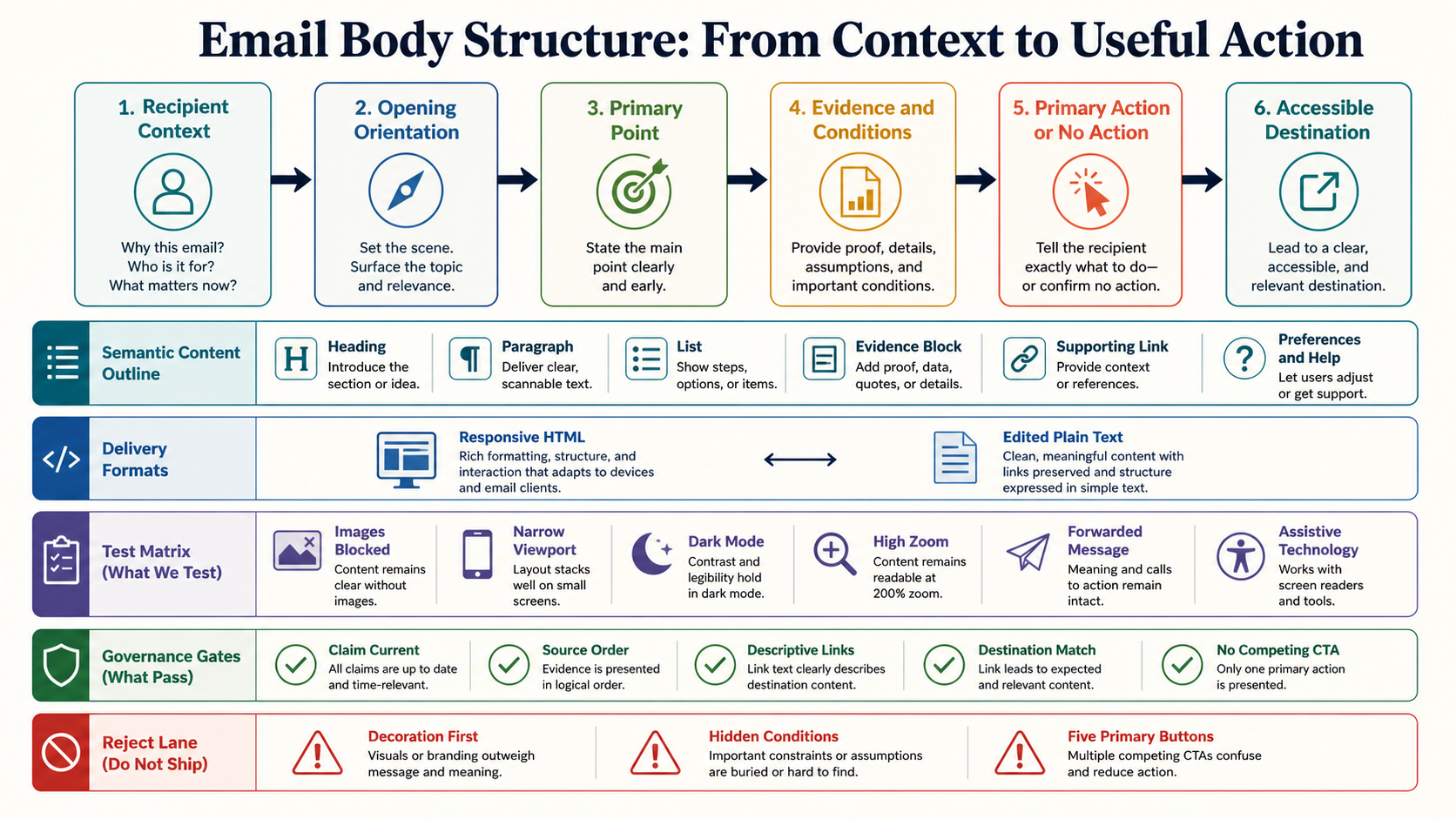
Email Subject Line Strategy: Clarity, Testing and Trust
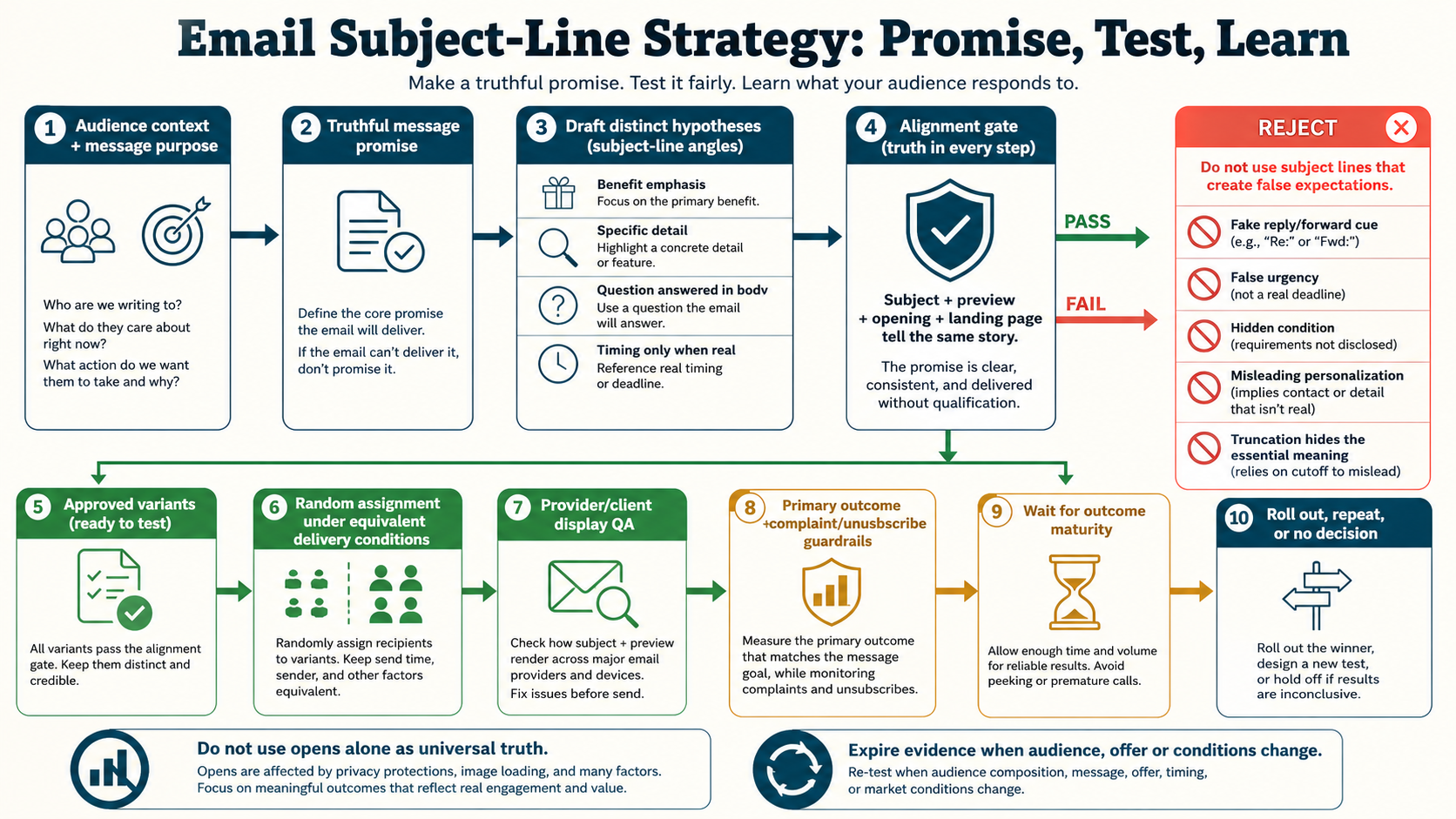
An email subject line is a compact promise shown in a mailbox interface. It should help the intended recipient decide whether the message is relevant now, while accurately representing the sender and content. There is no universal winning length, word list, punctuation rule or AI score. Strategy combines audience context, purpose, claim evidence, preheader coordination, client constraints, controlled testing and downstream outcomes such as qualified action, complaints and unsubscribes.
Define the subject line’s decision job
The subject is not the whole campaign. It identifies the topic, consequence or useful question at the inbox boundary. The From identity establishes who is speaking; the preheader can add context; the body and destination must fulfill the same promise. Write all four together.
A service alert, receipt, editorial issue, product lesson and promotion have different jobs. A security message should prioritize recognition and action, while a newsletter can preview its strongest topic. Do not disguise one purpose as another.
Collect message and audience inputs before drafting
| Input | Question |
|---|---|
| Audience | What relationship and current state exist? |
| Message purpose | What should the recipient understand or decide? |
| Value | Which concrete benefit or consequence is supported? |
| Conditions | Which date, eligibility, price or limitation is material? |
| Evidence | Which claim can the message actually fulfill? |
| Context | What has the sender already promised or sent? |
Without these inputs, brainstorming produces generic attention phrases rather than strategy.
Use patterns as drafting lenses, not magic formulas
| Pattern | Appropriate use | Risk |
|---|---|---|
| Direct value | Clear guide, update or benefit | Overpromising outcome |
| Specific question | Reader can recognize situation | Loaded assumption |
| News or change | Material current update | Calling routine content breaking news |
| Deadline | Real documented cutoff | Fake or reset urgency |
| Curiosity | Useful mechanism remains unanswered | Hiding offer or terms |
| Personal context | Reliable declared or account state | Inaccurate or invasive inference |
Prefer bounded specificity over vague excitement
Name the subject, audience consequence or next step as specifically as the inbox space allows. “Your August invoice is ready” is clearer than “Important update.” “Why Yahoo is deferring this route” creates a bounded technical question; “The secret they do not want you to know” does not.
Specificity requires truth. A number needs a defined list or method, a result needs scope and a deadline needs real behavior after expiry. Do not force a numeral into every subject merely because listicles once tested well.
Treat length as a client and content constraint
Clients show different amounts based on device, window, font, sender length and interface. Character count is not a semantic quality score. Put distinguishing information early where practical, remove filler and test the real sender, subject and preheader combination on representative devices.
A short vague subject can be worse than a longer clear one. Do not truncate necessary safety or account meaning merely to meet a five-to-eight-word rule. Localized text may expand, and some languages communicate differently within the same space.
Coordinate the preheader instead of repeating
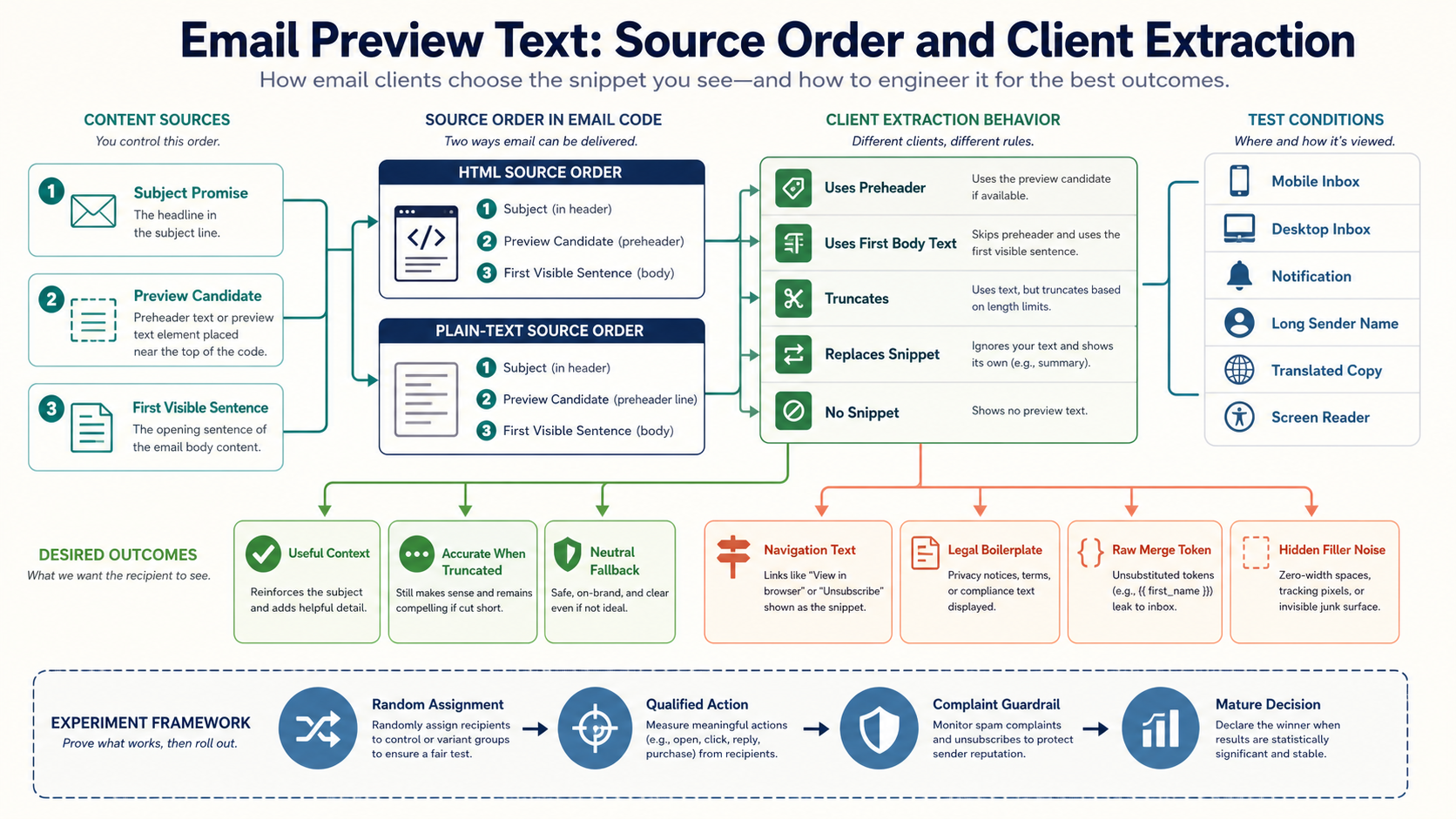
The preheader can add a condition, example, timing or secondary benefit. It should not repeat the subject word for word or expose hidden housekeeping text. Review how clients combine From name, subject and preview so the line remains coherent when truncated.
subject:  DMARC aggregate reports: the first checks
preheader: Separate alignment, source volume and unknown senders.

subject:  Your order shipped
preheader: Track two packages and review the revised arrival window.
The body opening must confirm both promises immediately.
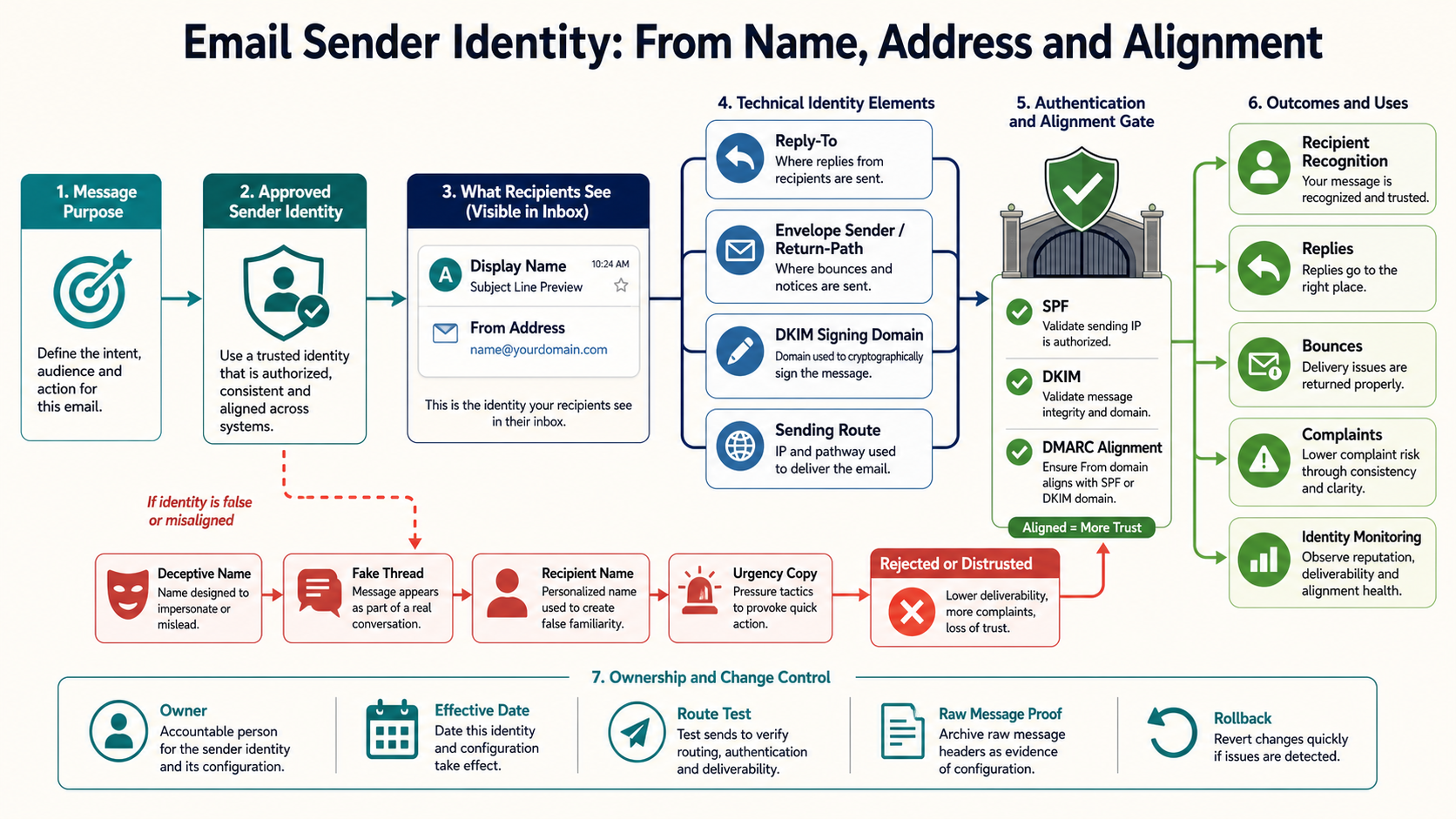
Keep sender identity and conversation state accurate
Do not start with Re: or Fwd: unless the message is an actual reply or forward. Do not imitate verification badges or mailbox controls with Unicode characters. The From name should be recognizable and consistent with the subscribed brand or service relationship.
A personal name can help when that person genuinely owns the communication and replies are monitored. Pretending bulk automation is a private conversation can increase distrust. Test sender and subject changes separately when the goal is to understand each effect.
Use curiosity with an explicit payoff
Leave the mechanism, comparison or result open while identifying the topic and value. Do not conceal the product, price, renewal or essential condition merely to force an open. The body should resolve the subject’s main question before requiring an unrelated action.
Curiosity often increases measured attention but can reduce qualified outcomes when the audience is broad or the payoff is weak. Include complaint and unsubscribe guardrails and inspect destination behavior.
Validate urgency, scarcity and timezones
subject_claim review:
  source_of_truth and claim owner
  eligible population and real inventory or capacity
  start, expiry and timezone
  behavior after expiry
  body and destination consistency
Only state last chance when it is genuinely the final opportunity for that person and offer. A countdown that resets or a sale that continues unchanged is misleading. Account and safety deadlines should be clear without promotional alarm.
Personalize only from reliable appropriate data
A first name may be missing, misspelled, shared or inappropriate. More useful personalization often reflects declared topic, product, account status or lifecycle, but subject lines are highly visible on locked screens and shared mailboxes. Do not expose sensitive purchases, health, finance or internal scores.
Define a neutral fallback and test every field boundary. An event such as a click may come from a scanner or forwarded message; do not write “you viewed” unless identity and behavior support that claim.
Use punctuation and Unicode for meaning, not imitation
Normal punctuation and relevant characters can be readable, but excessive capitals, repeated exclamation marks and decorative symbols consume space and harm accessibility. Rendering varies across platforms and fonts. Do not use characters to mimic replies, security status, checkboxes or verified identity.
Encode headers correctly and inspect the received message for broken characters. Internationalized content needs appropriate language, normalization and bidirectional review. A “spam word” list cannot replace correct claims and permission.
Write service and transactional subjects precisely
Identify the account event without exposing excessive data: receipt, password reset, shipment, security alert, terms change or support update. State required action and timing when real. Keep promotional copy out of critical subjects and avoid vague urgency that resembles phishing.
Test that body, links and sender identity support recognition. For suspicious or high-risk actions, direct the customer to a known account route and explain how to get help. Do not ask for secrets by email.
Review readability and cognitive load
Use plain language, familiar terms and enough context for the intended audience. Avoid wordplay that makes sense only visually or culturally when the action is important. Screen readers will announce punctuation and symbols differently, so decorative sequences can become noise.
Subject meaning should not depend on color, image or preheader alone. Localize for meaning rather than literal length and test with actual language reviewers. The destination must remain keyboard and assistive-technology usable.
Separate subject effects from deliverability myths
Mailbox providers use multiple identity, reputation, authentication, traffic and recipient-feedback signals. There is no public universal list of words that automatically sends legitimate mail to spam. Misleading headers and subjects can violate current guidance and drive complaints, but changing “free” to another word does not repair poor acquisition.
Before diagnosing a subject, check assignment, provider acceptance, deferral, rejection, queue age and available placement evidence. Client mix and privacy fetching can change opens without a copy effect.
Use AI generation within a claim-controlled workflow
Provide the model with approved audience, purpose, facts, exclusions, tone and exact constraints. Ask for distinct hypotheses rather than dozens of near-identical lines. Reject invented statistics, false urgency, unsupported personalization, fake reply language and claims the body cannot fulfill.
Human reviewers remain responsible for truth, privacy, accessibility and brand. Do not upload sensitive recipient or customer data to an unapproved tool. AI scoring based on historic opens inherits client privacy, audience selection and campaign confounding; treat it as a hypothesis, not predicted truth.
Design a subject-line experiment correctly
Randomize eligible recipients at the right unit, use simultaneous or appropriately blocked delivery, hold From name, preheader, body, offer and route stable, and declare one primary outcome. Estimate sample from baseline and minimum meaningful effect. Check sample-ratio mismatch and provider balance.
subject_test:
  hypothesis and exact variants
  assignment unit, sample plan and send window
  qualified primary outcome and maturity
  complaint and unsubscribe guardrails
  provider, client and data-quality checks
  rollout or stop decision
Raw opens should not be the sole primary outcome because privacy fetching and image blocking distort the event.
Choose outcomes beyond open rate
Qualified click, reply, conversion, task completion, retained value, complaint and unsubscribe reveal whether the promise attracted the right attention. For editorial mail, a qualified read proxy or downstream content use may fit. For service mail, correct task completion and support burden matter more than promotion.
Use intention-to-treat analysis for the subject package. A treatment that causes more filtering or complaints should not be evaluated only among accepted or opened recipients. Keep attribution separate from experimental lift.
Diagnose a subject-line result in order
- Confirm assignment, sample ratio and eligibility.
- Check provider transport and send-time balance.
- Review From, subject and preheader rendering.
- Compare client and privacy-open mix.
- Inspect qualified clicks, replies and destination behavior.
- Check conversion maturity and negative outcomes.
- Review audience and competing campaign exposure.
If the open winner loses qualified conversion or raises complaints, do not roll it out as the winner.
Worked case: the open-rate winner loses the decision
Variant A says “Your renewal options for September.” Variant B says “Do not lose access tonight.” The actual renewal window remains open for 14 days. B reports more opens, but support contacts show confusion, cancellations rise and no incremental renewals appear after maturity.
The team stops B because its urgency is false and the business outcome is worse. A revised test compares two truthful frames: continuity planning versus plan comparison. Primary outcome is completed informed renewal, with support and complaint guardrails. The subject, preheader and account page all use the same deadline.
The case shows why opens cannot excuse an inaccurate promise.
Maintain a subject-line evidence library
Store exact subject, preheader, From identity, audience, purpose, hypothesis, body and destination versions, send context, experiment design, mature outcomes and guardrails. Label patterns by context rather than “winner.” A line that worked for a weekly editorial audience is not evidence for a billing alert.
Expire lines tied to old prices, products, dates or proof. Record negative tests and complaint patterns so teams do not repeatedly rediscover harmful curiosity and urgency.
Subject-line production checklist
- The intended audience and message purpose are explicit.
- The subject accurately represents body and destination.
- The preheader adds context without contradiction.
- Length was tested in real inbox combinations.
- Identity and reply state are not imitated.
- Personalization is accurate and safe on visible screens.
- Numbers, urgency and scarcity have current evidence.
- Accessibility and localization are reviewed.
- Experiment design controls other message elements.
- Rollout uses qualified mature outcomes and recipient guardrails.
A strong subject line earns the right open from the right person and keeps the promise after the inbox.
Review the whole inbox presentation matrix
A subject appears beside the From name, sender address, avatar or brand indicator, date, labels and preview text. Its visible length changes by client, device, font and window. Test the complete combination, not a spreadsheet cell. Include narrow mobile, desktop, webmail, dark mode, localization and accessibility review.
| Element | Failure to catch |
|---|---|
| From name | Subject repeats brand or loses identity |
| Subject | Important distinction truncates |
| Preheader | Contradiction, repetition or hidden filler |
| Date and threading | False conversation or stale context |
| Mobile lock screen | Sensitive information exposure |
Capture the received header and screenshots with version evidence. Preview tools support quality assurance but do not predict opens or placement.
Plan samples from a decision threshold
Estimate baseline qualified outcome, minimum meaningful absolute effect, desired false-positive control, power and expected attrition before launch. The sample needed for a rare conversion is much larger than for an open. If traffic cannot support the decision, reduce variants or test a higher-frequency qualified outcome without pretending it is the business result.
Use simultaneous randomized assignment or block by time when capacity requires staged sending. Check provider, lifecycle and source balance. Stop harmful variants on complaint or deception guardrails, but do not repeatedly peek at ordinary results and declare a winner at the first favorable point.
Report achieved sample, maturity, interval and practical impact. “No significant difference” does not prove two subjects are equivalent unless the design supports that conclusion.
Separate subject performance from provider treatment
Before interpreting opens, compare assigned, attempted, accepted, deferred, rejected and expired recipients by provider and variant. A message-size or content difference can affect filtering, and send-time imbalance can expose variants to different provider conditions. Preserve full SMTP replies and queue age.
Open and click collection also varies with client distribution. Report privacy-prefetch and image-blocking limitations. If one variant’s audience contains more Apple Mail or one provider, raw open comparison can mislead even after correct randomization when analysis filters post-assignment populations.
Keep intention-to-treat for the decision and use delivery/client segments as diagnostics. Do not remove failed deliveries to make a subject appear stronger.
Respond to a misleading or incorrect subject release
Pause the affected campaign or variant and preserve assignment, exact headers, body, destination and provider acknowledgments. Determine whether the defect is a claim, wrong segment, expired deadline, exposed sensitive data, template mismatch or stale business state. Apply current suppressions and cancel waiting messages.
Do not automatically resend a corrected subject to everyone. Decide whether the correction is necessary, expected and safe, then exclude recipients who completed the action or opted out. If sensitive information was exposed, coordinate with security, privacy and support owners.
Update claim evidence, regression fixtures and the subject library. Count attempted and accepted messages, complaints, support impact and downstream confusion. A copy correction is incomplete while a scheduled old variant remains active.
Audit subject strategy by promise and mature outcome
Quarterly, sample service, editorial, lifecycle and promotional subjects. Reconcile each with audience, permission, From identity, preheader, body, destination and evidence. Find false reply prefixes, expired numbers, unsupported personalization, recurring fake urgency and AI-generated sameness.
Review experiments after conversion, refund and complaint maturity. Compare subject pattern by context, not one global open-rate ranking. Inspect whether the “winner” attracted the intended action and whether future engagement or unsubscribe changed. Remove raw-open leaderboards that ignore client privacy and audience mix.
Close findings by updating approved patterns, prohibited claims, test design and active workflows. Assign expiration to deadline and product-specific lines. The audit should reduce repeated folklore and improve the truth of the running program.
Bind the tested subject to the actual production artifact
Store exact encoded Subject header, From identity, preheader, body, destination, audience and assignment versions. ESP interfaces can trim whitespace, insert personalization or alter encoding, so inspect the received artifact. If a deadline, price or product field changes, create a new version and revalidate the claim.
Protect variants from last-minute edits after randomization. An emergency correction should stop or create a clearly labeled new treatment, not overwrite the record under test. Reconcile message IDs and assignments so provider and outcome evidence maps to what was actually sent.
Archive winning and losing variants with context, mature results and limitations. Version control prevents a phrase from becoming folklore detached from the audience and promise that produced the result.
Final subject-line release approval
The owner should read From name, subject, preheader, first paragraph and destination as one promise. Verify claims, personalization, deadline, sensitive visibility, encoding and localization. Attach the sample plan, primary qualified outcome, maturity, provider checks, complaint threshold and stop authority.
Run received-message checks through the production route and confirm that body and account state support the line at dispatch. Cancel variants when the underlying event, inventory or offer expires. Do not approve a subject whose success depends on a misleading reply state, fabricated urgency or an open-only metric.
Approval applies to the defined version and population. Material content, audience or product changes require review again.
Retire subjects tied to expired facts
Deadline, price, feature, event and performance subjects need an expiry in the content system. When the underlying condition ends, cancel scheduled and recurring uses, update templates and verify that regional copies no longer carry the claim. Preserve the historical experiment artifact, but do not keep it in an evergreen swipe file without the conditions that made it true.
Primary references
- Gmail email sender guidelines
- Apple Mail Privacy Protection
- RFC 5322 Internet Message Format
- FTC dark patterns report
- W3C writing for accessibility