Email Hooks and Open Loops: Earn Attention Without Clickbait
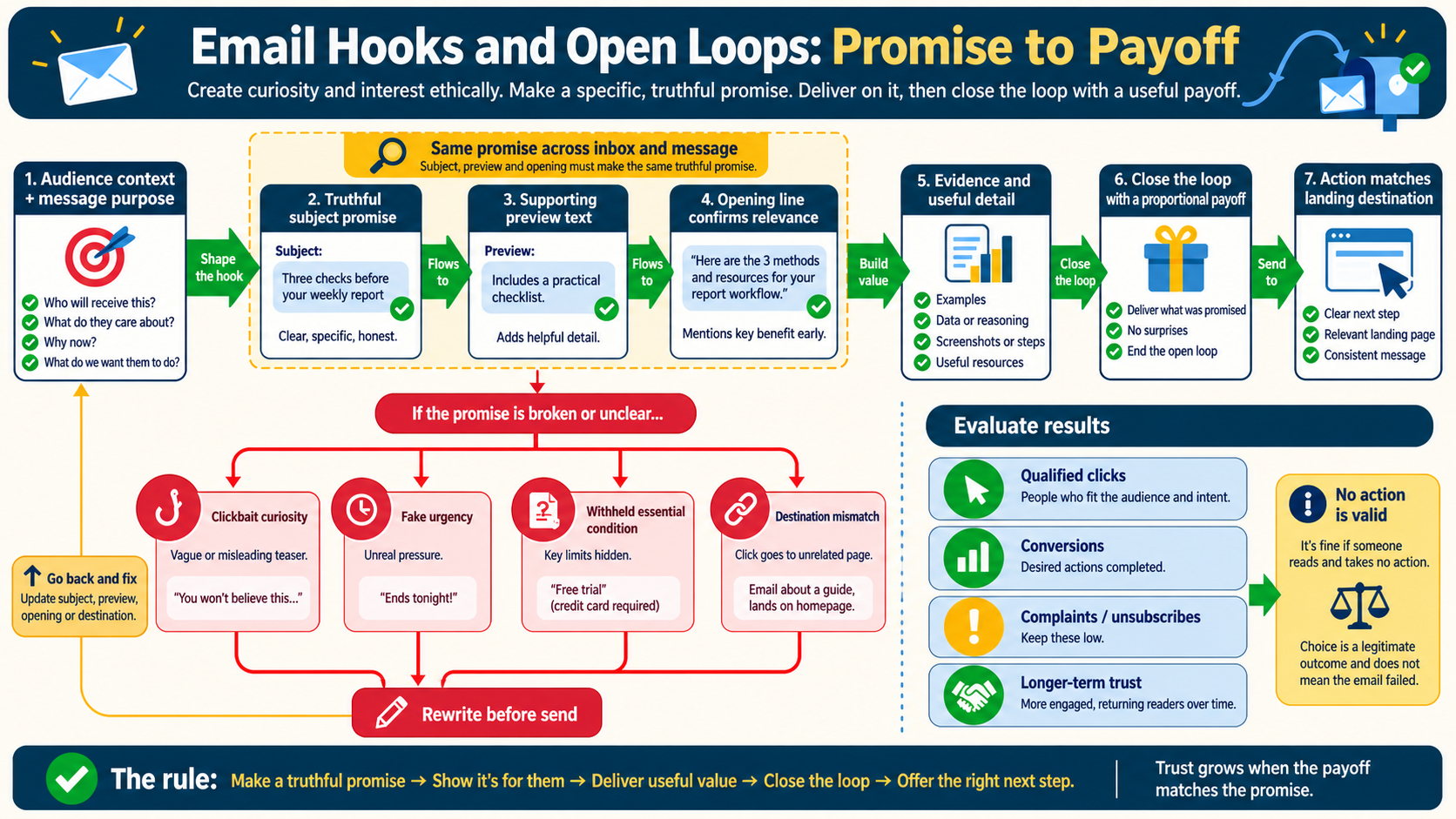
An email hook earns attention by making the next line useful to the intended reader. An open loop delays part of an answer so the reader has a reason to continue, but it creates a debt: the message must deliver the promised payoff at the right place and in proportion to the claim. Curiosity without relevance becomes noise; curiosity without resolution becomes clickbait; urgency without a real constraint becomes deception.
Define what the hook must do
The subject line earns an informed open, the preheader adds context, and the opening earns continued reading. They are connected but not interchangeable. Start from the audience’s current question and the message’s actual value. A useful hook establishes relevance, a credible promise or a meaningful tension without hiding material facts.
Do not optimize the hook separately from the body and destination. A dramatic first line followed by an unrelated offer can raise short-term attention while damaging complaints, unsubscribes and future trust.
Anchor attention in a real audience situation
A hook for a new subscriber, an active customer, a technical evaluator and a lapsed buyer should not sound the same. Record the lifecycle state, declared interest, source promise and likely decision. Relevance comes from matching that context, not inserting a first name or making an unsupported personal claim.
Write the question the reader can reasonably ask now. If the message cannot answer it, choose another angle. An audience segment built from weak inferred data needs a neutral formulation rather than false certainty.
Choose a hook pattern that fits the evidence
| Pattern | Use | Required proof |
|---|---|---|
| Specific problem | Name recognizable friction | Audience relevance |
| Unexpected observation | Challenge a real assumption | Data, example or reasoning |
| Question | Invite self-diagnosis | Answer in the message |
| Outcome preview | Show useful destination | Accurate scope and conditions |
| Story in motion | Open at a consequential moment | Truthful resolution |
Pattern interrupt is not permission to shock, insult or fabricate a mistake.
Design and close an open loop
context -> unresolved useful question -> evidence
        -> explanation -> proportional payoff -> next action

subject + preheader + body + link must remain aligned
Keep the delay short enough that the reader can evaluate the message. Resolve the main promise inside the email when possible; use the link for depth, a tool or an action, not to conceal the basic answer. Nested unanswered loops increase cognitive load and can feel manipulative.
Create a promise ledger before editing copy
| Element | Promise | Resolution |
|---|---|---|
| Subject | Reason to consider opening | Opening confirms topic |
| Preheader | Additional context | Body addresses detail |
| Opening | Useful question or tension | Evidence and explanation |
| CTA | What happens after click | Destination matches |
Review the ledger as a recipient would. If a payoff appears only after purchase or data capture, disclose that requirement before the click.
Rewrite vague curiosity into bounded specificity
| Weak or risky line | Better direction |
|---|---|
| This changed everything | Name what changed and for whom |
| You are making this mistake | Describe the observable condition |
| Only hours left | State the real deadline and consequence |
| Secret providers hate | Explain documented receiver behavior |
| Delete this email | Lead with the relevant decision instead of a trick |
Clarity can still create curiosity. The unanswered part should be the useful mechanism or result, not the identity of the offer.
Use questions that respect the reader’s knowledge
A question works when the reader can recognize the situation and expects a useful answer. Avoid loaded questions that assert failure, shame the reader or imply knowledge the sender does not have. “Which retry boundary is creating delay?” is more useful than “Why are you still doing delivery wrong?”
Answer the question with evidence, options and limitations. A question that exists only to push a link is not a real opening. If several questions are necessary, establish one primary thread and organize the rest as supporting decisions.
Earn surprise with contrast and evidence
An unexpected observation can break routine when the contrast is true and material. State the baseline, changed condition and evidence. Avoid absolute claims such as “everything you know is wrong” unless the message can support that extraordinary scope, which it usually cannot.
Surprise can come from a counterexample, a hidden denominator, a failure mode or a customer constraint. It does not require exaggerated percentages. When a number is used, preserve source, population, period, definition and uncertainty.
Keep deadlines and scarcity auditable
A real registration cutoff, inventory limit, contract date or service window can support urgency. Record the source of truth, timezone, affected audience and post-expiry behavior. The copy should explain the consequence without inventing danger. A resetting countdown or an offer that remains unchanged after “last chance” destroys the premise.
Urgency is not appropriate for every audience or decision. High-risk, health, financial and security contexts require special care and may need service-first clarity rather than promotional pressure.
Open a story at a meaningful change
A story hook can begin at the moment a decision, error or observation changes the expected path. Give enough context to understand who, what and why without withholding the basic truth. Composite or anonymized cases must be labeled appropriately; customer outcomes need permission and accurate conditions.
Resolve the narrative with the lesson the opening promised. Do not turn a minor anecdote into universal proof. The action should follow from the insight, not interrupt the story with an unrelated sales pitch.
Design the first screen as one coherent promise
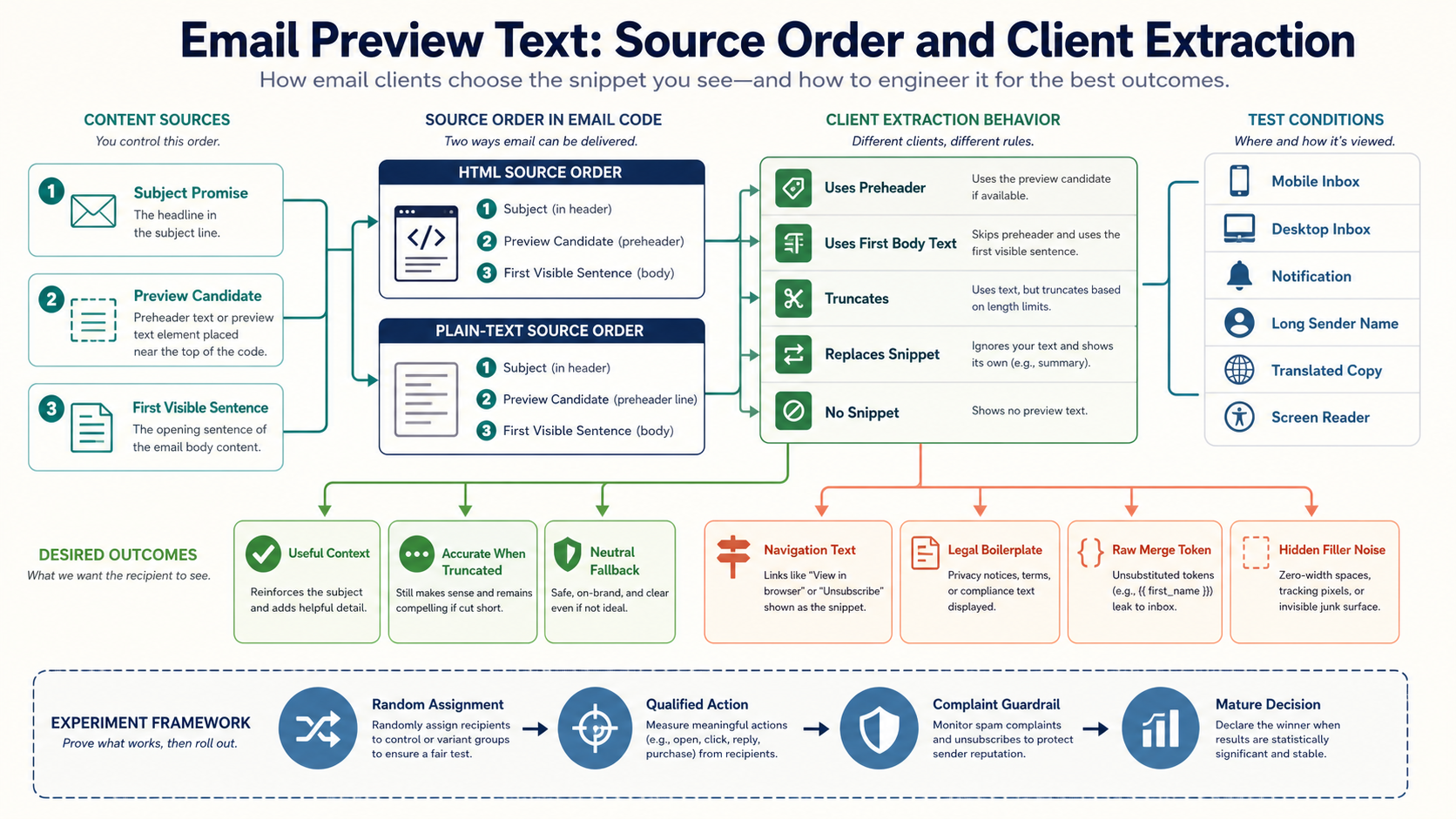
Inbox view may include From name, subject and preheader; the opened first screen may add logo, heading, opening and primary action. Review them together for repetition, contradiction and wasted space. A preheader that repeats the subject contributes nothing, while hidden filler can create confusing snippets.
Place enough value early for mobile and assistive-technology users, but do not force every message into an “above the fold” rule. Reading behavior varies, and important conditions should not be buried merely to keep a button high.
Make the opening easy to perceive and understand
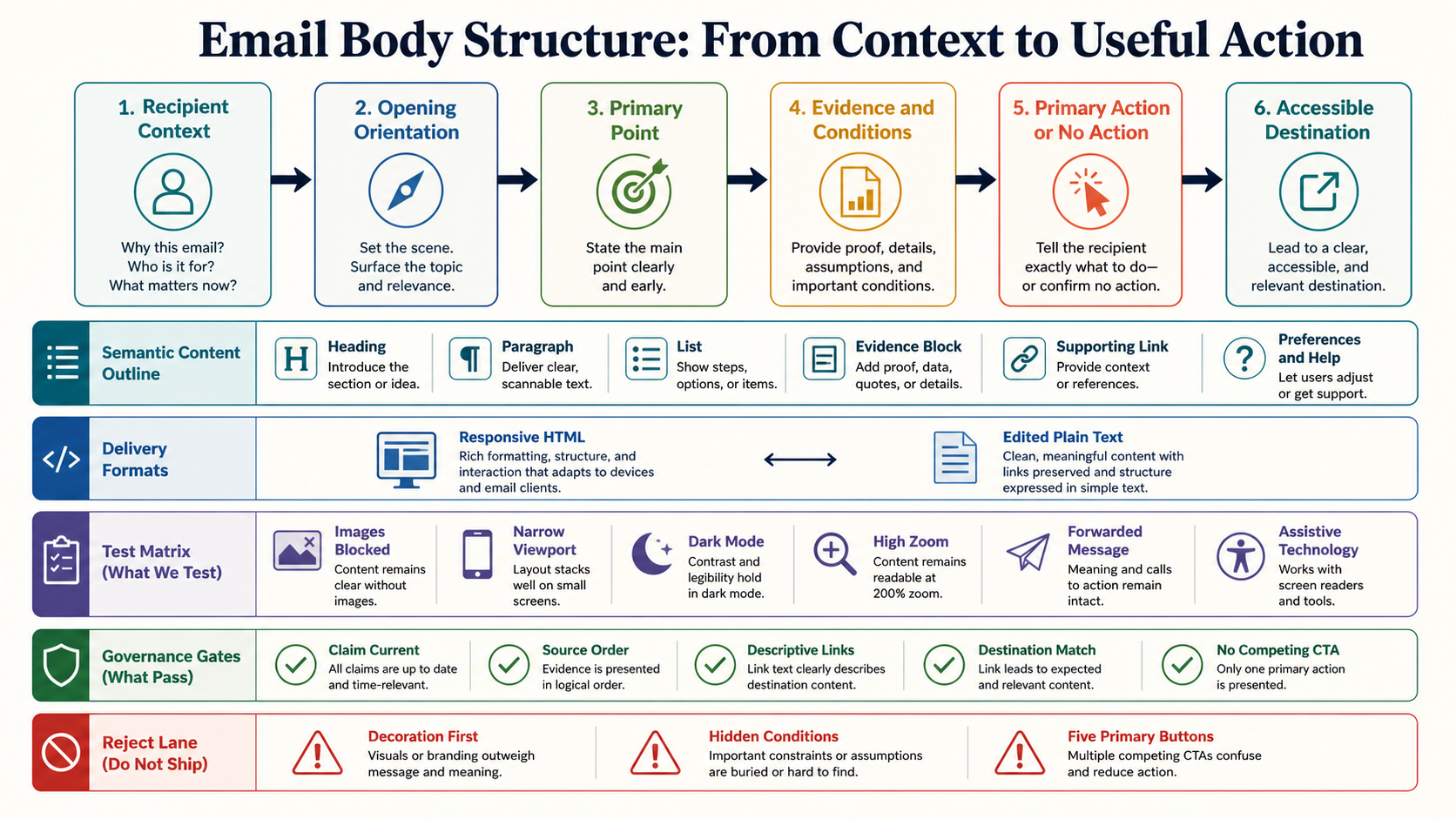
Do not rely on an image, color, animation or unusual typography to carry the hook. Use semantic headings where structure is needed, meaningful link text and a plain-text alternative. Avoid long all-capitals, excessive punctuation and character tricks that reduce readability or imitate mailbox interface elements.
Write concise sentences without reducing technical accuracy. Provide alt text for informative images and null alt for decoration. Test zoom, reflow, dark mode, images off and keyboard access to the destination.
Do not confuse copy performance with placement
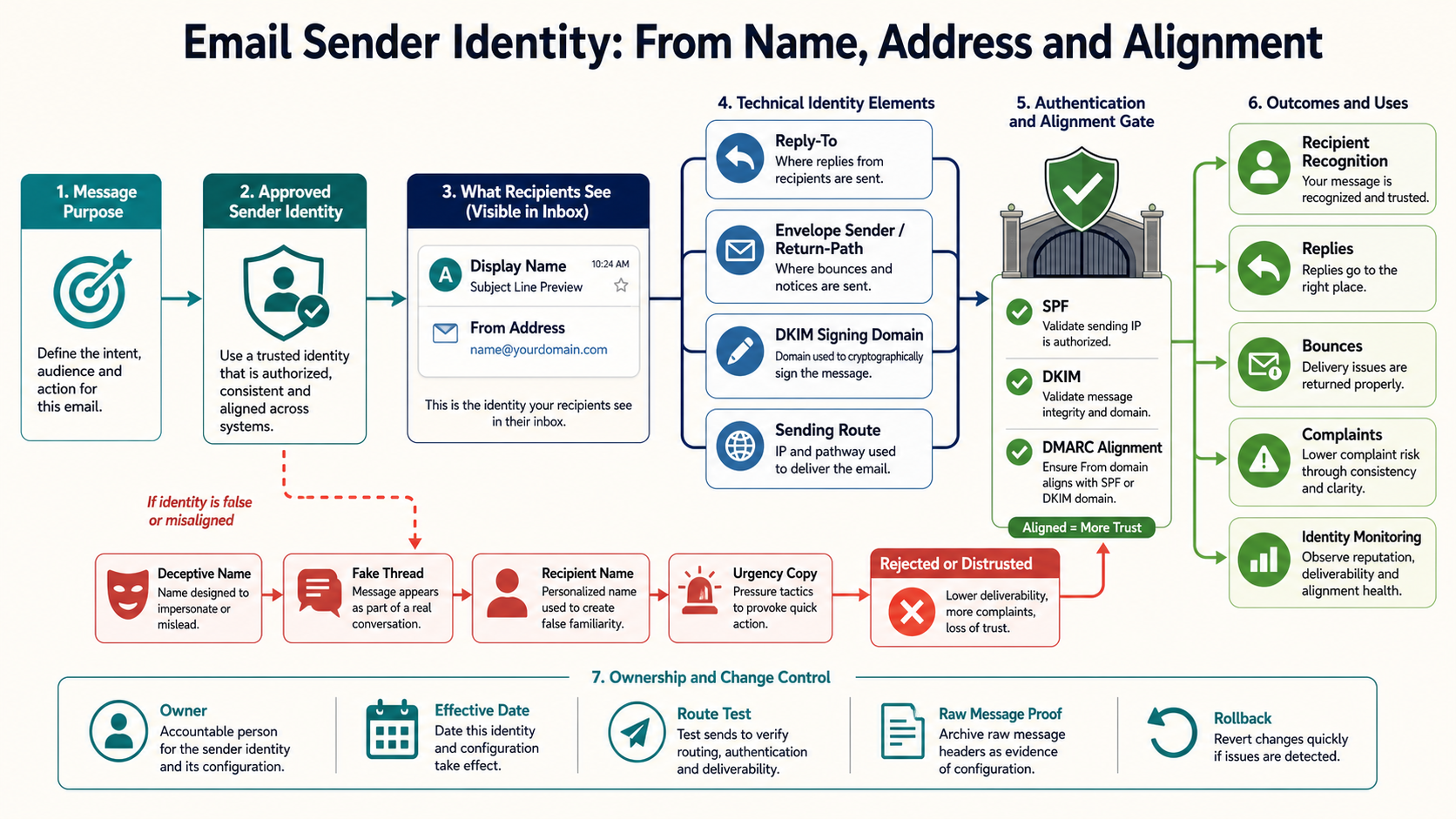
A subject line does not independently determine inbox placement. Receivers evaluate authentication, identity, reputation, recipient feedback, traffic behavior, content and many proprietary signals. Misleading subjects, hidden content and deceptive sender identity can violate current guidance and increase complaints, but a list of “spam words” is not a diagnostic model.
Segment acceptance, deferral, rejection and complaint evidence by provider before judging the hook. A drop in opens can be a transport, placement, client-privacy, audience or measurement change rather than copy.
Test the promise, not only the open
Randomize eligible recipients, choose one primary outcome and keep subject, From identity, preheader, body and landing-page versions traceable. Open data is distorted by privacy fetching and image blocking. Use qualified clicks, replies, conversion, holdout lift, complaint and unsubscribe with appropriate maturity.
hook decision record:
  audience and hypothesis
  exact subject, preheader and opening
  promised payoff location
  primary outcome and guardrails
  assignment, sample, maturity and result
If a hook wins opens but loses qualified outcomes or increases complaints, it did not win the business decision.
Diagnose a weak opening at the earliest boundary
- Confirm eligibility, assignment and audience mix.
- Check provider acceptance, deferral and placement evidence.
- Review From identity, subject and preheader rendering.
- Compare opening-to-body promise alignment.
- Inspect qualified click and reply classification.
- Check destination speed, message match and conversion.
- Review complaints, unsubscribes and support feedback.
Do not rewrite the opening when a broken link, wrong segment or delayed provider queue explains the outcome.
Worked rewrite: curiosity hides the useful answer
A campaign uses the subject “The mistake costing you thousands” and opens with “Most teams never see it.” The body finally reveals that incomplete SPF authentication is the topic, then sends the reader to a generic sales form. The copy assumes financial loss, delays the answer and provides no technical verification.
The rewrite names the situation: “When SPF lookup count breaks authentication.” The preheader adds “A safe way to inspect includes and redirects.” The opening explains the 10-lookup processing limit context and points to a practical check, while the CTA offers a deeper implementation guide. The hook still creates a question about the domain’s path, but the payoff is immediate and proportionate.
Testing uses qualified guide use and remediation, not opens alone.
Run a claim and payoff review
- Identify every explicit and implied claim.
- Confirm audience, evidence, scope and material conditions.
- Locate the payoff for each unanswered question.
- Verify subject, preheader, body and destination alignment.
- Remove fabricated urgency, scarcity and interface imitation.
- Check accessibility without images and with zoom.
- Review personalization and identity confidence.
- Define outcome, guardrails and maturity before release.
Have a reviewer unfamiliar with the draft state what they expect after each line. Differences reveal hidden assumptions.
Maintain a tested hook library with context
A library should store the exact copy, audience, message purpose, hypothesis, body and destination versions, send context, experiment design, mature outcomes and negative signals. Do not label phrases as universal winners. A hook that worked for one relationship and offer can fail elsewhere.
Retire claims when products, terms or evidence change. Restrict AI-assisted generation to reviewed drafts: models can create plausible but unsupported claims, false personalization and repetitive curiosity patterns. Human approval remains responsible for truth and recipient impact.
Email hook production checklist
- The opening serves a real audience question.
- The promise is accurate, bounded and relevant.
- Every open loop has a timely proportional payoff.
- Material terms appear before the action.
- Urgency and numbers have current evidence.
- Personalization does not overstate identity knowledge.
- The message works without images and supports accessibility.
- Provider and audience changes are separated from copy effects.
- The test uses qualified outcomes and recipient guardrails.
- The final destination completes the same promise.
The strongest hook is not the loudest line. It is the shortest truthful path from current reader context to useful evidence.
Run a hook workshop from evidence to variants
Begin with an approved message brief: audience state, current question, value, evidence, material conditions, destination and desired action. Ask writers to produce distinct hypotheses, not twenty synonyms. One might lead with a specific problem, another with an unexpected observation and another with a direct outcome. Label the promise and payoff for each.
Review variants aloud with From name and preheader. Remove claims unsupported by the body, assumptions about personal behavior, false deadlines and empty teaser phrases. Have someone outside the drafting team state what they expect after opening and after clicking; mismatches expose ambiguity.
Choose only variants that remain truthful under truncation and image blocking. Archive rejected patterns and reasons. The workshop output includes exact copy, evidence owner, test hypothesis and guardrails, not a subjective ranking of “catchiness.”
Localize the promise, not just the words
Curiosity, humor, idiom and directness vary by language and culture. Give translators the audience, message job, evidence, payoff and constraints rather than a subject string alone. Let them rewrite the mechanism while preserving claim scope. Review local deadlines, currency, examples and reading direction.
Do not force the translated opening into the original character count if clarity suffers. Test the real From, subject, preheader and first screen on representative clients. Wordplay may need a different hook, while safety and service messages should prioritize unambiguous action.
Use local reviewers to flag offense, shame, superstition or pressure that the source team misses. Preserve each locale as a versioned treatment; do not combine outcomes as if the copy were identical.
Control AI-assisted hook generation
Supply approved facts, audience, forbidden claims, tone, material conditions and exact destination. Ask for several structurally different drafts with a stated promise and payoff. A model can easily invent a percentage, imply that the recipient performed an action, create fake urgency or reuse tired phrases. Require a human to verify every explicit and implied claim.
Do not provide personal recipient data or confidential customer cases to an unapproved tool. Store the instruction and model or workflow version when it materially shapes production copy. Deduplicate generated variants against recent campaigns so automation does not create repetitive “one mistake” messages across every program.
AI performance scoring is not proof. Historical opens inherit privacy and selection bias. Put reviewed variants into the same controlled experiment and recipient-safety process as human drafts.
Release high-attention copy under reputation controls
A dramatic hook can change complaints and downstream behavior even when volume is unchanged. Forecast the target by provider, acquisition source and lifecycle state. Start with an appropriate bounded cohort and monitor full SMTP outcomes, complaints, unsubscribes, qualified actions and destination errors. Keep a journey or variant kill switch ready.
| Alert | First response |
|---|---|
| Complaint concentrated in one source | Stop source cohort and inspect expectation |
| Opens rise, qualified actions fall | Review promise and privacy/client mix |
| Clicks rise, conversion falls | Inspect scanners and destination match |
| Provider deferrals rise | Check volume, route and identity changes |
| Support says message is misleading | Pause variant and audit claim |
Do not keep a harmful hook live to reach statistical significance.
Evaluate the hook after outcomes mature
Reconcile assignment, acceptance, qualified clicks or replies, conversion, refunds, complaints and unsubscribes. Compare treatment with holdout or controlled variant and report uncertainty. Inspect whether the promised payoff was used, whether the destination continued the same message and whether a subgroup experienced a different claim.
Read qualitative evidence from replies and support under appropriate controls. Complaints such as “misleading,” “not relevant” or “already completed” map to claim, audience and state defects. Fix that boundary instead of replacing one curiosity phrase with another.
Record the conclusion in a contextual library: effective for which audience, purpose and evidence, with which negative outcomes. Retire hooks tied to expired facts. A mature no-lift result is valuable because it prevents repeated pressure and unsupported folklore.
Keep copy and outcome evidence joined by immutable versions
Assign an identifier to the exact From name, subject, preheader, opening, body, CTA and destination combination. Store audience and eligibility version, assignment, send window and classifier. If an editor changes one line after assignment, create a new artifact instead of rewriting the version under test.
Join provider acceptance, measured opens, raw and qualified clicks, destination sessions, conversions, complaints and unsubscribes at recipient or account grain. Preserve unknown states and maturity. This allows the team to distinguish a copy change from a route, audience, privacy-client or landing-page change.
Restrict recipient-level data and publish aggregate evidence. A hook library without artifact and audience versions turns correlation into folklore.
Final hook and open-loop approval
Before send, read the subject, preheader, opening and payoff without design. State every explicit and implied claim, the evidence behind it and where it resolves. Confirm material conditions appear before the action and that the destination continues the same promise. Test images off, truncation, localization and assistive use.
Attach the experiment plan, qualified outcome, complaint and unsubscribe guardrails, provider forecast, stop authority and observation window. Reject any variant that needs a fabricated statistic, personal assumption, fake reply or deadline to create interest.
After the test, keep the winner only for the context supported by evidence. Remove losing variants and expire claims. Approval is for a defined audience and message, not permanent permission to reuse the phrase everywhere.
Retain hook evidence without retaining excessive recipient data
Archive aggregate assignment, artifact versions, provider outcomes, classifier and mature business results. Keep only controlled recipient-level samples needed for incident and experiment reproduction, with appropriate purpose and retention. Remove exported drafts and review files that contain live personalization data.
When a recipient requests deletion or a campaign’s retention period ends, apply the governed process to raw and derived analytics while retaining only required suppression or aggregate evidence. A reusable copy library needs context and result, not a permanent behavioral dossier on every person.
Primary references
- Gmail email sender guidelines
- Apple Mail Privacy Protection
- W3C writing for accessibility
- FTC dark patterns report