Management Career Levels M1–M5: Scope, Leadership, and Promotion Guide
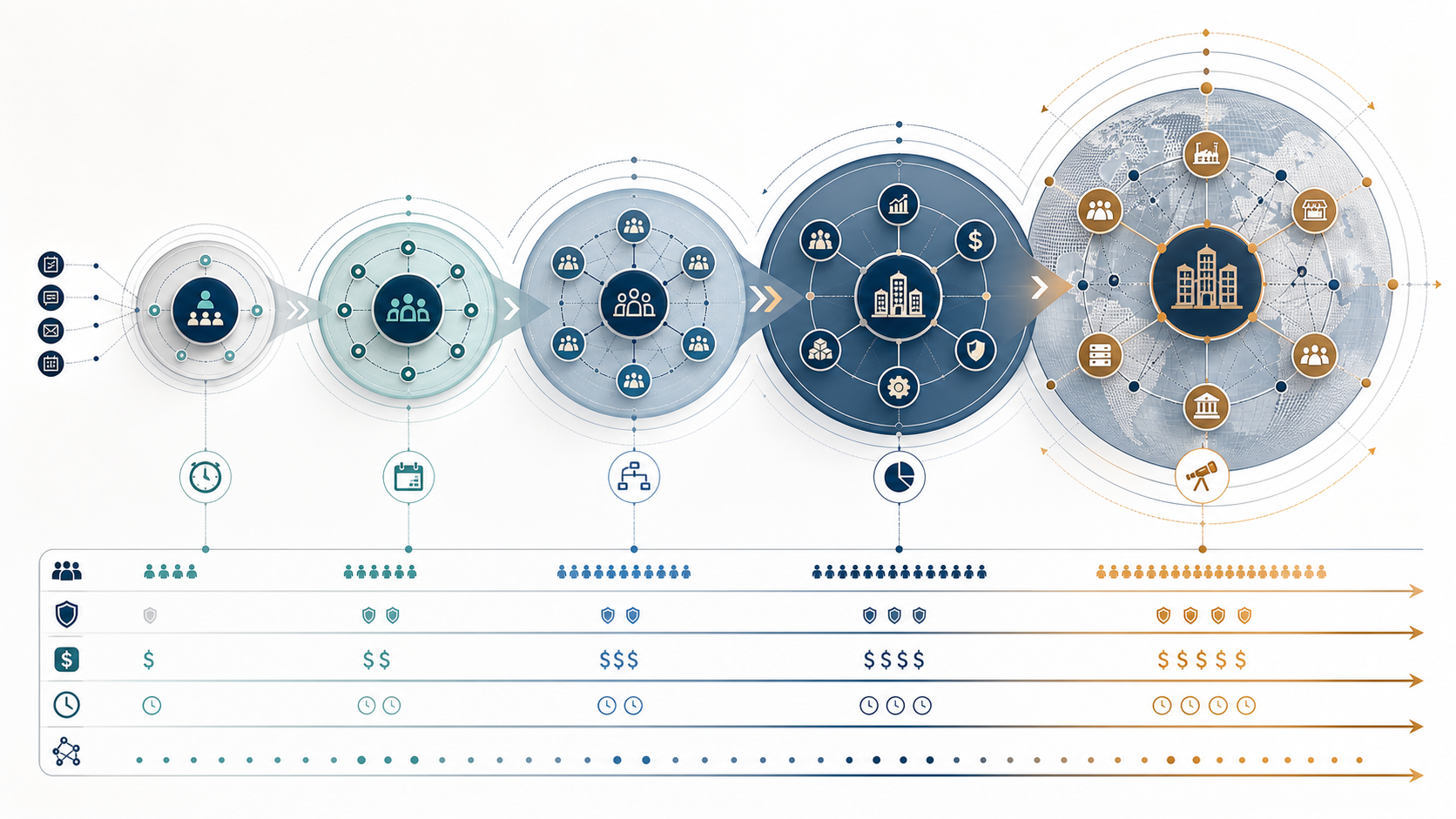
A management level should describe the size and difficulty of the responsibility, not how impressive a title sounds. This M1–M5 framework distinguishes direct team leadership, department ownership, multi-team direction, strategic-function leadership, and enterprise leadership. Use it to design roles, calibrate managers, discuss promotion, and show people what stronger management actually looks like.
The five levels are not a universal law and they are not a compensation survey. Organizations differ in size, operating model, regulation, geography, and terminology. A director in one company may have the same scope as a manager or vice president elsewhere. Map the framework to the work first; attach local titles and pay bands afterward.
Read the framework before choosing a level
Level is determined by the sustained scope of a role. It is not awarded for one difficult project, long service, a large meeting calendar, or the number of people copied on an email. Look at the decisions a manager owns repeatedly, the time horizon of those decisions, the organizational consequences, the leaders they develop, and the uncertainty they are expected to resolve.
| Level | Typical center of gravity | Planning horizon | Common leadership shape | Primary accountability |
|---|---|---|---|---|
| M1 | One team or operational unit | Days to quarters | Manager of individual contributors | Reliable team delivery and healthy day-to-day management |
| M2 | A department or several related teams | Quarters to a year | Senior manager, sometimes manager of managers | Department outcomes, capacity, systems, and staffing |
| M3 | Multiple departments or a substantial discipline | One to three years | Manager of managers | Cross-functional results and operating-model improvement |
| M4 | A strategically critical function or major portfolio | Two to five years | Leader of senior managers | Function strategy, material risk, investment, and organization design |
| M5 | Enterprise, major business, or exceptionally large function | Three to five years and beyond | Executive leader | Enterprise direction, durable capability, and long-term results |
These horizons overlap. An M1 still contributes to annual planning, and an M5 still intervenes in an urgent incident. The distinction is where the role spends most of its effort and what it is trusted to decide without escalation.
Use five dimensions, not headcount alone
| Dimension | Question to ask | Weak proxy to avoid |
|---|---|---|
| Organizational scope and impact | Which outcomes change because this role succeeds or fails? | Number of meetings or direct reports |
| Influence and people leadership | Whom must the manager align, develop, and hold accountable? | Title, charisma, or executive access |
| Autonomy and responsibility | Which decisions can the role make, and what risk accompanies them? | Being busy or working without supervision |
| Problem complexity | How ambiguous, cross-functional, novel, and consequential are the problems? | Technical difficulty by itself |
| Knowledge and evidence | What judgment, business understanding, and repeatable outcomes are required? | A degree, certificate, or years of service by itself |
Headcount can provide context, but a team of six controlling a regulated payment platform may carry more risk than a team of thirty performing repeatable low-risk work. Revenue, budget, customer reach, geographic spread, safety, security, availability, legal exposure, and reversibility all affect scope.
M1: lead one team well
An M1 converts a manager’s or department’s goals into clear weekly and quarterly work. The role directly affects team productivity, quality, engagement, and service. It normally manages three or more individual contributors, although the exact minimum should reflect the organization. M1 is the first level at which success depends on other people succeeding consistently, not on the manager personally rescuing every task.
| Dimension | M1 expectation | Observable evidence |
|---|---|---|
| Scope and impact | Owns outcomes for one work unit within established department goals | Commitments are met with visible quality, cost, and service measures |
| Leadership | Sets expectations, coaches contributors, addresses performance, and hires with support | Useful one-to-ones, fair feedback, stronger skills, and fewer unresolved issues |
| Autonomy | Applies policy and may approve limited exceptions using sound judgment | Routine decisions stay with the team; material risks are escalated early |
| Problems | Resolves operational conflicts, workload gaps, quality defects, and customer issues | Root causes are removed rather than repeatedly patched |
| Knowledge | Has advanced practical knowledge of the team’s work and basic management practice | Can review work, explain trade-offs, plan capacity, and coach safely |
A strong M1 does not become the permanent senior individual contributor for the team. They establish priorities, define ownership, remove obstacles, create a fair operating rhythm, and make performance expectations unmistakable. They know when an exception is reasonable and when an exception would create security, financial, employment, or customer risk.
The M1 operating rhythm
- Translate department objectives into a small set of measurable team commitments.
- Review workload and capacity before accepting additional commitments.
- Hold regular one-to-ones that cover performance, wellbeing, feedback, and development.
- Run short delivery reviews that expose blocked work without turning into status theatre.
- Give specific feedback close to the event and document material performance issues.
- Escalate risks with impact, evidence, options, recommendation, and required decision.
- Close the loop with customers and partner teams after incidents or missed commitments.
The promotion signal is not “the team survived while the manager worked late.” It is a team that can execute without constant rescue, has credible successors for important responsibilities, and improves its own system after mistakes.
M2: own a department and its system
An M2 leads a department, several connected teams, or a substantial work unit. They establish annual priorities within broader strategy and influence how services, processes, and plans are designed. They may manage contributors directly, lead teams through M1 managers, or use a mixed structure. Vendor delivery, workforce capacity, department budget, and operating policy commonly enter the role.
| Dimension | M2 expectation | Observable evidence |
|---|---|---|
| Scope and impact | Owns a department result and improves the system connecting its teams | Department objectives, service levels, capacity, and dependencies remain coherent |
| Leadership | Develops managers or senior leads and makes staffing decisions | Managers solve problems at their level and use consistent standards |
| Autonomy | Interprets policy, approves meaningful exceptions, and manages budget or vendors | Decisions balance delivery, people, finance, compliance, and external impact |
| Problems | Handles cross-team constraints and recommends changes to strategic plans | Recurring local conflicts are redesigned out of the operating model |
| Knowledge | Combines professional depth with knowledge of adjacent functions | Can challenge plans, compare options, and explain business consequences |
M2 is often the most underestimated transition. The manager must stop optimizing one team at the expense of the department. They create common planning, quality, hiring, incident, and performance practices while leaving enough room for team-level judgment. If every decision still returns to M2, the department has more hierarchy but no more capacity.
The move from M1 to M2
The work changes from managing people to managing a management system. An M2 should be able to explain why work enters the department, how priority is set, where capacity is constrained, how quality is measured, what risks are tolerated, and which leaders can assume more scope.
| M1 habit that once helped | Why it breaks at M2 | M2 replacement |
|---|---|---|
| Review every important deliverable personally | Creates delay and teaches managers to wait | Define review thresholds, delegate decisions, and audit outcomes |
| Solve conflicts between contributors | Bypasses their managers and weakens accountability | Coach managers to resolve conflict and intervene on systemic or high-risk cases |
| Keep plans in one detailed task list | Department dependencies and trade-offs disappear | Use objectives, capacity views, risks, and cross-team decision records |
| Be the deepest expert in every discussion | Discourages expert challenge and does not scale | Ask precise questions, use qualified experts, and own the decision process |
M3: direct several departments through leaders
An M3 leads multiple departments, a large operation, or an important professional discipline. They set mid-term priorities, introduce or revise policies and services, recommend strategy, and deliver results that are visible well beyond one department. M3 normally manages through M1 and M2 leaders and owns significant organization design, resource, vendor, and workforce decisions.
| Dimension | M3 expectation | Observable evidence |
|---|---|---|
| Scope and impact | Shapes several departments or an organization-wide capability | Material results improve across boundaries, not only in a favored unit |
| Leadership | Builds a capable management bench and aligns senior partners | Successors emerge, weak structures change, and leaders challenge constructively |
| Autonomy | Makes substantial operating, staffing, and investment decisions within strategy | Risks and benefits are explicit; decisions do not wait for perfect information |
| Problems | Resolves ambiguous operational and strategic problems spanning disciplines | Trade-offs produce durable organization-wide outcomes |
| Knowledge | Has mastery of the function and enough breadth to integrate adjacent areas | Translates specialist evidence into business choices for senior leaders |
At this level, local excellence can become an enterprise problem. One department can hit its target by transferring cost, risk, delay, or employee burden to another. M3 leaders define shared outcomes and make the whole value stream visible. They are accountable for the quality of their managers, not just for the presentation of consolidated metrics.
The move from M2 to M3
M3 work contains more uncertainty and fewer tidy ownership boundaries. The leader must frame a problem before assigning it. They decide which outcomes should be common, which decisions should remain local, and which capabilities need investment before a crisis exposes the gap.
- Replace department optimization with end-to-end outcome ownership.
- Replace identical procedures with explicit guardrails and justified local variation.
- Replace succession lists with observed readiness, development assignments, and risk coverage.
- Replace periodic reporting with leading indicators and decision-focused reviews.
- Replace informal influence with clear governance for contested cross-functional decisions.
M4: lead a strategically critical function
An M4 owns a major portion of a strategically important function, portfolio, asset base, or operating capability. Only a small number of such roles usually exist in a function. Their decisions have measurable organization-wide effect and may carry substantial financial, regulatory, security, safety, customer, or reputation exposure. They normally lead through M2 and M3 managers and regularly advise top executives or governing bodies.
| Dimension | M4 expectation | Observable evidence |
|---|---|---|
| Scope and impact | Owns a critical function or major portfolio with enterprise consequences | Strategy, investment, controls, and operating results reinforce one another |
| Leadership | Leads senior leaders and represents the organization authoritatively | Executive peers trust the evidence, commitments, and escalation judgment |
| Autonomy | Designs organization, policy, vendor, and resource choices within enterprise direction | Material risk is governed, not hidden or escalated indiscriminately |
| Problems | Solves unprecedented strategic problems across operations, finance, and people | Choices remain sound across several plausible futures |
| Knowledge | Is an organization-level authority with broad commercial and institutional judgment | Can explain what the enterprise should stop, start, protect, or transform |
M4 is not simply a larger M3. The leader has to allocate attention and investment among competing futures. They make the function legible to the enterprise: what value it creates, what risk it contains, what capacity it needs, what it will no longer do, and how today’s decisions change capability several years from now.
The move from M3 to M4
The transition is from integrating a broad operation to shaping a strategic institution. M4 leaders must keep operating truth connected to executive decisions. They should neither drown peers in functional detail nor replace evidence with slogans.
| Required shift | Practical test |
|---|---|
| From plans to choices | Can the leader state what will not be funded and why? |
| From risk reporting to risk ownership | Are appetite, controls, residual risk, owner, and escalation path explicit? |
| From leader development to institution building | Would the function remain effective after several senior departures? |
| From stakeholder updates to coalition building | Can peers commit resources to a shared outcome despite competing incentives? |
| From functional expertise to enterprise judgment | Will the leader accept a locally worse choice when it is better for the organization? |
M5: shape enterprise direction and capability
An M5 leads an enterprise, a major business, or a very large strategically critical function. They share responsibility for three-to-five-year organization strategy and are judged on durable results, not only the current reporting period. They lead through M3 and M4 executives, make high-consequence capital and talent choices, establish succession depth, and represent the organization to consequential external stakeholders.
| Dimension | M5 expectation | Observable evidence |
|---|---|---|
| Scope and impact | Shapes enterprise direction, portfolio, culture, resilience, and long-term value | Near-term delivery does not consume future capability or unmanaged risk |
| Leadership | Builds an executive team, succession system, and external confidence | Strong leaders disagree honestly, decide, and execute as one organization |
| Autonomy | Sets function or business strategy and makes material investment decisions | Governance receives transparent assumptions, alternatives, and consequences |
| Problems | Addresses complex, novel questions involving markets, capital, people, and legitimacy | Decisions remain adaptable while providing enough commitment to act |
| Knowledge | Combines deep management judgment with broad enterprise and external understanding | Recognized as a credible authority while continuing to seek disconfirming evidence |
M5 is normally not an individual-contributor designation. It does not mean the leader must personally approve everything. The role creates strategic clarity, decision architecture, capable leadership, and accountability across the enterprise. Centralizing routine decisions at M5 is a failure of organization design.
The move from M4 to M5
The most important shift is from advocating for a function to stewarding the whole organization. An M5 may decide not to maximize their own function’s budget because capital produces more value elsewhere. They must understand second-order effects: how a market choice changes operating risk, how a technology decision changes workforce needs, or how a short-term financial action changes customer trust.
- Set a small number of enterprise choices that can guide thousands of local decisions.
- Keep board or governing-body information candid, decision-ready, and free of manufactured certainty.
- Build succession for critical roles before a vacancy creates pressure for a weak appointment.
- Protect speak-up mechanisms and make bad news safe to surface early.
- Balance current performance, resilience, transformation, and long-term capability.
Separate management and individual-contributor careers
Management is a different job, not the automatic reward for technical excellence. A strong career architecture gives experienced individual contributors a path to comparable scope, influence, recognition, and compensation without requiring direct reports. Otherwise the organization promotes excellent specialists into work they may neither want nor perform well.
| Question | Management track | Individual-contributor track |
|---|---|---|
| Primary multiplier | People, teams, operating systems, and resource decisions | Expert judgment, designs, standards, invention, and cross-team technical influence |
| Core accountability | Results and health of the organization being led | Quality and impact of specialist decisions or output |
| Typical difficult work | Performance, hiring, conflict, priorities, capacity, organization design | Ambiguous technical or professional problems and durable expert direction |
| Promotion evidence | Sustained broader organizational outcomes through other leaders | Sustained broader expert impact without positional authority |
Do not force equivalence level by level. The tracks can be parallel without being identical. Define the scope and evidence for both, then make transitions deliberate. A trial assignment, acting-manager period, or reversible rotation can reveal fit before a permanent move.
Level the role before evaluating the person
Start with work the organization needs. Write the role’s outcomes, decision rights, interfaces, risks, planning horizon, budget, leadership shape, and expected complexity without naming an incumbent. Then compare the role to the framework. Only after the role is leveled should the panel assess whether a person is performing it.
- Define the business outcomes and why the role exists.
- List decisions the role owns, recommends, shares, and escalates.
- Map the teams, managers, functions, customers, regulators, and vendors affected.
- Describe recurring problems, uncertainty, consequence, and reversibility.
- Identify the normal planning horizon and material resources or risks.
- Compare evidence with adjacent levels, looking for the sustained center of gravity.
- Calibrate with unrelated functions so local title habits do not set the result.
A role can contain work from several levels. Level it where the material, recurring accountability sits. If the role is mostly M1 with one annual M3 presentation, it is not M3. If the organization expects M3 outcomes but withholds M3 authority, fix the role design rather than blaming the manager.
Define decision rights explicitly
| Decision category | Owns | Recommends | Consults | Escalates when |
|---|---|---|---|---|
| Team staffing | Approved positions, selection, routine allocation | New roles or material structure change | HR, finance, partner teams | Budget, employment, or capability risk exceeds authority |
| Priority | Work within agreed objectives and capacity | Trade-offs that alter department commitments | Customers and dependent owners | Two accountable owners cannot resolve a material conflict |
| Risk | Risk inside documented appetite | Treatment or acceptance outside local authority | Security, legal, compliance, finance, or safety | Exposure exceeds appetite or facts are insufficient for safe action |
| Policy exception | Low-risk exceptions explicitly delegated | New precedent or policy change | Policy owner and affected functions | Exception creates material legal, ethical, customer, or control impact |
Words such as “support,” “drive,” and “partner” are not decision rights. Name the decision, the accountable owner, required input, boundaries, and escalation condition. Clear rights reduce both reckless autonomy and approval congestion.
Promotion is sustained next-level scope
Promotion should recognize work that the organization needs and the person has performed at the next level with repeatable results. Potential matters when choosing development opportunities, but evidence matters when changing level. One heroic incident, temporary cover, or executive-sponsored project is useful data, not sufficient proof.
| Evidence | Strong signal | Insufficient by itself |
|---|---|---|
| Scope | Material next-level accountability sustained over multiple cycles | A one-time assignment with senior supervision |
| Results | Outcomes hold after the manager steps away | A metric improved by transferring cost or risk elsewhere |
| Leadership | Other leaders grow and can own harder decisions | Personal visibility or popularity |
| Judgment | Trade-offs are timely, transparent, ethical, and evidence-based | Always agreeing upward or avoiding difficult decisions |
| Complexity | Ambiguous cross-boundary problems are framed and resolved | More volume of the same familiar work |
A high performer can remain at the same level and still deserve exceptional reward. Promotion is not the only way to recognize impact. Conflating performance, potential, pay, retention, and level leads to inflated roles and unclear expectations.
Build a useful promotion evidence packet
- Role case: what next-level work exists and why the organization needs it.
- Outcome evidence: baselines, decisions, results, duration, and unintended effects.
- Leadership evidence: managers or contributors developed, succession, performance action, and team health.
- Complexity evidence: uncertainty, dependencies, constraints, risk, and judgment used.
- Peer evidence: specific observations from credible partners, including disagreement or failure.
- Boundary evidence: examples showing why the current level is too narrow and why the level above is not yet justified.
- Development plan: remaining risks and support required after promotion.
Use evidence that can be inspected. “Strategic,” “executive presence,” and “operates at scale” are conclusions. The packet should show the decisions, behavior, and outcomes that support those conclusions.
Calibrate across functions without false precision
A calibration panel should compare roles that look different but carry similar accountability. Engineering may express scope through platform availability, finance through capital and controls, operations through volume and safety, and people teams through workforce systems. The shared dimensions allow comparison without pretending the work is identical.
- Have reviewers score independently before discussion.
- Start with scope and decision rights, not incumbent reputation.
- Compare the proposed level with one role below and one above.
- Ask what evidence would change the panel’s conclusion.
- Record rationale and unresolved uncertainty.
- Audit results by function and other relevant groups for unexplained patterns.
- Review the role again when its work materially changes.
A numerical rubric can support discussion, but do not add points and declare a level automatically. A single high-consequence accountability can matter more than several routine dimensions, and local regulation or safety obligations may change the result.
Use education and experience as evidence, not gates
Many management roles commonly require a bachelor’s degree or equivalent professional preparation, and senior roles may benefit from advanced study. That does not make a credential the level. Education can build knowledge; it does not prove that someone can lead people, allocate resources, resolve conflict, exercise judgment, or deliver organization-wide results.
Write requirements around capabilities unless a law, license, regulator, or genuinely essential discipline requires a credential. Accept equivalent evidence where appropriate: progressively broader assignments, professional training, operational results, domain mastery, and demonstrated learning. Years of experience should indicate likely exposure, not become an unexamined barrier.
Interview for behavior at the required scope
| Area | Question | Listen for |
|---|---|---|
| Scope | Describe an outcome you owned across teams with conflicting incentives. | Clear accountability, system view, trade-offs, and measurable result |
| People | Tell us about a manager whose performance you had to change. | Expectations, diagnosis, coaching, fairness, documentation, and decision |
| Judgment | Describe a consequential decision made with incomplete information. | Options, assumptions, reversibility, risk, timing, and learning |
| Failure | Which leadership decision would you make differently? | Real accountability rather than blame or a disguised success story |
| Strategy | What did you stop funding or doing? | Explicit choice, opportunity cost, stakeholder management, and consequences |
| Succession | Who became able to do more because of your leadership? | Specific development actions and readiness evidence |
Ask follow-up questions about the candidate’s personal decision, not only what “we” did. Verify scale, duration, authority, and outcome. A polished vocabulary should not substitute for management evidence.
Plan the first 90 days by level
| Period | M1 emphasis | M2–M3 emphasis | M4–M5 emphasis |
|---|---|---|---|
| Days 1–30 | People, commitments, workflow, immediate risks | Managers, operating system, dependencies, talent, customers | Enterprise choices, portfolio, governance, external context, executive team |
| Days 31–60 | Clarify expectations and fix one recurring obstacle | Align priorities, decision rights, measures, and management cadence | Test strategy assumptions, risk, capital, capability, and succession |
| Days 61–90 | Deliver through the team and establish development plans | Commit to department or multi-team plan and structural changes | Make a small number of strategic choices and align accountable leaders |
Do not arrive with a generic reorganization. Diagnose before moving reporting lines. At the same time, “listen and learn” should not become avoidance when a safety, ethics, security, customer, or serious performance issue already has adequate evidence.
Diagnose a manager who appears under-leveled
A gap can come from capability, unclear expectations, missing authority, excessive workload, a weak manager, an impossible role, or an operating system that rewards the wrong behavior. Diagnose the system before labelling the person.
- Restate the required outcomes and level dimensions with concrete examples.
- Compare expected and actual decisions, behavior, and results.
- Check whether authority, information, resources, and partner commitments exist.
- Separate skill gaps from motivation, capacity, conduct, and role-design problems.
- Agree on a small development plan with measures, support, and dates.
- Review evidence frequently and act fairly if performance does not improve.
Do not solve an M2 gap by silently doing the manager’s job at M3. That hides the issue, exhausts the senior leader, and deprives the manager of usable feedback. Support can be substantial while accountability remains clear.
Common leveling mistakes
| Mistake | Why it causes damage | Correction |
|---|---|---|
| Title inflation for retention | Creates internal inequity and promises scope that does not exist | Address pay, recognition, or retention directly |
| Headcount formula | Ignores risk, complexity, managers, automation, and business impact | Use headcount as one context signal across all dimensions |
| Heroic manager reward | Rewards dependency and weak systems | Value durable team performance and prevention |
| Promotion for tenure | Confuses loyalty with next-level accountability | Reward contribution while requiring scope evidence for level |
| Potential treated as performance | Promotes a prediction without enough evidence or support | Use stretch assignments and assess sustained outcomes |
| One dominant function | Its titles become the company standard regardless of scope | Calibrate across functions with common dimensions |
| Invisible people leadership | Results conceal burnout, fear, bias, or undeveloped successors | Inspect how results are achieved and whether capability grows |
Do not confuse level with performance
Level describes the role’s scope. Performance describes how well a person fulfills it. Potential estimates readiness for broader or different work. Compensation reflects market, internal equity, performance, skills, location, and other policy choices. Keep the conversations connected but distinct.
| Situation | Interpretation | Action |
|---|---|---|
| Excellent results within current scope | High performance at level | Recognize and reward; discuss desired growth without assuming promotion |
| Some next-level work, inconsistent current delivery | Scope exposure without promotion readiness | Stabilize current accountability and diagnose capacity |
| Sustained next-level outcomes in a needed role | Possible leveling or promotion case | Calibrate evidence, role need, authority, and compensation |
| Current role no longer contains its documented scope | Role architecture problem | Redesign or re-level the role transparently |
Make leadership quality part of the result
Delivery achieved through fear, concealed risk, chronic overwork, discrimination, or preventable turnover is not strong management. Managers need technical or professional credibility, but they also need ethical judgment, evidence-based decisions, trust, inclusion, conflict handling, clear expectations, and development of others.
The CIPD Profession Map core behaviours emphasizes ethical practice, professional courage, valuing people, inclusive work, commercial drive, learning, insight, and situational decision-making. The U.S. Office of Personnel Management executive qualifications similarly connect leading people with accountability, developing others, judgment, resource stewardship, and results. These are useful reference points, not replacements for a company’s own role design.
Adapt M1–M5 to a small organization
A small company may use only M1, M2, and one enterprise leader. Do not create M3–M5 titles without the corresponding scope. A founder who owns enterprise strategy may perform M5-like work while the next manager owns one team. That gap is normal. Levels describe responsibility, not the number of rungs an organization must install.
As the company grows, add a management layer only when it creates decision capacity, leadership quality, or clearer accountability. If a new layer merely relays status upward and requests approval downward, it adds delay. Before adding it, identify decisions that will move, managers who need development, outcomes that need integration, and interfaces that need ownership.
Adapt the framework to regulated or high-risk work
In healthcare, finance, infrastructure, public service, security, aviation, or other high-consequence settings, scope includes duties that ordinary headcount and revenue measures miss. Consider professional accountability, segregation of duties, statutory decisions, safety cases, regulated capital, privacy, incident notification, service continuity, and public trust.
A manager cannot delegate accountable oversight simply because a specialist performs the analysis. Define who makes the decision, who supplies independent challenge, what evidence is retained, and which threshold requires escalation. Higher level should mean better risk judgment and governance, not broader permission to bypass controls.
Run an annual architecture review
- Compare documented roles with the decisions and outcomes people actually own.
- Find title inflation, compressed levels, duplicate authority, and orphaned accountability.
- Review management spans with complexity and manager capability, not a fixed target.
- Check whether M2–M5 leaders have credible successors and development assignments.
- Audit promotion and hiring results for unexplained differences across functions or groups.
- Confirm compensation bands still align with the revised architecture.
- Publish changes and transition rules before applying them to individuals.
Architecture should be stable enough to guide careers and flexible enough to reflect real work. Rewriting definitions every review cycle destroys trust. Ignoring a materially changed operating model creates equally serious distortion.
A manager’s self-assessment
- What outcomes would fail if my role disappeared, and for how long?
- Which decisions do I truly own rather than prepare for someone else?
- What is my normal planning horizon?
- Do I lead contributors, managers, senior managers, or an executive system?
- Which resources, customers, risks, and external obligations are affected?
- What capability has grown in other people because of my leadership?
- Which recurring problem have I removed from the system?
- Where have I made a transparent trade-off rather than promising everything?
- What evidence shows sustained performance, not activity?
- What work should move away from me if I take broader scope?
Answer with examples, dates, measures, and decisions. Then discuss the evidence with your manager. The purpose is not to negotiate a title from a checklist; it is to understand current scope, close gaps, and choose development work deliberately.
Implementation checklist for HR and leadership teams
- Define management and individual-contributor tracks separately.
- Translate M1–M5 into local examples, titles, decision rights, and compensation bands.
- Retain the five shared dimensions across functions.
- Train managers and calibration panels using real anonymized cases.
- Level roles before rating incumbents.
- Require observable promotion evidence and comparison with adjacent levels.
- Make people leadership, ethics, risk, and durable capability part of performance.
- Provide an appeal or review path for inconsistent decisions.
- Audit outcomes and correct structural bias.
- Review the architecture when strategy or operating model changes materially.
Final perspective
M1–M5 is most useful as a shared language for scope. M1 makes one team reliable. M2 makes a department work as a system. M3 connects several departments and develops leaders. M4 turns a critical function into an enterprise capability. M5 makes choices for the whole organization and protects its long-term ability to perform.
Good leveling will not remove judgment, and it should not try. It makes judgment inspectable. People can see the work expected, the authority provided, the evidence used, and the difference between excellent performance today and readiness for broader responsibility tomorrow.