MX Records and Email Routing: DNS, Priority and Failover
An MX record tells an SMTP sender which host accepts mail for a domain. It does not redirect a mailbox, test server health or guarantee instant failover. Reliable routing depends on authoritative DNS, address records, reachable SMTP services, recipient handling, retry behavior and monitoring. A correct design begins with protocol behavior and is verified externally before DNS changes.
Read an MX record correctly
example.com. 3600 IN MX 10 mx1.example.net.
example.com. 3600 IN MX 20 mx2.example.net.
mx1.example.net. 3600 IN A 192.0.2.10
mx1.example.net. 3600 IN AAAA 2001:db8::10
Lower preference numbers are tried first; they are not percentages or capacity weights. A final dot makes the target absolute in a zone file. The target must resolve to A/AAAA records. Avoid a CNAME as an MX target. Equal preference offers alternatives, but does not guarantee precise load distribution.
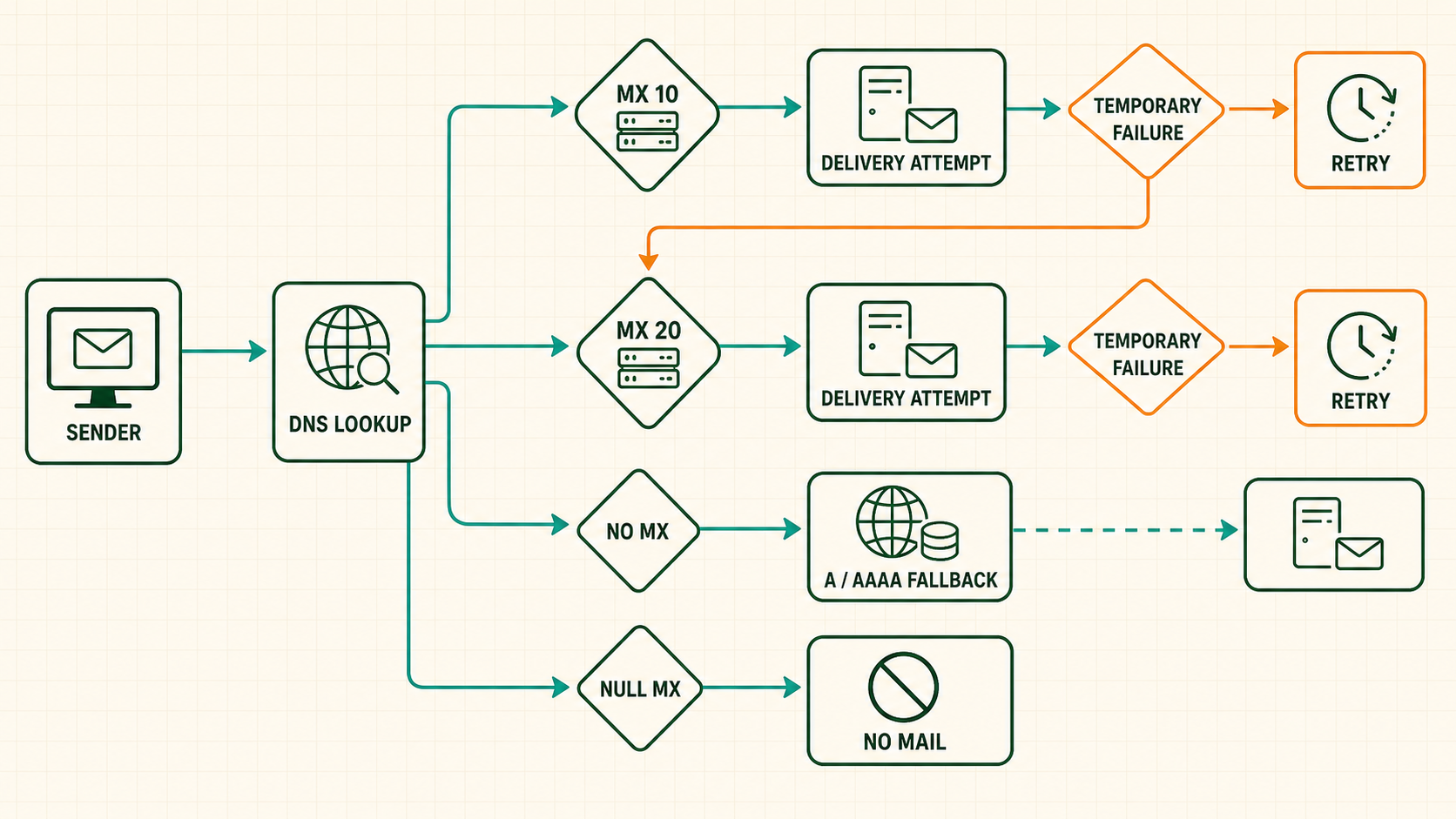
Follow the SMTP routing sequence
- Query MX for the recipient domain.
- Sort usable exchanges by preference and resolve addresses.
- Connect to TCP 25, negotiate SMTP and attempt the recipient.
- On temporary DNS, connection or SMTP failure, queue and retry, possibly using another host.
- On acceptance the receiver assumes responsibility; on permanent rejection stop retrying that recipient.
Remote sender retry schedules affect failover timing. A DNS change cannot force every queued MTA to reconnect instantly.
Understand no MX and null MX
| State | Meaning | Action |
|---|---|---|
| Valid MX | Use listed exchanges | Resolve and attempt |
| No MX | RFC 5321 implicit MX | Try domain A/AAAA |
MX 0 . | RFC 7505 null MX | Domain accepts no mail |
| Target lacks address | Broken routing | Temporary failure and diagnosis |
Null MX is explicit and different from accidentally forgetting MX.
Query multiple DNS views
dig +noall +answer MX example.com
dig +trace MX example.com
dig @1.1.1.1 MX example.com
dig A mx1.example.net
dig AAAA mx1.example.net
dig -x 192.0.2.10
Compare authoritative and public recursive answers. Check delegation, serial, DNSSEC validation where enabled and TTL remaining in caches. Split-horizon DNS can intentionally differ internally, but internet senders require a correct public view.
Test the server behind DNS
nc -vz mx1.example.net 25
openssl s_client -starttls smtp -connect mx1.example.net:25 -servername mx1.example.net -crlf

EHLO probe.example
MAIL FROM:<[email protected]>
RCPT TO:<[email protected]>
RSET
QUIT
Use an authorized test recipient and stop before DATA when only routing is tested. Validate banner, EHLO, STARTTLS certificate, accepted domain and response time. A DNS answer alone does not prove the mail service works.
Protect every secondary MX
A higher-preference backup must know valid recipients, reject invalid ones, enforce abuse controls and relay only to authorized destinations. Accepting every address and later bouncing creates backscatter. Define encryption, queue limits, lifetime, monitoring and the protected route to the primary system.
Many services instead use several fully capable front ends at equal preference. Whatever design is chosen, every published host needs equivalent recipient and security policy.
Migrate MX without losing mail
- Inventory domains, current MX, TTL and accepted-recipient sources.
- Build and test the new service before publication.
- Lower TTL one or two existing TTL periods beforehand when needed.
- Add the new route while the current service remains available.
- Verify public DNS and external deliveries.
- Monitor both through cache and sender retry windows.
- Remove the former route only after queues, aliases and logs are reconciled.
Run a controlled failover exercise
Send uniquely identified messages to monitored test recipients from independent external systems. Disable one node in an approved window, then observe connection failure, alternate-host use, delay and eventual delivery. Restore it and check duplicates and gaps.
Test invalid recipients too. Every active MX should reject them consistently. Capture DNS, SMTP replies, Message-ID, Received headers and timing. A successful TCP connection is not an end-to-end test.
Monitor DNS and SMTP separately
- Authoritative availability and consistent MX answers.
- Target A/AAAA resolution and DNSSEC state.
- External TCP/25 reachability.
- EHLO, STARTTLS and certificate behavior.
- Known-recipient acceptance and invalid-recipient rejection.
- Queue depth, oldest message, disk and delivery latency.
- Unexpected MX, TTL or certificate changes.
A running daemon can still reject all valid recipients after its directory fails.
Secure the receiving edge without breaking SMTP
Restrict administrative interfaces separately from public SMTP, patch the MTA and TLS library, rate-limit abusive patterns and log recipient enumeration attempts. Port 25 must remain reachable for internet mail, but submission ports and management services need authenticated, limited access. Never expose an open relay.
STARTTLS is normally opportunistic unless enforced through a policy such as MTA-STS or DANE in an appropriate design. Monitor certificate name and validity, but remember that ordinary SMTP delivery can proceed without encryption when no stronger policy applies. Document the intended transport policy so a stricter node does not behave differently from its peers.
Diagnose common MX failures in order
| Symptom | Check first | Likely boundary |
|---|---|---|
| NXDOMAIN | Delegation and queried domain spelling | DNS name |
| MX answer but no connection | A/AAAA, firewall and TCP 25 route | Network/service |
| TLS warning | Certificate name, chain, time and policy | Transport security |
| 550 unknown user | Recipient directory and domain ownership | Recipient policy |
| 451 repeated | Queue, directory, storage and downstream route | Temporary receiver condition |
Capture the complete DNS response and SMTP exchange. A shortened error string often removes the hostname or enhanced status detail needed to find the responsible system.
Keep DNS and mail changes reversible
Record the current zone values, provider configuration and validation evidence before a change. Use peer review for preference, hostname and TTL edits. Set a rollback condition based on failed external delivery, not on an arbitrary elapsed time. A rollback also requires the former service to remain operational and its accepted-recipient data to stay current.
After the change, verify each authoritative nameserver directly and compare several public resolvers. Retain old server logs until delayed and queued deliveries have aged out. Close the change only after inbound volume, rejects, latency and security controls match the intended baseline.
MX routing checklist
- Use absolute targets with valid A/AAAA.
- Interpret lower preference as preferred, not weighted.
- Understand implicit and null MX.
- Verify authoritative and recursive answers.
- Test port 25, EHLO, STARTTLS and recipients externally.
- Prevent relay and backscatter on secondary hosts.
- Keep old routes through cache and retry windows.
- Exercise failover with evidence.
- Monitor end-to-end acceptance and queues.
Trace MX resolution from delegation to usable addresses
dig +trace MX example.com
dig @ns1.example.net example.com MX +noall +answer
dig mx1.example.net A +short
dig mx1.example.net AAAA +short
dig -x 192.0.2.10 +short
An SMTP sender queries MX, orders usable exchanges by preference and resolves their A/AAAA records. Lower preference numbers are tried first; equal preference offers alternatives rather than guaranteed traffic percentages. MX targets must be hostnames with address records, not IP literals, and using a CNAME target is not a sound interoperable design.
Compare every authoritative server and public recursive views. A zone can be correct on one nameserver and stale on another. Record delegation, SOA serial, DNSSEC validation where used, TTL and exact answers.
Distinguish explicit MX, implicit MX and null MX
| DNS state | Sender behavior | Operator meaning |
|---|---|---|
| One or more usable MX | Attempt exchanges by preference | Published receiving service |
| No MX record | Implicitly try domain address under SMTP rules | Mail may still be attempted |
MX 0 . | Do not attempt delivery | Domain explicitly accepts no mail |
| MX target has no usable address | Temporary DNS/routing failure | Broken publication, not null MX |
| NXDOMAIN | Domain does not exist | Permanent naming failure |
Do not publish null MX on a domain that receives mail through hidden application paths. Conversely, omitting MX does not explicitly declare no mail because implicit behavior exists.
Test DNS, TCP, SMTP and recipient policy separately
nc -vz mx1.example.net 25
openssl s_client -starttls smtp \
  -connect mx1.example.net:25 \
  -servername mx1.example.net -crlf

EHLO probe.example
MAIL FROM:<[email protected]>
RCPT TO:<[email protected]>
RSET
QUIT
Use an authorized recipient and stop before DATA when testing only recipient routing. Capture banner, EHLO capabilities, STARTTLS certificate, response timing and full SMTP replies. Run externally because an internal split-DNS or firewall view can hide the public failure.
A successful TCP connection proves only port reachability. A daemon can be up while directory lookup fails, every valid recipient receives 451, or the host accidentally relays. Test valid and invalid recipients under approved conditions.
Design failover around sender retry behavior
MX preference is not active health checking. A sender may try another equal or higher-numbered exchange after connection or temporary failure, but retry schedule, caching and queue state belong to the remote MTA. DNS changes cannot force all queued senders to reconnect immediately.
| Design | Requirement | Risk |
|---|---|---|
| Equal-preference front ends | Equivalent recipient/security policy | One inconsistent node causes intermittent failures |
| Higher-numbered backup | Current recipient data and protected onward relay | Backscatter or open relay if it accepts everything |
| Cold disaster MX | Continuously tested DNS/TLS/recipient path | Fails precisely during emergency |
| DNS-only failover | TTL and cache overlap planning | Old and new routes coexist longer than expected |
Every published host needs queue, disk, certificate, abuse and recipient monitoring. A backup is production infrastructure even when rarely selected.
Prevent secondary MX backscatter and relay abuse
A secondary that accepts every recipient and later generates bounces becomes a backscatter source. Synchronize valid-recipient or routing data, reject invalid recipients during SMTP where possible, and authorize onward relay only to the protected destination. Set queue lifetime, disk limits, TLS policy and alerting.
secondary_mx_policy:
  accepted_domains: explicit inventory
  recipients: synchronized directory or safe verification
  relay_to: authenticated/restricted primary route
  public_relay: denied
  invalid_recipient: reject during RCPT
  queue_age_alert: defined by service objective
Test external relay attempts and recipient enumeration controls in an approved lab. Never copy a primary configuration that assumes an internal trusted network onto a public backup host.
Migrate receiving routes without losing or duplicating mail
- Inventory domains, aliases, valid-recipient sources, current MX/TTL and queued dependencies.
- Build the new service, authentication, TLS, monitoring and downstream delivery before DNS.
- Lower TTL sufficiently ahead when a shorter cache is required.
- Add/test the new path while the former route remains current.
- Verify authoritative/public DNS and deliver from independent external senders.
- Monitor both routes through cache and remote retry windows.
- Remove old MX only after volume, queues, aliases and logs reconcile.
Keep recipient-directory updates synchronized during overlap. Rollback requires the former service to remain operational; a DNS record alone cannot restore a decommissioned MTA.
Align MX changes with MTA-STS, DANE and certificates
An MTA-STS cached policy may authorize only listed MX patterns. Advertising a new emergency host before adding it to policy can cause enforced senders to defer. DANE deployments depend on DNSSEC-validated TLSA records and require their own safe transition. Certificate SANs must match actual MX hostnames, not only the recipient domain.
| Change | Precondition |
|---|---|
| New MTA-STS MX | Add policy pattern, release policy ID and allow cache overlap |
| Certificate rotation | Deploy complete trusted chain on every node |
| DANE key/cert change | Publish TLSA overlap under valid DNSSEC |
| Remove host | Drain queues and account for cached MX/policy |
Probe each address with correct SNI and compare TLS-RPT reports by MX host after changes.
Monitor the complete receiving path
- Delegation, authoritative consistency, SOA serial and DNSSEC.
- MX answers, target A/AAAA and unexpected changes.
- External TCP/25, banner, EHLO and STARTTLS certificate.
- Known-recipient acceptance and invalid-recipient rejection.
- Queue depth, oldest message, disk and downstream delivery latency.
- Directory freshness, relay restrictions and abuse anomalies.
- MTA-STS policy endpoint and TLS-RPT failure categories.
Use end-to-end synthetic messages with unique Message-ID from independent systems, then verify receipt and headers. A green DNS probe does not prove delivery, and a received synthetic message does not prove every node is healthy.
Worked failure: backup MX accepts mail but cannot deliver it onward
The primary MX becomes unreachable during maintenance. Remote senders select the higher-numbered backup and receive 250. Operators assume failover succeeded, but the backup’s relay route uses an expired internal credential and its queue grows for hours. External monitoring checked only TCP/25.
The team preserves queue IDs and ages, restores the authenticated onward route and controls queue release to prevent a delivery burst. It verifies recipient suppression and duplicate behavior, then sends synthetic messages through each published MX. No mail is deleted merely to make queue graphs green.
Permanent controls add oldest-queue and downstream-delivery objectives, certificate/credential expiry monitoring, valid-recipient synchronization and a scheduled failover exercise. MX resilience is accepted only when a message travels from external sender through the alternate host into the final mailbox.
Keep a reversible DNS and mail change record
Record pre-change zone answers, service configuration, recipient-source version, certificate fingerprints, MTA-STS/DANE artifacts, external tests, owner and rollback condition. Verify each authoritative nameserver directly after publication and retain old logs until delayed mail ages out.
Close the change when inbound volume, invalid-recipient behavior, queue latency, downstream delivery and security controls match the intended baseline across every advertised host. A short successful test immediately after DNS edit is not sufficient evidence.
Test IPv4 and IPv6 paths independently
If an MX hostname publishes both A and AAAA, remote senders may choose either address according to their implementation and network state. A working IPv4 path does not excuse an unreachable IPv6 listener, wrong IPv6 firewall, missing reverse DNS or different SMTP configuration. Broken IPv6 can create intermittent delay that is difficult to reproduce from an IPv4-only monitor.
dig +short A mx1.example.net
dig +short AAAA mx1.example.net
nc -4 -vz mx1.example.net 25
nc -6 -vz mx1.example.net 25
openssl s_client -4 -starttls smtp -connect mx1.example.net:25
openssl s_client -6 -starttls smtp -connect mx1.example.net:25
Run probes from networks with real connectivity and correct hostname validation. Compare banner, EHLO, STARTTLS, certificate and recipient response across every address. If IPv6 is not production-ready, do not publish an AAAA record merely because the host has an address.
Distinguish DNSSEC validation failure from an unsigned answer
A resolver that validates DNSSEC treats a bogus chain differently from an unsigned domain. Expired signatures, broken delegation signer records, incorrect key rotation or inconsistent authoritative zones can make MX resolution fail for validating senders while a nonvalidating local lookup appears normal.
| Observation | Check |
|---|---|
SERVFAIL at validating resolver | Use dig +dnssec, trace delegation and inspect DS/DNSKEY/RRSIG |
| One nameserver differs | SOA serial, zone transfer/deployment and signature set |
| Works with validation disabled | Do not bypass; repair the DNSSEC chain |
| Intermittent after key rotation | TTL overlap and publication sequence |
Monitor signature expiry and validate changes before deployment. DNSSEC rollback must follow a safe provider-specific sequence; deleting records randomly can prolong a bogus state through caches.
Troubleshoot MX delivery in protocol order
- Confirm the recipient domain spelling, existence and delegation.
- Query MX at every authoritative server and compare recursive answers.
- Resolve every target A/AAAA and check routing/firewall to TCP 25.
- Capture banner and EHLO; verify expected hostname and capabilities.
- Negotiate STARTTLS with the MX hostname and inspect chain/SAN.
- Test a controlled valid and invalid recipient.
- Inspect receiving queues, directory and downstream route.
- Trace a uniquely identified message to final mailbox.
| Symptom | Earliest likely boundary |
|---|---|
| NXDOMAIN | Name/delegation |
| MX answer, no address | Target DNS |
| Connection refused/timed out | Network, firewall or daemon |
| STARTTLS mismatch | Certificate/SNI or wrong node |
| Valid user rejected | Recipient directory or accepted-domain policy |
| Accepted but not delivered | Queue/downstream mailbox |
Stop at the earliest failing boundary. Changing MX preference cannot repair a stale recipient directory.
Design receiving capacity for normal and failover states
Measure connections, recipients, bytes, TLS handshakes, content-scanning cost, directory latency and downstream throughput by minute and node. Capacity must handle loss of a node without uncontrolled 421/451 responses or disk exhaustion. Use temporary SMTP failures when the system cannot safely accept responsibility; never return 250 and silently discard.
Set queue age and disk thresholds, reserve headroom for retries, and test backpressure. Remote senders can retry in bursts after recovery. Release queued mail in controlled order while preserving per-message expiry and avoiding duplicates. A load balancer health check should exercise SMTP readiness, not only TCP accept.
Record maintenance mode so a draining node stops receiving new sessions but completes or safely returns current transactions. Reconcile accepted recipients with queued/delivered outcomes during every failover exercise.
Assign ownership across DNS, network, MTA and directory
MX reliability crosses teams. DNS owns delegation and records; network owns routes and port 25; messaging owns SMTP, queues and relay; identity teams own accepted recipients; security owns TLS and abuse controls. Keep one service inventory and incident contact path. Test escalation during failover so operators can repair the earliest boundary without waiting to discover who controls it.
Review third-party receiving providers for domain verification, data retention, routing exports and exit procedure. Before contract termination, preserve aliases, recipient states, logs and overlap routing. Removing a vendor MX before the replacement accepts every required domain creates permanent bounces that DNS rollback may not immediately cure.
Final operational test
Verify every advertised address and complete one end-to-end delivery through each intended failover route before approval. Archive the evidence with the DNS release.