RFC 8617 ARC: Chain Validation, Sealer Trust and Forwarding Evidence
RFC 8617, published as an Experimental RFC in July 2019, defines the Authenticated Received Chain protocol for carrying authentication assessments through intermediaries that can break SPF, DKIM or DMARC. ARC can validate a chain of custody and identify what a sealer asserted at each hop. It does not make the message safe, make DMARC pass, or establish that a sealer deserves trust.
What is ARC?
ARC means Authenticated Received Chain. It is a set of signed email headers used by participating intermediaries to preserve authentication evidence across forwarding. Each intermediary can record what SPF, DKIM and DMARC looked like when it received the message, sign the message state it forwards, and seal that evidence into an ordered chain.
Think of ARC as a signed custody log attached to the email. It answers: which participating intermediary handled the message, what authentication result that intermediary observed, and whether the evidence was changed after it was sealed. It does not identify the human sender, scan content for malware, guarantee inbox placement, or automatically authorize delivery.
The original sender normally does not add ARC
The original sending system normally publishes SPF, signs with DKIM and sends a message whose visible From domain can pass DMARC alignment. It usually does not create an ARC set. ARC is designed for Internet Mail Handlers that receive and then pass on a message, such as mailing lists, forwarding services, security scanners, inbound gateways and multi-tier mail systems.
The first ARC-participating intermediary adds instance i=1. If another participating intermediary later handles the same message, it adds i=2. The original sender could technically act as an ARC sealer if it is also performing an intermediary role, but ARC is not a replacement for the sender’s SPF, DKIM or DMARC configuration.
Why is ARC needed?
Forwarding changes the SMTP path, so the original envelope domain can fail SPF at the final receiver. Mailing lists and gateways may add a footer, rewrite a URL, change MIME encoding or prefix the Subject, which can invalidate the original DKIM signature. With both aligned SPF and DKIM unavailable, current DMARC can fail even though an intermediary previously received an authentic message.
ARC preserves the intermediary’s earlier assessment as signed evidence. A final receiver that validates the chain and trusts the relevant sealer can consider that history in its local disposition policy. The final receiver remains responsible for its decision, and an ARC pass must never be displayed as a DMARC pass.
How ARC works from sender to final receiver
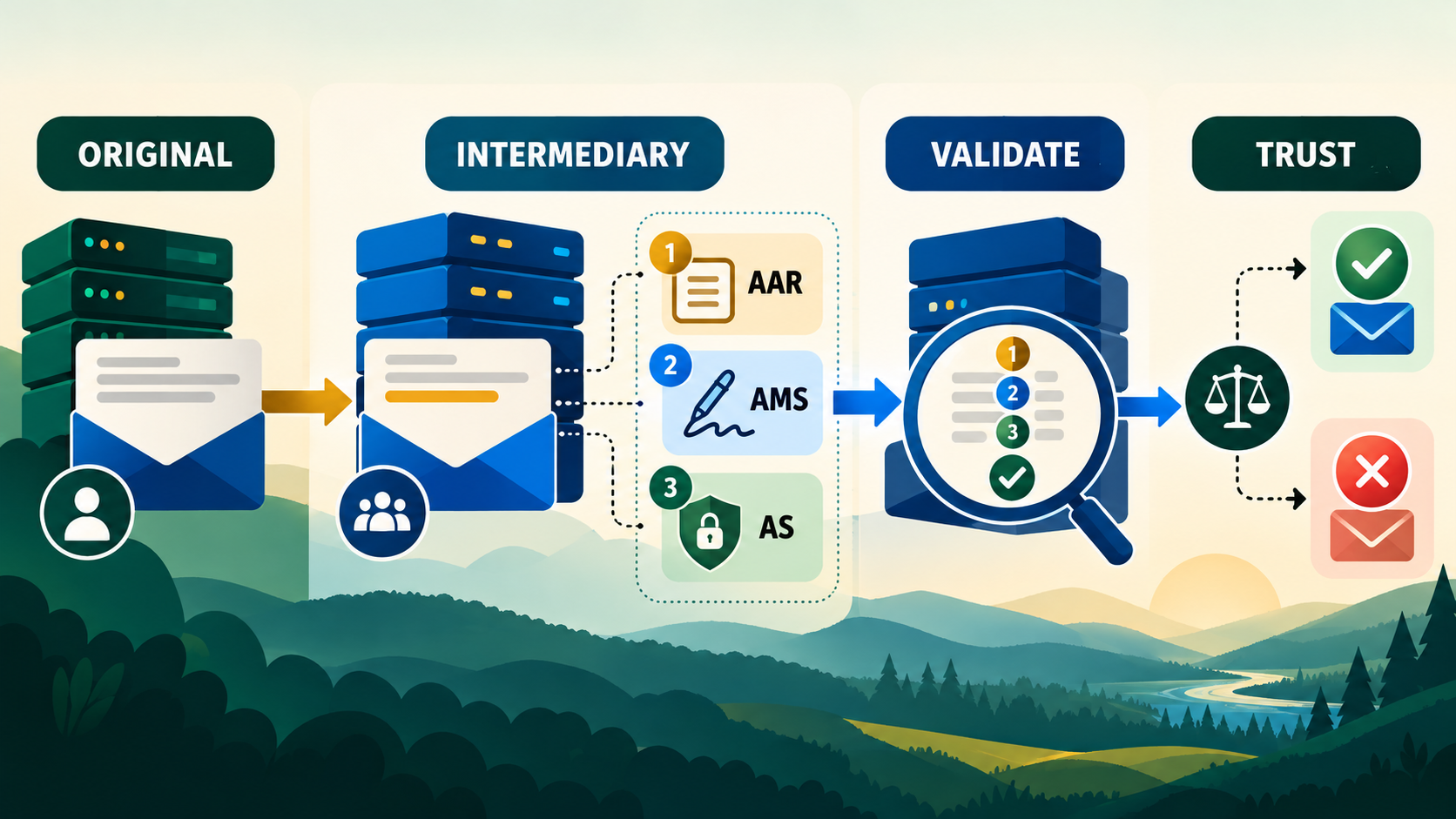
1. Original sender sends the message with normal SPF and DKIM evidence. It usually adds no ARC set.
2. Intermediary A receives the message and evaluates SPF, DKIM and DMARC before changing it.
3. Intermediary A records those results in AAR i=1.
4. After its permitted modifications, it signs the resulting message in AMS i=1.
5. It seals the first ARC set in ARC-Seal i=1 with cv=none.
6. Intermediary B receives the message, validates set 1 and performs its own authentication checks.
7. Intermediary B adds AAR, AMS and ARC-Seal with i=2 and cv=pass if set 1 validated.
8. Final receiver validates the newest AMS and every ARC-Seal, then separately decides whether it trusts the sealers.
9. ARC evidence may inform local handling when forwarding broke current DMARC, but it does not change dmarc=fail into dmarc=pass.
Every participating intermediary appends one complete ARC set. It does not replace the previous set. The increasing instance numbers create the ordered chain, while signatures reveal whether protected message or chain data changed later.
Meaning of i=, a=, d=, s=, c=, h=, bh=, b= and cv=
These are tag-value fields inside ARC-Message-Signature and ARC-Seal. Most signing tags are inherited from DKIM, but ARC gives i= a different meaning: it is the ARC set number, not a DKIM signing identity. The exact role of each tag is shown below.
| Tag | Plain meaning | Where used | Why the validator needs it | Example |
|---|---|---|---|---|
| i= | ARC instance number. It identifies which AAR, AMS and ARC-Seal belong to the same custody step. | AAR, AMS and ARC-Seal | Orders ARC sets from 1 through N and detects missing, repeated or mixed sets. In ARC this is not the DKIM AUID meaning of i=. | i=2 |
| a= | Cryptographic signing algorithm and hash algorithm. | AMS and ARC-Seal | Tells the validator how to verify b= using the public key. The example value means RSA signing with SHA-256. | a=rsa-sha256 |
| d= | Domain that takes responsibility for the ARC signature. | AMS and ARC-Seal | Combines with s= to locate the public key and identifies the sealing domain whose trust is evaluated separately. | d=forwarder.example |
| s= | Selector naming the signing key. | AMS and ARC-Seal | Lets one domain publish and rotate multiple keys. The DNS lookup is s._domainkey.d. | s=arc2026 |
| c= | Canonicalization rules applied before hashing. The first value covers headers and the second covers the body. | AMS only | Allows predictable whitespace normalization so harmless transport formatting does not automatically break the signature. | c=relaxed/relaxed |
| h= | Ordered list of message header fields covered by AMS. | AMS only | Defines exactly which visible headers are protected, such as From, To, Subject, Date and Message-ID. | h=from:to:subject:date:message-id |
| bh= | Base64 value of the cryptographic hash of the canonicalized message body. | AMS only | Detects body changes. The receiver recomputes the body hash and compares it with bh=. | bh= |
| b= | Base64 cryptographic signature created with the sealer private key. | AMS and ARC-Seal | Proves that the signed data validates against the public key selected by d= and s=. AMS signs message state; ARC-Seal signs chain state. | b= |
| cv= | The sealer’s declared result for the ARC chain received before it added the current set. | ARC-Seal only | Shows whether there was no earlier chain, or whether the prior chain passed or failed. The final receiver still validates independently. | cv=none or cv=pass |
| t= | Unix timestamp indicating when the signature was created. | AMS and ARC-Seal, optional | Provides signing-time context for troubleshooting and policy. It does not by itself prove when the message was sent or received. | t=1793361600 |
Annotated ARC-Message-Signature
ARC-Message-Signature:
 i=2;                         # second ARC custody set
 a=rsa-sha256;                # RSA signature with SHA-256
 d=forwarder.example;         # domain responsible for this signature
 s=arc2026;                   # public-key selector
 c=relaxed/relaxed;           # header/body canonicalization
 h=from:to:subject:date:message-id; # protected message headers
 bh=<BASE64-BODY-HASH>;        # hash of canonicalized message body
 b=<BASE64-SIGNATURE>          # signature over the AMS signing input

DNS public-key lookup:
arc2026._domainkey.forwarder.example TXT
The validator combines s=arc2026 and d=forwarder.example to query arc2026._domainkey.forwarder.example. It uses that DNS public key and the algorithm in a= to verify b=. It independently recomputes the body hash for bh= and prepares the headers named by h= using c=.
Why forwarding creates an authentication evidence gap
SPF normally fails after forwarding because the forwarder’s IP is evaluated against the original envelope domain. Mailing lists and gateways can modify the subject, body, MIME structure or headers and break the original DKIM signature. DMARC can then fail even when the intermediary received a message that originally passed aligned authentication.
The final receiver cannot reproduce the first intermediary’s original SMTP connection or unmodified message. ARC lets each participating handler record its observed assessment, sign the message state at that custody step and seal the ordered chain.
RFC 8617 is Experimental, not Standards Track
ARC is published in the Experimental category. Production use exists, but RFC 8617 must not be labelled Standards Track. Implementations should follow its structure precisely, measure actual receiver behavior and avoid assuming universal deployment or policy treatment.
Every ARC set contains exactly three fields
| ARC field | Purpose | Critical evidence | Common confusion |
|---|---|---|---|
| ARC-Authentication-Results (AAR) | Records the authentication assessment observed when the ARC participant received the message. | i= plus RFC 8601-style results such as spf, dkim and dmarc. | AAR is testimony from the sealer, not a new evaluation by the final receiver. |
| ARC-Message-Signature (AMS) | Signs selected message headers and body at the current custody step using DKIM-derived mechanics. | i=, a=, d=, s=, c=, h=, bh= and b=. | A passing latest AMS does not mean every older AMS still verifies. |
| ARC-Seal (AS) | Cryptographically covers the ARC chain state and current ARC set. | i=, a=, d=, s=, cv= and b=. | A valid seal authenticates the sealing domain’s assertion; it does not make that domain trustworthy. |
All three fields in one set carry the same instance number. A participant adding instance 2 does not edit instance 1. The append-only sequence lets later validators detect missing, duplicated or cryptographically altered custody evidence.
Two-instance ARC header example
ARC-Seal: i=2; a=rsa-sha256; d=forwarder.example; s=arc2026;
 cv=pass; b=<INSTANCE-2-SEAL>
ARC-Message-Signature: i=2; a=rsa-sha256; d=forwarder.example;
 s=arc2026; c=relaxed/relaxed; h=from:to:subject:date:message-id;
 bh=<INSTANCE-2-BODY-HASH>; b=<INSTANCE-2-SIGNATURE>
ARC-Authentication-Results: i=2; forwarder.example;
 spf=fail smtp.mailfrom=sender.example;
 dkim=fail header.d=sender.example;
 dmarc=fail header.from=sender.example;
 arc=pass header.oldest-pass=0

ARC-Seal: i=1; a=rsa-sha256; d=list.example; s=arc2026;
 cv=none; b=<INSTANCE-1-SEAL>
ARC-Message-Signature: i=1; a=rsa-sha256; d=list.example;
 s=arc2026; c=relaxed/relaxed; h=from:to:subject:date:message-id;
 bh=<INSTANCE-1-BODY-HASH>; b=<INSTANCE-1-SIGNATURE>
ARC-Authentication-Results: i=1; list.example;
 spf=pass smtp.mailfrom=sender.example;
 dkim=pass header.d=sender.example;
 dmarc=pass header.from=sender.example
The newest set is normally prepended above earlier sets, so visual order may be N to 1. Validation relies on explicit i= values and exact header semantics, not display order alone.
Instance numbers must be continuous
A valid chain has one set for every integer from 1 through N with no gaps or repetitions. Every set has exactly one AAR, AMS and AS. A parser must group all fields by instance before interpreting results.
The maximum is 50 sets. A message containing more than 50 has chain status fail. Enforce this before expensive cryptographic work to control resource use.
What cv=none, cv=pass and cv=fail mean
The ARC-Seal at instance 1 uses cv=none because no prior chain existed. Later seals use cv=pass when the prior chain validated. A discovered cv=fail, a non-none value at instance 1 or a non-pass value at a later instance causes chain validation failure.
The cv= value is an assertion by that sealer about the chain it received. The final validator checks structure, latest AMS and every seal rather than trusting it blindly.
Validator algorithm and outcomes
1. Collect every AAR, AMS and ARC-Seal field.
2. If no sets exist, return chain status none.
3. If more than 50 sets exist, return fail.
4. Group by i= and require exactly one AAR, one AMS and one AS per instance.
5. Require continuous instances 1..N with no gaps or duplicates.
6. Require AS[1] cv=none and every later AS cv=pass; reject cv=fail.
7. Validate the most recent AMS against the current message.
8. Optionally validate older AMS values to calculate oldest-pass.
9. Validate every ARC-Seal from N down to 1.
10. Return pass only if every mandatory step succeeds.
11. Apply a separate local trust policy to sealing domains.| Observed state | Chain status | What it establishes | Policy boundary |
|---|---|---|---|
| No ARC sets | none | No ARC chain was available to validate. | Do not treat absence as failure or approval. |
| Complete 1..N sets, latest AMS valid, every seal valid and cv structure correct | pass | The chain is structurally and cryptographically valid under RFC 8617. | The receiver still decides whether sealers and assertions are trusted. |
| More than 50 sets | fail | The chain exceeds the protocol maximum. | Stop ARC validation and continue other local policy as configured. |
| Missing or duplicate field; gap or repeated instance | fail | The chain structure is invalid. | Do not reconstruct or renumber the chain. |
| Instance 1 cv is not none, or later cv is not pass | fail | The declared validation progression violates RFC 8617. | A later signature does not repair malformed history. |
| Latest AMS fails or any ARC-Seal fails | fail | Current custody or chain integrity could not be validated. | Do not use earlier AAR claims as authenticated ARC evidence. |
| Earlier AMS fails but mandatory validation succeeds | pass with optional oldest-pass evidence | A prior content signature stopped validating after a later custody step. | This can locate modification but not prove it was acceptable. |
Why the latest AMS is mandatory
The most recent AMS binds the current message state to the latest custody step. If it fails, current content cannot be connected reliably to that ARC set and chain validation fails. Earlier AMS validation is optional for determining oldest-pass; an older failure does not itself invalidate a chain whose required seals and latest AMS validate.
oldest-pass is diagnostic evidence
A validator can check older AMS values from newest to oldest. If an older AMS fails, oldest-pass identifies the lowest instance in the contiguous newer range whose AMS values pass. Zero means all checked AMS values passed. This can help locate where content changed.
It does not say whether the modification was legitimate, malicious or responsible for DMARC failure. Compare custody metadata, Received fields and known intermediary behavior.
ARC-Seal protects the chain, not message reputation
Every ARC-Seal must validate from the greatest instance down to 1. The signature attributes the sealed chain to the domain in d= using selector s=. It establishes cryptographic responsibility for the assertion, not organizational honesty.
Chain validation and sealer trust are separate decisions
A chain can pass while containing assertions from a malicious, compromised or poorly operated sealer. Receiver policy needs a separately governed trust model based on intermediary role, observed behavior, abuse controls, route evidence and expected modifications.
Do not create a global “ARC pass means accept” rule. Trust should be scoped to known forwarding uses and must not override malware, phishing, replay or other security evidence.
Example bounded sealer-trust record
{
  "sealer_domain": "forwarder.example",
  "trust_scope": "mailing-list-forwarding",
  "accepted_ingress": ["documented provider routes"],
  "expected_modifications": ["list footer", "subject tag"],
  "required_chain_status": "pass",
  "required_original_assertion": "dmarc=pass",
  "prohibited_override": ["malware", "known phishing", "replay anomaly"],
  "owner": "Messaging Security",
  "evidence_reference": "ARC-TRUST-014",
  "reviewed_at": "2026-10-30",
  "expires_at": "2027-01-30"
}
Govern the sealer trust lifecycle
A trust entry needs an owner, evidence reference, approval date and expiry date. Review it when a provider changes signing domains, forwarding routes, ARC software or abuse controls. Remove trust when the expected intermediary relationship ends. A stale allowlist converts a useful custody signal into an undocumented authentication bypass.
Measure outcomes for trusted and untrusted sealers separately. Useful evidence includes replay rates, complaint patterns, downstream authentication failures, unexpected source networks and changes to signed content. Trust should become narrower when evidence is incomplete, not broader because an ARC chain happens to validate.
Sealer implementation workflow
1. Validate any prior ARC chain and obtain none, pass or fail.
2. Run local SPF, DKIM, DMARC and other authentication checks.
3. Finish message modifications represented by this custody step.
4. Set the new instance to the prior maximum i + 1.
5. Create AAR containing the new i= and locally observed results.
6. Create AMS over the current message state and selected headers.
7. Create ARC-Seal over the chain and set using the prior chain status.
8. Insert exactly one AAR, AMS and AS for the new instance.
9. Record selector, signing domain, software and validation evidence.
Seal after establishing the message state represented by AMS. AAR should contain results observed on receipt, not invented results after modification. Sanitize local Authentication-Results before turning them into AAR evidence.
Complete modifications before sealing the custody step
A mailing list that adds a subject prefix, footer or List-Unsubscribe fields should make those changes before generating its AMS. A security gateway that rewrites URLs should likewise seal the rewritten state. Modifying signed content after AMS creation makes the newest signature fail at the next validator and destroys the evidence ARC was intended to preserve.
Operational pipelines should document the exact order of MIME normalization, content filtering, header insertion, DKIM signing and ARC sealing. Test that order after every mail-filter or MTA upgrade. An ARC implementation can be standards-compliant in isolation while the surrounding processing order still produces invalid chains.
ARC keys and DNS selector publication
ARC uses DKIM-derived signing and selector discovery. Publish the public key below s._domainkey.d and protect the sealer private key. Use a new selector for each key generation and rotate with DNS overlap instead of replacing cached key material.
# Example 2048-bit RSA key for an ARC sealer.
install -d -m 0700 /etc/arc/keys/forwarder.example
openssl genpkey -algorithm RSA \
  -pkeyopt rsa_keygen_bits:2048 \
  -out /etc/arc/keys/forwarder.example/arc2026.private.pem
chmod 0600 /etc/arc/keys/forwarder.example/arc2026.private.pem

# Extract DKIM-format public-key material for DNS.
openssl pkey \
  -in /etc/arc/keys/forwarder.example/arc2026.private.pem \
  -pubout -outform DER \
  | openssl base64 -A

# Publish the generated value:
arc2026._domainkey.forwarder.example. 300 IN TXT (
  "v=DKIM1; k=rsa; p=<GENERATED-PUBLIC-KEY>" )

dig +short TXT arc2026._domainkey.forwarder.example
This is a generic key and DNS example, not a complete sealer configuration. ARC software must explicitly support RFC 8617 and generate AAR, AMS and AS correctly. DKIM signing support alone does not implement ARC.
Rotate ARC selectors without breaking validation
Publish the new public key before the new selector is used, allow time for DNS propagation, then switch signing. Keep the previous selector available for at least the longest realistic message delay, retry window and forensic retention period that requires live validation. Removing it immediately can turn delayed but legitimate messages into unverifiable chains.
Track selector activation and retirement independently from DKIM selectors even when the same key-management platform is used. Never reuse private keys across unrelated tenants. A compromised ARC key can authenticate false historical assertions, so revocation response must include selector withdrawal, trust-policy review and investigation of messages sealed during the exposure window.
Interpret multi-provider chains one instance at a time
A message can pass through a forwarding provider, mailing list and inbound gateway, each adding a set. The final receiver should display each sealer and its AAR rather than compressing the chain into one green badge. Different instances can report different SPF, DKIM and DMARC outcomes because they observed different connections and message states.
When troubleshooting, compare instance numbers with Received chronology, but do not assume ARC instance order alone proves every transport hop. Systems that do not participate in ARC can relay a message without adding a set. ARC describes participating custody assertions, not a complete network trace.
AAR inherits Authentication-Results trust concerns
AAR uses RFC 8601-style results plus an ARC instance. A sealer must derive it from authentication evidence it trusts at receipt. Copying attacker-supplied Authentication-Results into AAR would cryptographically preserve forged claims.
ARC does not make DMARC pass
The final receiver still performs current SPF, DKIM and DMARC evaluation. ARC can supply authenticated historical assertions that local policy may consider when current DMARC fails after forwarding. Any override is a receiver policy decision and should be reported separately from actual DMARC.
A tool must not rewrite dmarc=fail as pass because arc=pass. Show current authentication, chain status, historical assertions and disposition as separate evidence layers.
Reporting the arc method
RFC 8617 registers the arc method with none, pass and fail. It defines properties including smtp.remote-ip and header.oldest-pass. Report only values observed by the validator and preserve the local authserv-id trust boundary.
ARC does not prevent replay
An attacker can replay an intact message and passing chain to more recipients if signatures remain valid. ARC inherits DKIM replay concerns and can amplify DNS and cryptographic work. Combine ARC with recipient context, rate and reputation evidence.
Bound DNS, header and cryptographic resources
A chain of N sets can require up to 2N DNS queries before redirections. Cache safely, enforce the 50-set maximum, limit header sizes and set bounded timeouts. A malicious chain can create query load and timing signals.
Report an ARC timeout separately from independent malware, authentication and delivery decisions. Do not let optional ARC analysis create an unbounded message-processing path.
ARC adds durable handling metadata
ARC can expose domains, authentication identities and remote IP evidence across custody steps. Apply access control and retention to raw messages and forensic exports. Avoid copying complete personal data into broad analytics.
What an ARC analyzer should display
- Chain status none, pass or fail with the failed step.
- Set count, highest instance and continuity.
- One AAR, AMS and AS status per instance.
- Sealer domain, selector, algorithm and DNS-key result.
- AS cv value and independent validator result.
- Latest AMS and optional oldest-pass.
- AAR methods attributed to the sealer.
- Current SPF, DKIM and DMARC separately.
- Sealer trust separately from cryptographic validity.
- Raw evidence behind escaped disclosure.
Production acceptance tests
- No fields returns none.
- One correct i=1/cv=none set validates.
- A correct second set with cv=pass validates.
- A missing AAR, AMS or AS fails.
- Duplicate or skipped instance fails.
- Instance 1 with cv=pass fails.
- Later instance with cv=none or fail fails.
- Broken latest AMS fails.
- Broken older AMS changes oldest-pass evidence.
- Broken seal at any instance fails.
- More than 50 sets fails before unbounded work.
- An untrusted passing sealer does not trigger acceptance.
Failures an ARC audit should detect
- RFC 8617 described as Standards Track.
- AAR, AMS and AS collapsed into one status.
- Instance gaps or duplicates ignored.
- cv=pass trusted without validation.
- arc=pass shown as DMARC pass.
- Every valid sealer automatically trusted.
- Forged Authentication-Results copied into AAR.
- Only the latest set displayed.
- oldest-pass treated as chain validity.
- DNS and header limits absent.
- Replay risk ignored.
- Safety inferred from valid custody signatures.
Current status and implementation boundary
RFC 8617 remains Experimental. ARC is evidence transport for intermediated email, not a universal authentication override. Cryptographic validation, sealer trust and final disposition must remain separable and auditable.
This guide was reviewed on October 30, 2026. Provider behavior can vary, so production decisions require received-message evidence from actual routes and mailbox providers.
Primary standards and registries
- RFC 8617: The Authenticated Received Chain Protocol: Experimental ARC specification covering sets, sealing, validation and security.
- RFC 8601: Authentication-Results: Result syntax and trust-boundary handling inherited by AAR.
- RFC 6376: DKIM Signatures: Signature and DNS-key mechanisms used by AMS and ARC-Seal.
- IANA Email Authentication Parameters: Registered ARC method results and properties.
- RFC 7960: DMARC indirect email flows: Background on intermediary effects on authentication and DMARC.