Aggregate Performance Reporting Draft: Technical Guide
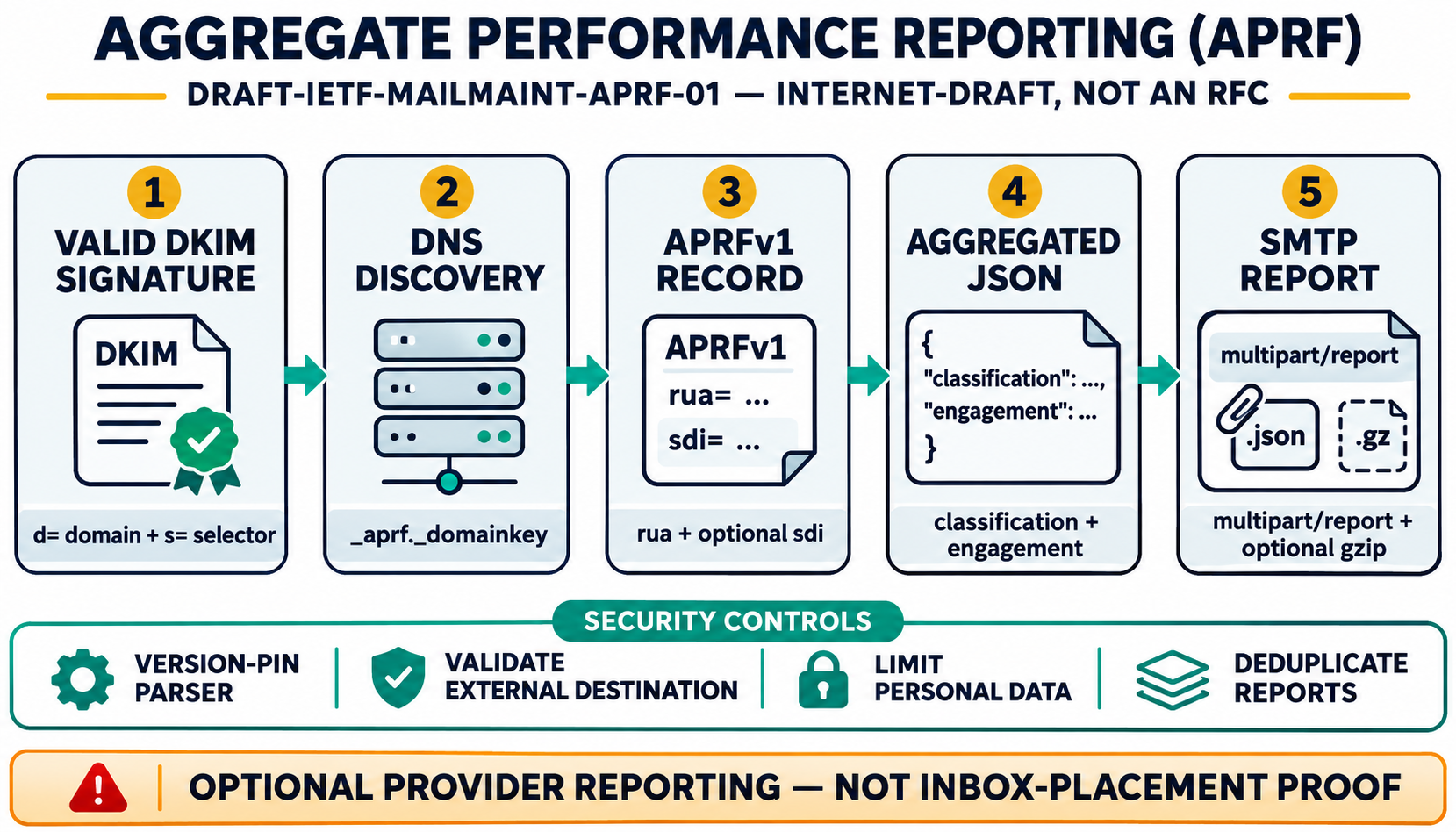
Aggregate Performance Reporting, or APRF, is a proposal for mailbox providers to send DKIM-domain performance aggregates to signers. The current source is draft-ietf-mailmaint-aprf-01, published October 31, 2026. It defines DNS discovery, a JSON report, SMTP delivery and optional signer-defined segmentation. It is not an RFC, provider reporting is optional, key ABNF remains unfinished, and its categories are not a universal reputation score.
Current document status
| Question | Verified answer on November 21, 2026 | Operator consequence |
|---|---|---|
| What is the current document? | draft-ietf-mailmaint-aprf-01, published October 31, 2026 and expiring May 4, 2027 | Pin analysis and parser experiments to revision 01. |
| Is it an RFC? | No. It is an active MailMaint working-group Internet-Draft | Do not call APRF a standard or promise provider support. |
| What status does its header request? | Standards Track | Intended status is not approval and can change during review. |
| What did it replace? | draft-brotman-aggregate-performance-reporting | Use the working-group draft as the current source. |
| Is the syntax complete? | No. DNS ABNF and destination-validation ABNF are still marked TODO | Do not freeze a production grammar from revision 01. |
| Is reporting mandatory? | No. A report generator can decline to send reports | No report is unknown, not proof of zero traffic or bad DNS. |
Standards Track does not mean RFC
The document header states an intended Standards Track status, while the Datatracker identifies it as a working-group Internet-Draft. Internet-Drafts can be revised, replaced or abandoned. Revision 01 expires May 4, 2027 unless updated. Production documentation should name the exact draft revision and should not cite APRF as an established IETF standard.
Which earlier draft it replaces
The working-group document replaces draft-brotman-aggregate-performance-reporting. That change shows working-group adoption, not completion. Links, parsers and internal design records should follow the active draft-ietf-mailmaint-aprf series while retaining the revision used for each test.
What APRF is trying to solve
Senders often see SMTP acceptance, bounces and complaints but not the receiver’s aggregate classification and engagement signals. APRF proposes a controlled channel for an MBP to disclose some domain-based performance information. It does not require the MBP to expose scoring logic, and the provider decides which metrics, buckets and recipients are appropriate.
APRF is not DMARC aggregate reporting
DMARC aggregate reporting describes authentication and alignment observations under RFC 9990. APRF is a separate draft aimed at classification and engagement metrics grouped around valid DKIM identities. Use a distinct mailbox, schema, parser, storage namespace and dashboard. Never feed APRF JSON into a DMARC XML processor or label it a DMARC report.
Identity boundaries
| Identity | Source | APRF use | Boundary |
|---|---|---|---|
| DKIM signing domain | Valid signature d= tag | Selects the reporting namespace and dkim_domain field | May differ from the visible RFC 5322 From domain. |
| DKIM selector | Valid signature s= tag | Selects a selector-specific discovery name and dkim_selector field | A selector is not a campaign or customer unless the signer designed it that way. |
| Visible From domain | RFC 5322 From field | May influence a generator decision to release data | The draft’s report grouping remains DKIM-centric. |
| Report generator | Mailbox provider or reporting service | Creates source, version, time period and metric buckets | Its labels and thresholds are provider-defined. |
| Report recipient | mailto URI in rua | Receives the JSON MIME attachment | External destinations require authorization and secure processing. |
| SDI segment | A DKIM-signed header named by sdi | Optionally subdivides aggregate results | Can leak business or personal information if designed badly. |
Only a valid DKIM signature starts discovery
The generator performs discovery against a domain used in a valid DKIM signature and includes its selector. A visible From domain alone is not the lookup input. If a message has more than one valid signature, the draft says discovery should be performed for each one. The generator still decides whether reporting to any discovered destination is suitable.
DNS discovery names
| Candidate | Example for d=email.example.org and s=selector1 | Precedence and meaning |
|---|---|---|
| Selector omitted | _aprf._domainkey.email.example.org | Broad declaration for selectors under the signing domain. |
| Wildcard selector | *._aprf._domainkey.email.example.org | DNS wildcard declaration when no explicit name exists. |
| Explicit selector | selector1._aprf._domainkey.email.example.org | Most specific match and therefore highest precedence. |
| Multiple valid signatures | Repeat discovery for each valid d= and s= pair | Discovery does not obligate a generator to send every possible report. |
# Replace the documentation values with a real DKIM d= and s= pair.
dig +short TXT selector1._aprf._domainkey.email.example.org
dig +short TXT '*._aprf._domainkey.email.example.org'
dig +short TXT _aprf._domainkey.email.example.org

# Keep answers, TTLs, DNSSEC validation state and retrieval UTC as evidence.
dig +dnssec TXT selector1._aprf._domainkey.email.example.org
Apply discovery precedence carefully
Revision 01 lists the omitted-selector name, wildcard name and explicit-selector name, then says the most specific match applies in reverse order. An explicit selector therefore wins, a matching wildcard follows, and the selector-omitted declaration is broadest. Keep the raw answers because cached negative results, wildcard synthesis and DNS views can complicate troubleshooting.
APRF record tags
| Tag | Draft rule | Safe implementation |
|---|---|---|
| v | Required and exactly APRFv1 | Ignore a record with a missing or different version. |
| rua | One or more comma-separated mailto URIs; each has its own mailto prefix | Validate address syntax, limit destination count and authorize external domains. |
| sdi | Optional header name and one-character separator | Require a DKIM-signed field, at most four parts and a separator other than semicolon, equals or comma. |
| Unknown tags | Not yet fully specified by completed ABNF | Retain raw evidence, ignore safely and never reinterpret an unknown tag as authorization. |
Draft DNS examples
selector1._aprf._domainkey.email.example.org. 300 IN TXT \
  "v=APRFv1;rua=mailto:[email protected]"

_aprf._domainkey.email.example.org. 300 IN TXT \
  "v=APRFv1;rua=mailto:[email protected],mailto:[email protected];sdi=X-Example-Segment,^"

# Revision 01 still contains ABNF TODOs. Treat this as a draft experiment,
# not a frozen production grammar or a promise that an MBP will report.
Keep records short enough for reliable DNS transport and control changes through normal DNS review. A valid record only requests reports. It does not prove that an MBP implements the draft, has enough data, trusts the signer or will send to every destination.
The ABNF gap matters
Both the record grammar and external-destination grammar contain TODO markers in revision 01. That means edge cases such as whitespace, duplicate tags, URI syntax, case handling and wildcard construction are not ready for strict interoperable assumptions. An experimental parser should reject ambiguous authorization and record a specific quarantine reason rather than guess.
Signer-Defined Identifier design
The optional sdi tag names an RFC 5322 header and one printable ASCII separator. The separator cannot be semicolon, equals or comma. The draft limits the segmented header value to four parts and requires the header field to be covered by the related DKIM signature. Generator use remains optional.
DKIM-Signature: v=1; d=email.example.org; s=selector1; h=from:to:subject:x-example-segment; ...
X-Example-Segment: transactional^billing^renewal

# The configured SDI field must be covered by the related valid DKIM signature.
# Use stable, non-personal categories. Never put an address, order number,
# account ID or recipient identifier into the segment value.
Choose a stable SDI taxonomy
Use broad operational dimensions such as transactional versus promotional, brand family or program class. Do not encode recipient addresses, customer IDs, order numbers, health status, account balances or a unique campaign-recipient token. A label that is safe in internal logs can still become inappropriate when transferred to an external provider and returned in reports.
Avoid SDI header collisions
Two signers can select the same header name with different separators. The draft warns that results can become undesirable. Choose an organization-specific field name, document ownership, include it in the correct DKIM h= list and confirm that relays do not rewrite it after signing.
One UTC day per report
The report must cover one UTC day, beginning at 00:00 UTC and ending at 23:59:59 UTC. Store the supplied epoch values rather than deriving a local date. Validate the interval but preserve the raw values when a provider differs, because a parser should quarantine an invalid report without destroying evidence.
JSON document schema
| JSON field | Meaning in revision 01 | Validation rule |
|---|---|---|
| header.version | Generator-defined data-definition version | Treat as an opaque string and bind transformations to source plus version. |
| header.source | Common name of the reporting MBP | Do not use the display string as cryptographic authentication. |
| header.dkim_domain | Reported d= value, possibly wildcard rolled up | Validate as a domain or the draft’s wildcard form. |
| header.dkim_selector | Reported s= value, possibly * for rollup | Store separately from dkim_domain. |
| header.report_start/end | Unix epoch boundaries for one UTC day | Require integers, start before end and expected daily duration. |
| header.contact_info | Optional contact address | Validate and render as untrusted data. |
| header.sdi_used | Used SDI, N/A when ignored, N/F when absent or invalid | Do not convert N/A and N/F into the same null state. |
| header.extra_info | Optional interpretation supplied by generator | Store as untrusted text, never execute or render as HTML. |
| body segment | Optional segment array plus classification and/or engagement | Cap parts and cardinality; accept omitted optional sections. |
Illustrative revision-01 JSON
[
  {
    "header": {
      "version": "2026a",
      "source": "Receiver MBP, Inc.",
      "dkim_domain": "email.example.org",
      "dkim_selector": "selector1",
      "report_start": 1793404800,
      "report_end": 1793491199,
      "contact_info": "[email protected]",
      "sdi_used": "X-Example-Segment,^",
      "extra_info": "Illustrative generator-defined categories"
    },
    "body": [
      {
        "segment": ["transactional", "billing", "renewal"],
        "classification": {"inbox": 10000, "unwanted": 500},
        "engagement": {"positive": 100, "neutral": 500, "negative": 50}
      }
    ]
  }
]
The field names and sample metric categories follow revision 01, but the values above are illustrative documentation values. They are not NitWings measurements and must not be used as provider thresholds. The draft’s own examples remain provisional along with the document.
Classification metrics
Classification is intended to disclose placement information. Revision 01 mentions inbox, unwanted, forwarded and promotional as examples, while allowing other provider categories. Counts may be bucketed and the reported scalar may be the upper bound. Compare a category only within a documented source and version.
Engagement metrics
Engagement covers actions during the report period, even if the underlying message arrived earlier. Positive, neutral and negative are intentionally not universally defined. The appendix gives possible examples, but a provider can use different inputs and may keep exact logic confidential.
Interpretation matrix
| Metric family | Draft examples | Time semantics | What it cannot prove |
|---|---|---|---|
| Classification | inbox, unwanted, forwarded, promotional or another provider category | Messages received during the report period | A universal folder taxonomy or individual placement. |
| Engagement positive | Potentially open, click or not-spam action | Actions occurring during the report period regardless of message receipt date | Human attention unless the provider defines the signal. |
| Engagement neutral | Potentially filing or forwarding | Provider bucket for actions in the period | A cross-provider comparable score. |
| Engagement negative | Potentially spam, unopened deletion or unsubscribe | Provider bucket for actions in the period | A complaint rate without a documented denominator. |
| Bucket scalar | Upper bound selected by generator | Approximate count for privacy or policy reasons | An exact event count. |
Do not invent rates or denominators
A bucket value without a documented population is not automatically a rate. Classification counts and engagement-action counts also use different time semantics. Never divide engagement by classification simply because both appear in one file. Record the raw bucket, provider definition and any explicit denominator separately.
SMTP and MIME delivery
Revision 01 specifies SMTP delivery using multipart/report. The attachment is application/json with a .json suffix. A generator can instead gzip it as application/gzip with .json.gz. A receiving implementation should support bounded gzip processing.
Subject: APRF: 20261031email.example.orgselector1_ReceiverMBP
Content-Type: multipart/report; boundary="aprf-boundary"

--aprf-boundary
Content-Type: text/plain; charset=utf-8

Aggregate Performance Reporting attachment.
--aprf-boundary
Content-Type: application/json
Content-Disposition: attachment; filename="20261031email.example.orgselector1_ReceiverMBP.json"

[{"header":{...},"body":[...]}]
--aprf-boundary--
Filename and subject are routing hints
The proposed name contains report end date, DKIM domain, selector and source, with spaces removed from source. The subject begins with APRF:. These strings are untrusted routing hints, not authentication. Never use the attachment filename directly as a filesystem path, and never deduplicate only on Subject.
Bound compressed reports
Inspect MIME metadata and compressed size before decompression. Stream into a quota-limited temporary object, cap expansion ratio and total output, and reject nested archives. Calculate hashes of both the original message and extracted attachment. A gzip file must still produce one permitted JSON document.
Duplicate and replacement handling
The draft says a later report matching the same report name and period should overwrite prior data. An evidence system should not physically erase the earlier artifact. Mark the old normalized record superseded, retain both hashes and received timestamps, and publish the replacement only after full validation.
External rua authorization
When the destination domain does not align with the DKIM domain, the generator should validate that destination before delivery. Revision 01 proposes a TXT name composed from selector, DKIM domain, _aprf and destination domain, with value v=APRFv1. This is conceptually similar to external DMARC report authorization but uses a different namespace.
# DKIM identity: selector1 / email.example.org
# External rua: [email protected]
selector1.email.example.org._aprf.reports.example.net. 300 IN TXT "v=APRFv1;"

# Revision 01 also allows wildcard components, but its ABNF is unfinished.
# Publish only after the report destination operator explicitly authorizes it.
Vendor destinations need two approvals
DNS authorization shows that the destination domain accepts the draft’s report flow. It does not complete privacy, procurement, security or retention review. Require both a valid DNS response and an internal vendor authorization covering data fields, region, subprocessors, access, deletion and incident response.
Privacy and low-volume leakage
The draft recognizes that low-volume aggregates can expose information otherwise hidden in a larger population. Providers can apply message or distinct-recipient thresholds. Signers should independently reduce SDI cardinality, avoid personal labels, restrict dashboards and expire raw reports according to a documented need.
Data minimization rules
- Use no recipient-level identifier in DNS, SDI, filenames or dashboard keys.
- Limit report mailbox access to deliverability, security and privacy-approved roles.
- Keep raw MIME separate from broadly accessible analytics.
- Define retention for raw, normalized and aggregate datasets separately.
- Do not enrich APRF with customer data merely because a segment label can be joined.
Threat and control matrix
| Threat | Why it exists | Receiver control |
|---|---|---|
| Forged report mail | SMTP delivery and a familiar source string do not authenticate the attachment | Authenticate transport and message where available, allowlist expected sources only after evidence, and mark provenance. |
| Oversized MIME or gzip bomb | Compressed JSON can expand far beyond attachment size | Limit message, part, compressed and decompressed sizes before parsing. |
| JSON resource exhaustion | Deep nesting, huge arrays and numbers can exhaust parser resources | Set depth, token, string, segment and integer limits. |
| Duplicate overwrite abuse | Revision 01 says same name and period should overwrite prior data | Keep immutable versions, compare hashes and promote only a validated replacement. |
| Destination exfiltration | A rua outside the signing domain transfers performance data elsewhere | Require the draft’s external-destination DNS authorization and an internal vendor approval. |
| Low-volume privacy leakage | Small buckets and specific SDI labels can expose individuals or customers | Use generator thresholds, coarse segments, access control and retention limits. |
| Formula or HTML injection | Fields may enter spreadsheets and dashboards | Escape output, neutralize spreadsheet formulas and never trust extra_info as markup. |
Safe ingestion pipeline
1. Receive into a dedicated mailbox with ordinary anti-abuse controls.
2. Save the original message and calculate SHA-256 before extraction.
3. Enforce total message, MIME-part and attachment limits.
4. Accept only expected JSON or gzip attachment media types.
5. Decompress into a bounded temporary stream, never an unbounded buffer.
6. Parse JSON with depth, size, integer and segment-count limits.
7. Validate fields against the pinned APRF revision and local schema.
8. Bind source, DKIM identity, report period and received provenance.
9. Quarantine failures without feeding production metrics.
10. Store immutable raw evidence and a separately versioned normalized row.
11. Deduplicate by logical key while retaining replacement history.
12. Publish dashboards only after privacy and access controls pass.
Version the parser at two levels
Pin the IETF draft revision because document syntax can change. Separately retain header.version, which the generator uses to mark a change in its data definitions. A parser that understands draft 01 can still need a new provider-specific mapping when a source changes what positive or unwanted means.
Normalized data model
logical_key       = source + dkim_domain + dkim_selector + report_start + report_end
received_at_utc   = required timestamp
raw_sha256        = immutable message or attachment hash
draft_revision    = "draft-ietf-mailmaint-aprf-01"
generator_version = opaque header.version string
sdi_state         = used | not_used | not_found
segment_path      = zero to four non-personal strings
metric_family     = classification | engagement
metric_name       = provider-supplied key
bucket_upper      = validated non-negative integer
parse_state       = accepted | quarantined | superseded
supersedes_hash   = nullable prior raw_sha256
Missing, zero and unavailable are different
An omitted optional section is unavailable, not zero. No report can mean non-participation, a generator decision, insufficient volume, transport failure or configuration error. A reported bucket of zero is a provider statement inside a received report. Preserve these states separately in APIs and dashboards.
Operational state model
| State | Meaning | Alert treatment | First check |
|---|---|---|---|
| Report received and valid | A generator supplied data for a DKIM identity and period | Evaluate trend only within the same source and version | Confirm period, domain, selector and parser version. |
| Report received but quarantined | MIME, JSON, identity or size validation failed | Security or integration alert, not a deliverability alert | Preserve hash and failure reason. |
| No report | Generator may not participate, may decline, or delivery may fail | Unknown unless a previously stable feed stops | Query discovery names and review mailbox/MTA logs. |
| Empty classification | Optional section omitted or unavailable | Do not create zeros | Check raw JSON and generator documentation. |
| Version changed | Provider says its metric definition changed | Break the time series until mapped | Read extra_info and validate a new transformation. |
| Duplicate period | A later report matches name and time period | Validate replacement and retain both artifacts | Compare source, hashes, structure and received times. |
Monitoring and alerts
CRITICAL: parser sandbox bypass, decompression limit, malware or destination takeover
HIGH: previously stable source missing for three complete UTC periods
HIGH: generator version changes and no approved mapping exists
MEDIUM: duplicate logical key has a different hash or materially different totals
MEDIUM: invalid external-destination authorization or expired vendor approval
INFO: first valid report, optional section absent, provider uses coarse buckets

Never page on a provider-defined negative bucket alone. First establish its
definition, denominator, baseline, revision and corroborating delivery evidence.
Build a source-specific baseline
Baseline only after several complete periods under the same source, generator version, DKIM identity, SDI taxonomy and traffic mix. Keep promotions and transactions distinct. A sudden bucket change is a lead for investigation, not proof that a provider changed placement globally.
Correlate without overclaiming
Join APRF to MTA acceptance, temporary failures, permanent bounces, complaints, DMARC authentication, controlled seed observations and business outcomes at a suitably aggregated level. Agreement across independent evidence strengthens a diagnosis. Disagreement should remain visible rather than being forced into one health color.
Do not automate traffic changes from APRF alone
Never pause a provider, rotate domains, move IPs or suppress recipients because one negative bucket rose. First verify source version, denominator, traffic composition, duplicate replacement state and corroborating SMTP or complaint evidence. Human review should approve any production traffic change during the draft stage.
Controlled experiment sequence
- Select one stable DKIM domain and selector with accountable ownership.
- Create a dedicated report mailbox and hardened ingestion boundary.
- Publish a single aligned
ruarecord without SDI. - Verify all three discovery candidates and captured TTLs.
- Wait without assuming any provider will send a report.
- Validate first reports manually and preserve raw MIME.
- Enable normalized read-only dashboards after schema and privacy review.
- Add a coarse SDI only when its business value and leakage risk are documented.
- Test external authorization before moving to a vendor destination.
- Re-review every new draft revision before parser or DNS changes.
Rollback and withdrawal
Remove the APRF TXT request, wait through relevant TTLs and keep the mailbox able to receive delayed messages during a defined grace period. Revoke vendor access and authorization when no longer required. Withdrawal cannot recall data already sent, so close the retention and deletion workflow as part of rollback.
Common implementation mistakes
- Calling revision 01 an RFC or a deployed provider requirement.
- Looking up the visible From domain instead of each valid DKIM d= and s= identity.
- Assuming record publication guarantees reports.
- Encoding recipient or customer identifiers in SDI.
- Trusting Subject, filename or source string as authentication.
- Parsing gzip without expansion limits.
- Converting absent optional sections to zero.
- Comparing positive or inbox across providers without definitions.
- Overwriting duplicate raw evidence permanently.
- Sending reports to an external vendor without DNS and organizational authorization.
Production-readiness gate
Revision 01 does not pass a final production-standard gate because ABNF is unfinished and interoperability is not established. It can pass a controlled research gate when DNS is reversible, ingestion is isolated, schemas are pinned, privacy is reviewed, alerts are non-automating and all displays say Internet-Draft.
Current status on November 21, 2026
The active document is draft-ietf-mailmaint-aprf-01, published October 31, discussed by the MailMaint working group at IETF 127 on November 18, and scheduled to expire May 4, 2027. It remains work in progress. This guide must be rechecked when revision 02, working-group last call, IETF last call or an RFC appears.
Primary IETF sources
- Aggregate Performance Reporting revision 01: Current October 31, 2026 working-group draft, DNS discovery, JSON fields, delivery, validation and security text.
- APRF Datatracker record: Current version, replacement relationship, authors, revision history and expiry.
- MailMaint active documents: Working-group document status and active revision.
- IETF 127 MailMaint agenda: November 18, 2026 APRF working-group agenda entry.
- IETF 127 APRF slides: Working-group presentation and open design discussion.
- RFC 6376 DKIM: Valid DKIM signature identities used for APRF discovery.
- RFC 8259 JSON: Normative JSON data format referenced by the draft.