Spamhaus Sender Infrastructure: HELO, PTR and FCrDNS Guide
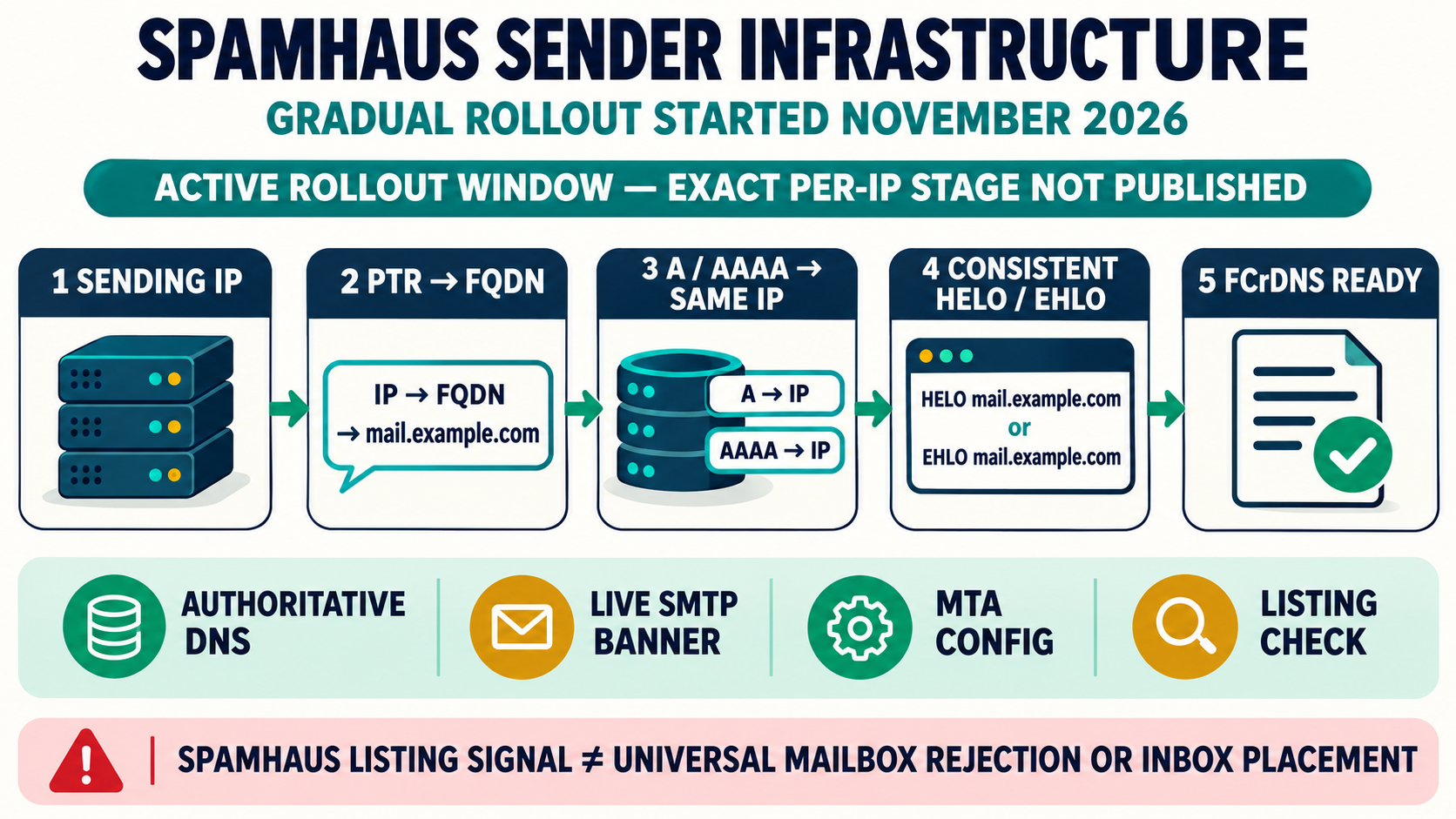
Spamhaus says it began a gradual rollout of sender-infrastructure enforcement in November 2026 and will continue over several months. The highlighted baseline requires every sending IP to have a valid HELO or EHLO identity, reverse DNS through a PTR record, and matching forward resolution. The exact stage for a particular IP is not published, so operators should verify every real egress path rather than wait for a listing.
Current rollout status
| Question | Verified position on November 21, 2026 | Operator interpretation |
|---|---|---|
| Has the rollout window begun? | Spamhaus currently says gradual enforcement starts in November 2026 and continues over several months | Treat the announced rollout window as active; do not claim every IP is already evaluated identically. |
| Is there one universal cutover date? | No exact per-IP or universal completion date is published | Test every production egress IP and retain current evidence. |
| What are the highlighted DNS requirements? | Valid HELO/EHLO, PTR for every sending IP, and matching forward A or AAAA resolution | Build an IP-to-name-to-IP loop and verify the live greeting. |
| Does compliance guarantee no listing? | No | Permission, abuse, authentication, volume and security remain separate listing signals. |
| Does a Spamhaus listing equal universal rejection? | No. Receivers consume and apply Spamhaus data under their own policy | Preserve the actual receiver SMTP response and listing evidence separately. |
| Does passing guarantee inbox placement? | No | Infrastructure hygiene is a prerequisite, not an inbox entitlement. |
Active window does not mean universal completion
The current sender-guidelines page says the requirement is gradually rolling out starting in November 2026. Spamhaus’s October 21 announcement says the process will occur over several months. There is no published per-IP schedule in those sources. State the current window accurately and avoid inventing a day when all infrastructure became subject to identical treatment.
These are established SMTP hygiene controls
Reverse DNS, forward confirmation and a valid greeting are not new protocol concepts. Spamhaus describes the rollout as stronger enforcement of basic requirements. Existing systems can still fail because a cloud migration, new NAT, IPv6 enablement, failover node or ESP pool changed the public identity without a matching DNS and MTA update.
Keep every identity separate
| Identity or object | Direction | Required relationship | Common mistake |
|---|---|---|---|
| Sending IP | Observed TCP source at receiving MX | Must be the actual public IPv4 or IPv6 used by the production MTA | Testing a control-plane address or NAT inside address. |
| PTR / reverse DNS | IP to hostname | Every sending IP should return a valid fully qualified hostname | Trying to create PTR in the ordinary forward DNS zone. |
| A / AAAA | Hostname to IP address | The PTR hostname resolves back to the same sending IP | Forward hostname points only to a web server or different mail node. |
| HELO/EHLO hostname | SMTP client announces name to receiver | Resolves to the connecting IP and remains consistent for that IP | Using localhost, a short host name or a provider placeholder. |
| Envelope MAIL FROM domain | Message transaction identity | Has correct SPF authorizing actual sending infrastructure | Assuming it must equal the HELO or PTR name. |
| DKIM signing domain | Message signature identity | Valid signature and appropriate DMARC alignment with visible From | Treating FCrDNS as a substitute for DKIM or DMARC. |
| Visible From domain | RFC 5322 author identity | Authorized, expected and authenticated through aligned SPF or DKIM | Changing it to the infrastructure domain merely to match PTR. |
What forward-confirmed reverse DNS means
Start with the public source IP observed by a receiver. Its PTR returns a fully qualified domain name. The A record for an IPv4 host or AAAA record for an IPv6 host then includes that same source address. This IP-to-name-to-IP loop is FCrDNS. Test the actual source, not a nearby host with similar naming.
PTR is controlled by the address-space operator
Most organizations cannot publish reverse DNS inside their normal domain zone. The ISP, cloud provider, hosting company or delegated reverse-zone operator controls the PTR. Obtain its supported procedure before cutover. A forward A record without the corresponding PTR does not complete the loop.
Forward DNS is controlled by the hostname owner
The organization controlling mailout1.example.net publishes its A or AAAA record. The answer can contain more than one address, but the actual sending source must be among them. Avoid unnecessary round-robin sets because they complicate attribution and can confirm some nodes while hiding a broken one.
HELO and EHLO are live SMTP evidence
The SMTP client announces HELO or EHLO after connection. Spamhaus requires that hostname to resolve to the sending IP and remain consistent across connections from that IP. It recommends making it consistent with the reverse-DNS hostname where possible. Do not assume the running MTA uses hostname -f or the value shown in a control panel.
Required versus recommended details
The current guidance marks correct PTR, matching forward resolution and HELO resolution as required. It recommends branded reverse DNS rather than generic provider names, consistency between HELO and PTR, and a webpage explaining the HELO domain or redirecting to the main brand. Preserve that distinction while still treating recommendations as meaningful reputation hygiene.
DNS validation matrix
| Test | Example expected result for 192.0.2.25 | Failure meaning |
|---|---|---|
| Reverse lookup | 192.0.2.25 PTR mailout1.example.net. | Missing, invalid or unrelated public reverse identity. |
| Forward IPv4 lookup | mailout1.example.net A 192.0.2.25 | PTR hostname does not confirm the connecting IPv4 address. |
| Forward IPv6 lookup | IPv6 PTR hostname AAAA contains the same IPv6 source | IPv6 path is not forward-confirmed. |
| Live HELO/EHLO | EHLO mailout1.example.net from 192.0.2.25 | Production MTA is announcing another or unstable identity. |
| Authority | PTR controlled by address-space operator; A/AAAA by hostname zone owner | The change request was sent to the wrong DNS owner. |
| TTL and propagation | Authoritative and recursive answers agree after planned TTL window | Mixed caches can produce temporary inconsistent evidence. |
# IPv4 documentation example. Replace with every real sending IP.
dig +short -x 192.0.2.25
dig +short A mailout1.example.net
dig +trace -x 192.0.2.25

# Record the authoritative answer, TTL and retrieval time.
dig +noall +answer PTR 25.2.0.192.in-addr.arpa
date -u +'%Y-%m-%dT%H:%M:%SZ'
Check authoritative and recursive views
During a change, authoritative DNS may be correct while recursive caches still hold an older answer. Record both answers, TTL and timestamp. Do not declare a permanent defect during an expected propagation interval, but do not expose production traffic until the old answer has a safe relationship with the new source.
IPv6 is an independent production identity
| IPv6 control | Spamhaus guidance | Operational check |
|---|---|---|
| Allocation size | Customer allocations should be at least /64 | Document routed prefix and delegated ownership. |
| Reverse DNS | Valid reverse DNS is required | Test the exact IPv6 source used for outbound SMTP. |
| Forward confirmation | PTR hostname resolves back through AAAA to the same address | Do not validate only a companion IPv4 A record. |
| Source stability | Sending identity should not rotate through uncontrolled addresses | Bind the MTA and monitor observed IPv6 egress. |
| Dual stack | IPv4 and IPv6 are separate sending paths | Pass every check independently for each address family. |
| Fallback | Disabling broken IPv6 can be a containment step, not a permanent substitute | Repair DNS and controlled routing before re-enabling. |
# Replace the documentation address with the exact outbound IPv6 source.
dig +short -x 2001:db8:100::25
dig +short AAAA mailout6.example.net
ip -6 route get 2001:4860:4860::8888

# A valid IPv4 loop does not validate the IPv6 path.
Dual stack requires two complete loops
An IPv4 PTR and A record do not validate IPv6. Receivers can observe either address family depending on routing and MTA policy. Inventory every public source, confirm the correct PTR and A or AAAA loop, capture the live HELO and monitor reputation separately.
MTA and topology controls
| MTA or topology | Identity control | Required validation |
|---|---|---|
| Single Postfix instance and one egress IP | myhostname, smtp_helo_name and smtp_bind_address | Live receiver sees the configured hostname from the bound source IP. |
| Postfix multi-instance | One instance or transport boundary per egress identity | Each queue path binds the intended IP and announces the matching hostname. |
| Exim outbound SMTP transport | primary_hostname or transport helo_data plus interface | Expansion produces the correct hostname for the selected source address. |
| PowerMTA or commercial MTA | Per-source-host IP and HELO configuration | Export the exact source/virtual-MTA mapping and verify it at a remote receiver. |
| NAT gateway | Public translated source, not private MTA address | PTR, forward DNS and HELO are checked against the public egress observed remotely. |
| Load balancer or relay tier | Each public source address has a stable assigned identity | No shared frontend produces unrelated or changing HELO values. |
| ESP shared pool | Provider owns PTR and live MTA identity | Obtain provider evidence; customer DNS cannot repair provider IP reverse DNS. |
Postfix single-egress configuration
# main.cf example for one stable egress identity.
myhostname = mailout1.example.net
smtp_helo_name = $myhostname
smtp_bind_address = 192.0.2.25

# IPv6 only when the exact address is routed and fully prepared.
# smtp_bind_address6 = 2001:db8:100::25

# Verify effective values, then reload through normal change control.
# postconf myhostname smtp_helo_name smtp_bind_address smtp_bind_address6
smtp_helo_name controls the name sent by the Postfix SMTP client and normally defaults to myhostname. smtp_bind_address selects the IPv4 source when configured. Verify effective configuration with postconf, reload through normal change control and prove the public result remotely.
Postfix parameters and their boundaries
| Postfix parameter | Role | Safe interpretation | Verification |
|---|---|---|---|
| myhostname | Canonical name of the Postfix system and default source for several identities | Set a fully qualified hostname owned and controlled for this MTA; do not assume changing it affects only outbound HELO | postconf -h myhostname plus full regression of local and inbound behaviors. |
| smtp_helo_name | Name the Postfix SMTP client sends in EHLO or HELO | Defaults to $myhostname; override globally only when every outbound source can use the same resolvable name | postconf -h smtp_helo_name and a real receiver-side SMTP session. |
| smtp_bind_address | Optional IPv4 source address for outbound SMTP connections | Bind the real local address only when routing supports it; confirm NAT does not translate to another public source | postconf -h smtp_bind_address, ip route get and remote receiver logs. |
| smtp_bind_address6 | Optional IPv6 source address for outbound SMTP connections | Configure only after the exact IPv6 has PTR, matching AAAA, route and reputation controls | postconf -h smtp_bind_address6, ip -6 route get and remote receiver logs. |
| smtp_bind_address_enforce | Postfix 3.7+ behavior when a configured bind cannot be applied | Set yes when silent fallback to a different source would violate identity design; test failure and queue behavior first | postconf mail_version smtp_bind_address_enforce and a controlled unavailable-address test. |
| inet_protocols | Address families available to Postfix | Do not enable IPv6 merely because the host has an address; the outbound IPv6 identity must pass separately | postconf inet_protocols and paired IPv4/IPv6 deliveries. |
| master.cf -o overrides | Per SMTP client service values | Use a separate transport service to bind one source and HELO tuple | postconf -M, postconf -P where supported, and remote evidence for that transport. |
Check effective Postfix configuration
# Record version and non-default effective configuration.
postconf mail_version
postconf -n | egrep '^(myhostname|inet_protocols|inet_interfaces|smtp_helo_name|smtp_bind_address|smtp_bind_address6|smtp_bind_address_enforce)[[:space:]]*='

# Show effective values even when they are defaults.
postconf -h myhostname
postconf -h smtp_helo_name
postconf -h smtp_bind_address
postconf -h smtp_bind_address6
postconf -h smtp_bind_address_enforce

# Validate syntax before applying, then reload and inspect service state.
postfix check
postfix reload
postfix status
journalctl -u postfix --since '10 minutes ago' --no-pager
postconf -n shows non-default main.cf values, so it can omit an important value that remains at its default. Query each parameter explicitly with postconf -h. Record the Postfix version because smtp_bind_address_enforce is available in Postfix 3.7 and later.
Validate and reload without hiding errors
Run postfix check before reload, capture its exit status and output, then use the platform’s normal service process. Inspect logs immediately. A successful reload means the configuration was accepted; it does not prove that existing queued mail selected the intended transport, source address or HELO.
Postfix multi-IP and multi-instance design
For each outbound transport or Postfix instance, define one evidence tuple:

queue/instance -> public source IP -> PTR FQDN -> A/AAAA back to source -> HELO

Do not select a new source IP without selecting its matching HELO identity.
Do not rely on a private bind address when NAT changes the public source.
Failover is eligible only after the complete tuple passes from outside.
A single global HELO with several unrelated public IPs can produce partial matches. Use explicit transport or multi-instance boundaries where necessary. Keep queue recovery and failover from silently selecting an IP whose DNS and hostname were prepared for another node.
Per-transport Postfix HELO and source binding
# /etc/postfix/master.cf: one explicit SMTP client service per identity.
smtp-ip1 unix  -       -       n       -       -       smtp
  -o smtp_bind_address=192.0.2.25
  -o smtp_helo_name=mailout1.example.net
  -o smtp_bind_address_enforce=yes

smtp-ip2 unix  -       -       n       -       -       smtp
  -o smtp_bind_address=192.0.2.26
  -o smtp_helo_name=mailout2.example.net
  -o smtp_bind_address_enforce=yes

# Route selection must return smtp-ip1: or smtp-ip2: deliberately.
# The exact lookup design depends on whether separation is by sender,
# destination, application, tenant or independent Postfix instance.
Postfix permits smtp_bind_address and smtp_helo_name in main.cf for all SMTP clients or as -o overrides on a specific master.cf SMTP client service. The route-selection map must choose that transport deliberately. Do not deploy the example without defining how messages enter each transport and how a failed bind behaves on the installed version.
Prevent silent source-address fallback
On Postfix 3.7 and later, smtp_bind_address_enforce=yes defers delivery when the SMTP client cannot apply the configured IPv4 or IPv6 bind. The default is no, which permits delivery after a warning. Enforcement can prevent identity leakage, but only after a controlled failure test confirms that mail queues safely instead of using an unintended route.
Postfix runtime and routing evidence
# Show master.cf service definitions and supported per-service fields.
postconf -M | grep '^smtp-ip'
postconf -P | grep '^smtp-ip'    # Postfix versions supporting -P

# Confirm local address and kernel route. This still does not prove public NAT.
ip addr show
ip route get 198.51.100.10 from 192.0.2.25

# Force one controlled queued delivery through the intended transport,
# then correlate queue ID in logs with receiver-side source and EHLO evidence.
postqueue -p
journalctl -u postfix --since '5 minutes ago' --no-pager
Local routing evidence stops at the host boundary. NAT, policy routing and upstream relays can change the public source later. Correlate the Postfix queue ID and timestamp with a receiver-side connection record. The public source and EHLO observed remotely are the decisive infrastructure evidence.
Exim outbound identity example
# Illustrative Exim transport boundary. Validate syntax for the deployed version.
remote_smtp:
  driver = smtp
  interface = 192.0.2.25
  helo_data = mailout1.example.net

# If expressions select interfaces, make helo_data select the corresponding
# hostname and test every expanded combination at a remote receiver.
The example shows the control boundary, not a drop-in file for every Exim release. Confirm the running configuration, expansion values and interface selection. A syntactically valid configuration is not proof until a receiver observes the expected public source and greeting.
PowerMTA and commercial MTAs
Commercial MTAs commonly map virtual MTAs or source hosts to an IP and HELO name. Export that mapping for every pool and compare it with observed sessions. Do not copy configuration syntax from another product version without its documentation. The invariant is the same: selected public source, PTR hostname, forward confirmation and live greeting must agree.
NAT can invalidate an otherwise correct server
The local MTA may bind to a private address while a gateway translates it to another public IP. Receivers evaluate the public IP. Map private source, NAT rule, public address, reverse DNS, HELO and failover behavior. If multiple internal nodes share one public source, their greetings must not vary unpredictably.
Load balancers and SMTP relays need special care
A load balancer can make legitimate infrastructure resemble compromised proxy behavior if many unrelated greetings emerge from one frontend. Preserve source selection intentionally, avoid proxying arbitrary external clients and ensure the public-facing identity is stable. When a relay performs SMTP submission onward, validate the relay’s egress rather than only the originating application.
Prove the real path remotely
1. Send one neutral message through the real production queue and route.
2. Capture the public source IP at a receiver you control.
3. Capture the exact HELO/EHLO string from receiver SMTP logs.
4. Query PTR for the observed source from an independent resolver.
5. Query A and/or AAAA for the PTR hostname from authoritative DNS.
6. Confirm the observed source is present in the forward answer set.
7. Repeat for every failover, pool, region and address family.
8. Preserve timestamp, TTL, config version and result.
Illustrative receiver-side SMTP transcript
S: 220 mx.receiver.example ESMTP
C: EHLO mailout1.example.net
S: 250-mx.receiver.example
S: 250-STARTTLS
S: 250 SIZE 52428800
C: MAIL FROM:<[email protected]>
S: 250 2.1.0 Sender accepted

Receiver connection log for the same session:
client_ip=192.0.2.25
client_helo=mailout1.example.net
ptr=mailout1.example.net
fcrdns=pass

This is illustrative. Capture the real receiver transcript or logs.
EHLO is the client command. It is not the receiving server’s 220 banner. When STARTTLS is used, SMTP issues EHLO again after the TLS handshake. Capture the identity from the receiver’s connection telemetry or an explicitly returned diagnostic rather than inferring it from the recipient MX banner.
How to interpret the Postfix delivery log
postfix/smtp[24180]: 7A91B2C04D: to=<[email protected]>,
  relay=mx.receiver.example[198.51.100.40]:25, delay=1.2,
  delays=0.05/0.02/0.31/0.82, dsn=2.0.0, status=sent
  (250 2.0.0 queued as 8F4C11A2)

What this local line proves:
- queue ID, destination MX, response, timing and accepted handoff.

What it does not normally prove by itself:
- public source after NAT, receiver-observed EHLO, PTR, FCrDNS or inbox placement.
A normal Postfix postfix/smtp success line provides valuable transaction evidence, but it often does not print the client’s own EHLO or public source. Temporary debug verbosity can expose more detail, but broad SMTP debug logging can be noisy and sensitive. Prefer a controlled receiver and a narrow test instead of enabling global verbose logging in production.
Received header and authentication example
Received: from mailout1.example.net (mailout1.example.net [192.0.2.25])
        by mx.receiver.example with ESMTPS id 8F4C11A2
        for <[email protected]>; Sat, 21 Nov 2026 14:20:00 +0000
Authentication-Results: mx.receiver.example;
        spf=pass smtp.mailfrom=bounce.example.com;
        dkim=pass header.d=example.com header.s=selector1;
        dmarc=pass header.from=example.com
Received-SPF: pass (mx.receiver.example: domain of bounce.example.com
        designates 192.0.2.25 as permitted sender)
From: Example Alerts <[email protected]>
Return-Path: <[email protected]>
DKIM-Signature: v=1; a=rsa-sha256; d=example.com; s=selector1; ...

Receiver syntax varies. Treat each field as receiver-generated evidence,
and retain the unmodified raw message rather than copying only pass labels.
The earliest trusted Received field added by the first external receiver can show its view of the client hostname and address. Formatting and hostname verification differ by receiver, and sender-supplied earlier headers are untrusted. Pair the raw header with the receiver’s Authentication-Results and your MTA transaction evidence.
A handcrafted SMTP test has limits
Tools such as Swaks can prove that a selected source can connect and announce a chosen EHLO, but that does not prove the production queue uses the same settings. The strongest test sends through the real scheduler, routing rules, NAT and failover path while a receiver under your control logs the connection.
Shared ESP infrastructure
When an ESP owns the sending IP, it also controls PTR and the live MTA greeting. Customers can configure branded envelope and DKIM domains, but cannot repair provider reverse DNS. Ask the ESP for the exact egress IP, HELO and remediation evidence. A dedicated IP still requires coordination if the provider owns its reverse zone.
Safe infrastructure migration
| Change | Before cutover | During cutover | After cutover |
|---|---|---|---|
| New outbound IP | Create PTR, forward record, SPF authorization, monitoring and low-risk test path | Bind a small approved cohort and retain live greeting evidence | Remove old authorization only after queues and rollback window close. |
| Rename HELO hostname | Publish forward record and web/ownership context if used | Expect a new or changed reputation identity and keep volumes controlled | Retire old DNS only after no production node announces it. |
| Move hosting provider | Obtain provider PTR delegation or change procedure | Verify public NAT and every failover IP | Remove dangling forward, PTR requests and SPF includes. |
| Enable IPv6 | Allocate at least /64, route it, publish reverse and forward DNS | Start with bounded traffic and compare IPv4 evidence | Monitor separate IPv6 reputation and failures. |
| ESP pool migration | Get old and new pool IP/HELO ownership boundaries | Do not assume provider UI label identifies actual egress | Capture real headers and SMTP logs for the new pool. |
A hostname change can create a new reputation boundary
Spamhaus says HELO domains without sending history may receive additional filtering and advises treating changes in IP or HELO as new assets when history is absent. Do not rename a healthy identity casually. When change is necessary, prepare DNS first, use wanted recipients, keep volume controlled and monitor the new tuple.
FCrDNS does not replace SPF, DKIM or DMARC
Spamhaus also requires sender authentication in its guidelines. Publish SPF for the HELO and envelope domains as applicable, sign outbound messages with DKIM and maintain DMARC alignment for the visible From domain. A perfect PTR loop cannot authorize an unrelated message identity.
Map HELO, SPF, DKIM and DMARC correctly
| Layer | Example identity | DNS or message evidence | DMARC contribution |
|---|---|---|---|
| HELO SPF | mailout1.example.net | TXT at mailout1.example.net authorizes 192.0.2.25; receiver may report smtp.helo | Ordinary non-null MAIL FROM messages do not use HELO SPF as the DMARC SPF identifier. |
| MAIL FROM SPF | bounce.example.com | SPF TXT authorizes 192.0.2.25; Authentication-Results shows smtp.mailfrom | Can support DMARC when the validated MAIL FROM domain aligns with the visible From domain. |
| Null reverse-path SPF | MAIL FROM:<> with HELO mailout1.example.net | RFC 7208 defines the MAIL FROM identity using postmaster at the HELO domain | The HELO-derived MAIL FROM identity is the relevant SPF identity for the bounce. |
| DKIM | d=example.com; s=selector1 | Valid DKIM signature and selector public key | Can support DMARC when d= aligns with the visible From domain. |
| Visible From | [email protected] | RFC 5322 From header and DMARC record at _dmarc.example.com | This Author Domain is the identity against which SPF or DKIM alignment is evaluated. |
| PTR and HELO | 192.0.2.25 and mailout1.example.net | Reverse DNS, matching forward DNS and live SMTP transcript | Important infrastructure evidence, but not itself a DMARC authentication mechanism. |
Publish and test HELO-domain SPF
RFC 7208 recommends checking the HELO identity separately and notes that a host-specific HELO SPF policy is useful because it normally authorizes one host. Publish a narrow SPF record at the HELO hostname when that identity is used operationally. It does not replace the SPF record for the envelope MAIL FROM domain.
MAIL FROM SPF is the ordinary DMARC SPF identity
RFC 9989 states that DMARC relies on SPF validation of the MAIL FROM identity, not an independent HELO SPF pass. For an ordinary message, bounce.example.com must pass SPF and align with the visible From domain if SPF is expected to support DMARC. With a null reverse path, RFC 7208 derives the MAIL FROM identity from postmaster at the HELO domain.
Illustrative DNS records for all identity layers
; Infrastructure identity and FCrDNS
25.2.0.192.in-addr.arpa. 300 IN PTR mailout1.example.net.
mailout1.example.net.    300 IN A   192.0.2.25

; HELO SPF: useful for HELO checking and null reverse-path messages
mailout1.example.net.    300 IN TXT "v=spf1 ip4:192.0.2.25 -all"

; Envelope MAIL FROM SPF: this is the ordinary DMARC SPF identity
bounce.example.com.      300 IN TXT "v=spf1 ip4:192.0.2.25 -all"

; DKIM and DMARC use separate names and purposes
selector1._domainkey.example.com. 300 IN TXT "v=DKIM1; k=rsa; p=..."
_dmarc.example.com.      300 IN TXT "v=DMARC1; p=reject; rua=mailto:[email protected]"
These are documentation examples, not records to copy literally. Use the real public source, domains, selector and DKIM key. Ensure there is one SPF record per queried name, keep SPF within its DNS-query limit and stage DNS before routing production traffic.
Query authentication records and verify the message
# Infrastructure identity
dig +short -x 192.0.2.25
dig +short A mailout1.example.net

# SPF identities
dig +short TXT mailout1.example.net
dig +short TXT bounce.example.com

# DKIM and DMARC identities
dig +short TXT selector1._domainkey.example.com
dig +short TXT _dmarc.example.com

# Then send through the real Postfix path and inspect receiver-generated
# Authentication-Results plus the earliest trusted Received header.
DKIM verification and alignment
DKIM signs selected headers and the body using the private key corresponding to the public selector record. The receiver reports a validated signing domain in header.d. DMARC can use DKIM only when at least one passing DKIM signing domain aligns with the visible RFC 5322 From domain under the applicable strict or relaxed mode.
DMARC evaluation
DMARC evaluates the visible From Author Domain against authenticated identifiers. It passes when aligned SPF through the MAIL FROM identity or aligned DKIM passes. PTR and HELO FCrDNS are not DMARC mechanisms. A message can therefore pass Spamhaus infrastructure checks and fail DMARC, or pass DMARC while its HELO infrastructure remains poor.
Authentication diagnostic order
- Record public source IP, PTR, forward confirmation and live HELO.
- Record MAIL FROM and check its SPF result and alignment.
- Record every DKIM signature, selector, validation result and signing domain.
- Record visible From and the applicable DMARC record.
- Determine whether aligned SPF or aligned DKIM produced DMARC pass.
- Keep the receiver’s local disposition separate from each protocol result.
Infrastructure compliance does not repair list abuse
The sender guidelines begin with confirmed opt-in and warn against purchased, rented and harvested lists. Spam traps, complaints, artificial engagement and compromised hosts can still cause listings. Treat DNS readiness as one control in a larger permission, authentication and security system.
Do not use artificial warm-up services
Spamhaus explicitly warns against services that generate artificial traffic or simulate opens, clicks and replies. Infrastructure used to inflate engagement can itself be listed. Warm a genuinely new or inactive source only with legitimate, expected recipients and controlled real volume.
Spamhaus result and receiver response are different evidence
A receiver can consume Spamhaus data and combine it with local reputation, authentication and content policy. Another receiver can apply the same dataset differently. Record the exact Spamhaus listing or checker state separately from the actual SMTP response, recipient domain and time.
Listing investigation flow
receiver SMTP rejection
  -> preserve full enhanced response and queue ID
  -> identify public egress IP, HELO, MAIL FROM and recipient domain
  -> check IP and domain through official Spamhaus reputation tools
  -> determine infrastructure defect, abuse/list quality, compromise or other cause
  -> contain affected source or stream
  -> correct root cause
  -> follow official remediation instructions for the actual listing
  -> resume bounded traffic and verify receiver outcomes
Do not retry permanent failures blindly
If the receiver returns a permanent 5xx response, ordinary repeated delivery attempts will not repair the cause and can waste capacity. Preserve the complete enhanced response, identify the affected source and remediate. For 4xx deferrals, use bounded SMTP retry policy while investigating; do not create a second high-volume stream to evade the signal.
Diagnostic matrix
| Observation | First question | Evidence | Bounded action |
|---|---|---|---|
| Spamhaus checker reports HELO/DNS problem | Was the exact public production IP checked? | Checker result, authoritative DNS and live remote sample | Correct the failing identity without changing unrelated mail domains. |
| Receiver rejects and mentions Spamhaus | Which IP or domain and which Spamhaus dataset did the receiver cite? | Complete enhanced SMTP response, time, egress IP and reputation check | Stop blind retries and follow the applicable remediation path. |
| PTR passes but HELO fails | Does the MTA announce a different hostname? | Remote SMTP log or controlled test response plus MTA configuration | Change the live HELO mapping, not the PTR blindly. |
| HELO resolves but PTR differs | Does each identity still resolve to the source, and is PTR branded and stable? | PTR, A/AAAA and live greeting | Align when practical; meet required forward confirmation and remove generic placeholders. |
| Only IPv6 traffic fails | Does the exact IPv6 have PTR and matching AAAA? | IPv6 source, route, reverse tree and remote response | Contain IPv6 path if necessary, then repair it independently. |
| One failover node fails | Was its public source omitted from inventory? | Routing event, NAT translation, PTR and MTA instance mapping | Quarantine the node or correct its full identity before reuse. |
Understand checker limitations
Spamhaus notes that HELO/DNS checker results may not be available for all IPs and may lag recent changes under internal policy. An unavailable result is not a pass or fail. Keep independent authoritative DNS and live SMTP evidence, then use the official reputation checker for current listing information.
Evidence map
| Artifact | What it proves | What it does not prove |
|---|---|---|
| Authoritative PTR answer | Address-space owner publishes a reverse name | The hostname resolves back or the live MTA uses it. |
| Authoritative A/AAAA answer | Hostname maps to stated addresses | Which public source an actual SMTP session used. |
| Remote SMTP session log | Observed source IP and HELO/EHLO at a receiver | Authentication, permission, reputation or inbox placement. |
| Postfix or MTA configuration export | Intended bind and greeting settings | That NAT, failover or running process applied them. |
| Spamhaus reputation checker result | Current visible listing or diagnostic result under tool limits | Future state or every receiver’s disposition. |
| Receiver SMTP response | That receiver’s transaction decision and stated reason | A universal policy across mailbox providers. |
| Received message headers | Accepted path, authentication and observed message identities | Rejected attempts or all egress nodes. |
Continuous monitoring
CRITICAL
  production IP loses PTR or forward confirmation
  live HELO becomes localhost, provider default or unknown hostname
  a failover begins sending without an approved identity tuple
  Spamhaus listing appears with active receiver rejection evidence

HIGH
  authoritative and recursive DNS disagree beyond the change window
  IPv6 egress changes or rotates unexpectedly
  multiple HELO names appear from one stable sending IP

INFORMATIONAL
  planned TTL change, new prepared host, checker result unavailable
Monitor DNS as production configuration
Alert on PTR removal, unexpected A or AAAA changes, wildcard introduction, abandoned CNAMEs and TTL changes. Schedule external probes from more than one resolver. Tie every planned change to the MTA source inventory and prevent deletion while a queue, failover or rollback can still use the identity.
Test failover before the incident
Standby nodes frequently miss reverse DNS or announce a default hostname because they rarely send. Exercise each failover path with a controlled message before it is needed. Preserve its source IP, DNS loop, HELO, TLS behavior, SPF, DKIM and receiver response.
Misconfiguration can indicate compromise
An unexplained HELO change, new egress IP, residential-looking PTR or open relay pattern can reflect malware or proxy abuse rather than an ordinary deployment error. Involve security, preserve process and network evidence, isolate the host and rotate exposed credentials before requesting reputation remediation.
Assign ownership across layers
| Owner | Responsibility | Change evidence |
|---|---|---|
| Network/IP owner | Public egress, routing, NAT, IPv6 allocation and provider coordination | Observed source addresses and route records. |
| Reverse-DNS owner | PTR creation and removal | Provider ticket, authoritative response and TTL. |
| DNS/domain owner | Forward A/AAAA, SPF and hostname lifecycle | Zone diff, DNSSEC state and authoritative checks. |
| MTA operations | Bind address, HELO/EHLO, queues and failover identity | Configuration, reload, process state and remote proof. |
| Deliverability | Spamhaus and receiver evidence, cohort monitoring and escalation | Listing checks, SMTP responses and trend. |
| Security | Compromise, proxy abuse, malware and credential investigation | Incident containment and clean-host validation. |
| ESP/vendor manager | Provider-owned pool evidence and service obligations | Support case, source inventory and resolution. |
Rollback strategy
For a new source, route queued traffic back to the last known-good egress only if that route remains authorized and capacity-safe. For a DNS change, retain old forward records through TTL and rollback windows when they do not create a dangling risk. Never restore a compromised system merely because its reputation was better.
Common incorrect conclusions
- “PTR exists, so FCrDNS passes.” Forward resolution must include the source.
- “HELO must always equal PTR.” Spamhaus requires HELO to resolve to the source and recommends consistency with PTR where possible.
- “The server hostname proves the live greeting.” Only remote SMTP evidence proves what was announced.
- “IPv4 passes, so dual stack passes.” IPv6 is a separate path.
- “The ESP customer can set PTR.” The IP or reverse-zone owner controls it.
- “Passing the checker prevents listings.” Other infrastructure, permission, abuse and compromise signals remain.
- “A listing means every mailbox rejects.” Receiver policies differ.
- “No listing means inbox placement.” Placement is a separate receiver decision.
- “New HELO is only cosmetic.” It can create a new reputation boundary.
- “Artificial warm-up protects reputation.” Spamhaus explicitly warns it can cause listing.
Production readiness gate
- Inventory every actual public IPv4 and IPv6 source.
- Confirm a valid PTR FQDN for each address.
- Confirm the PTR hostname resolves back to that exact address.
- Capture live HELO or EHLO through the real production route.
- Confirm the greeting resolves to the observed source and remains stable.
- Validate SPF, DKIM and DMARC independently.
- Exercise failover, NAT, relay and multi-instance paths.
- Check official Spamhaus reputation and diagnostic tools.
- Monitor DNS, MTA config, public source and receiver outcomes continuously.
- Retain an owner, change record and bounded rollback for every tuple.
Current status on November 21, 2026
Spamhaus’s maintained sender-guidelines page continues to state that gradual enforcement starts in November 2026. Its October announcement says the rollout occurs over several months. This article therefore treats the rollout window as active while making no claim that every IP has reached the same stage. Recheck the official source before attributing a future listing or receiver response to this rollout.
Primary and technical sources
- Spamhaus Sender Guidelines: Current minimum requirements, November 2026 rollout note, HELO, FCrDNS, IPv6, authentication, permission and warm-up guidance.
- Spamhaus October 21 rollout announcement: Announcement that gradual enforcement begins in November 2026 and continues over several months.
- Spamhaus Reputation Checker: Official IP and domain reputation investigation surface.
- Spamhaus CSS blocklist information: Infrastructure and DNS context for Combined Spam Sources listings.
- RFC 5321 SMTP: SMTP client greeting and transaction semantics.
- RFC 1912 common DNS errors: Operational reverse and forward DNS consistency guidance.
- Postfix smtp manual: Postfix SMTP client and smtp_helo_name behavior.
- Postfix configuration parameters: smtp_bind_address, smtp_bind_address6, smtp_helo_name and myhostname configuration.