Italy Email Pixel Deadline Passed: Post-Deadline Audit Guide
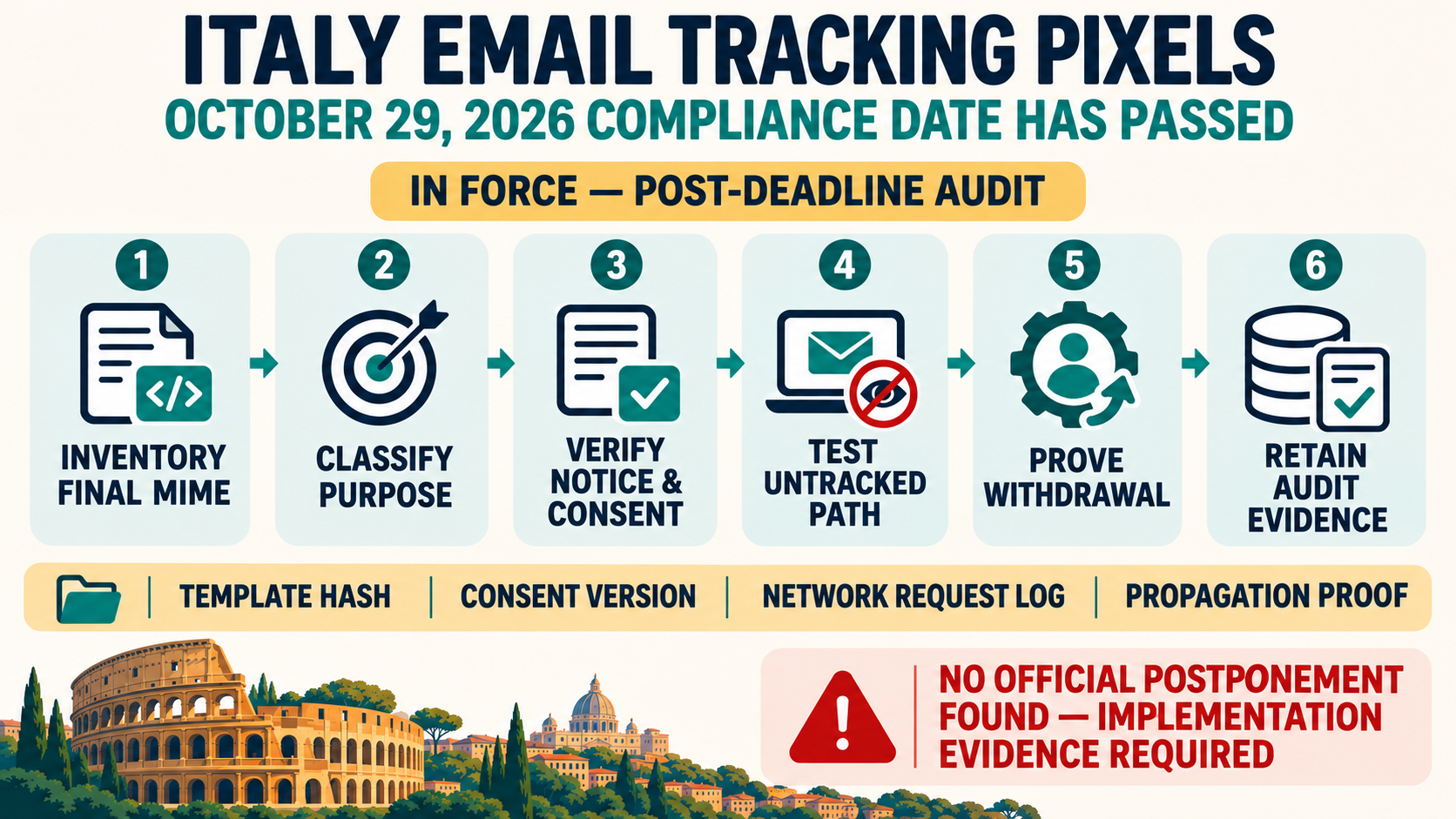
Italy’s October 29, 2026 email tracking-pixel conformity date has passed. The Garante’s April guidelines were published in the Official Gazette on April 29 and provided six months for affected organizations to conform. The authority’s October reminder named October 29 explicitly and included verification of the guidelines in its second-half 2026 inspection activity. This is now a post-deadline evidence problem, not a future preparation date.
Verified deadline status
| Item | Verified position on November 21, 2026 | Audit meaning |
|---|---|---|
| Guidelines adopted | April 17, 2026, decision no. 284 | The primary rule source remains the full Garante decision. |
| Official Gazette publication | April 29, 2026, General Series no. 98 | The six-month conformity period runs from publication. |
| Conformity date | October 29, 2026 | The date has passed and must not be described as scheduled. |
| Postponement | No official postponement found in the Garante sources reviewed | Do not invent an additional grace period. |
| Inspection context | The October reminder included pixel-guideline verification in second-half 2026 inspection activity | Retain reproducible evidence, not only a policy statement. |
| Current operating state | Post-deadline compliance and evidence review | Existing processing needs a working control now, not a future migration plan. |
The deadline is no longer scheduled
The maintained Garante reminder says organizations, platforms and newsletters had to adapt notices, consent and revocation systems by October 29, 2026. As of November 21, that date is historical. Internal tickets, dashboards and web pages must not continue to say not yet effective or recheck after the date.
Do not invent a grace period
The official sources reviewed for this update contain no postponement. A vendor roadmap, unfinished migration or informal assurance does not change the authority’s published date. If counsel identifies a later official measure for a bounded case, preserve that exact source and scope rather than applying it universally.
Why evidence matters after the date
The October notice connected the rules with inspection activity planned for the second half of 2026. A configuration screenshot proves only one screen at one time. A defensible pack must connect the approved purpose and permission to the final email, network request, retained fields, downstream uses and withdrawal behavior.
Design review versus post-deadline audit
A design review asks what the architecture should do. A post-deadline audit asks what a real recipient and each data system experience now. That requires controlled messages, final MIME, observed HTTP requests, queue state, vendor settings and data lineage. Policies without runtime evidence remain unverified controls.
Map the complete processing boundary
| System boundary | Evidence to collect | Typical hidden gap |
|---|---|---|
| Acquisition form or account settings | Notice shown, consent wording, controller, purpose and timestamp | A marketing checkbox is treated as permission for individual email tracking without explaining it. |
| CRM or consent ledger | Separate email and tracking state plus notice version | One boolean cannot represent tracking-only withdrawal. |
| ESP and template renderer | Account tracking defaults, template code and final MIME | The ESP injects a pixel after the application selected an untracked template. |
| CDN and image origin | URL format, request logs, field schema, retention and access | Recipient identifiers survive in CDN logs even after dashboard aggregation. |
| Redirect and link service | Redirect chain, tokens, query parameters and destinations | Pixel removal is claimed as no tracking while links remain individually monitored. |
| CDP, warehouse and models | Event consumers, joins, exports, activation and deletion | An open event collected for one purpose drives frequency or profiling elsewhere. |
| Preference and suppression services | Propagation acknowledgements and queue handling | Withdrawal is stored centrally but already-rendered messages still contain a unique pixel. |
Create a live inventory
program_id
message_purpose
controller
recipient_scope
template_id + version
esp_account + tracking settings
remote_image_hosts
redirect_hosts
identifier/token format
request-log fields
event consumers
retention period
email permission rule
tracking permission rule or documented exception
withdrawal endpoint + propagation targets
owner + last verified UTC
Inventory by program and rendered path, not only by business unit. The same ESP account can contain a compliant untracked service template and a promotional template that injects a unique pixel. Record accountable owners and last verification time so unknown systems do not silently become approved.
Separate message purpose from tracking purpose
Transactional, service, institutional and promotional describe why a message is sent. They do not automatically decide why a remote image records a request. A shipping confirmation can still contain optional engagement analytics, while a bounded security message may use a pixel for a distinct necessary operation. Classify both layers.
Post-deadline classification matrix
| Observed design | Post-deadline classification | Release decision |
|---|---|---|
| Unique pixel measures an individual open for campaign optimization | Individual tracking generally requiring prior informed consent under the guidelines | Block unless the exact valid tracking permission and withdrawal path are proven. |
| Unique event drives frequency, suppression or commercial profiling | Behavioral use with an individual consequence | Block without purpose-specific permission and downstream controls. |
| Campaign-common asset creates only aggregate statistics | Potential narrow consent-free route when individual behavior cannot be measured | Release only after technical non-linkability and purpose boundaries are tested. |
| Pixel is necessary for a bounded authentication or security operation | Potential narrow exception | Document necessity, fields, action and retention; prohibit engagement reuse. |
| Required service or institutional message uses proof of awareness | Potential purpose-specific exception | Require a documented duty and proportionality analysis. |
| Transactional email contains ordinary engagement tracking | Not automatically exempt because the message is transactional | Evaluate the tracking purpose separately from the message purpose. |
| No remote tracking request in final MIME | Untracked delivery path | Verify redirects and other remote resources separately. |
Email permission and tracking permission remain separate
A person can continue receiving an otherwise permitted newsletter while refusing individual open tracking. Model at least email permission, tracking permission, controller, purpose, notice version and withdrawal time. One global subscribed boolean cannot implement granular withdrawal reliably.
Reproduce the information actually provided
Retain the exact notice copy, language, screen or channel, controller identity, purposes, fields, vendor categories, retention and withdrawal route. A current privacy policy URL is insufficient if the organization cannot show which version the recipient saw before the tracked operation.
Reproduce the consent event
Evidence should identify the affirmative action, time, source, controller and purpose plus a hash or immutable reference to the notice and wording. Do not backfill consent because messages were opened, because an address was already subscribed, or because a vendor marked tracking enabled.
Implement a pre-send render gate
1. Resolve whether the message itself may be sent.
2. Resolve the exact tracking purpose independently.
3. Load the current tracking permission or approved exception.
4. Fail closed on unknown, conflicting or stale state.
5. Select the tracked or untracked template.
6. Apply ESP and localization rendering.
7. Inspect the final MIME, not only source HTML.
8. Block unique remote requests on the untracked path.
9. Recheck withdrawal and suppression immediately before release.
10. Store the rule version, template hash and decision evidence.
Audit final MIME, not the template editor
ESP account settings, content blocks, localization, link rewriting and analytics integrations can modify the message after the application chooses a template. Capture the exact MIME delivered to controlled accounts on both tracked and untracked paths. Hash it and associate it with the rule and configuration versions.
# Decode a controlled message and inspect all remote resources.
munpack -t controlled-message.eml
grep -Eoi 'https?://[^"<> ]+' controlled-message.eml | sort -u

# Search common open-pixel indicators. Findings require investigation;
# absence of these names does not prove that tracking is absent.
grep -Ein 'open|track|pixel|beacon|1x1|transparent' controlled-message.eml
Interpret MIME and request findings
| MIME or request finding | Interpretation | Required action |
|---|---|---|
| Unique query token on a 1x1 remote image | Likely recipient or message-level tracking | Trace token creation, mapping, purpose and permission. |
| Email address or account ID in URL | Direct identifier disclosure to every receiving log layer | Block release and replace with an approved design. |
| High-entropy opaque token | Reduced exposure but still personal when linkable internally | Retain purpose, access, retention and withdrawal controls. |
| Same image URL for every campaign recipient | Supports aggregate design but is not sufficient alone | Inspect cookies, request headers, CDN logs and send-log joins. |
| Tracking domain appears only after ESP render | Platform-side injection | Disable the setting and test final MIME again. |
| No pixel but every link redirects through a unique token | A different tracking operation remains | Inventory and assess link processing separately. |
| Proxy or scanner fetch | Resource request does not prove human reading | Store as an observed fetch, not verified attention. |
Run a paired network test
CONTROL A: tracking consent active
  -> render tracked template
  -> expected bounded request may occur
  -> verify purpose-approved fields only

CONTROL B: tracking refused or withdrawn
  -> render untracked template
  -> open in a fresh controlled client
  -> no recipient-linked image request
  -> no engagement redirect or SDK added later

Compare final MIME, DNS hosts, HTTP requests, CDN logs and warehouse rows.
Keep message purpose, content, client and timing as similar as practical. Change only the tracking state. Inspect what the mailbox client requests, what the CDN receives and what the warehouse stores. A successful negative test proves that exact path and version, not every template.
An opaque token is still linkable data
Replacing an email address with a random token reduces exposure and enumeration risk, but the event remains personal when a system can resolve the token to a recipient. Do not label pseudonymous individual tracking anonymous or aggregate. Keep mapping, access, purpose and deletion under control.
Test aggregate measurement at collection
The Garante describes a narrow consent-free possibility for global campaign statistics used for deliverability or anti-spam purposes when the operation cannot measure individual behavior. A dashboard that aggregates unique recipient events later does not meet that architecture merely because users see only a percentage.
[ ] One image URL is common to every recipient in the campaign
[ ] URL, cookies and headers contain no recipient or message join key
[ ] CDN and origin do not retain a reconstructable individual mapping
[ ] IP and client data are minimized or anonymized as designed
[ ] Output is limited to approved campaign-level statistics
[ ] No individual frequency, suppression, profiling or scoring consumer exists
[ ] A red-team join against send logs cannot reconstruct who opened
Document the aggregate denominator
Define whether the output counts image requests, messages, recipients or campaigns and how proxies, scanners, caching and images-disabled clients affect it. Do not call a resource request a human open. Keep SMTP delivery, complaints, clicks and business outcomes as separate evidence.
Test narrow security exceptions
For authentication, password change, account activation or rights workflows, document the specific threat or requested action, why the event is necessary, which fields are collected, what automated or human response follows, and when the data is deleted. Block reuse by engagement and marketing systems.
Test service and institutional exceptions
A required message is not automatically permission for general tracking. Record the duty to communicate, why actual awareness or the event is necessary, proportionality, fields and retention. Remove promotional optimization and profiling from the exception path.
Audit tracked links separately
The tracking-pixel decision does not make every redirect identical to a pixel. However, removing a pixel while keeping unique link tokens can leave a broader behavioral system in place. Inventory redirects, query parameters, destination analytics, cookie behavior and downstream activation under their own purpose and legal analysis.
Prove granular withdrawal end to end
tracking-only withdrawal
  -> durable preference write
  -> event with propagation_id
  -> CRM acknowledgement
  -> ESP acknowledgement
  -> CDP/model acknowledgement
  -> cancel or rerender queued tracked MIME
  -> controlled negative delivery
  -> close only after no linked request is observed
Previously rendered messages need handling
A queued message can contain a unique tracker created before withdrawal. The release system must cancel it or regenerate it through the untracked path. Checking only the CRM at send time is insufficient when the payload was rendered earlier and no longer reflects current permission.
Treat propagation as a distributed transaction
Generate one propagation identifier and collect acknowledgements from CRM, ESP, CDP, automation, warehouse permissions and queue service. Define a maximum completion interval and fail safe when a required system does not acknowledge. Retain bounded proof without keeping unnecessary recipient data indefinitely.
Verify vendor behavior, not marketing claims
Record every ESP, CDN, image host, redirector, analytics provider and subprocessor that receives the request or event. Inspect live settings, defaults, schemas, regions, retention, access, independent use and deletion. Re-run tests after vendor migrations and material releases.
Evidence matrix
| Control claim | Minimum evidence | Negative test |
|---|---|---|
| Tracking is disclosed | Exact notice copy, version, surface, language and display time | A new account cannot proceed to tracked email before the information is available. |
| Consent is valid | Controller, purpose, affirmative action, time, source and notice hash | Unknown, refused and expired states render untracked. |
| Withdrawal is granular | Tracking-only preference plus separate email permission | Recipient disables tracking and still receives the permitted untracked message. |
| Aggregate route is non-individual | Common asset, no recipient key, anonymized technical data and restricted logs | Operators cannot reconstruct a recipient by joining send and request data. |
| Security use is necessary | Threat scenario, requested action, fields, decision and short retention | The event cannot reach marketing analytics or personalization. |
| Vendor obeys the decision | Configuration export, contract instruction, subprocessor list and deletion test | Provider default change cannot silently re-enable tracking. |
| Queued mail respects withdrawal | Queue search, rerender or cancellation evidence and propagation ID | A pre-rendered tracked copy is not released after withdrawal. |
Build a reproducible audit bundle
01-scope-and-purpose-register
02-role-and-vendor-map
03-notice-and-consent-versions
04-preference-state-and-withdrawal-tests
05-template-source-and-final-mime-hashes
06-controlled-network-request-evidence
07-aggregate-non-linkability-test
08-security-or-service-exception-assessments
09-retention-access-and-deletion-controls
10-incident-and-remediation-history
11-change-approval-and-next-review-date
Use representative controlled accounts and redact recipient data where possible. The audit pack should allow a reviewer to reproduce the decision and the network behavior without broad access to production subscriber records.
Put tracking settings under change control
Changes to ESP open tracking, template libraries, redirect services, consent schemas and event consumers need an owner, ticket, reviewer, deployment time, negative test and rollback. Detect changes outside the approved path instead of relying on annual questionnaire answers.
Continuous monitoring
ALERT IMMEDIATELY
  tracking request after refused/withdrawn state
  unapproved tracking domain in final MIME
  vendor setting enables tracking without approved change
  recipient identifier appears in image URL or CDN export

REVIEW DAILY
  preference propagation failures
  queued tracked messages after withdrawal
  parser or inventory failures leaving templates unclassified

REVIEW EACH RELEASE
  final MIME hosts, template hash, ESP settings, downstream consumers
Remediation priorities
| Priority | Condition | Action window |
|---|---|---|
| Release blocker | Unique tracking occurs with refused, unknown or absent required permission | Stop before next send. |
| Critical incident | Tracking continues after recorded withdrawal or data reaches an unapproved party | Contain immediately and start privacy incident review. |
| High remediation | Notice, permission or vendor configuration cannot be reproduced | Pause affected tracked processing until evidence exists. |
| Medium remediation | Retention, access or metric labels are broader than the documented purpose | Correct on a controlled plan with an owner and due date. |
| Observation | Aggregate-only endpoint passes non-linkability tests but documentation needs clarification | Record and close the documentation gap without relabeling it non-compliant. |
Incident response matrix
| Failure | Containment | Evidence to preserve | Exit condition |
|---|---|---|---|
| Tracking after refusal | Pause affected renderer and journey | Preference history, final MIME, request and vendor configuration | Controlled refusal produces no individual tracking request. |
| Withdrawal not propagated | Stop release of queued tracked copies | Propagation IDs, queue state and downstream acknowledgements | All active systems confirm new state and a negative test passes. |
| Vendor re-enabled default pixel | Disable account or template injection | Configuration audit log and deployment history | Guardrail detects and blocks a repeated enablement. |
| Aggregate endpoint became linkable | Stop collection and restrict raw logs | Schema, joins, access history and affected periods | Architecture prevents recipient reconstruction and approved remediation completes. |
| Unapproved downstream reuse | Revoke consumer access and pause activation | Dataset lineage, model inputs and exports | Purpose metadata and access enforcement prevent reuse. |
| Notice and behavior diverge | Suspend the undisclosed behavior | Notice version, rendered content and processing map | Updated design and information agree before restart. |
Preserve evidence before remediation
Retain the affected final MIME, preference history, configuration, request log, data lineage, vendor response and deployment timeline before modifying them. Record remediation as a new event. Silently rewriting consent timestamps or deleting every log can make scoping and accountability impossible.
Connect the system to rights handling
Rights and withdrawal workflows need to locate the token mapping, request events, profiles, models, exports and vendors relevant to the person and purpose. Deletion decisions can differ where minimum suppression evidence must remain. Document each retained field and its bounded reason.
Apply separate retention periods
Final MIME samples, raw request logs, normalized events, consent proof, withdrawal proof and aggregate statistics do not need identical retention. Minimize raw network data and restrict it sharply. Preserve consent and suppression evidence only to the extent justified for accountability and prevention of renewed processing.
Assign cross-functional ownership
| Owner | Post-deadline responsibility | Evidence reviewed |
|---|---|---|
| Privacy and legal | Interpret scope, purpose, consent or exception and rights response | Decision record, notices, consent text and incident assessment. |
| Marketing operations | Classify programs and avoid unauthorized open-based automation | Journey rules, cadence logic and campaign inventory. |
| Deliverability | Separate aggregate health evidence from individual engagement | SMTP data, complaints, aggregate endpoint and metric definitions. |
| Engineering | Implement rendering, preference resolution and bounded event schemas | Code, configuration, tests, hashes and deployment record. |
| Data engineering | Control joins, retention, access and purpose metadata | Lineage, warehouse grants, deletion jobs and exports. |
| Procurement and vendor management | Bind ESP, CDN and analytics suppliers to approved instructions | Contract, subprocessor inventory and configuration review. |
| Security and incident response | Contain unauthorized collection and preserve defensible evidence | Logs, timeline, affected scope and verified remediation. |
Worked post-deadline audit
An Italian newsletter claims that people who refuse tracking receive an untracked version. The auditor creates two controlled accounts with the same subscription and different tracking states. The source templates look correct, but final MIME shows that the ESP added the same unique open pixel to both messages at account level.
The team pauses the affected journey, preserves MIME and settings, disables platform injection, rerenders queued messages and repeats the paired network test. The refused account now generates no recipient-linked image request, while the tracked account follows the approved consent path. The organization adds a deployment guard that rejects untracked MIME containing the ESP tracking host.
Common false assurances
- “The pixel is invisible, so it does not affect the user.” Hidden collection is one reason transparency matters.
- “The ESP is compliant.” The controller must verify its configured processing.
- “The dashboard is aggregate.” Individual collection can remain underneath.
- “The token is random.” Linkable pseudonymous data remains controlled data.
- “The message is transactional.” Message purpose does not automatically exempt analytics.
- “Withdrawal updates the CRM.” Queue, renderer and downstream consumers also need proof.
- “Apple or another proxy opened it.” A fetch still is not reliable human-attention evidence.
- “The deadline was recent.” The official conformity date has passed.
Post-deadline release gate
- Every active program has a named message and tracking purpose.
- The current notice and permission or bounded exception can be reproduced.
- The final tracked and untracked MIME are captured and hashed.
- Paired network tests show the intended difference.
- Tracking-only withdrawal reaches queues and every downstream consumer.
- Aggregate routes pass recipient non-linkability tests.
- Vendor defaults and changes are monitored.
- Raw logs, access and retention are minimized.
- Incidents have a contained, evidence-preserving runbook.
- The accountable owner approves the current evidence, not only the design.
Current status on November 21, 2026
The six-month conformity date ended October 29, 2026. The Garante’s maintained topic page still links the April decision and implementation material, and the October reminder states that notices, consent and withdrawal systems had to be adapted by that date. No official postponement was identified in the primary sources reviewed. This article should be updated if the authority publishes later enforcement, clarification or judicial developments.
Primary Italian sources
- Garante decision no. 284 of April 17, 2026: Primary guidelines, Official Gazette publication, scope, transparency, consent, exceptions, withdrawal, privacy by design and six-month conformity period.
- Garante October deadline reminder: October 5 vademecum naming October 29, 2026 and inspection activity.
- Garante tracking-pixel topic page: Maintained authority index and implementation summary.
- Garante implementation vademecum: Authority implementation material for organizations using tracking pixels.