Storytelling in Email: Structure a Useful Narrative
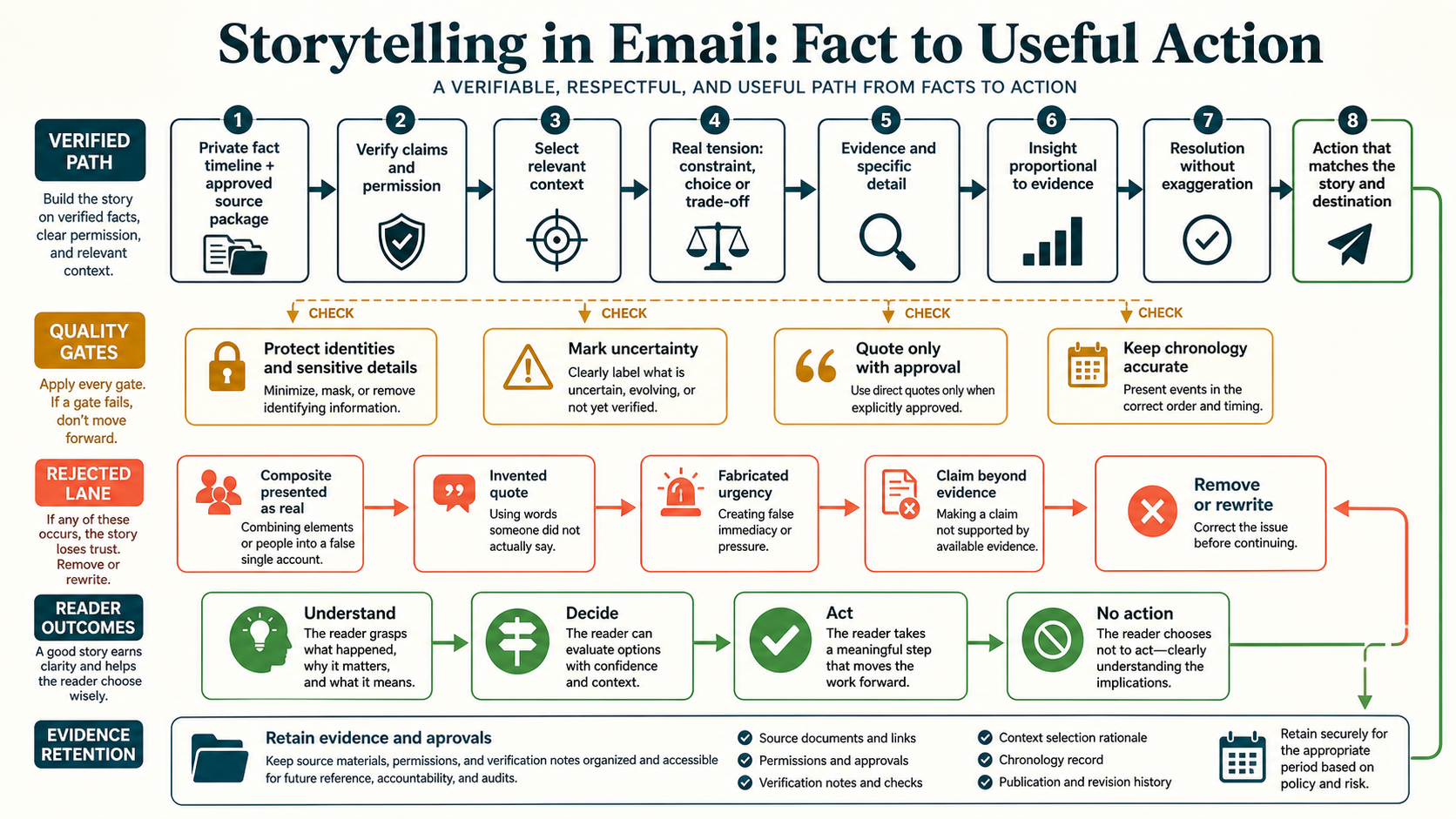
Storytelling in email is the disciplined selection of context, change, evidence and meaning. It is not a requirement to invent a hero, amplify fear or turn every campaign into a dramatic transformation. A useful email story helps the reader recognize a situation, understand what changed, see why the evidence matters and choose an appropriate next action. The narrative must fit the relationship, message length and truth available.
Define the reader decision before the plot
Write what the reader should understand or decide after the story. A product lesson may explain a failure mode; a customer case may help assess fit; a founder note may provide context for a change. The story exists to make that decision clearer, not to delay a generic CTA.
Also define the no-action outcome. A reader may learn that the approach is not suitable, that prerequisites are missing or that more evidence is needed. Honest stories support those conclusions.
Use a compact evidence-based arc
relevant context -> change or tension -> choices
                 -> evidence -> insight -> resolution
                 -> reader application or next action
Not every email needs every stage at equal length. The opening establishes just enough context, the middle carries the decision and evidence, and the end resolves the main question. The CTA should follow from the insight rather than interrupt it.
Choose a story source with sufficient evidence
| Source | Use | Risk |
|---|---|---|
| Customer case | Show situation and implementation | Permission, selection and confidentiality |
| Operator incident | Explain diagnosis and recovery | Sensitive systems or blame |
| Product change | Explain why a decision changed | Marketing overclaim |
| Research or data | Make a pattern understandable | Missing methods or uncertainty |
| Personal observation | Connect experience to a bounded lesson | Anecdote presented as universal proof |
Separate fact, interpretation and composite example
Record the factual events, measurements and sources before writing. Label interpretation as interpretation. If details are changed or several cases are combined to protect identity, say that the scenario is composite or illustrative. Do not create a named customer, quote or outcome that never existed.
Preserve material conditions such as baseline, product, period, scale and implementation support. A 37% improvement without denominator and method is decoration, not evidence.
Protect people and operational details
Obtain appropriate permission for names, logos, quotes and identifiable outcomes. Remove credentials, addresses, account identifiers, internal hosts and unnecessary personal data. Anonymization requires more than changing a name when the situation remains recognizable.
Customer support, health, employment and security stories need heightened review. Sometimes the correct decision is to publish a general failure pattern with no narrative person. Store source evidence under controlled access, separate from the public draft.
Give the actor a decision, not invented drama
The central actor can be a customer, operator, team or system owner. Describe relevant constraints, available evidence and choices. Avoid stereotypes, exaggerated incompetence or emotional states that were never observed. A technical story remains engaging when the consequences and tradeoffs are clear.
Use role and goal only when they help the reader transfer the lesson. The customer is not a prop for brand heroism; show their agency and the contribution of context, tools and support.
Build tension from a real gap
| Useful tension | Question created |
|---|---|
| Expected versus observed result | Which boundary changed? |
| Two valid goals conflict | Which tradeoff should win? |
| Evidence is incomplete | What would reduce uncertainty? |
| Time or capacity is constrained | What is safe to prioritize? |
| Initial diagnosis is wrong | Which evidence corrected it? |
Fabricated scarcity and withheld material terms are not narrative tension. They are pressure or deception.
Select concrete detail that advances the decision
Use a few specific details: a relevant timestamp, observed error, customer constraint, comparison or action. Remove ornamental detail that slows the path or exposes private information. Technical precision can make a story credible without turning it into a raw log dump.
Explain uncommon terms at first use. If a command, metric or configuration is essential, present it in a readable example and state what the reader should observe. Link to deeper implementation after giving the core insight.
Open at the earliest meaningful change
Begin where normal expectation breaks or a consequential choice appears. Provide enough who, what and why for orientation. Avoid false cliffhangers such as “what happened next shocked us” when the event is routine. The opening promise should match the actual scale.
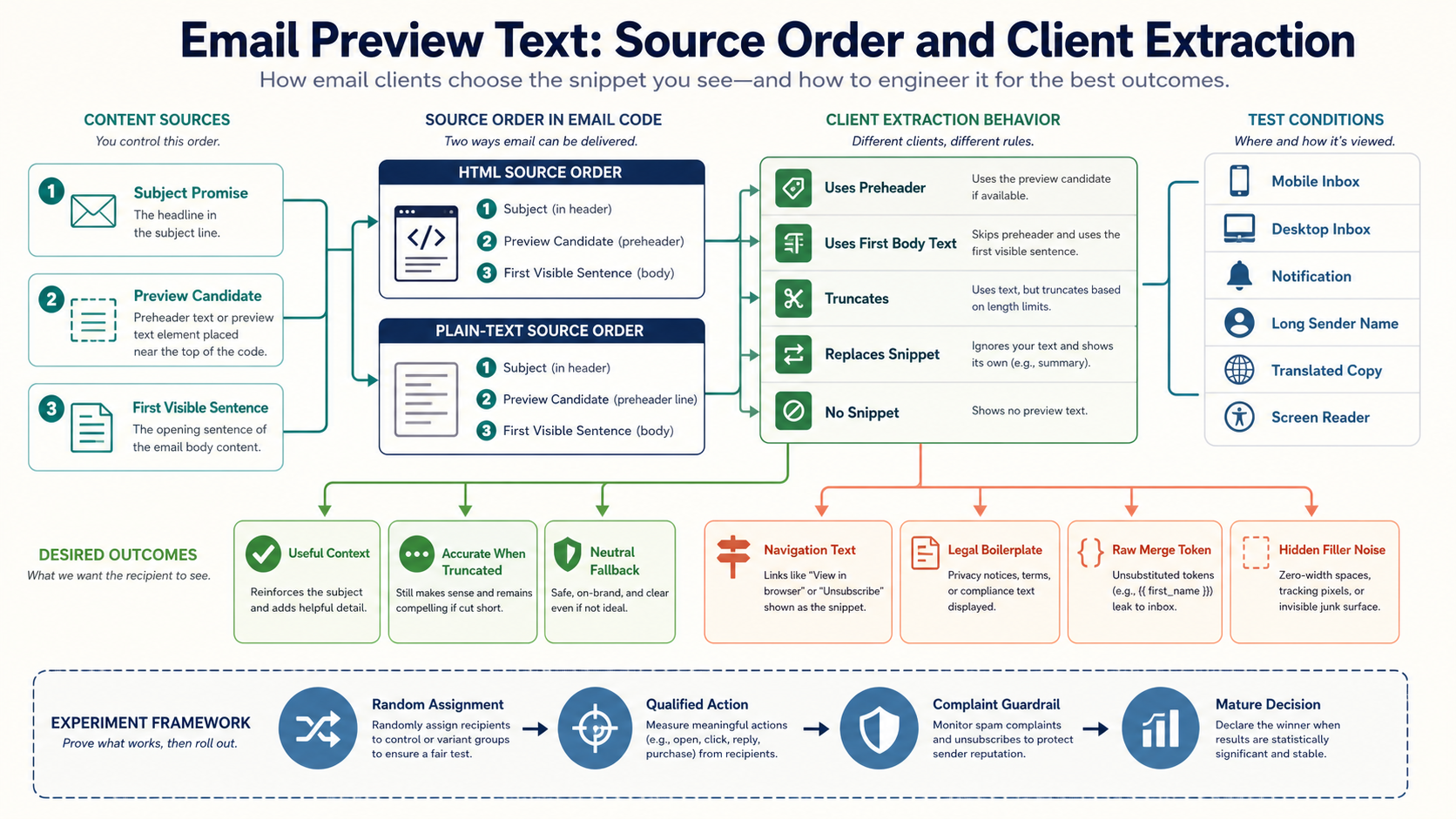
Subject and preheader should identify the topic and add context. Do not disguise a marketing story as a reply or security alert. The first screen must remain understandable without a hero image.
Use evidence to move the story
The middle should show observations, alternatives and why one path was chosen. A useful sequence is: symptom, first hypothesis, test, result, revised hypothesis, controlled change and verification. This gives readers a transferable method rather than a magical outcome.
Keep uncertainty visible. If several causes remain plausible, do not force a clean narrative resolution. Explain which evidence would distinguish them and what safe action was taken meanwhile.
Resolve the main promise proportionately
State what changed, what did not, which evidence supports the conclusion and what limitations remain. A recovery story should include verification and delayed outcomes, not stop when the configuration was changed. A customer case should include tradeoffs and ongoing work where material.
Close open loops before the CTA. The reader should receive a useful lesson even without clicking. A link can provide a checklist, implementation guide or consultation, but should not hold the basic answer hostage.
Make the next action a continuation of the lesson
After an incident story, the action might be to inspect a boundary, download a runbook or compare a configuration. After a customer story, it might be to assess prerequisites. State exactly what happens after the click and use descriptive link text.
Not every story needs a commercial CTA. A reply prompt, preference choice or no action may best fit. One primary next step is easier to understand than several unrelated buttons.
Match narrative form to email constraints
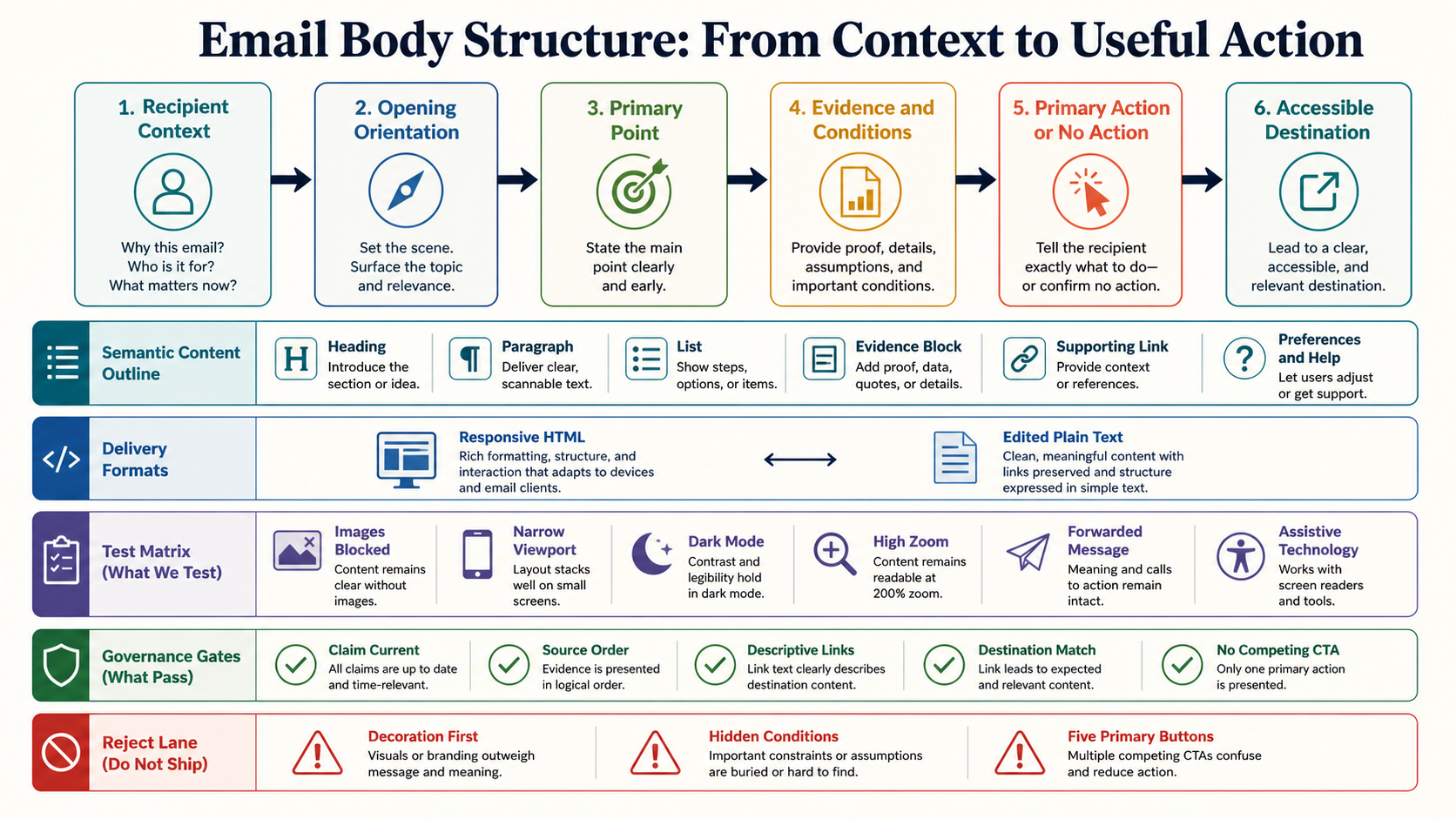
A short story can use three compact paragraphs; a technical case may need headings, a table or a small code block. HTML supports hierarchy and diagrams, while a complete text alternative must preserve the logic. Do not publish the whole narrative as an image.
Use readable line length, contrast, meaningful links and alt text. Test mobile, images off, dark mode and localization. If the story is long, provide a clear summary and a deeper destination rather than compressing text into tiny type.
Use a series only when each installment has value
A multi-email story can support a course, migration diary or customer journey, but each message needs a useful resolution and a clear preview of the next. Do not stretch one answer across five emails solely to manufacture clicks. Let subscribers control cadence and stop when their lifecycle changes.
Maintain series state, maximum exposure, cancellation and expiry. A person joining late needs a coherent entry point, while someone who completes the action should not receive outdated suspense.
Review case-study claims and numbers
| Claim element | Evidence to retain |
|---|---|
| Baseline | Population, period and definition |
| Intervention | Actual version, scope and co-changes |
| Outcome | Formula, maturity and uncertainty |
| Attribution | Experiment or stated limitation |
| Customer quote | Approved wording and context |
A neat before-and-after narrative does not prove causality. Separate measured lift from attribution and anecdote.
Test narrative treatments against useful outcomes
Randomize eligible recipients and define whether the treatment is the opening, structure, length or complete story package. Keep assignment and versions. Raw opens are unreliable as the primary outcome because privacy fetching and image blocking alter them.
story_test:
  audience, hypothesis and assignment unit
  exact narrative and non-story comparator
  qualified read proxy, reply or action
  conversion and mature value
  complaint, unsubscribe and support guardrails
Do not assume a story caused every conversion after a click. Use holdout lift where practical.
Worked story: an apparent copy problem is a queue problem
A campaign’s click rate falls at one mailbox provider. The team plans to replace the story opening because aggregate engagement is down. Provider-level SMTP evidence shows temporary deferrals and long queue age during the first hours; late recipients receive the time-sensitive message after its useful window.
The narrative explains the initial symptom, competing hypotheses, queue evidence, corrected throttling and controlled recovery. It does not claim the story “fixed engagement.” The lesson is to diagnose delivery boundaries before editing content. The CTA links to an SMTP troubleshooting guide that continues the same problem.
This structure turns a real operational decision into a transferable story without inventing a customer transformation.
Run a narrative accuracy review
- The reader decision and benefit are explicit.
- Facts, interpretation and illustrative material are labeled.
- People, quotes and customer details have appropriate permission.
- Tension comes from a real gap or tradeoff.
- Numbers retain population, period and definition.
- The main promise resolves before the CTA.
- Accessibility and text fallback preserve the story.
- Material limitations and uncertainty remain visible.
- The destination continues the same lesson.
- Measurement includes recipient and reputation guardrails.
Maintain a story evidence package
Archive the source timeline, approved facts, claim calculations, permissions, anonymization decisions, content versions, links and experiment result. Restrict private evidence and expose only the reviewed public narrative. Set review dates for product, price and performance claims.
AI may help outline or edit, but it must not invent dialogue, emotion, customer identity or outcomes. Require a fact-by-fact review against source material. Retire or update stories when evidence, permission or context changes.
Storytelling production checklist
- The story serves a defined current reader decision.
- The opening provides enough context and an honest promise.
- Actor, tension and detail remain factual and proportionate.
- Evidence moves the narrative rather than decoration.
- Privacy, confidentiality and customer permission are protected.
- The resolution includes verification and limitations.
- The CTA follows from the insight.
- Format works without images and supports accessibility.
- Case claims do not overstate causality.
- Testing uses qualified mature outcomes.
A useful email story leaves the reader with a method or decision, not merely an emotion.
Localize narrative meaning and social context
A story’s humor, directness, conflict and emotional weight can shift in translation. Give local writers the factual timeline, reader decision, evidence, approved claims and privacy constraints. Let them adapt scene and rhythm while preserving truth. Do not force idioms, character stereotypes or a dramatic frame that is inappropriate in the market.
Review names, dates, currency, legal terms, support routes and reading direction. A case from one region may require context before it supports another. Treat each localization as a versioned artifact and secure customer approval for the actual public language when quotes or identity are used.
Machine translation can drop limitations or intensify causality. Require bilingual fact review and test subject, preheader, body and destination together.
Build a line-level story claim matrix
For every factual sentence, record source, owner, scope, expiry and whether it is fact, interpretation or illustrative explanation. Pay particular attention to “because,” “resulted in,” “only,” “first,” “best” and numerical outcomes. These words can turn a narrative sequence into a causal or comparative claim.
| Sentence role | Evidence |
|---|---|
| Setting | Time, population and starting condition |
| Problem | Observed symptom and impact |
| Decision | Options and actual rationale |
| Outcome | Definition, maturity and uncertainty |
| Lesson | Boundary of generalization |
Remove or qualify claims that cannot be supported. The story can remain compelling when uncertainty is honest.
Run an evidence-first editorial pipeline
Start with a source interview or incident record, then create a factual timeline before narrative drafting. Separate private evidence from the public working document. The writer proposes structure; a subject-matter reviewer validates decisions; privacy, legal or customer owners review sensitive claims; an editor checks reader value, accessibility and payoff.
source package -> fact timeline -> claim matrix
               -> narrative draft -> specialist review
               -> customer or privacy approval
               -> final artifact and evidence archive
Version customer quotes and never “improve” meaning without approval. If a material fact changes during review, update the story arc rather than forcing the earlier conclusion.
Publish incident stories without weakening security
Wait until containment and verification are complete enough to avoid harming response. Remove exploit details, credentials, personal data, internal addresses and defensive gaps that remain open. Coordinate with security and affected parties. Do not use an active incident as promotional urgency.
A useful structure explains impact, detection boundary, decisions, correction, validation and preventive changes. State unknowns and avoid individual blame where system design is the relevant lesson. If notification obligations apply, operational communications take priority over editorial storytelling.
After publication, monitor whether product or configuration changes make the lesson stale. Link to current technical guidance and retire unsafe examples while preserving the historical conclusion appropriately.
Evaluate narrative performance after maturity
Reconcile assigned population, provider acceptance, qualified interactions, destination use, conversion, complaints, unsubscribes and replies. Compare with the planned non-story treatment or holdout. Review whether the audience reached the intended insight, not only whether they clicked.
Classify replies and support feedback for relevance, confusion, perceived manipulation, privacy concern and usefulness. A strong emotional response with poor decision quality is not success. Inspect cohorts that may interpret the story differently, using privacy-safe minimums.
Record the conclusion in the story catalog with audience, purpose, evidence and limitations. Update the underlying product or support process when the story exposes real friction. Retire narratives whose claims, permission or context no longer hold.
Operate serialized stories as cancellable journeys
Store series, episode, subject, entry reason, maximum exposure, wait, expiry and completion state. A purchase, support case, unsubscribe or lifecycle change can make the next episode irrelevant. Recheck current state at dispatch instead of assuming the reader follows the planned sequence.
Each episode should provide a useful resolution and include enough context for someone who missed earlier mail. Do not resend merely because an open was not measured. Allow cadence preference and a clear exit. If the story contains time-sensitive facts, expire the episode rather than sending it late after a queue outage.
Measure the series by assignment and final reader decision, not cumulative opens. Persistent holdouts help distinguish natural progress, while complaint and unsubscribe identify narrative fatigue.
Make the destination complete the same narrative
Validate that the landing page, guide, video or consultation continues the subject and email payoff. Preserve key terminology, facts, price and eligibility. A story about technical learning should not land on a generic form that withholds the promised method. Give the reader the expected content before an unrelated upsell.
Test mobile speed, authentication, accessibility, regional availability and link expiry. Use descriptive CTA text and a controlled HTTPS domain. If the destination changes materially, update or stop scheduled stories rather than allowing promise drift.
Join qualified destination use and business outcomes to the exact story version. A click followed by immediate exit can indicate mismatch, scanner activity or access failure; inspect evidence before rewriting the narrative.
Final narrative publication approval
The accountable editor should trace every public claim to the fact timeline and verify permissions, anonymization, scale, causality and current context. A subject-matter owner confirms the decision and technical lesson; privacy or customer owners approve identifiable material; accessibility review confirms that the narrative and action work without images.
Attach subject, preheader, body, destination, localization, experiment, complaint guardrail and retirement date. Read the story without design and state the lesson in one sentence. If the conclusion differs from the evidence package, revise the narrative rather than the facts.
Approval expires when product behavior, data, customer permission or destination changes. Stop scheduled copies when the story becomes inaccurate.
Retire stories when truth or permission changes
Set review dates for customer identity, quotes, product behavior, performance claims and destinations. When permission is withdrawn or context changes, stop scheduled campaigns, remove active references and update related guidance. Preserve a controlled historical artifact only where appropriate.
Retirement must cover translations, ESP copies, social excerpts and sales templates. A story that was accurate once can become misleading when its conditions disappear.
Protect the private source package
Keep interviews, incident records, customer approvals and raw measurements under restricted access and appropriate retention. Public editors should work from the approved fact matrix, not unrestricted customer files. When retention expires, remove private evidence according to policy while preserving only the governed publication and decision record.
Primary references
- W3C writing for accessibility
- Apple Mail Privacy Protection
- Gmail email sender guidelines
- FTC dark patterns report