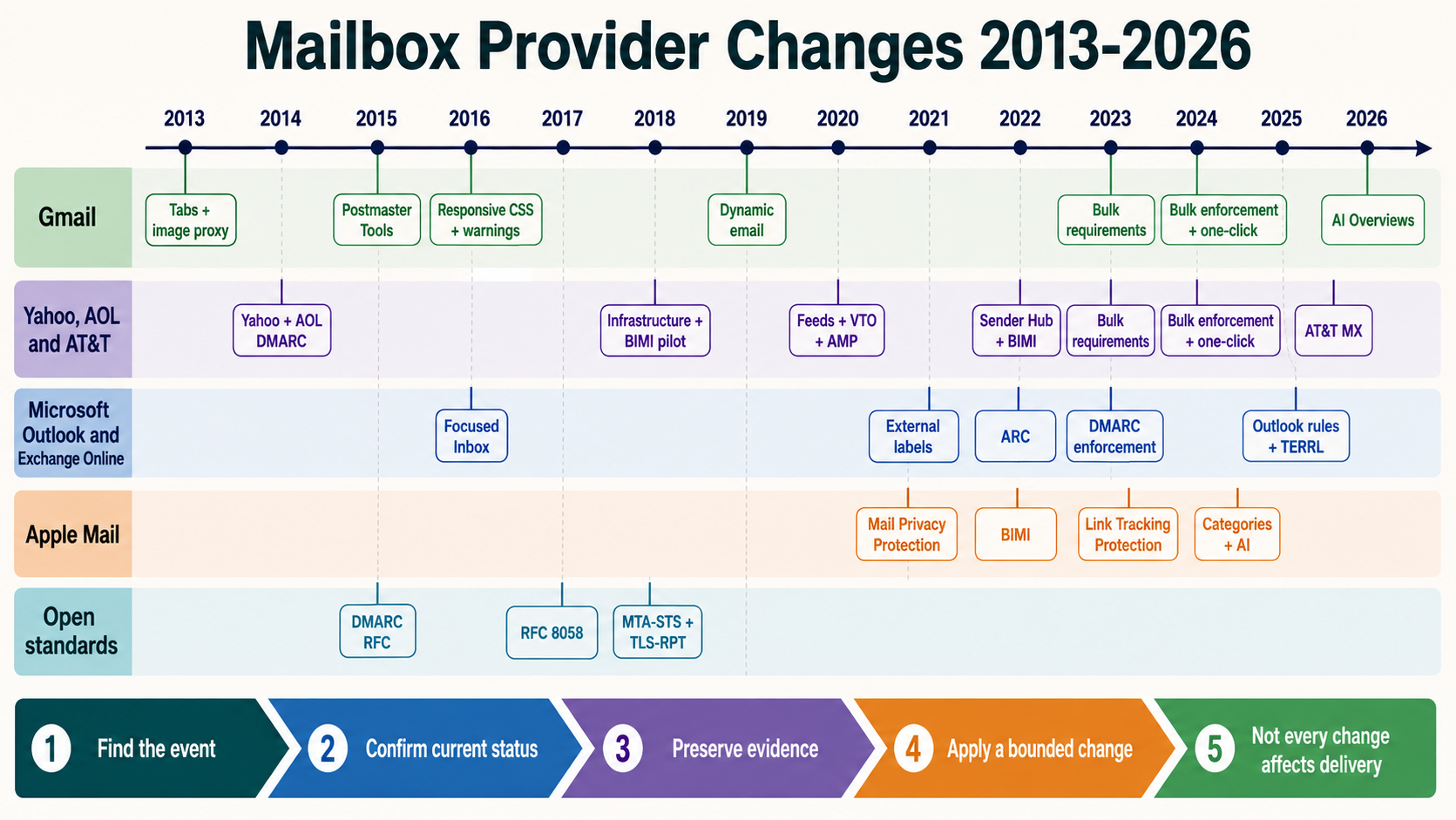
Yahoo Expanded AMP Email to Mobile in 2022: Platform and ESP Registration
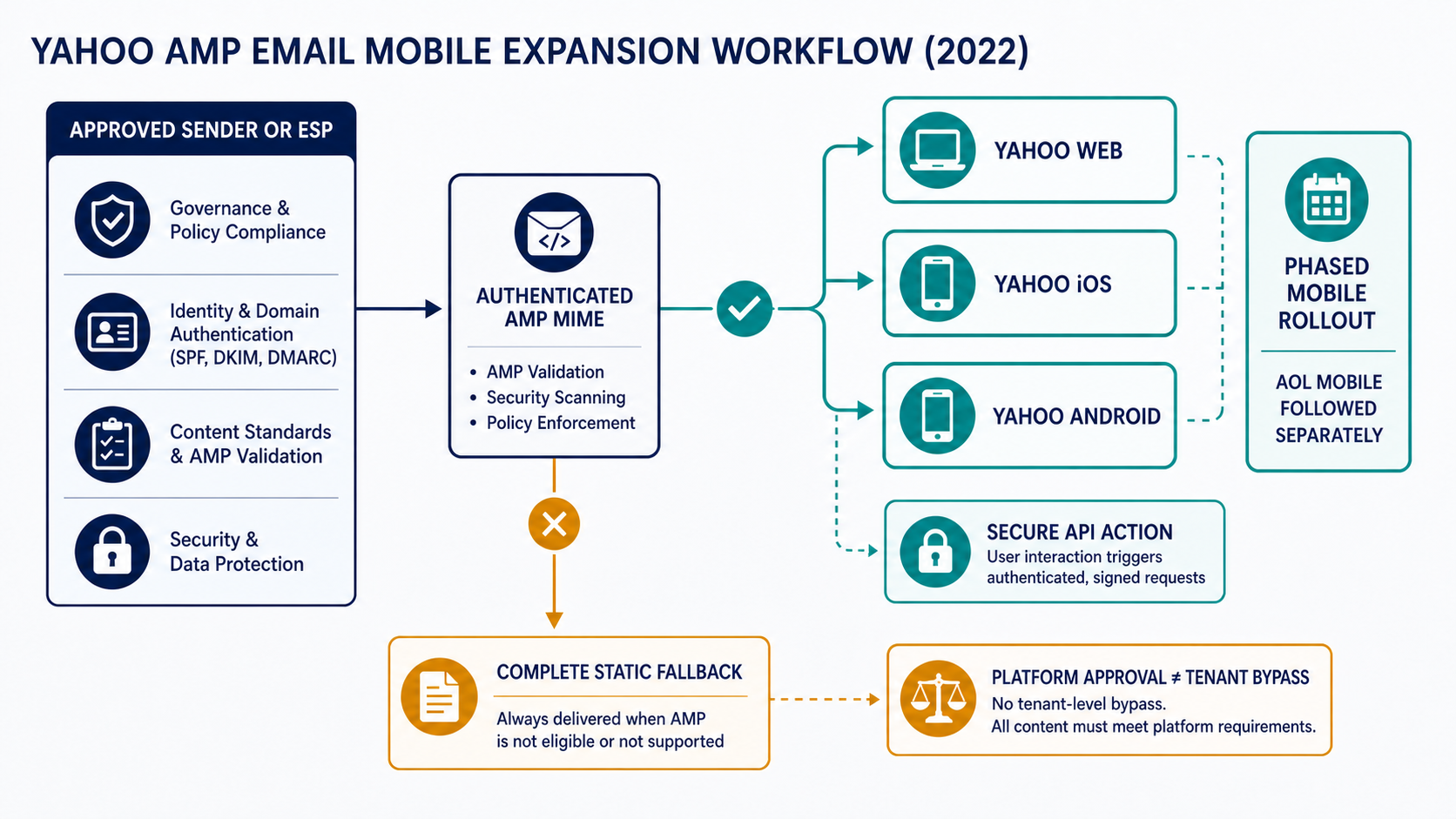
On April 12, 2022, Yahoo announced that AMP email, called Dynamic Messages in its consumer experience, was expanding from webmail into Yahoo Mail applications on iOS and Android. The provider described a phased mobile ramp, with AOL mobile support following, and made platform-level registration easier for approved ESPs. That materially expanded the addressable surface for interactive email, but it also increased the number of client, version, cache, network and lifecycle states a sender needed to test. ESP approval reduced registration friction; it did not transfer unlimited trust to every customer or remove the need for authenticated mail, secure endpoints, valid AMP markup and complete static fallback.
The dated mailbox-provider change
| Event field | Verified value | Why it matters |
|---|---|---|
| Historical event date | April 12, 2022 | This is the provider-change date, not the NitWings publication date. |
| Mailbox provider | Yahoo Mail ecosystem | The affected provider estate determines which recipient cohorts require separate evidence. |
| Change area | Interactive email | This identifies whether the change altered authentication, filtering, visibility, measurement or sender operations. |
| Current status | active-on-supported-yahoo-surfaces-with-approved-sender-or-platform-registration | Historical instructions are interpreted against the feature or standard that exists now. |
The 2020 Yahoo webmail launch gave dynamic email a controlled desktop surface. Mobile recipients could still receive the same MIME message while using only its static alternative.
By 2022, mobile apps represented a significant part of inbox access. Extending the rendering engine made in-message actions more useful for immediate tasks but introduced small-screen accessibility, app-version and intermittent-network constraints.
Yahoo also recognized that approving every sender identity individually created friction for ESPs. Platform approval could establish a governed trust relationship for customer traffic under that platform.
This event is best understood as a change in one layer of the email system. Transport acceptance, authentication, placement, interface presentation and user action remain different states. The article therefore records what Yahoo AMP email mobile support changed and what it did not change.
How the system worked before the change
A Yahoo recipient might see AMP on web and static HTML on mobile. Analytics that grouped both as one campaign could confuse surface coverage with content performance.
Each sender or DKIM domain could require a registration workflow even when an ESP already enforced the same technical controls across customers.
Desktop-oriented components were not automatically mobile-safe. Tap targets, form states, error messages and fallback links needed separate testing.
Before Yahoo AMP email mobile support, teams often had incomplete evidence because sender logs ended at SMTP acceptance while recipient-side behavior occurred inside Yahoo Mail ecosystem. That boundary matters: an accepted message can still be filtered, presented differently, ignored or acted upon later.
What changed on the provider side
Yahoo began ramping dynamic rendering in current iOS and Android apps and said AOL mobile applications would follow. Availability therefore needed to be treated as phased, not instantly universal.
Approved sending platforms could cover customers under platform-level registration. The platform became accountable for preventing abusive or technically broken tenants from using the capability.
Dynamic actions could now occur in short mobile sessions. Authentication expiry, app backgrounding and network retries had to be handled without duplicate transactions.
The implementation of Yahoo AMP email mobile support created a new operating dependency, not a permanent entitlement. Senders still needed controlled rollout, supported fallbacks, reliable identity and evidence from the actual affected cohort.
Message path before and after
Before
Approved AMP sender -> Yahoo web supports dynamic part
Mobile app selects static HTML fallback
Campaign report combines unlike client experiences
After
Approved sender or governed ESP platform -> authenticated AMP MIME
Yahoo web + phased iOS/Android support -> dynamic action
AOL mobile follows separately
Unsupported, expired or failed state -> complete static fallback
Who and what the change affected
| Traffic or stakeholder | What changed | Required interpretation |
|---|---|---|
| Recipients in the affected provider surface | Yahoo AMP email mobile support changed what the mailbox could display, infer or act upon. | Segment evidence by supported client, account and provider estate. |
| Permission-based senders | A new capability or recipient signal entered the message path. | Consent, expectation and normal filtering still apply. |
| Deliverability operators | Diagnosis gained another provider-controlled state. | Keep acceptance, placement, presentation and engagement separate. |
| Campaign and lifecycle teams | Message design or timing needed a compatible operating rule. | Protect transactional purpose, suppression and fallback behavior. |
| Data and analytics teams | Historical metrics could change meaning or coverage. | Version definitions and do not compare incompatible populations. |
| Security and privacy owners | The trust or data boundary changed. | Approve endpoints, access, retention and exception handling. |
Effect on delivery, placement and recipient visibility
An ESP should gate AMP per tenant using authentication, complaint, permission and endpoint review. One platform approval must not permit a newly onboarded customer to publish arbitrary dynamic forms.
Mobile rendering increases the importance of accessible controls and concise error states. A broken action can generate repeat clicks, support contacts and complaints even when SMTP delivery is perfect.
For Yahoo AMP email mobile support, Interactive MIME does not replace the ordinary message. A production send needs a valid static HTML or text alternative because support varies by client, account, forwarding path and security policy. A malformed dynamic part should degrade to a complete message, not a blank shell or a call to open an unsupported component.
For Yahoo AMP email mobile support, Every live action widens the security boundary. Remote data endpoints need HTTPS, strict authorization, narrow CORS behavior, replay protection and server-side validation. The state shown at render time can differ from the state at click or submission time, so the server remains authoritative for price, inventory, identity and eligibility.
For Yahoo AMP email mobile support, Mailbox rendering approval and SMTP delivery are separate decisions. Authentication, reputation, consent, complaint behavior and content safety still determine acceptance and placement. Dynamic capability must never be described as an allowlist.
Interpret Yahoo AMP email mobile support at the smallest defensible unit: provider, recipient domain, stream, sending domain, DKIM identity, IP pool, campaign and time window. Portfolio averages can hide both a provider-specific regression and an improvement limited to one eligible surface.
Effect on measurement and diagnosis
Report client surface, dynamic eligibility and fallback selection before comparing outcomes. A web cohort from 2020 is not a valid baseline for a phased mobile population in 2022.
Record action retries and deduplicate by business operation. Mobile network recovery can replay a request; request count is not order count.
When measuring Yahoo AMP email mobile support, An action inside the message may bypass the normal landing-page redirect, so a web-analytics-only funnel undercounts engagement. Instrument the application endpoint with a non-personal campaign identifier, action type, outcome and privacy-approved aggregate dimensions. Do not place recipient identity in a URL merely to make the new surface measurable.
When measuring Yahoo AMP email mobile support, Compare dynamic and fallback cohorts separately. Client support, sender approval and account configuration create selection effects. A higher conversion rate among rendered AMP recipients does not prove that the format caused the difference unless assignment and eligibility are handled explicitly.
Create an evidence contract before declaring the impact of Yahoo AMP email mobile support. Name the event, collection point, population, numerator, denominator, latency, privacy boundary and owner. If any of those are unknown, label the conclusion as directional rather than causal.
Advantages for email marketers
| Potential advantage | When the advantage is real | Evidence to verify |
|---|---|---|
| Clearer recipient experience | The message is expected, authenticated and supported. | User outcomes improve without complaint growth. |
| Better operational evidence | Provider and sender states remain separately observable. | Incidents can be isolated to a specific layer. |
| Stronger identity or control | Configuration matches the verified organizational domain. | Authentication and trust checks remain stable. |
| Safer optimization | A controlled cohort and complete window are used. | Clicks, conversions and complaints support the decision. |
| Repeatable deployment | Ownership, rollback and monitoring are documented. | A second team can reproduce the result. |
Disadvantages and operational risks
| Cost or risk | How it appears | Control |
|---|---|---|
| Capability is mistaken for allowlisting | Teams expect placement without reputation discipline. | State explicitly that normal filtering continues. |
| Unsupported clients receive a broken experience | Content or action disappears outside the target surface. | Maintain and test a complete fallback. |
| A proxy metric becomes business truth | A UI or collection change looks like performance. | Use named denominators and downstream outcomes. |
| Too many variables change together | No cause can be assigned after a regression. | Use a staged rollout with rollback thresholds. |
| Provider-specific behavior is generalized | One domain trend is applied to the full list. | Segment by recipient provider and supported surface. |
| Exceptions outlive their reason | Allow lists, access or configuration increase risk. | Assign an owner, expiry and periodic review. |
What email teams needed to do at the time
- Confirm the historical scope. Record the announced provider, date, clients and eligibility.
- Inventory affected traffic. Map recipient domains, streams, identities and sending platforms.
- Validate authentication. Check SPF, DKIM, DMARC alignment and TLS independently.
- Build a safe fallback. Keep the message useful when the new surface is unavailable.
- Test controlled mailboxes. Capture headers, screenshots, timestamps and outcomes.
- Define measurement. Name populations, denominators, latency and privacy limits.
- Stage the rollout. Change one bounded cohort and set stop conditions.
- Brief support teams. Give them expected behavior and an escalation evidence pack.
What email teams should do now
- Read the current provider documentation. Do not assume the 2020 to 2022 launch rules are unchanged.
- Reconfirm eligibility and support. Test the exact clients, accounts and sending identities in use.
- Keep authentication aligned. Monitor SPF, DKIM, DMARC and TLS as separate controls.
- Preserve permission evidence. A presentation feature does not repair weak acquisition.
- Segment provider traffic. Diagnose Yahoo Mail ecosystem separately before changing global policy.
- Protect suppressions and transactional streams. Do not let experimentation delay required state changes.
- Retain raw evidence. Store message IDs, timestamps, headers, configuration and test results.
- Use outcome metrics. Include clicks, conversions, complaints, opt-outs and support impact.
- Review security and privacy. Limit data, endpoints, credentials and exceptions.
- Maintain rollback. Name the owner and the threshold that returns traffic to the known-safe path.
Worked deliverability scenario
An ESP enables an AMP preference form for all customers after platform approval. One tenant uses an unsigned subscriber identifier and another has no equivalent HTML preference route.
The platform introduces tenant review, signed opaque tokens, scoped endpoint credentials, idempotency keys and automated fallback checks. It also blocks dynamic sending when DMARC alignment or complaint thresholds fail.
The mobile ramp is measured by eligible render coverage, successful preference updates, fallback completion and complaint impact. Customers gain reach without converting platform trust into an uncontrolled shared risk.
The decisive improvement for Yahoo AMP email mobile support is operational: the team separates provider evidence from assumptions, changes one controlled variable, records a rollback threshold and waits for a complete observation window. That prevents a visible interface change from becoming an excuse for unrelated domain, volume or creative changes.
Evidence and diagnostics
- Message identity: RFC 5322 From, envelope sender, DKIM domain and selector.
- Transport: connecting IP, TLS result, SMTP response and provider timestamp.
- Authentication: SPF, DKIM, DMARC and ARC results from the received header.
- Eligibility: provider registration, tenant setting, certificate or supported-client state.
- Rendering: raw MIME, fallback, screenshots and client version.
- Recipient scope: provider domain, account type, geography and app surface.
- Behavior: clicks, replies, conversions, complaints and unsubscribes.
- Change record: deployment time, owner, cohort, configuration diff and rollback threshold.
- Comparison: unaffected control cohort with the same purpose and acquisition source.
Failure modes and incorrect conclusions
- Equating SMTP acceptance with inbox placement. These are separate receiver decisions.
- Calling a provider UI change a reputation penalty. Verify transport and folder evidence first.
- Removing the fallback. Support and eligibility are never universal.
- Changing IP, domain, creative and cadence together. The test becomes uninterpretable.
- Trusting opens as the only outcome. Collection and privacy controls distort them.
- Ignoring the recipient denominator. Portfolio averages conceal provider-specific effects.
- Keeping permanent exceptions. Unowned allow lists and credentials accumulate risk.
- Using launch documentation as current policy. Recheck the maintained provider page.
Current status and superseding changes
Yahoo continues to document AMP for Email and sender or platform approval through Sender Hub. Exact supported surfaces and requirements should be confirmed there before launch.
Mobile applications update independently. A campaign must remain useful during version fragmentation, disabled dynamic mail, forwarding and provider-side fallback.
For sensitive account changes, require appropriate reauthentication and server authorization. Inbox access alone is not proof that the current actor may perform every account operation.
Current behavior for Yahoo AMP email mobile support must be checked again before a production change because provider documentation, client support and eligibility can evolve. The dated event remains useful as a historical control point, while the linked current documentation governs present operation.
A production runbook for Yahoo AMP email mobile support should contain more than a setup instruction. Record the business purpose, accountable owner, approved sending identities, affected recipient population, prerequisites, evidence sources, known unsupported paths, rollout cohort, stop threshold and rollback method. Attach a dated configuration export or DNS answer instead of relying on a screenshot with no timestamp. Review the runbook after an ESP, gateway, domain, certificate, mailbox client or provider policy changes.
Incident handling for Yahoo AMP email mobile support should begin with a narrow comparison. Select one affected message and one known-good message with the same stream and nearby time. Compare SMTP responses, authentication results, raw MIME, provider or tenant eligibility, client presentation and downstream action. Widen the query only after identifying the first state where their paths differ. This is faster and safer than changing sending IPs, From domains and creative together.
Ownership for Yahoo AMP email mobile support must cross organizational boundaries. Deliverability owns provider evidence and traffic controls; engineering owns MIME, APIs and event integrity; security owns trust and endpoint risk; privacy owns collection and retention; marketing owns permission, promise and cadence; support owns recipient-facing explanations. A launch is incomplete when any team lacks the evidence required to distinguish expected behavior from failure.
Evidence for Yahoo AMP email mobile support also needs a retention rule. Keep enough raw headers, configuration history and aggregate outcome data to investigate a delayed complaint or regression, but do not retain recipient-level data merely because it was convenient during launch. Limit access by role, document the permitted purpose, remove expired exports and preserve only the minimum artifacts needed to reproduce the operational conclusion.
Finally, retain a negative control for Yahoo AMP email mobile support. Send a technically valid message that is intentionally outside the feature’s eligible condition, while keeping purpose and audience comparable. The difference shows whether Yahoo Mail ecosystem is applying the feature where expected. It also prevents teams from interpreting an unrelated seasonal, audience or reputation shift as proof that the feature caused the result.
Operator checklist
- Record the exact historical event date and source.
- Document what changed and what explicitly did not change.
- Map affected providers, domains, clients and account types.
- Validate SPF, DKIM, DMARC alignment and TLS.
- Keep a complete, accessible fallback message.
- Test with raw headers and controlled recipient accounts.
- Separate acceptance, placement, presentation and action metrics.
- Name every numerator, denominator and observation window.
- Monitor complaints, opt-outs and downstream outcomes.
- Set rollout ownership and rollback thresholds.
- Revalidate the current provider requirement before deployment.
Primary and contemporaneous references
- Yahoo Postmaster: AMP mobile expansion: Primary evidence used to verify the dated event or current operating requirement.
- Yahoo Sender Hub: AMP for Email: Primary evidence used to verify the dated event or current operating requirement.
- AMP Project: AMP for Email: Primary evidence used to verify the dated event or current operating requirement.