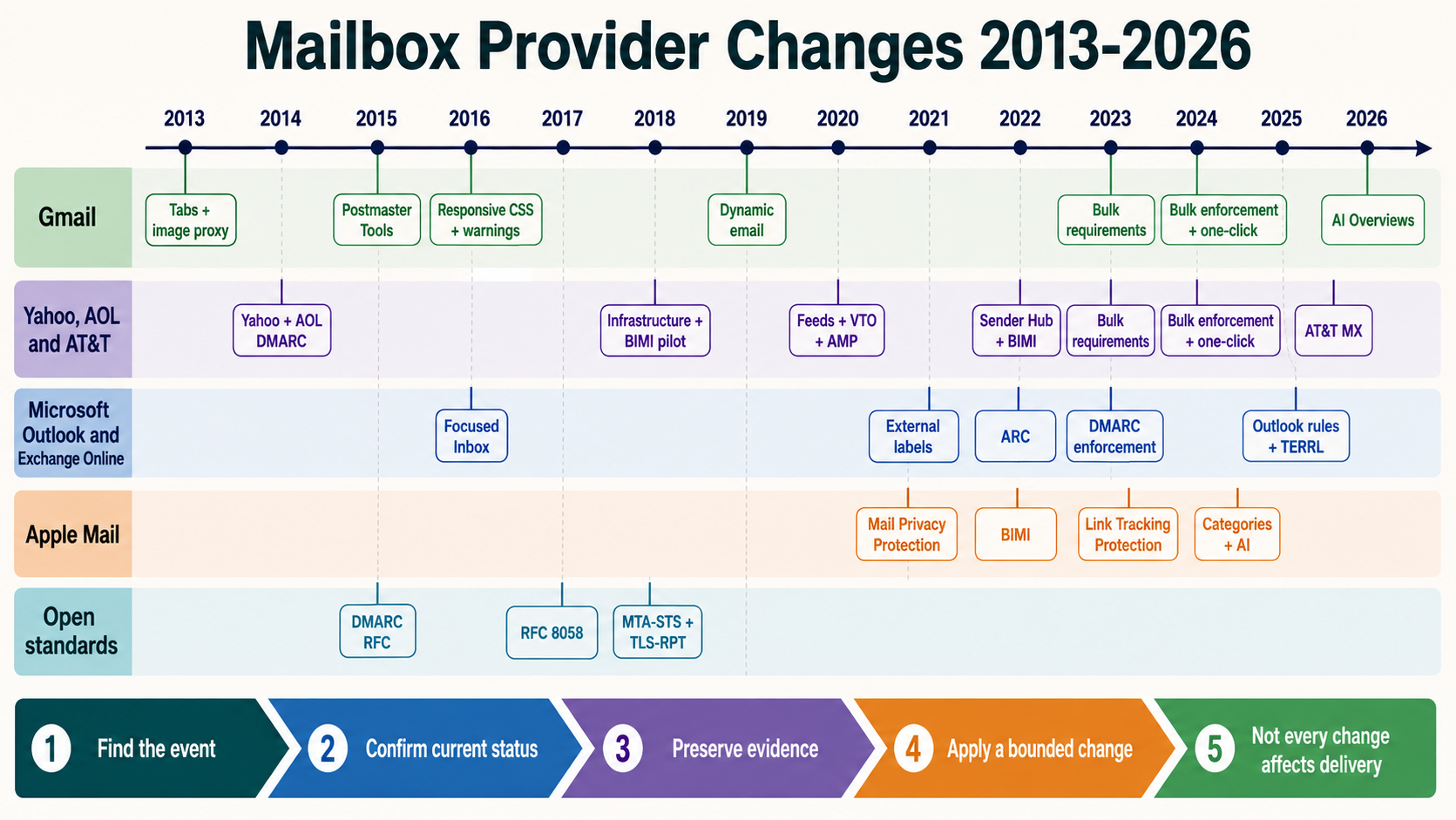
Yahoo BIMI Pilot in 2018: Early Provider-Controlled Brand Identity
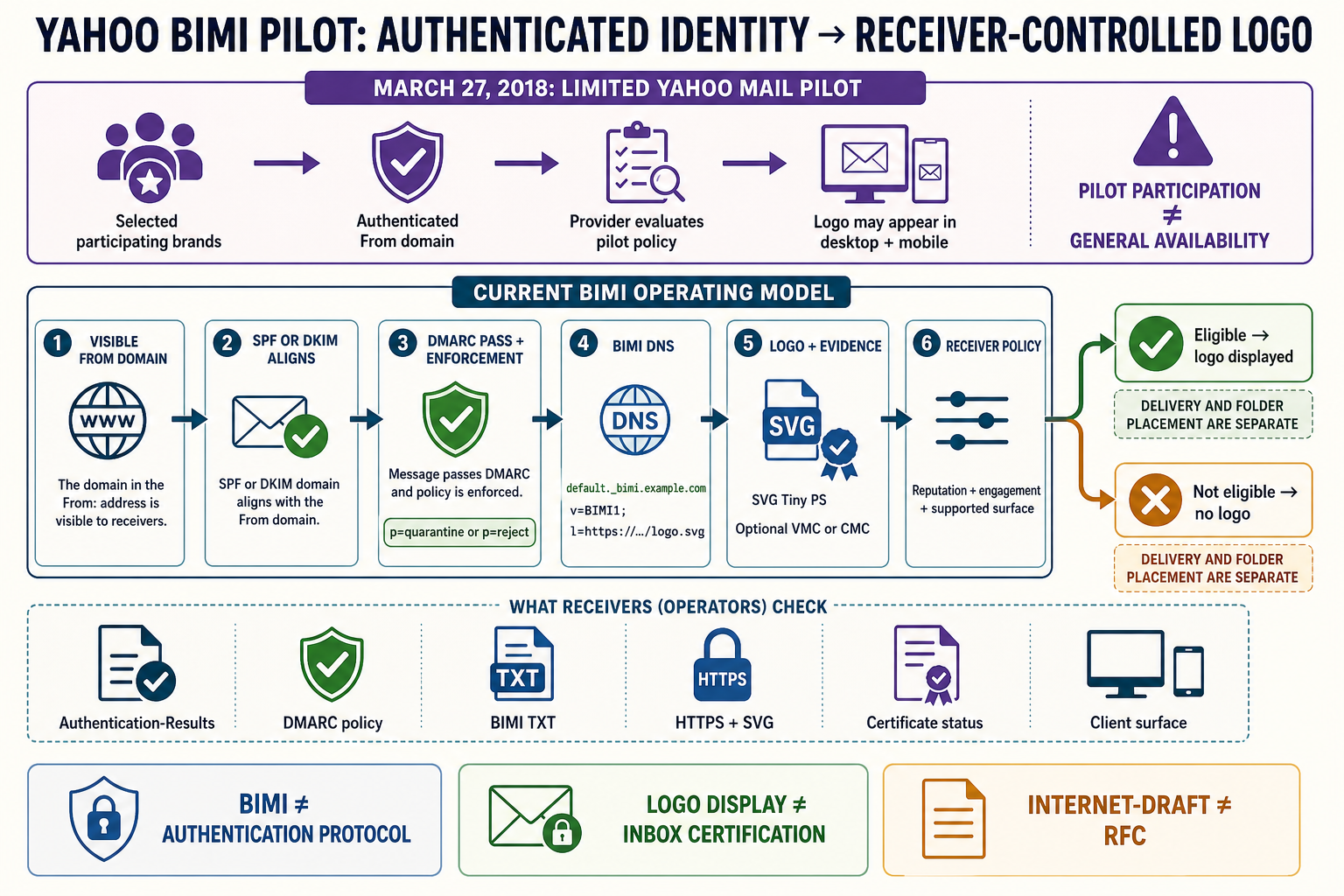
On March 27, 2018, the first Brand Indicators for Message Identification pilot was announced for Yahoo Mail desktop and mobile applications. A limited set of participating brands could have a provider-controlled logo shown beside authenticated messages. The experiment connected strong domain authentication with scalable brand-logo discovery, but it did not create a sender allowlist, a delivery certification or a promise that every eligible message would display a logo. Receiver policy and reputation remained part of the decision.
The dated mailbox-provider change
| Event field | Verified value | Why it matters |
|---|---|---|
| Historical event date | March 27, 2018 | This is the provider-change date, not the NitWings publication date. |
| Mailbox provider | Yahoo Mail ecosystem | The affected provider estate determines which recipient cohorts require separate evidence. |
| Change area | Brand identity | This identifies whether the change altered authentication, filtering, visibility, measurement or sender operations. |
| Current status | pilot-evolved-to-current-yahoo-bimi-support | Historical instructions are interpreted against the feature or standard that exists now. |
Mailbox interfaces had long shown avatars and curated brand images, but those systems were usually provider-managed. A brand had limited ability to publish one indicator that multiple receivers could discover while preserving a reliable relationship between the logo and the authenticated author domain.
BIMI emerged from the AuthIndicators community as an open mechanism layered on SPF, DKIM and DMARC. The pilot tested whether a receiver could validate the message, discover the sender-designated logo and display it consistently without trusting arbitrary content supplied inside the message.
The 2018 pilot used selected brands and Yahoo applications to learn from real deployment. Contemporary coverage described logos appearing beside the From identity before open. This was experimental scope, not general availability for every domain on March 27.
The ecosystem later added formalized SVG profiles, DNS assertion records and certificate models. Current implementation must follow current BIMI and provider guidance rather than reconstructing the pilot’s unpublished enrollment path.
How the system worked before the change
Before the pilot, sender logos could come from address-book photos, provider databases, proprietary brand programs or user-created avatars. The displayed image might not be controlled through the authenticated sending domain and could differ among providers.
DMARC already let receivers evaluate whether SPF or DKIM aligned with the visible From domain and apply the domain owner’s policy. DMARC did not define a logo format or tell a mail client which visual identity to display.
A sender could place a logo in the message body, but that image appeared only after the message was opened and rendered. It did not provide a standardized message-list indicator and could be copied easily by an attacker.
Brand display and delivery were often conflated. A provider-curated logo could appear for a well-known sender, leading marketers to assume the image caused inbox placement. In reality, identity display happened only after transport, authentication, abuse and placement decisions.
What changed on the provider side
The Yahoo pilot tested a receiver-controlled BIMI path. A participating domain authenticated mail under DMARC, published or coordinated an approved brand indicator, and allowed Yahoo to decide whether the message and logo met pilot policy. Yahoo then rendered the logo in supported interfaces.
The design put the author domain at the center. Current BIMI uses a TXT assertion record under `_bimi`, generally at a selector such as `default._bimi.example.com`, containing a BIMI version and an HTTPS location for a valid SVG logo. An optional evidence-document URL can point to a mark certificate.
Strong DMARC is a prerequisite. Current BIMI guidance requires quarantine or reject at full enforcement for the organizational and author-domain scope. SPF and DKIM still need correct authorization and alignment. BIMI is not a new authentication protocol and cannot repair a failing DMARC result.
Receiver policy remains final. The receiver can require reputation, engagement, bulk volume, certificate evidence or other anti-abuse controls. Publishing a syntactically valid record is a request for eligible display, not an instruction that overrides the mailbox provider.
Message path before and after
Before
Message reaches mailbox provider
    |
    +----> transport + authentication + filtering
    |
    +----> provider or contact avatar database
    |          +----> logo may be absent, curated or inconsistent
    |
    v
Inbox presentation
    +----> sender has limited standardized logo control
After
Visible From domain
    |
    +----> SPF or DKIM alignment ----> DMARC pass
    +----> strong DMARC policy ------> quarantine or reject, full scope
    |
    v
Receiver queries selector._bimi.author-domain
    |
    +----> valid BIMI TXT ----> SVG logo URL
    +----> optional VMC or CMC evidence
    |
    v
Receiver reputation + eligibility policy
    |
    +----> display logo in supported surface
    +----> no display, with delivery handled separately
Who and what the change affected
| Traffic or stakeholder | What changed | Required interpretation |
|---|---|---|
| Pilot brands | They tested provider-rendered logos tied to authenticated domains. | Pilot inclusion did not define general availability. |
| Yahoo Mail recipients | They could see a consistent brand cue in supported interfaces. | A logo remains a cue, not proof that content is safe. |
| Domain owners | They gained a scalable DNS-based indicator model. | Protect every legitimate source before DMARC enforcement. |
| Security teams | BIMI created an incentive for strong authentication. | Continue phishing and account-compromise controls. |
| Design teams | Logo assets required a constrained secure SVG format. | Use BIMI-compatible artwork and test small-size legibility. |
| Deliverability teams | Logo eligibility introduced another receiver-policy state. | Keep display separate from acceptance and placement. |
Effect on delivery, placement and recipient visibility
BIMI does not move mail from spam to inbox. The receiver evaluates transport, authentication, policy, reputation, content and recipient signals before or alongside brand-display eligibility. A message can pass DMARC and still be rejected, spam-foldered or shown without a logo.
Strong DMARC can improve domain protection when legitimate sources are inventoried and aligned. Moving directly to reject only to qualify for a logo can block invoices, support tools, employee systems or vendors that were not discovered. Authentication rollout needs reports, ownership and controlled enforcement.
A logo may improve recognition, but engagement is not guaranteed. Recipient expectation, permission, frequency, content value and prior history remain more important. Claims of universal open-rate uplift from BIMI should include controlled evidence and provider scope.
A BIMI record failure usually affects logo discovery, not SMTP delivery. Missing DNS, an invalid SVG, certificate mismatch or provider eligibility can suppress the image while the message continues through ordinary filtering. Troubleshooting must classify the symptom at the right layer.
Compromised authenticated infrastructure can still send harmful mail with legitimate identity evidence. BIMI does not scan landing pages, prevent account takeover or certify message intent. Security teams need rapid key revocation, vendor controls and incident response.
Effect on measurement and diagnosis
Start with received Authentication-Results. Record the visible From domain, aligned SPF or DKIM identifier, DMARC result and policy. A DNS BIMI lookup is irrelevant if the actual message does not satisfy the provider’s authentication prerequisites.
Query the exact BIMI selector and author domain from multiple resolvers. Validate TXT syntax, HTTPS accessibility, MIME type, redirects, TLS and the SVG Tiny PS profile. DNS publication alone does not prove the receiver fetched or accepted the asset.
If a VMC or CMC is used, validate the evidence URL, certificate chain, expiration, organization and logo relationship according to current issuer and provider rules. Certificate presence does not force every receiver to display a checkmark or image.
Run controlled tests in the actual Yahoo or AOL surfaces documented as supporting BIMI. Record app, platform, message-list versus read view, time and account history. Do not infer provider-wide display from a screenshot in another client.
Measure business impact with a holdout where feasible. Keep deliverability, logo display and outcome as separate variables. A rise in clicks after authentication cleanup may not be caused by the visual indicator alone.
Advantages for email marketers
| Potential advantage | When the advantage is real | Evidence to verify |
|---|---|---|
| Consistent sender-designated identity | The receiver accepts a valid domain-linked indicator. | Logo matches the controlled SVG in supported surfaces. |
| Incentive for DMARC enforcement | All legitimate sources are aligned before policy tightening. | Aggregate reports and low authentication failure. |
| Scalable DNS discovery | Records and assets are maintained reliably. | Authoritative lookup and successful secure fetch. |
| Improved recipient recognition | The logo is familiar, legible and expected. | Controlled recognition or outcome study. |
| Certificate-backed mark evidence | Provider supports and validates the relevant certificate. | Valid VMC or CMC chain and provider eligibility. |
Disadvantages and operational risks
| Cost or risk | How it appears | Control |
|---|---|---|
| Logo is called an allowlist | Teams expect inbox placement after publishing DNS. | Separate display, placement and delivery KPIs. |
| DMARC is enforced too quickly | Unknown legitimate sources fail policy. | Inventory, align, monitor and stage enforcement. |
| SVG is technically invalid | Record resolves but provider cannot render the asset. | Validate Tiny PS, TLS and content type. |
| Provider policy is ignored | Sender assumes every supporting client must display. | Document receiver-local reputation and eligibility. |
| Certificate is overclaimed | A mark certificate is presented as message safety. | Explain its limited logo-rights and provider role. |
| Compromised account retains logo | Authenticated harmful mail may still carry brand identity. | Use access control, monitoring and rapid revocation. |
What email teams needed to do at the time
- Inventory all senders. Find every platform using the organizational and From domains.
- Align SPF and DKIM. Make legitimate traffic pass DMARC consistently.
- Move DMARC to enforcement carefully. Use aggregate evidence and accountable remediation.
- Prepare an eligible logo. Create secure, square, small-size-readable vector artwork.
- Publish and validate BIMI DNS. Test selector, record, HTTPS and asset response.
- Participate only through legitimate pilot channels. Do not claim general eligibility from a private test.
- Measure display separately. Record client surface and account context.
- Keep security controls active. BIMI supplements authentication and reputation; it does not replace them.
What email teams should do now
- Follow current Yahoo BIMI criteria. Use a valid SVG record, DMARC enforcement, bulk traffic and healthy reputation.
- Use current BIMI Group guidance. Validate the latest record, SVG and certificate requirements.
- Remember the specification status. Current IETF material is an active Internet-Draft, not an RFC.
- Prefer organizational-domain governance. Control subdomains, selectors and delegated vendors centrally.
- Evaluate VMC or CMC needs by provider. Yahoo currently can display without requiring a VMC, while other providers differ.
- Monitor asset availability. Alert on DNS, TLS, certificate, content type and SVG failures.
- Test supported surfaces. Yahoo mobile message list and read views can differ from desktop presentation.
- Do not use logo display as placement proof. Continue SMTP, complaint and folder monitoring.
- Protect authentication keys. Rotate compromised selectors and remove abandoned vendors.
- Review claims with legal and brand teams. Do not market BIMI as certification of message safety.
Worked deliverability scenario
A retailer publishes `default._bimi` and expects the logo to appear at Yahoo. DNS returns a logo URL, but controlled mail displays only a generic avatar. The deliverability team assumes Yahoo is blocking the campaign.
Received headers show DMARC passing through SPF, but the organizational domain still publishes `p=none`. The SVG also contains unsupported external resources and returns through a redirect. SMTP acceptance and inbox placement are normal.
The retailer inventories remaining vendors, aligns their mail and moves DMARC to full quarantine after monitoring. Design exports a valid Tiny PS logo served directly over HTTPS. The team validates current Yahoo criteria and tests actual supported mobile and read surfaces.
The logo begins appearing for eligible traffic. Reporting keeps authentication, inbox placement, logo display and conversion as separate measures. No claim is made that the image caused delivery or that every account will show it.
Evidence and diagnostics
- Message identity: one visible From domain, SPF, DKIM and DMARC alignment.
- DMARC policy: organizational and author-domain enforcement, subdomain policy and full percentage.
- BIMI DNS: selector, TXT syntax, duplicate records, TTL and authoritative response.
- Logo fetch: HTTPS, direct response, status, MIME type, size and availability.
- SVG validation: Tiny PS profile, square view box, no forbidden scripts or external dependencies.
- Evidence document: VMC or CMC URL, validity, chain, mark and organization.
- Receiver eligibility: bulk scope, reputation, engagement and provider-specific requirements.
- Client evidence: Yahoo or AOL surface, app version, message-list or read view and screenshot.
- Delivery evidence: SMTP, folder, complaints and outcomes kept independent of logo display.
Failure modes and incorrect conclusions
- Calling BIMI an RFC. Current IETF BIMI text remains work in progress.
- Calling BIMI authentication. It relies on SPF, DKIM and DMARC rather than replacing them.
- Calling logo display inbox certification. Receiver filtering and reputation remain independent.
- Using p=none. Current BIMI guidance requires enforcement.
- Publishing an ordinary SVG. BIMI uses a constrained secure profile.
- Assuming every provider requires the same certificate. VMC and CMC policies differ.
- Testing only DNS. Message eligibility, receiver policy and client surface also matter.
- Ignoring compromised senders. A valid brand indicator cannot make malicious content safe.
Current status and superseding changes
The 2018 Yahoo trial evolved into current BIMI support. Yahoo Sender Hub states that Yahoo and AOL mobile applications can show BIMI logos in message-list and read views, with additional use in desktop read and shopping experiences.
Yahoo currently requires a valid BIMI record pointing to an SVG logo, DMARC quarantine or reject, bulk traffic and sufficient reputation and engagement. Yahoo says it does not currently require a VMC for logo display, though certificate evidence can inform eligibility.
The broader BIMI ecosystem now supports VMC and CMC evidence models, but provider implementations differ. The current BIMI technical document remains an active Internet-Draft and explicitly leaves display policy to receiving organizations.
The durable interpretation is precise: BIMI coordinates a domain owner’s preferred indicator with a receiver after strong authentication. It can improve consistent identity presentation, but it does not guarantee delivery, inbox placement, a checkmark, recipient trust or message safety.
Operator checklist
- Record March 27, 2018 as the first Yahoo pilot announcement.
- Describe the initial deployment as a limited pilot, not general availability.
- Verify all legitimate mail before moving DMARC to enforcement.
- Publish and validate the exact selector and author-domain BIMI record.
- Use a compliant SVG Tiny PS asset served reliably over HTTPS.
- Evaluate VMC or CMC requirements for each target provider.
- Test the actual Yahoo or AOL surface where display is supported.
- Keep logo display separate from SMTP and folder placement.
- State that current BIMI technical text remains an Internet-Draft.
- Protect DKIM keys, vendors and brand claims after deployment.
Primary and contemporaneous references
- Dark Reading: First BIMI pilot announcement: Contemporaneous March 27, 2018 release.
- BIMI Group: Yahoo trial retrospective: Standards-group account of the 2018 trial.
- Yahoo Sender Hub: BIMI: Current Yahoo eligibility and display scope.
- BIMI Group: Implementation Guide: Current deployment sequence.
- IETF Datatracker: BIMI Internet-Draft: Current work-in-progress specification and status.