Yahoo BIMI Verified Checkmarks in 2022: A New Brand Trust Indicator
Yahoo announced verified BIMI checkmarks in its iOS and Android Mail applications on November 1, 2022. The visual mark helped recipients distinguish a provider-verified BIMI logo from ordinary avatars and unverified sender imagery. It was an identity presentation decision, not a delivery certification. A sender still needed aligned authentication, enforced DMARC, suitable logo evidence, stable reputation and Yahoo eligibility, and Yahoo retained control over whether the logo and checkmark appeared. For marketers, the useful change was a stronger recognition cue. The dangerous interpretation was that buying a certificate or publishing a BIMI record guaranteed inbox placement, engagement or protection from complaints.
The dated mailbox-provider change
| Event field | Verified value | Why it matters |
|---|---|---|
| Historical event date | November 1, 2022 | This is the provider-change date, not the NitWings publication date. |
| Mailbox provider | Yahoo Mail ecosystem | The affected provider estate determines which recipient cohorts require separate evidence. |
| Change area | Brand identity | This identifies whether the change altered authentication, filtering, visibility, measurement or sender operations. |
| Current status | active-provider-controlled-bimi-verification-presentation | Historical instructions are interpreted against the feature or standard that exists now. |
Yahoo had piloted BIMI before the checkmark. A logo could appear when the provider accepted the authenticated domain and its BIMI assertion, but recipients had limited visual evidence that the image came through a verification process.
The 2022 mobile redesign introduced a checkmark beside eligible BIMI senders. This separated verified brand presentation from contact photos and other mailbox-generated avatars.
The change also made troubleshooting more granular. Delivery, folder placement, logo display and checkmark display became four different outcomes.
This event is best understood as a change in one layer of the email system. Transport acceptance, authentication, placement, interface presentation and user action remain different states. The article therefore records what Yahoo BIMI verified checkmarks changed and what it did not change.
How the system worked before the change
An authenticated sender could publish BIMI and potentially receive a logo, but the interface did not provide this particular verified-checkmark cue.
Recipients could mistake a familiar-looking avatar for provider-verified identity. Senders sometimes treated any logo appearance as proof that the entire authentication chain was healthy.
Operations teams often tested only DNS syntax and ignored certificate coverage, organizational-domain alignment, provider eligibility and cache behavior.
Before Yahoo BIMI verified checkmarks, teams often had incomplete evidence because sender logs ended at SMTP acceptance while recipient-side behavior occurred inside Yahoo Mail ecosystem. That boundary matters: an accepted message can still be filtered, presented differently, ignored or acted upon later.
What changed on the provider side
Yahoo added a checkmark to distinguish senders whose BIMI logos met its verification requirements. The launch covered Yahoo Mail mobile applications and remained conditional on provider assessment.
The mark verified a brand-identity presentation path. It did not validate message content, recipient consent, commercial claims or inbox placement.
Logo and checkmark needed to be recorded separately in tests because a provider could support a logo surface without granting the stronger visual indicator.
The implementation of Yahoo BIMI verified checkmarks created a new operating dependency, not a permanent entitlement. Senders still needed controlled rollout, supported fallbacks, reliable identity and evidence from the actual affected cohort.
Message path before and after
Before
Authenticated message -> Yahoo filtering -> inbox presentation
Possible sender avatar or BIMI logo -> no verified-checkmark distinction
Recipient evaluates identity with limited interface evidence
After
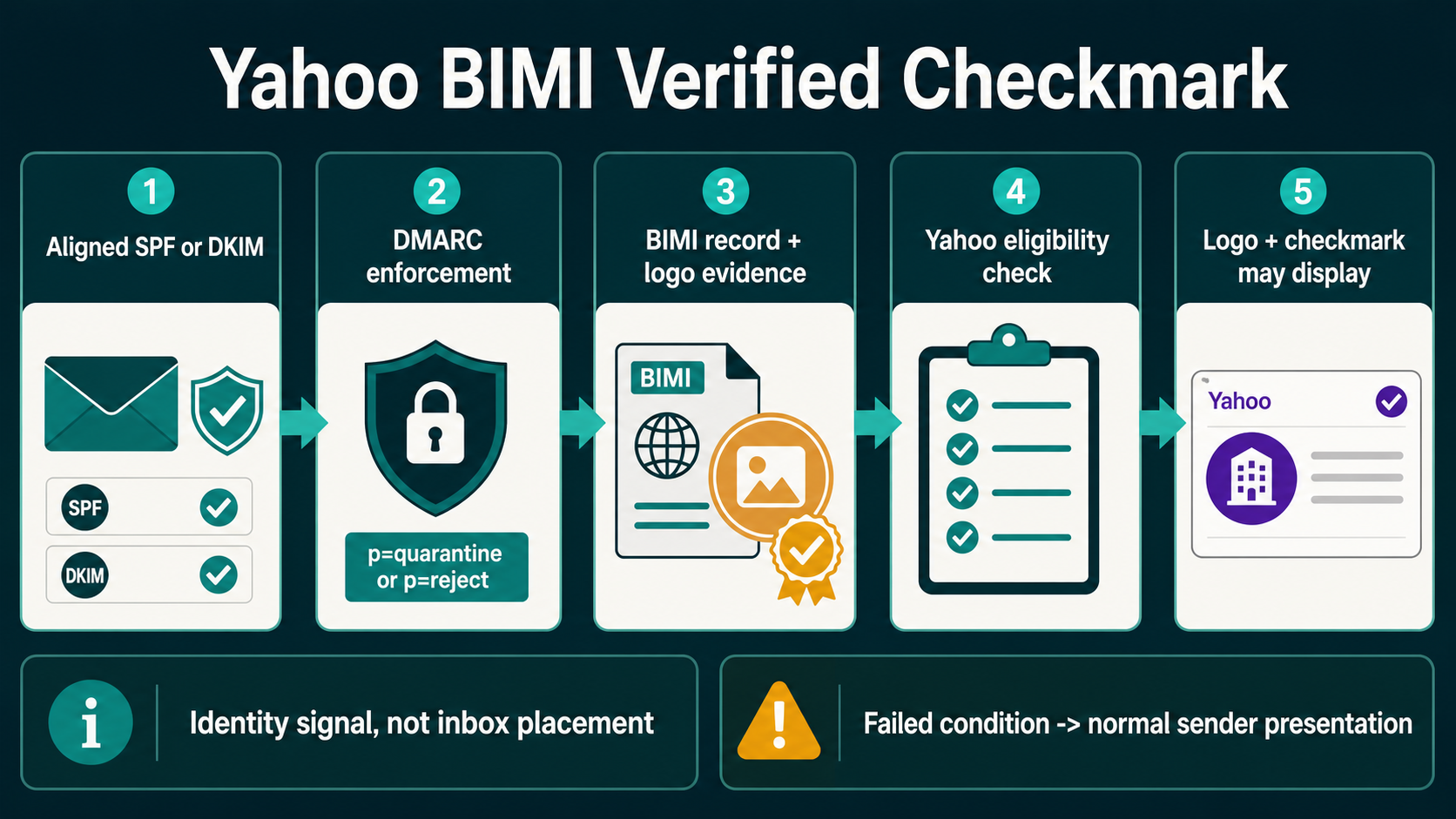
Aligned SPF or DKIM -> DMARC enforcement -> BIMI DNS assertion
Eligible logo evidence -> Yahoo verification and reputation checks
Supported Yahoo mobile surface -> verified logo plus checkmark may appear
Any failed condition -> normal sender presentation remains
Who and what the change affected
| Traffic or stakeholder | What changed | Required interpretation |
|---|---|---|
| Recipients in the affected provider surface | Yahoo BIMI verified checkmarks changed what the mailbox could display, infer or act upon. | Segment evidence by supported client, account and provider estate. |
| Permission-based senders | A new capability or recipient signal entered the message path. | Consent, expectation and normal filtering still apply. |
| Deliverability operators | Diagnosis gained another provider-controlled state. | Keep acceptance, placement, presentation and engagement separate. |
| Campaign and lifecycle teams | Message design or timing needed a compatible operating rule. | Protect transactional purpose, suppression and fallback behavior. |
| Data and analytics teams | Historical metrics could change meaning or coverage. | Version definitions and do not compare incompatible populations. |
| Security and privacy owners | The trust or data boundary changed. | Approve endpoints, access, retention and exception handling. |
Effect on delivery, placement and recipient visibility
Checkmark absence must not trigger emergency IP rotation. First verify DMARC disposition and alignment, BIMI record lookup, SVG accessibility, evidence document, covered domain, message authentication and the exact Yahoo client.
Because Yahoo controls final display, a technically complete configuration can still be ineligible. Support evidence should state that distinction without claiming filtering.
For Yahoo BIMI verified checkmarks, BIMI is a presentation layer built on authenticated identity. DMARC enforcement, aligned authentication, logo evidence, DNS publication and provider eligibility are prerequisites, but none of them guarantee inbox placement or a particular mailbox category. Normal reputation and abuse systems still apply.
For Yahoo BIMI verified checkmarks, The visible logo must correspond to the organizational domain evaluated by the receiver. A parent-company certificate does not automatically cover every sending domain, and a technically valid SVG does not prove that the provider will display it. Domain inventory and certificate coverage must precede rollout.
For Yahoo BIMI verified checkmarks, A missing logo is not proof of delivery failure. Causes include unsupported clients, cache delay, record errors, certificate or evidence problems, DMARC failure, provider reputation decisions and message-specific identity alignment. Diagnose the chain in that order rather than repeatedly changing creative.
Interpret Yahoo BIMI verified checkmarks at the smallest defensible unit: provider, recipient domain, stream, sending domain, DKIM identity, IP pool, campaign and time window. Portfolio averages can hide both a provider-specific regression and an improvement limited to one eligible surface.
Effect on measurement and diagnosis
Use controlled Yahoo accounts and capture the same message across supported and unsupported surfaces. Record delivered folder, logo state and checkmark state independently.
Any recognition experiment needs downstream outcomes and a stable control. Open-rate movement alone cannot prove the checkmark caused attention, particularly where image proxying affects the signal.
When measuring Yahoo BIMI verified checkmarks, Measure BIMI as a trust and recognition experiment, not as a deliverability certification. Compare eligible and non-eligible surfaces with careful client segmentation, then examine clicks, conversions, complaints and reported impersonation alongside opens.
When measuring Yahoo BIMI verified checkmarks, Logo impressions are generally not a sender-controlled event stream. Provider rendering is conditional and cached, so absence of a logo-view counter does not justify embedding new tracking into the logo asset. Use DNS, certificate, authentication and controlled mailbox evidence.
Create an evidence contract before declaring the impact of Yahoo BIMI verified checkmarks. Name the event, collection point, population, numerator, denominator, latency, privacy boundary and owner. If any of those are unknown, label the conclusion as directional rather than causal.
Advantages for email marketers
| Potential advantage | When the advantage is real | Evidence to verify |
|---|---|---|
| Clearer recipient experience | The message is expected, authenticated and supported. | User outcomes improve without complaint growth. |
| Better operational evidence | Provider and sender states remain separately observable. | Incidents can be isolated to a specific layer. |
| Stronger identity or control | Configuration matches the verified organizational domain. | Authentication and trust checks remain stable. |
| Safer optimization | A controlled cohort and complete window are used. | Clicks, conversions and complaints support the decision. |
| Repeatable deployment | Ownership, rollback and monitoring are documented. | A second team can reproduce the result. |
Disadvantages and operational risks
| Cost or risk | How it appears | Control |
|---|---|---|
| Capability is mistaken for allowlisting | Teams expect placement without reputation discipline. | State explicitly that normal filtering continues. |
| Unsupported clients receive a broken experience | Content or action disappears outside the target surface. | Maintain and test a complete fallback. |
| A proxy metric becomes business truth | A UI or collection change looks like performance. | Use named denominators and downstream outcomes. |
| Too many variables change together | No cause can be assigned after a regression. | Use a staged rollout with rollback thresholds. |
| Provider-specific behavior is generalized | One domain trend is applied to the full list. | Segment by recipient provider and supported surface. |
| Exceptions outlive their reason | Allow lists, access or configuration increase risk. | Assign an owner, expiry and periodic review. |
What email teams needed to do at the time
- Confirm the historical scope. Record the announced provider, date, clients and eligibility.
- Inventory affected traffic. Map recipient domains, streams, identities and sending platforms.
- Validate authentication. Check SPF, DKIM, DMARC alignment and TLS independently.
- Build a safe fallback. Keep the message useful when the new surface is unavailable.
- Test controlled mailboxes. Capture headers, screenshots, timestamps and outcomes.
- Define measurement. Name populations, denominators, latency and privacy limits.
- Stage the rollout. Change one bounded cohort and set stop conditions.
- Brief support teams. Give them expected behavior and an escalation evidence pack.
What email teams should do now
- Read the current provider documentation. Do not assume the 2020 to 2022 launch rules are unchanged.
- Reconfirm eligibility and support. Test the exact clients, accounts and sending identities in use.
- Keep authentication aligned. Monitor SPF, DKIM, DMARC and TLS as separate controls.
- Preserve permission evidence. A presentation feature does not repair weak acquisition.
- Segment provider traffic. Diagnose Yahoo Mail ecosystem separately before changing global policy.
- Protect suppressions and transactional streams. Do not let experimentation delay required state changes.
- Retain raw evidence. Store message IDs, timestamps, headers, configuration and test results.
- Use outcome metrics. Include clicks, conversions, complaints, opt-outs and support impact.
- Review security and privacy. Limit data, endpoints, credentials and exceptions.
- Maintain rollback. Name the owner and the threshold that returns traffic to the known-safe path.
Worked deliverability scenario
A retailer publishes BIMI and sees its logo in one Yahoo mobile account but no checkmark in another. The marketing team assumes the second message was sent to spam and asks to move IPs.
The operator confirms both messages reached the inbox, then finds that the second visible From domain is not covered by the evidence document. DMARC passes, but the verified identity chain is incomplete for that sub-brand.
The company aligns its domain inventory and certificate coverage, retests after DNS and provider cache time, and keeps delivery reporting separate from presentation reporting.
The decisive improvement for Yahoo BIMI verified checkmarks is operational: the team separates provider evidence from assumptions, changes one controlled variable, records a rollback threshold and waits for a complete observation window. That prevents a visible interface change from becoming an excuse for unrelated domain, volume or creative changes.
Evidence and diagnostics
- Message identity: RFC 5322 From, envelope sender, DKIM domain and selector.
- Transport: connecting IP, TLS result, SMTP response and provider timestamp.
- Authentication: SPF, DKIM, DMARC and ARC results from the received header.
- Eligibility: provider registration, tenant setting, certificate or supported-client state.
- Rendering: raw MIME, fallback, screenshots and client version.
- Recipient scope: provider domain, account type, geography and app surface.
- Behavior: clicks, replies, conversions, complaints and unsubscribes.
- Change record: deployment time, owner, cohort, configuration diff and rollback threshold.
- Comparison: unaffected control cohort with the same purpose and acquisition source.
Failure modes and incorrect conclusions
- Equating SMTP acceptance with inbox placement. These are separate receiver decisions.
- Calling a provider UI change a reputation penalty. Verify transport and folder evidence first.
- Removing the fallback. Support and eligibility are never universal.
- Changing IP, domain, creative and cadence together. The test becomes uninterpretable.
- Trusting opens as the only outcome. Collection and privacy controls distort them.
- Ignoring the recipient denominator. Portfolio averages conceal provider-specific effects.
- Keeping permanent exceptions. Unowned allow lists and credentials accumulate risk.
- Using launch documentation as current policy. Recheck the maintained provider page.
Current status and superseding changes
Yahoo continues to document BIMI through Sender Hub and retains discretion over display. Current eligibility and evidence requirements must be checked before certificate purchase or renewal.
BIMI adoption has expanded across providers, but their logo and checkmark rules are not interchangeable. Validate each provider and client separately.
Current behavior for Yahoo BIMI verified checkmarks must be checked again before a production change because provider documentation, client support and eligibility can evolve. The dated event remains useful as a historical control point, while the linked current documentation governs present operation.
A production runbook for Yahoo BIMI verified checkmarks should contain more than a setup instruction. Record the business purpose, accountable owner, approved sending identities, affected recipient population, prerequisites, evidence sources, known unsupported paths, rollout cohort, stop threshold and rollback method. Attach a dated configuration export or DNS answer instead of relying on a screenshot with no timestamp. Review the runbook after an ESP, gateway, domain, certificate, mailbox client or provider policy changes.
Incident handling for Yahoo BIMI verified checkmarks should begin with a narrow comparison. Select one affected message and one known-good message with the same stream and nearby time. Compare SMTP responses, authentication results, raw MIME, provider or tenant eligibility, client presentation and downstream action. Widen the query only after identifying the first state where their paths differ. This is faster and safer than changing sending IPs, From domains and creative together.
Ownership for Yahoo BIMI verified checkmarks must cross organizational boundaries. Deliverability owns provider evidence and traffic controls; engineering owns MIME, APIs and event integrity; security owns trust and endpoint risk; privacy owns collection and retention; marketing owns permission, promise and cadence; support owns recipient-facing explanations. A launch is incomplete when any team lacks the evidence required to distinguish expected behavior from failure.
Evidence for Yahoo BIMI verified checkmarks also needs a retention rule. Keep enough raw headers, configuration history and aggregate outcome data to investigate a delayed complaint or regression, but do not retain recipient-level data merely because it was convenient during launch. Limit access by role, document the permitted purpose, remove expired exports and preserve only the minimum artifacts needed to reproduce the operational conclusion.
Finally, retain a negative control for Yahoo BIMI verified checkmarks. Send a technically valid message that is intentionally outside the feature’s eligible condition, while keeping purpose and audience comparable. The difference shows whether Yahoo Mail ecosystem is applying the feature where expected. It also prevents teams from interpreting an unrelated seasonal, audience or reputation shift as proof that the feature caused the result.
Operator checklist
- Record the exact historical event date and source.
- Document what changed and what explicitly did not change.
- Map affected providers, domains, clients and account types.
- Validate SPF, DKIM, DMARC alignment and TLS.
- Keep a complete, accessible fallback message.
- Test with raw headers and controlled recipient accounts.
- Separate acceptance, placement, presentation and action metrics.
- Name every numerator, denominator and observation window.
- Monitor complaints, opt-outs and downstream outcomes.
- Set rollout ownership and rollback thresholds.
- Revalidate the current provider requirement before deployment.
Primary and contemporaneous references
- Yahoo Postmaster: Get Stuff Done: Primary evidence used to verify the dated event or current operating requirement.
- Yahoo Sender Hub: BIMI: Primary evidence used to verify the dated event or current operating requirement.
- Yahoo Sender Hub: Best practices: Primary evidence used to verify the dated event or current operating requirement.