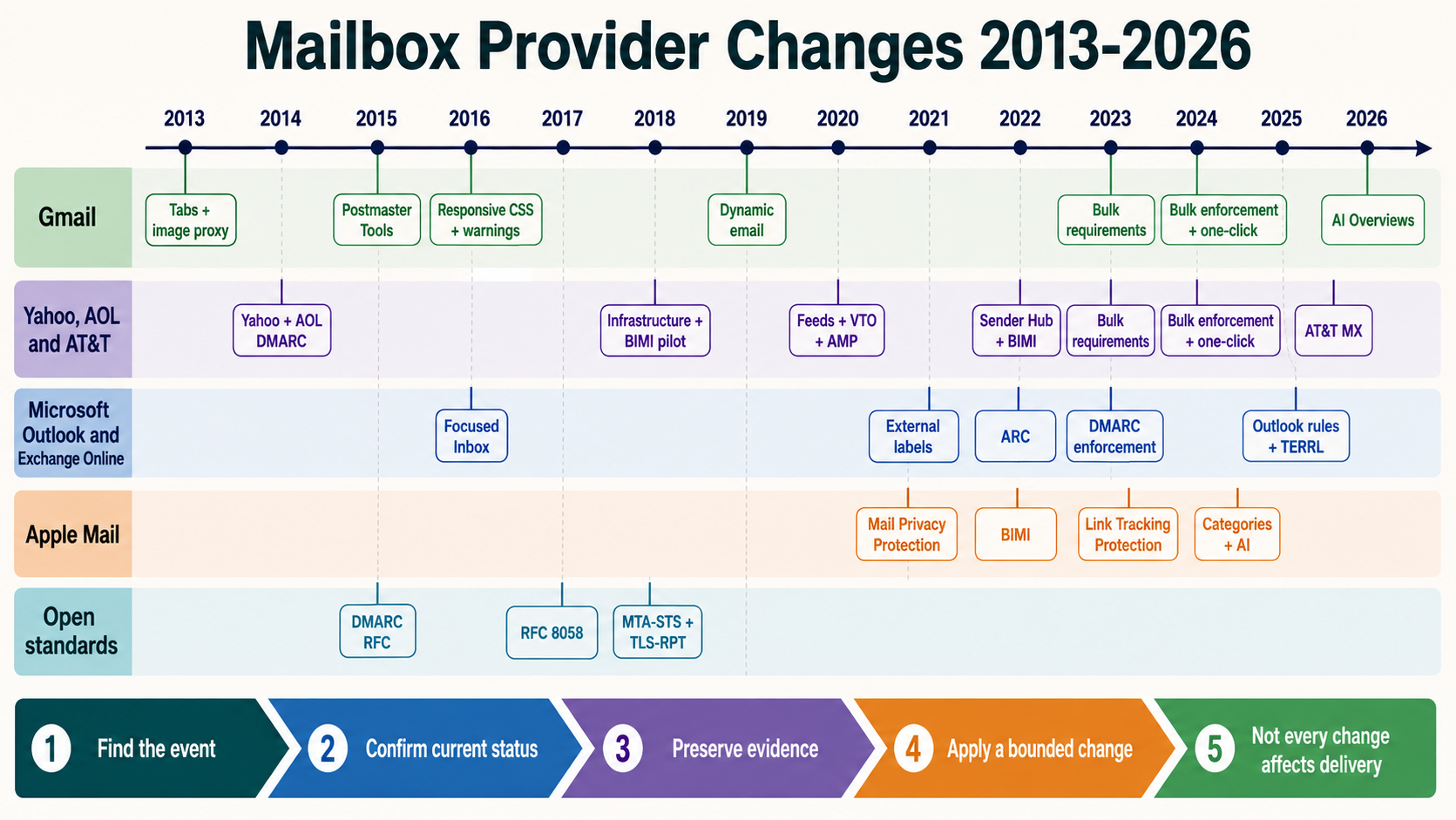
Yahoo DMARC Reject Policy in 2014: The Impact on Third-Party Sending
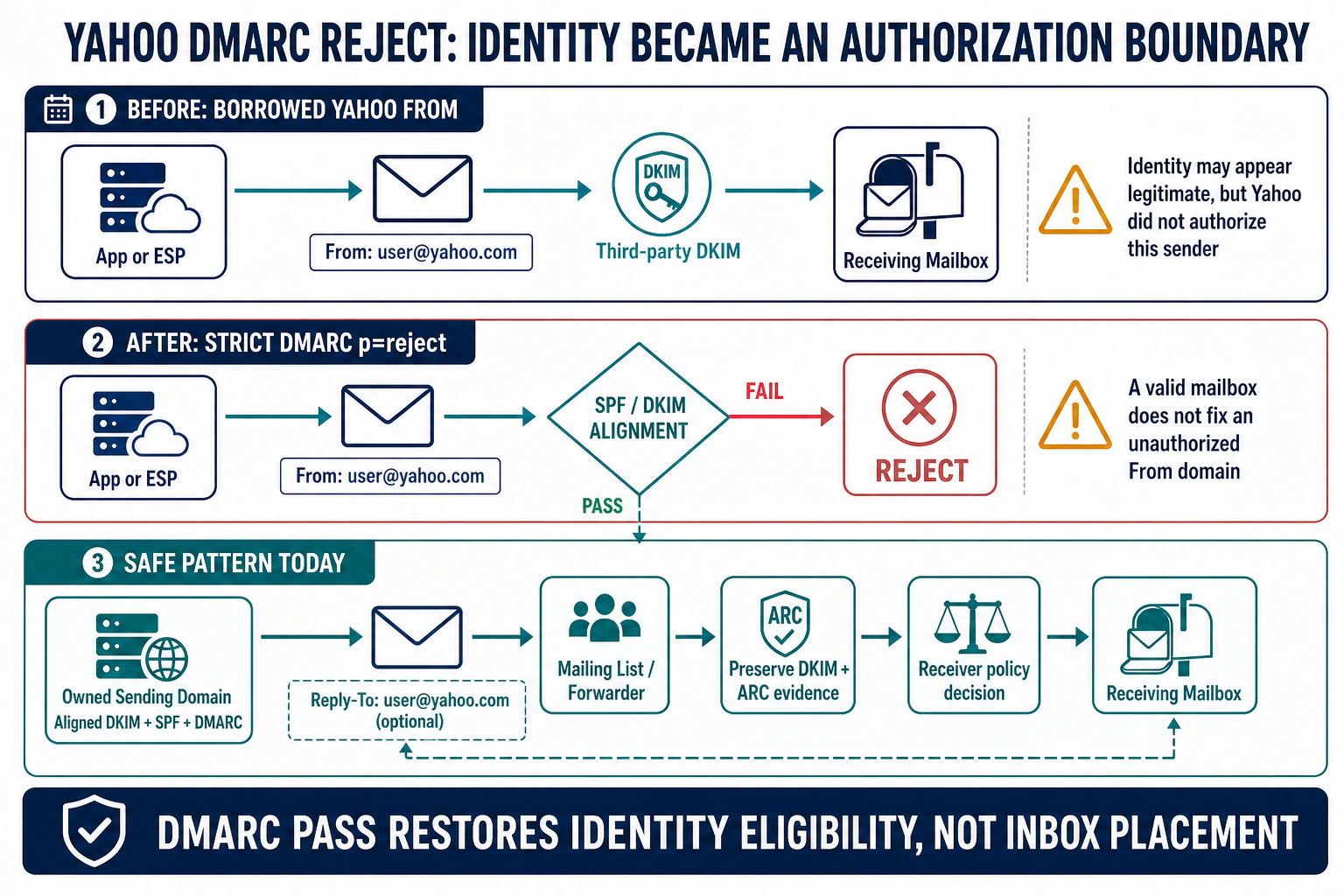
In early April 2014, Yahoo changed the DMARC policy for yahoo.com from monitoring to `p=reject`. Receivers honoring the policy could reject messages that displayed an `@yahoo.com` address in RFC5322.From when neither an aligned Yahoo DKIM signature nor aligned SPF authorization survived. The change sharply reduced a valuable spoofing path, but it also disrupted mailing lists, forwarding services and applications that sent legitimate mail on behalf of Yahoo users through unrelated infrastructure.
The dated mailbox-provider change
| Event field | Verified value | Why it matters |
|---|---|---|
| Historical event date | Early April 2014 | This is the provider-change date, not the NitWings publication date. |
| Mailbox provider | Yahoo Mail ecosystem / Yahoo.com | The affected provider estate determines which recipient cohorts require separate evidence. |
| Change area | Authentication/DMARC | This identifies whether the change altered authentication, filtering, visibility, measurement or sender operations. |
| Current status | active | Historical instructions are interpreted against the feature or standard that exists now. |
The source document correctly gives month-level timing instead of inventing an exact day. Contemporaneous records place the change in early April 2014, during a phishing campaign that impersonated Yahoo users. Yahoo later described the decision as protection for its users and contacts: mail claiming to be from a Yahoo address but lacking the expected cryptographic authorization should not be delivered.
DMARC was already deployed before RFC 7489 appeared in March 2015. The 2014 Yahoo event therefore belongs to operational DMARC history, not the later RFC publication date. Its practical importance came from scale. A major consumer mailbox domain published a strict requested disposition for mail using its identity, exposing long-standing incompatibilities in indirect mail flows.
The policy applied to the domain in the visible From field, not to every message destined for a Yahoo recipient. This distinction is essential. Yahoo was acting as the owner of `yahoo.com` and telling DMARC-aware receivers how to handle unauthorized use of its author domain. A company sending from its own domain to Yahoo mailboxes faced a different inbound deliverability evaluation.
A live DNS check on August 31, 2026 returned `v=DMARC1; p=reject; pct=100` for `_dmarc.yahoo.com`. The historical policy is therefore not merely an obsolete anecdote. Its central identity boundary remains active, even though DMARC specifications, forwarding mitigations and the Yahoo/AOL operating ecosystem have evolved.
How the system worked before the change
Before strict rejection, an application could place a Yahoo user’s address in the visible From field and send the message through its own SMTP service. A photo-sharing application, “send this to a friend” form, discussion list or ESP account might do this to make the message appear directly authored by the Yahoo user. The message could fail aligned authentication, but a receiver was less likely to apply a domain-owner-requested rejection because yahoo.com had not requested that strict disposition.
SPF generally authenticated the RFC5321.MailFrom or HELO identity used by the third-party server, not the unrelated yahoo.com address shown to the recipient. DKIM could authenticate a third-party signing domain, but it would not align with yahoo.com. Unless Yahoo itself signed the message and its signature survived, DMARC had no aligned pass for the visible author domain.
Mailing lists added another failure path. A subscriber could post from a Yahoo address through Yahoo’s outbound system, producing an aligned Yahoo DKIM signature. The list then redistributed the message from its own server. SPF alignment failed because the list server was not Yahoo. If the list modified the subject, footer, MIME structure or body, the original Yahoo DKIM signature could fail. The redistributed copy then failed DMARC despite being a legitimate list post.
Forwarding could preserve the body and Yahoo DKIM signature, allowing DMARC to pass, but forwarding was not uniformly safe. Intermediaries that modified content, broke signatures or reconstructed messages could remove the aligned result. The 2014 ecosystem also lacked today’s mature ARC deployment, and ARC still would not mean that every receiver must override a strict policy.
What changed on the provider side
Publishing `p=reject` changed the requested receiver action after DMARC failure. A DMARC-aware receiver evaluated the RFC5322.From domain, checked whether SPF passed with an aligned authenticated domain or DKIM passed with an aligned signing domain, and applied local policy informed by Yahoo’s reject request when neither path aligned.
Authorized Yahoo-originated mail normally had the evidence required to pass. Obvious spoofing that simply inserted an `@yahoo.com` From address while sending from attacker infrastructure failed. Unfortunately, legitimate third-party systems using the same identity pattern also failed. DMARC could identify missing alignment; it could not infer that the Yahoo user had clicked a legitimate “share” button or intentionally subscribed to a mailing list.
The change forced applications to distinguish author identity from transport identity. A service should send using a domain it controls and authenticates, preserve the Yahoo user’s address in Reply-To or clearly labelled body context when appropriate, and avoid implying that Yahoo authorized the service to send as yahoo.com. Mailing-list software adopted From rewriting or other mitigation patterns, with usability, reply-routing and authorship tradeoffs.
The policy did not state that every DMARC failure must be rejected in every circumstance. Receivers retain local policy and can consider other evidence. Operators nevertheless had to design as if a published reject policy would be honored because relying on undocumented receiver exceptions produced unpredictable delivery and security risk.
Message path before and after
Before
Yahoo user address in visible From
        |
        +----> Yahoo outbound mail with aligned authentication
        |
        +----> Third-party app, ESP or mailing list
                    |
                    v
No aligned yahoo.com SPF or surviving DKIM
                    |
                    v
Receiver applies local filtering without yahoo.com reject request
                    |
                    +----> May deliver, spam or reject
After
Yahoo user address in visible From
        |
        v
Receiver performs DMARC evaluation
        |
        +----> Aligned Yahoo DKIM or SPF passes
        |              |
        |              v
        |          Continue local delivery evaluation
        |
        +----> No aligned pass
                       |
                       v
              yahoo.com policy: p=reject
                       |
                       v
              Reject or strong policy handling

Safer third-party pattern:
Authenticated service From + Yahoo user in Reply-To or author context
Who and what the change affected
| Traffic or stakeholder | What changed | Required interpretation |
|---|---|---|
| Mail sent directly by Yahoo | Aligned Yahoo authentication could satisfy DMARC. | Do not treat the strict policy as a block on properly authenticated Yahoo-originated mail. |
| Attackers spoofing yahoo.com | Mail lacked aligned Yahoo authorization and became eligible for reject handling. | This was the primary security benefit and policy purpose. |
| ESPs using a customer’s Yahoo address as From | The ESP could not legitimately align SPF or DKIM with yahoo.com. | Use an authenticated organizational domain in From and preserve the consumer address only where appropriate. |
| Mailing lists | Redistribution and body modification could break the original aligned DKIM signature while SPF failed. | Apply list-aware From handling, preserve author context and test reply behavior. |
| Forwarders and gateways | Unmodified DKIM could survive, while modifications or reconstruction could cause DMARC failure. | Preserve signatures and authentication context; use ARC as evidence, not a universal bypass. |
| Share-by-email and invitation products | User intent did not create domain-level authorization to send as yahoo.com. | Send from a controlled domain with transparent on-behalf-of and Reply-To semantics. |
Effect on delivery, placement and recipient visibility
The direct effect was rejection or stronger filtering of messages that claimed Yahoo authorship without aligned authentication. This was a domain-identity deliverability change, not a general content-filter adjustment. A message could be wanted by the recipient and operationally legitimate yet still fail because the visible author domain’s authentication contract was not satisfied.
For ESP customers, the failure often appeared after a campaign or application had worked for years. The sender might see a provider-specific rejection while messages using corporate From domains continued normally. The correct diagnosis began with the visible From domain and Authentication-Results, not with IP warmup, keyword removal or random content changes.
Mailing-list impact was structural. A list could not repair alignment by adding its own DKIM signature if the visible From remained yahoo.com, because the list’s signing domain did not align with the author domain. Rewriting the visible From to the list domain could restore alignment but changed presentation and reply expectations. Preserving the original author in Reply-To, Sender or body context required careful standards and usability testing.
The change also reduced spoofed Yahoo mail that might otherwise damage recipient trust and create phishing complaints. That security benefit supports overall ecosystem quality. A strict domain policy can make messages bearing the protected identity more trustworthy, provided legitimate systems stop borrowing the domain without authorization.
For modern deliverability operations, consumer mailbox addresses should not be used as visible From identities for commercial or automated mail sent through unrelated infrastructure. A sender needs a domain it controls, DNS access, aligned DKIM, aligned SPF where practical and DMARC reporting. That operating model avoids dependence on a consumer provider’s identity policy.
Effect on measurement and diagnosis
The first diagnostic metric was DMARC alignment failure by visible From domain. Aggregate DMARC reports, where available to the domain owner, could show unauthorized sources claiming yahoo.com. Third-party senders did not control Yahoo’s reports, so they needed their own SMTP rejection logs, delivered headers and application identity inventory.
A sudden rise in hard bounces for messages with Yahoo visible From addresses should not be mixed with unknown-user bounces or reputation blocks. Store the SMTP reply, remote host, enhanced status, From domain, DKIM signing domains, envelope sender and application route. Classifying every 5xx as “bad address” would incorrectly suppress valid recipients while leaving the identity defect unresolved.
Complaint, click and conversion data describe different questions. A message rejected for DMARC never reaches the recipient, so its absence from engagement metrics is not evidence of weak content. Conversely, fixing From alignment can restore eligibility for delivery but cannot guarantee inbox placement or recipient interest.
When mailing lists rewrite From, longitudinal reporting must annotate the identity change. Reply rate, recognition, threading and recipient trust can move even when transport improves. The remediation should therefore be evaluated through both authentication success and user-facing behavior rather than declared complete after the first 250 response.
Advantages for email marketers
| Potential advantage | When the advantage is real | Evidence to verify |
|---|---|---|
| Strong protection against simple yahoo.com spoofing | Receivers evaluate DMARC and honor the reject request. | Reduced unauthorized yahoo.com sources and DMARC-aligned pass for legitimate Yahoo mail. |
| Clear domain-ownership boundary | Third parties stop presenting Yahoo consumer identities as if Yahoo authorized their transport. | Controlled service From domain with aligned DKIM and transparent Reply-To handling. |
| Lower phishing exposure for users and contacts | Attackers cannot produce aligned Yahoo authentication. | Policy rejection, recipient-abuse trends and authenticated-source inventory. |
| Pressure to modernize applications and lists | Operators implement purpose-correct identities and list mitigations. | Stable authentication, usable reply behavior and fewer policy rejections. |
| Improved trust in authenticated Yahoo mail | Receivers and recipients distinguish protected identity from unauthenticated claims. | Delivered Authentication-Results and low abuse signals, not logo or From text alone. |
Disadvantages and operational risks
| Cost or risk | How it appears | Control |
|---|---|---|
| Legitimate third-party mail rejection | Applications send with an @yahoo.com visible From through unrelated MTAs. | Use a controlled authenticated From domain and preserve the user address in Reply-To or body context. |
| Mailing-list breakage | Redistribution fails SPF alignment and body modification breaks Yahoo DKIM. | Use list-aware From handling, preserve signatures where possible and test ARC-informed receiver paths. |
| Reply-routing confusion | From rewriting changes where ordinary replies or reply-all actions go. | Define Reply-To and list headers deliberately and test major clients. |
| Incorrect bounce suppression | DMARC policy rejections are stored as invalid-recipient failures. | Classify identity-policy failures separately and repair the sending application. |
| Unauthorized workaround domains | Teams rotate domains or use lookalike identities to restore delivery. | Use an owned recognizable domain with governance, consent and aligned authentication. |
| Assuming ARC guarantees acceptance | A valid ARC chain is treated as permission to ignore DMARC. | Use ARC as receiver evidence; retain local policy, list mitigation and original authentication checks. |
What email teams needed to do at the time
- Inventory every Yahoo visible From address. Locate campaigns, forms, invitations, ticket systems and lists sending through non-Yahoo infrastructure.
- Stop ESP From-address borrowing. Replace consumer Yahoo From identities with a domain the sender controls and can authenticate.
- Preserve human reply paths. Put the Yahoo user address in Reply-To only when the user expects replies and the product clearly explains the sender.
- Update mailing-list behavior. Evaluate From rewriting, reply handling, DKIM preservation and recipient-client presentation together.
- Classify SMTP policy failures. Keep DMARC rejections separate from invalid recipients, content blocks and transient deferrals.
- Test forwarded and modified messages. Compare original and redistributed headers to identify where aligned DKIM is lost.
- Communicate the identity change. Explain why the service From address changed so users do not interpret the correction as impersonation.
- Retain rollback and monitoring. Track authentication, rejection, reply and complaint outcomes after the new identity is deployed.
What email teams should do now
- Never use an @yahoo.com From address for unrelated automated infrastructure. User intent does not grant DNS or signing authority over yahoo.com.
- Operate an owned sending domain. Configure DKIM, SPF, DMARC and valid DNS with clear stream ownership.
- Use current DMARC specifications. RFC 9989 now defines the core protocol, with reporting in RFCs 9990 and 9991.
- Preserve indirect-mail evidence. Maintain DKIM signatures and valid ARC chains where intermediaries participate, without assuming an override.
- Keep list identity understandable. Test visible From, Reply-To, Sender, List-ID and reply-all behavior across clients.
- Map Yahoo and AOL as one provider ecosystem operationally. Retain recipient-domain cohorts while using current Yahoo Sender Hub processes.
- Monitor current live policy. DNS changes can occur; retrieve and timestamp the actual DMARC record during an incident.
- Separate authentication repair from placement work. Passing DMARC restores identity eligibility but does not guarantee inbox placement.
- Protect consent and complaint controls. Correct authentication cannot make unwanted or deceptive third-party mail acceptable.
Worked deliverability scenario
A community platform lets members invite colleagues and places the member’s personal Yahoo address in From. The platform sends through its ESP with an aligned envelope domain and its own DKIM signature. Recipients at DMARC-aware providers begin rejecting invitations after Yahoo’s policy change.
The ESP authentication is technically valid for the ESP domains, but it does not align with the visible yahoo.com author. The platform cannot publish SPF for yahoo.com or obtain a Yahoo DKIM signing key. Rotating the sending IP, warming a new pool or changing invitation copy cannot solve the alignment defect.
The platform changes From to `[email protected]`, signs with an aligned organizational domain and places the member’s Yahoo address in Reply-To only after confirming that replies should go to the member. The body clearly states who initiated the invitation, and abuse controls rate-limit invitations and suppress complaints. The team tests ordinary reply and reply-all behavior before release.
SMTP policy rejections fall, but the team does not declare inbox success from acceptance alone. It monitors authentication results, invitation acceptance, complaints, abuse reports and Yahoo-specific delivery responses. The correction works because it aligns visible transport identity with the domain the platform controls while preserving transparent human context.
Evidence and diagnostics
- Visible author: exact RFC5322.From address and organizational domain as received.
- SPF path: RFC5321.MailFrom, sending IP, SPF result and whether the authenticated domain aligns with From.
- DKIM path: every signing domain, selector, verification result and alignment with From after intermediary modifications.
- DMARC result: evaluated policy domain, policy value, alignment mode, disposition and receiver Authentication-Results.
- SMTP outcome: remote MX, response class, enhanced status, diagnostic text, queue ID and retry or suppression action.
- Indirect path: mailing-list, forwarder or gateway Received chain, content modifications and ARC set where present.
- User-facing identity: From, Reply-To, Sender, List-ID, list footer and reply behavior in major clients.
- Current DNS evidence: timestamped TXT response for `_dmarc.yahoo.com`; never rely only on a copied historical value.
Failure modes and incorrect conclusions
- Treating an ESP DKIM pass as a DMARC pass. The signing domain must align with the visible From domain.
- Adding the Yahoo address only to SPF. A third party cannot authorize itself in Yahoo’s DNS, and envelope authentication must align.
- Suppressing recipients after policy rejection. The mailbox can be valid; the message identity is defective.
- Rewriting From without testing replies. Transport may recover while conversations, moderation or list behavior breaks.
- Assuming all forwarding fails. A surviving aligned DKIM signature can pass DMARC; modifications determine the actual result.
- Assuming ARC automatically overrides reject. ARC communicates authenticated history, while the final receiver decides how to use it.
- Using a deceptive lookalike domain. A workaround that confuses recipients trades one trust problem for another.
Current status and superseding changes
Yahoo continues to publish a strict DMARC policy for yahoo.com. The August 31, 2026 live record requested `p=reject` at `pct=100`. Operators must query current DNS during real incidents because policy content and reporting destinations can change.
The governing DMARC documents have changed. RFC 7489, published after the Yahoo event, was obsoleted in May 2026 by Standards Track RFC 9989, while aggregate and failure reporting moved to RFCs 9990 and 9991. Historical analysis should explain the 2014 behavior using the concepts available then and point current implementations to the current standards.
Yahoo and AOL now operate as one Yahoo-hosted delivery ecosystem, and Sender Hub provides current requirements, feedback-loop management, Insights and support. That consolidation does not erase recipient-domain cohorting, but it changes where senders obtain evidence and request help.
The lasting lesson is that the visible author domain is an authorization boundary. Applications and ESPs should not borrow consumer-domain identities. Mailing lists and intermediaries need explicit identity and authentication handling rather than relying on receivers to overlook a strict policy.
Operator checklist
- Show the event date as early April 2014 without inventing an unsupported exact day.
- Confirm whether the investigated mail claims yahoo.com in RFC5322.From.
- Test SPF and DKIM alignment independently using the received message.
- Identify mailing-list or forwarding modifications that broke an original Yahoo signature.
- Replace third-party Yahoo From usage with a controlled authenticated service domain.
- Preserve the Yahoo user in Reply-To or body context only when transparent and operationally correct.
- Classify DMARC policy rejections separately from invalid recipients and reputation blocks.
- Test From rewriting, replies, threading and list behavior before rollout.
- Query the live DMARC record and use current RFC 9989-series guidance.
- Monitor authentication, rejections, complaints and business outcomes after remediation.
Primary and contemporaneous references
- Yahoo Sender Hub: DMARC FAQ: Current Yahoo explanation of strict DMARC policy and possible interference with authorized but unverifiable identity use.
- DMARC.org: Yahoo to Expand Use of Strict DMARC Policy: Historical background placing the yahoo.com change in early April 2014.
- AWS Messaging Blog: Yahoo changed. Should you?: Contemporaneous operator explanation of the third-party sending impact.
- RFC Editor: RFC 9989 DMARC: Current Standards Track DMARC protocol that obsoletes RFC 7489.
- RFC Editor: RFC 8617 ARC: Current ARC protocol used to communicate authentication state through intermediaries.