Zero-Party Data for Email: Consent, Preference and Activation
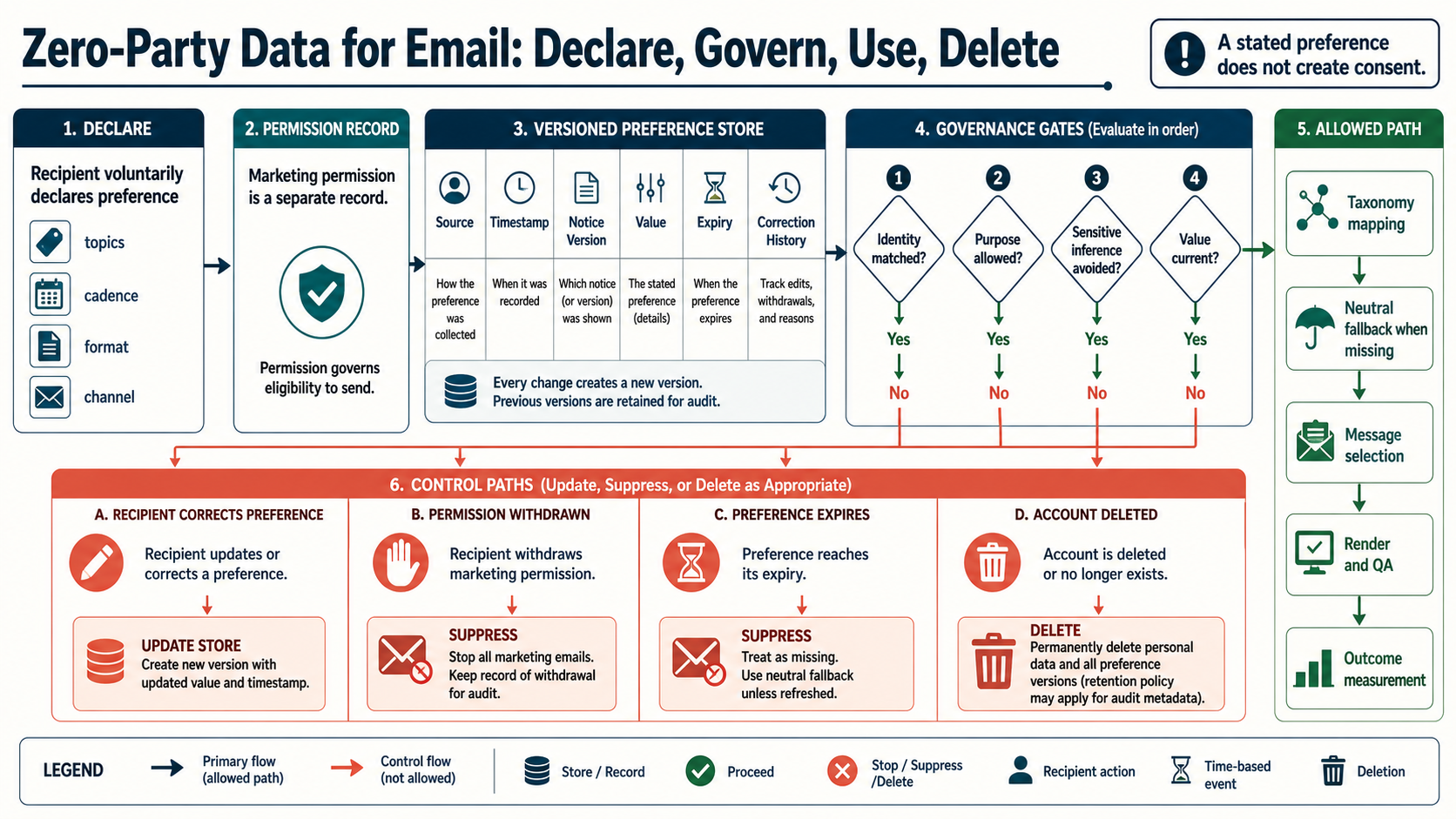
Zero-party data is a marketing label for information a person intentionally provides, such as stated interests, goals, product preferences or communication choices. The useful distinction is declared versus inferred, not a new legal category. An answer does not create unlimited permission: collection purpose, marketing consent, sensitivity, accuracy, retention and subscriber control still require separate decisions. Good activation makes communication more relevant and lets the person inspect, correct or withdraw the preference.
Define declared data without category confusion
| Data | Example | Interpretation |
|---|---|---|
| Declared preference | Chosen topic or frequency | Intentional answer in stated context |
| Observed first-party behavior | Purchase or authenticated feature use | Event, not a stated preference |
| Inferred attribute | Predicted interest or churn score | Model output with uncertainty |
| Third-party attribute | Acquired profile or audience flag | External provenance and higher risk |
Keep provenance and interpretation so an inferred score is never relabeled as something the customer told you.
Start from a useful purpose and decision
Ask only when the answer can change a current experience: topic selection, product recommendations, onboarding path, language, cadence or support. Write the decision and possible values before designing the form. If every answer receives the same campaign, collection has no benefit and adds privacy and quality risk.
Explain why the information is requested and how it will be used near the question. Do not hide a profiling purpose behind a quiz with no meaningful result for the participant.
Separate preference from marketing permission
A person can state an interest without agreeing to promotional email, and can subscribe without answering optional profiling questions. Store program, brand, purpose, notice version, source and time for permission. Store the preference as a separate record with its own context and effective dates.
An unsubscribe or complaint overrides marketing eligibility even if the preference still exists. A later purchase or preference update does not silently reverse that suppression. Necessary service communication must remain limited to its service purpose.
Create a declared-preference data contract
declared_preference(
  subject_key, preference_name, preference_value,
  purpose, collection_context, notice_version,
  declared_at_utc, effective_from, expires_at,
  source, status, correction_reason
)
Define allowed values, identity scope, null meaning, source owner, freshness, downstream users and deletion or correction behavior. Free text may contain sensitive or unexpected data and requires stronger access and review. Preserve history only where needed; current activation should use the effective record.
Write questions people can answer accurately
Use plain language, balanced choices and an honest “not sure” or “none” where appropriate. Avoid forcing a single persona onto someone with several goals. State whether a selection changes email, product, both or neither. Do not use a preselected option to manufacture a preference.
| Poor question | Improved design |
|---|---|
| What do you love? | Which topics should this newsletter include? |
| How often do you want offers? | Choose weekly, monthly or no promotional email |
| What is your biggest fear? | Which implementation constraint should guidance address? |
| Tell us everything | Ask one purpose-specific optional question |
Choose moments that provide reciprocal value
Signup can collect the minimum promise and optional topic; onboarding can ask the next success goal; a preference center can support ongoing control; a recommendation tool can use answers for an immediate result. Do not interrupt every visit with the same survey or block service access behind unrelated marketing questions.
Record the exact surface and version. If an incentive is offered, disclose terms and do not make the reward contingent on answers favorable to the sender. Rate-limit abuse and validate mailbox ownership separately where appropriate.
Resolve identity conservatively
A preference may belong to a person, account, subscription, household or device context. Do not copy one user’s answer to every account member. Anonymous answers can remain session-level until a transparent, appropriate link is established. Store identity confidence and effective dates.
When profiles merge, reconcile conflicting preferences and stronger suppressions rather than choosing the latest timestamp blindly. When they split, avoid exposing one person’s interests to another. Provide a support path for correction.
Minimize sensitive and high-risk answers
Health, finance, religion, politics, precise location and similar information can create significant risk. Do not collect it merely because personalization is possible. Require a documented purpose, appropriate legal and policy review, strict access and a safer alternative where applicable.
A generic content preference can often replace a sensitive attribute. For example, ask which educational topic to receive rather than why the person needs it. Do not place sensitive values in subject lines, URLs, image paths or vendor logs.
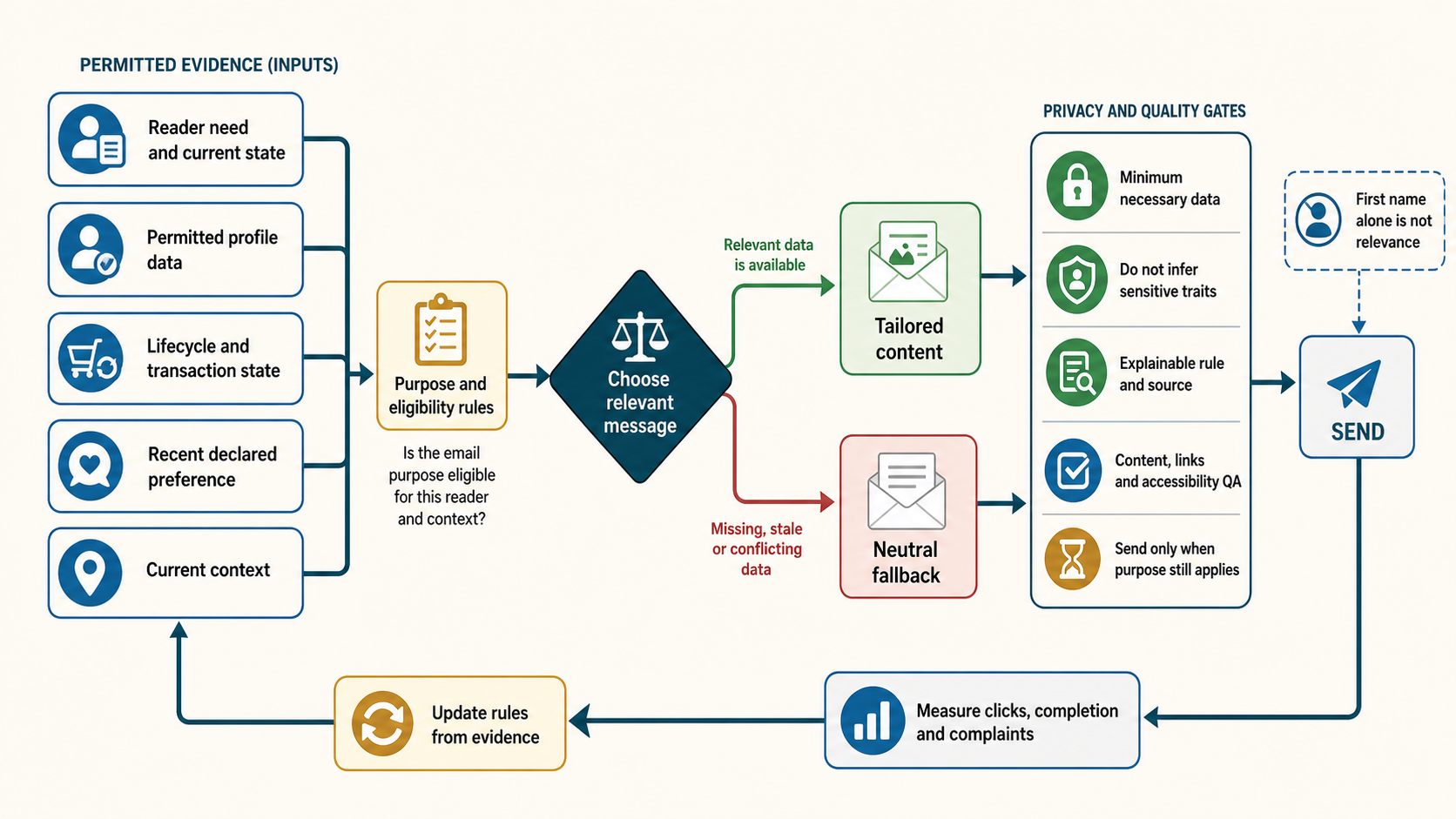
Translate answers into explicit communication rules
| Preference | Activation | Stop or fallback |
|---|---|---|
| Topic | Select relevant content modules | Neutral edition if unavailable |
| Frequency | Apply program cadence cap | Global suppression still wins |
| Goal | Choose onboarding path | Exit after milestone or change |
| Product category | Eligible recommendations | Inventory and ownership check |
| Language | Approved localized template | Declared fallback language |
Version the mapping so the same stored value cannot silently change meaning after a taxonomy redesign.
Resolve declared, observed and current-state conflicts
A person may declare interest in a category but later return the product, change role or update the preference. Declared data deserves weight, but it is not permanently true. Define precedence using purpose and effective time. A service or safety state can temporarily override a promotional preference without deleting it.
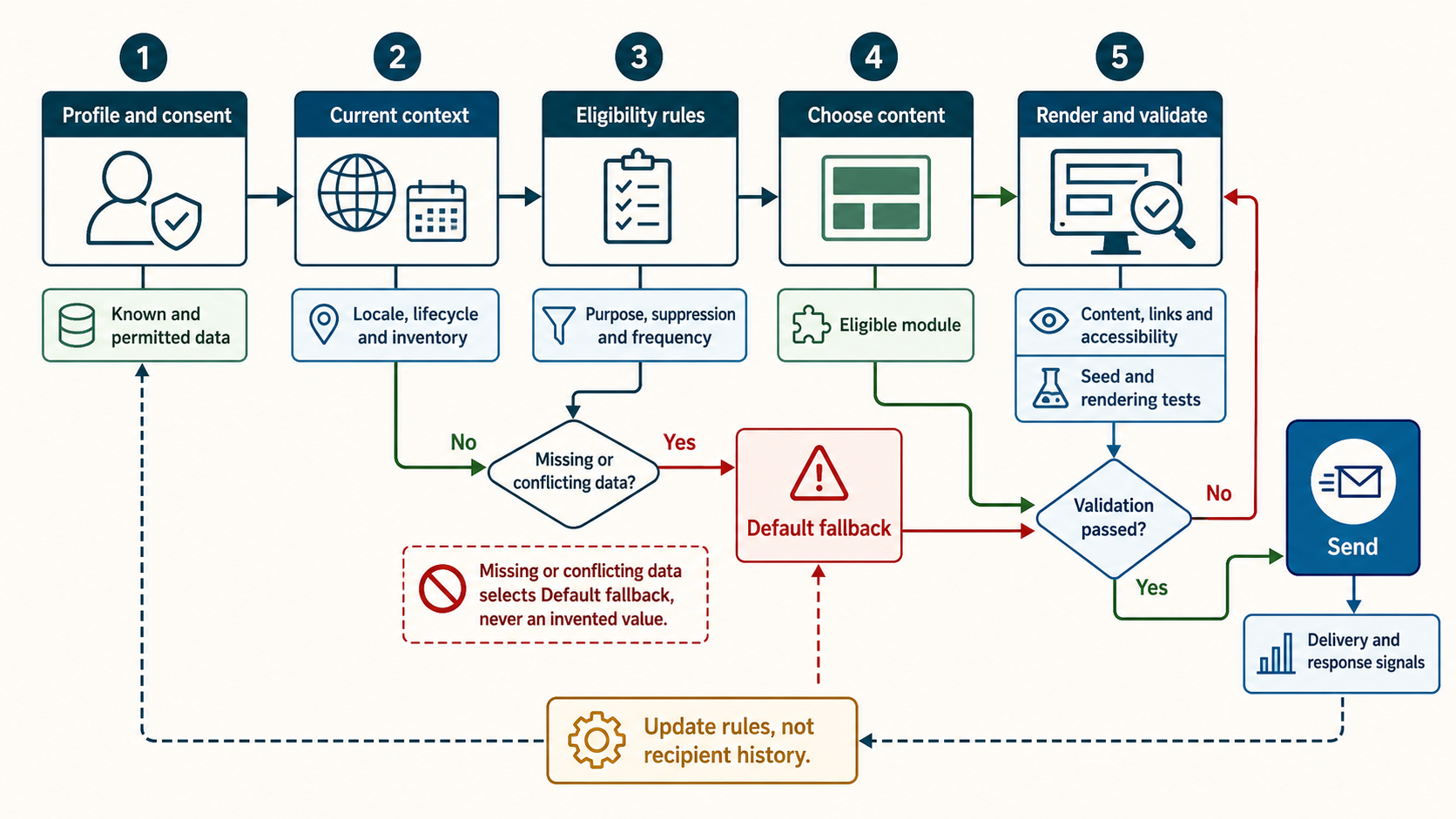
Do not interpret a lack of clicks as a new declared preference. Ask for correction when uncertainty matters, and use a neutral message when sources disagree. Record the reason for every conflict resolution.
Build a preference center that actually controls sending
Show recognizable programs, current choices, sender or brand, frequency and a clear unsubscribe path. Confirm changes and propagate them to CRM, warehouse, ESP and queued messages within the documented objective. Do not use confusing double negatives or make “save” subscribe the person to new lists.
One-click unsubscribe for relevant subscription traffic is separate from a preference-center visit. A preferences page can support granular control, but it must not replace required one-click behavior where applicable.
Review freshness and expire assumptions
Some preferences remain useful for years; others describe a short project. Define review or expiry from the decision. A goal collected during onboarding should stop driving “getting started” content after activation. An annual planning interest may need confirmation in a new cycle.
Do not send repeated “confirm your preferences” mail to an old or weakly permitted audience. Expiry can move a value to unknown and select neutral content; it should not remove complaint or unsubscribe evidence.
Protect preference systems and vendors
Use least privilege, field-level access where needed, audit trails and encryption appropriate to the risk. Restrict exports and unapproved analytics tools. A template author may need a topic flag but not the raw questionnaire. Separate raw answers from activation-ready derived values.
Authenticate preference updates, protect against cross-account changes and use CSRF and session controls for account surfaces. Signed email links should be scoped and expiring. Monitor bulk changes and unauthorized taxonomy or mapping edits.
Monitor accuracy, coverage and activation drift
Report answer rate, unknown rate, conflicts, expiry, correction, deletion and downstream usage by question version. A high completion rate can reflect a forced form rather than useful data. Sample whether messages actually honor the chosen topics and frequency.
preference_reconciliation:
  valid current answers
  - suppressed marketing subjects
  - expired or conflicting records
  = eligible activation population

unexplained differences require investigation
Track missing and unsupported values after product taxonomy changes. Fail to neutral content rather than guessing.
Measure relevance and incremental value
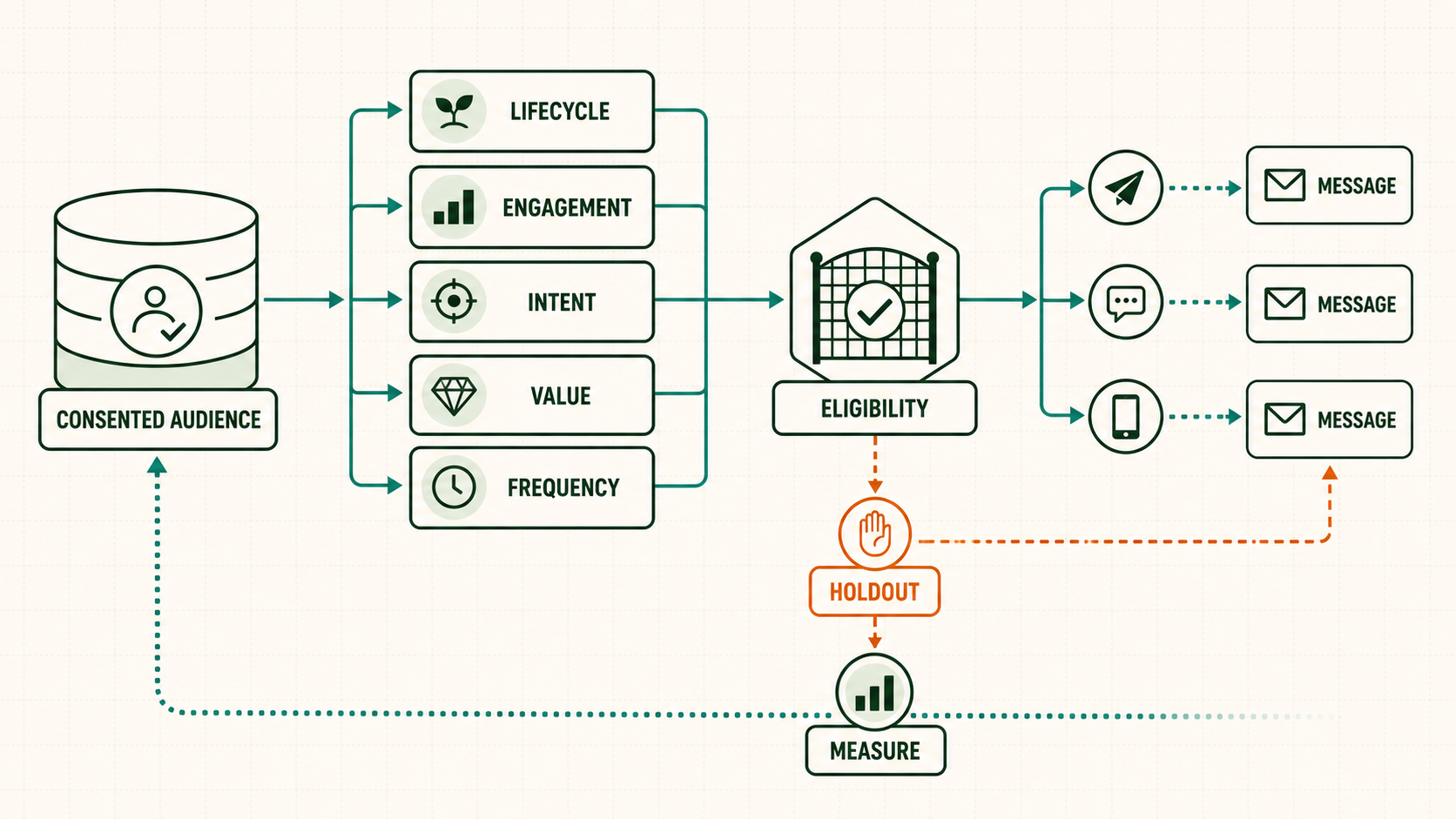
Randomize the invitation, preference-driven treatment or mapping where appropriate. Compare qualified engagement, product success, conversion, retention, complaint and unsubscribe against a neutral or holdout experience. Keep assignment independent from whether the person answered so self-selection is visible.
Do not claim that preference respondents cause better performance merely because motivated customers answer more often. Report completion and treatment effects separately, with maturity and confidence.
Worked case: an old goal causes irrelevant email
A customer selects “launch my first campaign” during onboarding. Eighteen months later the same value still drives beginner education, even though authenticated product events show advanced use. The customer changes frequency but the ESP receives only the old nightly profile and continues sending.
The team pauses the affected path, preserves preference and event history, and adds effective dates plus a goal-completed transition. Frequency changes move through a real-time suppression and preference service. The old declared answer remains historical context but no longer controls current onboarding.
Regression tests cover goal completion, preference update, profile merge, stale warehouse data and unsubscribe after scheduling.
Preference activation incident response
- Stop the affected mapping or campaign.
- Preserve question, notice, taxonomy, profile and activation versions.
- Identify collection, identity, mapping, synchronization or dispatch failure.
- Apply current unsubscribe and complaint before correction.
- Remove or quarantine exposed sensitive values.
- Recompute in shadow mode and sample subject histories.
- Resume a bounded population and monitor complaints and corrections.
Count people who received wrong topics, frequency or sensitive personalization and assess notification duties with appropriate owners.
Maintain a preference and activation catalog
Catalog every question, purpose, allowed values, optionality, notice, identity level, sensitivity, retention, downstream mapping, owner and retirement date. Review forms and hidden legacy fields after product, privacy-policy, ESP and taxonomy changes.
Keep a decision ledger for personalization experiments and exceptions. Retire a question by stopping collection, removing activation dependencies, handling existing records under policy and verifying that copied forms no longer submit the field.
Zero-party data production checklist
- The answer changes a useful current experience.
- Declared, observed and inferred data remain distinct.
- Preference and marketing permission are separate records.
- Questions are optional where appropriate and understandable.
- Identity scope and conflict behavior are explicit.
- Sensitive data is minimized and protected.
- Activation mappings are versioned with neutral fallback.
- Customers can inspect, correct and withdraw choices.
- Expiry and deletion propagate to downstream systems.
- Measurement separates self-selection from incremental impact.
Declared data creates trust only when the organization honors what the person actually said.
Migrate preference taxonomies without changing meaning silently
Products and editorial topics evolve, but an old value cannot be mapped to a broader new category merely to increase reach. Create an explicit old-to-new mapping with equivalence, split, merge, unknown and retire outcomes. Review whether the original notice and purpose support the new use.
| Change | Safe treatment |
|---|---|
| Exact rename | Map with version and preserve history |
| One topic splits | Ask or use neutral parent content |
| Several topics merge | Check scope; do not broaden silently |
| Product retired | Stop activation and explain alternatives if relevant |
| Unknown value | Quarantine and investigate |
Run the mapping in shadow mode, compare populations and sample histories before activation. Keep rollback while preserving newer corrections and suppressions.
Propagate correction, withdrawal and deletion
A customer-facing change is incomplete until CRM, preference service, warehouse, ESP, personalization cache and queued messages agree. Use a stable request or event ID, scope, effective time and acknowledgement from each consumer. If a critical consumer is stale, hold affected marketing.
preference_change_event(
  change_id, subject_key, field_scope,
  old_state, new_state, effective_at_utc,
  source, notice_or_request_version
)

consumer_ack(change_id, system, applied_at, result)
Deletion may require removing raw and derived data while retaining minimal suppression evidence under the applicable policy. Do not rebuild a deleted preference from an old export or model. Test corrections and withdrawals end to end after integration changes.
Check who answers and who benefits
Preference respondents are self-selected. People with more time, trust, digital access or stronger interest may answer at higher rates, so their performance cannot be generalized automatically to nonrespondents. Forms and choice sets can also exclude needs the designers did not anticipate.
Report invitation, exposure, completion, skip, unknown and activation by relevant cohort with privacy-safe minimums. Test accessibility, language and mobile use. Provide an optional free-text route only when the organization can protect and act on it; otherwise expand balanced choices through research.
Measure whether activation improves outcomes within answer groups using controlled treatment. Do not penalize a person for declining optional profiling or use the absence of an answer as a negative trait.
Control preference data shared with vendors
Inventory which ESPs, CDPs, recommendation systems, analytics tools and agencies receive raw or derived values. Give each only the fields and purpose required, with access, retention, deletion, incident and onward-sharing controls. A vendor does not need the original questionnaire when a coarse eligible-content flag is sufficient.
Do not embed preference values in tracking URLs, custom headers or filenames. Use pseudonymous identifiers and secure transfer. Review vendor logs, support access and exports. Test whether withdrawal and deletion reach vendor copies and backups under the agreed process.
At migration or termination, export only governed current data, apply suppressions, reconcile counts and obtain deletion or return evidence. Revoke tokens and stop webhooks so stale systems cannot recreate profiles.
Run an annual declared-data purpose review
List every active question and field with purpose, collection surface, answer rate, sensitivity, downstream decisions, owner, retention and last use. Remove fields that no longer change a useful experience. Sample messages to verify that preferences are honored and that no hidden model relabels inferred data as declared.
Review permission separation, preference-center clarity, taxonomy changes, identity merges, stale values, vendor access and deletion performance. Compare complaints, corrections and “why did I receive this?” support cases by activation rule. Inspect small or vulnerable cohorts for inappropriate personalization.
Close the review with owned removals and mapping changes, not merely a data dictionary update. Notify or ask customers when a genuinely new use requires a fresh choice. The most trustworthy zero-party program often collects less and honors it better.
Test whether asking and using the preference helps
A complete experiment can separate the invitation effect from activation. Randomize eligible people to no question, optional question with neutral content, and optional question with preference-driven content where practical. Preserve nonresponse as an observed choice; do not analyze only respondents and claim causality.
Define a primary outcome tied to the purpose, such as qualified content use, onboarding success or retained subscription. Include completion burden, correction, complaint, unsubscribe and privacy support as guardrails. Wait for enough messages and time to observe whether relevance persists.
Report answer distribution and treatment lift separately. A popular choice can have no incremental value, while a low-frequency choice may be essential for a smaller group. Use the result to simplify questions and activation, not to maximize profile completeness.
Recover preference systems without restoring stale profiles
During outage, stop dependent personalization when current permission, suppression or sensitive values are uncertain. Preserve event offsets, current snapshots, change acknowledgements and queued messages. Restore unsubscribe and complaint state first, followed by effective current preferences and only then optional enrichment.
Do not replay every old preference event or queued campaign. Reconcile each current subject, discard expired intermediate changes and cancel messages whose content or cadence is obsolete. If vendor delivery is uncertain, use change IDs and status lookup to avoid duplicate activation.
Resume with a bounded neutral cohort, then preference-specific branches. Monitor wrong-topic messages, frequency violations, corrections and support. Recovery is successful when current choices are honored, not when the event queue is empty.
Final declared-preference activation approval
The owner should state why each question is asked, which communication decision it changes, whether it is optional, how long it remains useful and how a person corrects or removes it. Confirm that marketing permission is independently valid and that unsubscribe, complaint and service states have clear precedence.
Attach the question and notice version, identity scope, sensitivity review, taxonomy mapping, downstream recipients, neutral fallback, deletion path, experiment and incident stop mechanism. Test missing, conflicting, expired and withdrawn values through the production pipeline.
Approval expires when purpose, taxonomy, vendor, model, message program or collection surface changes materially. Do not broaden activation under an old answer merely because the technical field can be reused.
Release preference activation through shadow and canary
Run new mapping in shadow mode and compare selected topics, frequencies, exclusions and unknowns with the current system. Sample complete subject histories and verify that permission and suppression remain independent. Then release a small canary with a neutral fallback and an immediate mapping kill switch.
Monitor wrong-topic reports, preference corrections, frequency violations, provider outcomes and downstream event lag. Expand only after the observation window supports both technical correctness and recipient value. Rollback restores the prior mapping while preserving newer choices, complaints and unsubscribes.
Primary references
- Gmail email subscription guidelines
- Gmail email sender guidelines
- RFC 8058 One-Click Unsubscribe
- FTC dark patterns report