Email Segmentation Strategy: From Broad Lists to Intent Cohorts
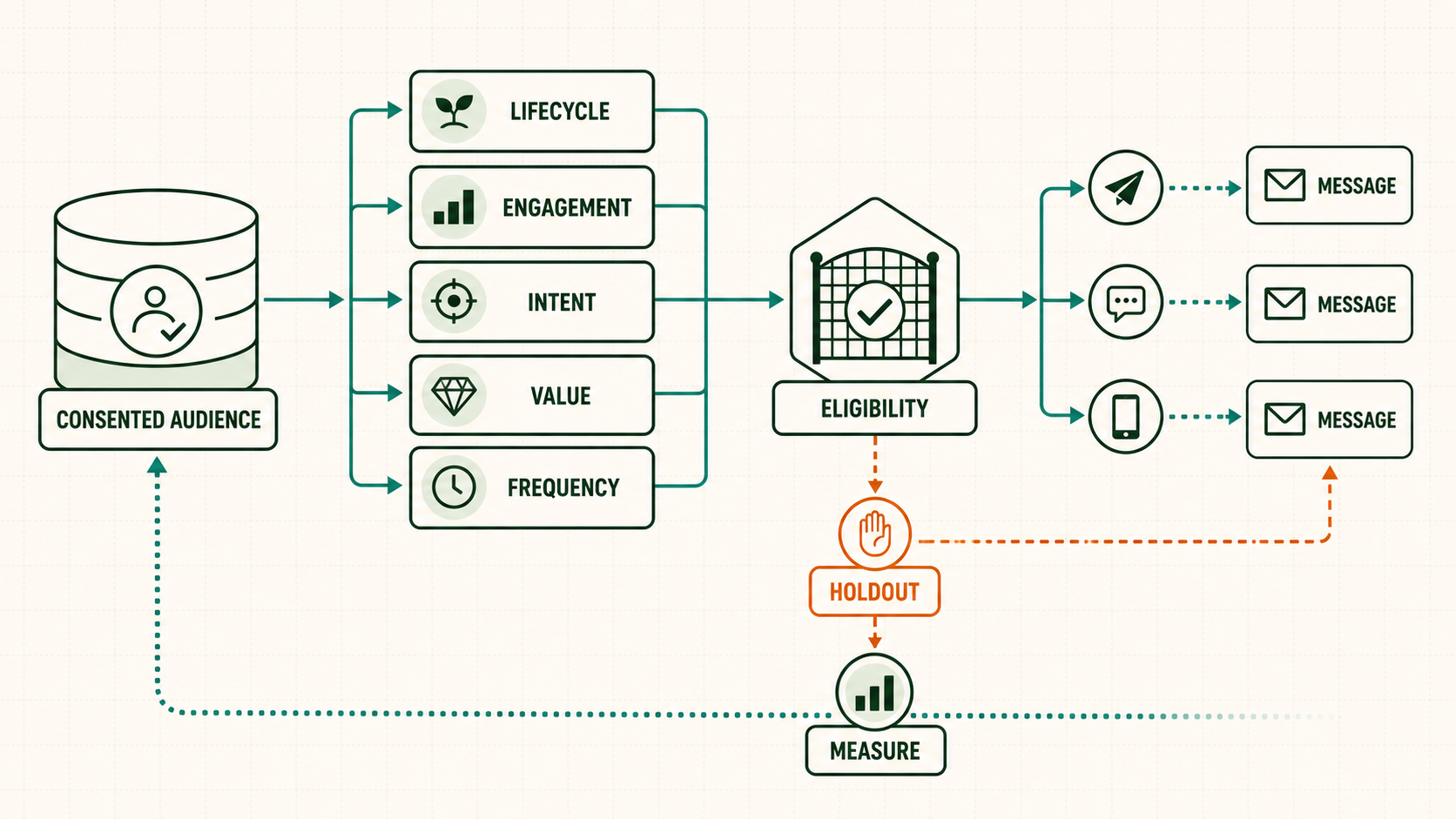
Useful segmentation is a decision system, not a collection of marketing labels. It decides who is eligible, which message has priority, when contact is safe, and how the team will learn whether the decision created value. Consent and durable suppressions come before engagement scores. Every segment needs a data contract, deterministic definition, owner, refresh schedule, exclusions and exit condition.
Start with permission and eligibility
Build the eligible population before commercial targeting. Exclude hard bounces, complaints, unsubscribes, invalid addresses, legal restrictions and program suppressions. Confirm consent covers the purpose, brand and channel. A purchase can inform relevance but does not reverse an unsubscribe.
Represent suppression with reason, scope, source, effective time and policy version. A boolean loses whether exclusion is address-wide, brand-specific or temporary. Apply the strongest rule first and record counts after each exclusion.
Choose dimensions that change a decision
| Dimension | Evidence | Decision |
|---|---|---|
| Lifecycle | New, activated, retained, lapsing | Purpose and education |
| Behavior | Qualified click, feature use, reply | Relevant next step |
| Intent | Recent high-value action | Priority and timing |
| Value | Margin, plan, predicted value | Offer economics |
| Engagement | Meaningful multi-channel activity | Cadence |
| Frequency | Recent contacts | Cap or cool-down |
Do not create a segment merely because a field exists. State which treatment changes.
Write a reproducible segment contract
segment: renewal_window_30d
owner: lifecycle-operations
refresh: daily 02:00 UTC
entry: active AND renewal_date in [today+25,today+30]
exclude: complaint OR unsubscribe OR hard_bounce OR capped
exit: renewed OR expired OR outside_window
priority: 80
version: 4
Include source tables, timezone, null behavior, identity resolution and late data. Save version and recipient reason codes on selection.
Rank signal meaning and reliability
A purchase or authenticated product event carries clearer intent than an image request. Apple privacy fetching can create machine opens and security scanners can create automated clicks. Keep provenance, classification and confidence. Do not define high intent as opened yesterday without stronger evidence.
Use recency, frequency and context together. Negative evidence matters: complaints, unsubscribe and repeated ignored high-frequency mail should reduce or end eligibility.
Prefer explainable rules before scores
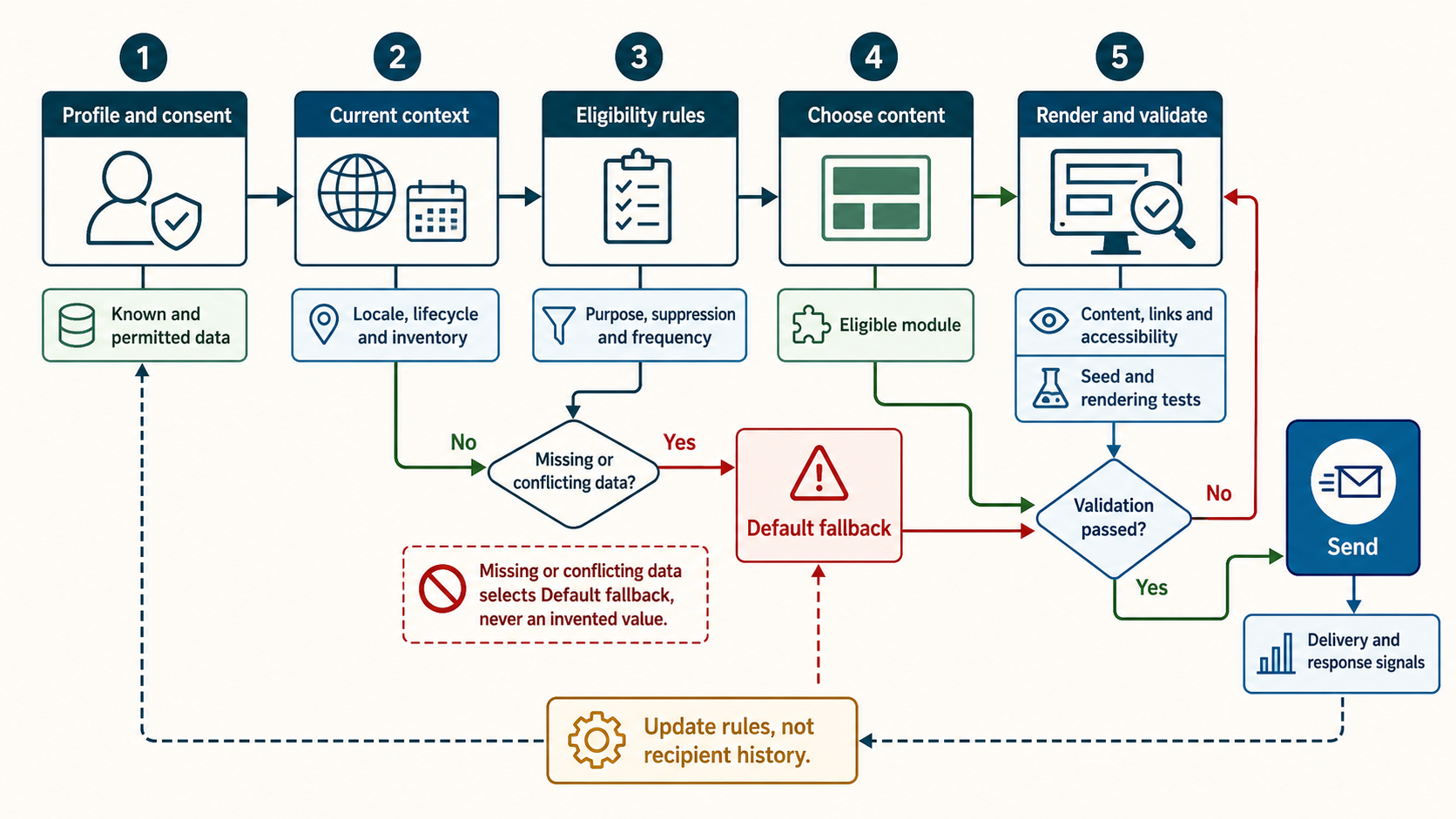
Start with deterministic conditions testable on example recipients. If a model is justified, document target, training window, features, calibration, drift and threshold. Consent and suppression remain hard gates outside the model.
Version every definition. That makes incident replay possible and reveals whether performance changed because audience, rule or message changed.
Resolve overlap and frequency globally
Recipients may qualify for welcome, promotion and renewal simultaneously. Use one arbitration layer. Service-critical communication is classified separately; within marketing use explicit priority, cool-down and caps.
| Overlap | Resolution |
|---|---|
| Renewal plus promotion | Prioritize renewal |
| Multiple intent segments | Select most recent qualified intent |
| Global cap reached | Queue, replace or skip by policy |
| Complaint arrives | Cancel queued marketing immediately |
Measure incrementality with holdouts
Randomly assign an eligible control before message selection. Keep assignment stable and prevent contaminating campaigns when isolation is required. Compare conversion, revenue, retention or product use, not only response among clickers.
A high-intent segment can convert without email. Record eligible, excluded, selected, sent and control populations so incremental lift can be calculated.
Detect population and source drift
- Daily population, entries, exits and exclusion counts.
- Null and stale-source rates.
- Overlap with higher-priority journeys.
- Frequency-cap and suppression application.
- Acceptance, complaints and unsubscribe by provider.
- Qualified and incremental outcomes by version.
Pause when safety data is stale. A sudden population jump may be a business event, timezone bug, duplicate identity or failed exclusion join.
Rebuild an inflated engagement segment
A retailer calls anyone with an open in seven days engaged and sends daily promotion. Proxy opens inflate membership while complaints rise. The team rebuilds eligibility from current permission, uses purchase and qualified site activity for intent, and applies a global five-day cap.
Renewal gets priority over promotion. A persistent holdout measures incremental orders. The audience shrinks, complaints fall and incremental margin per eligible thousand improves.
Validate rules with recipient-level fixtures
Create positive, negative and boundary fixtures before releasing a segment. Include a consented eligible recipient, an unsubscribe, complaint, hard bounce, null lifecycle value, exact date boundary, frequency-cap boundary, duplicate identity and overlapping high-priority journey. The expected eligibility and reason code should be explicit for every fixture.
Run the same fixtures after warehouse, CRM or timezone changes. Compare a preview count with the materialized audience, and sample real selected recipients without exposing unnecessary personal data. A count that looks reasonable is not proof that exclusion precedence is correct.
Make the segment observable at send time
Materialize an immutable selection snapshot containing recipient key, segment version, eligibility time, reason codes, chosen treatment, holdout assignment and exclusion result. The sending platform should acknowledge how many records it accepted and report any additional suppression it applied. Reconcile those counts before interpreting campaign performance.
Late events need explicit rules. A complaint or unsubscribe received after selection but before send must cancel queued marketing. A purchase may remove a recipient from an abandoned-cart message, while a delayed open should not override the stronger state. Define this final eligibility check close to dispatch and log every cancellation reason.
Limit data to what the decision needs
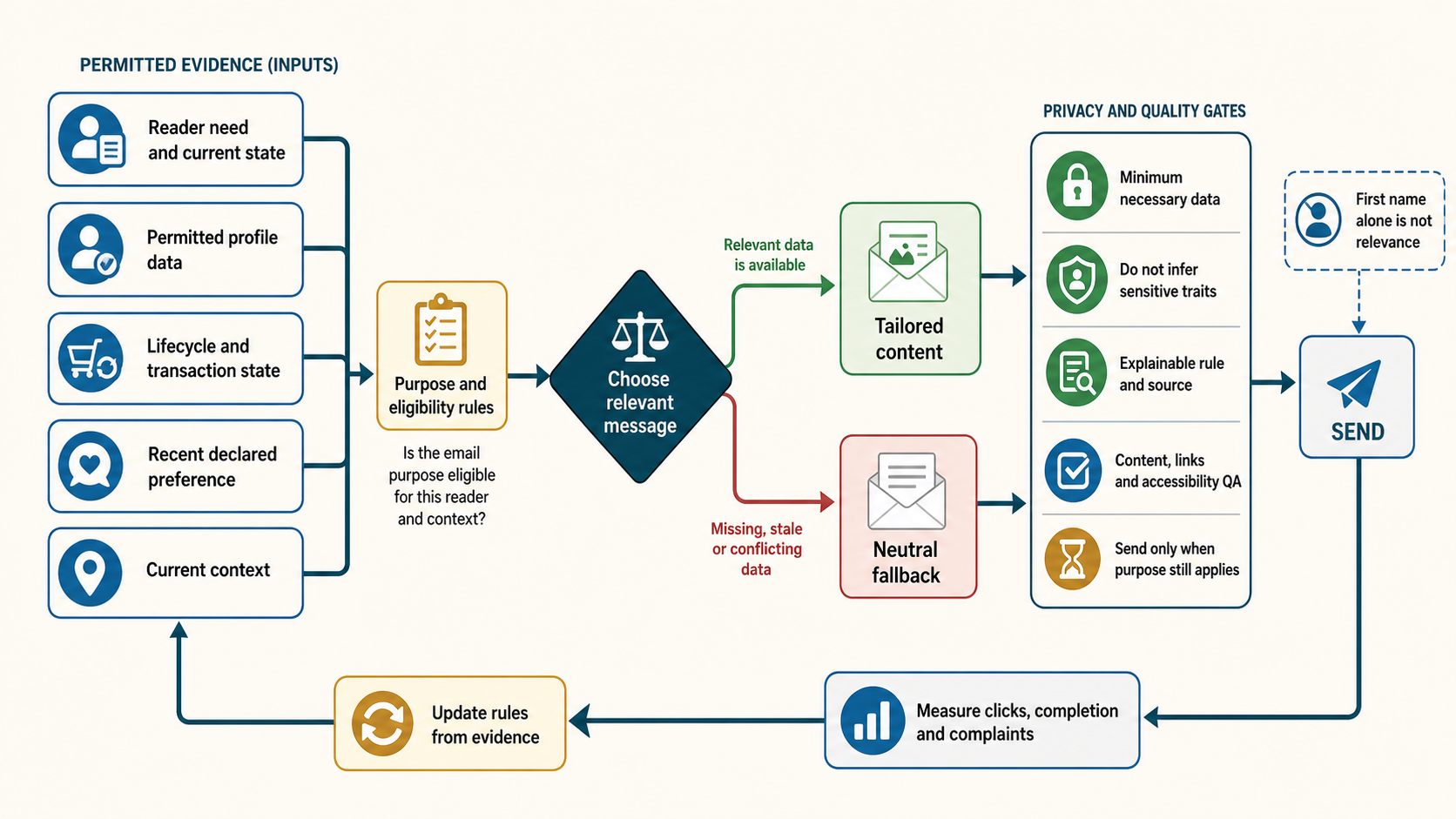
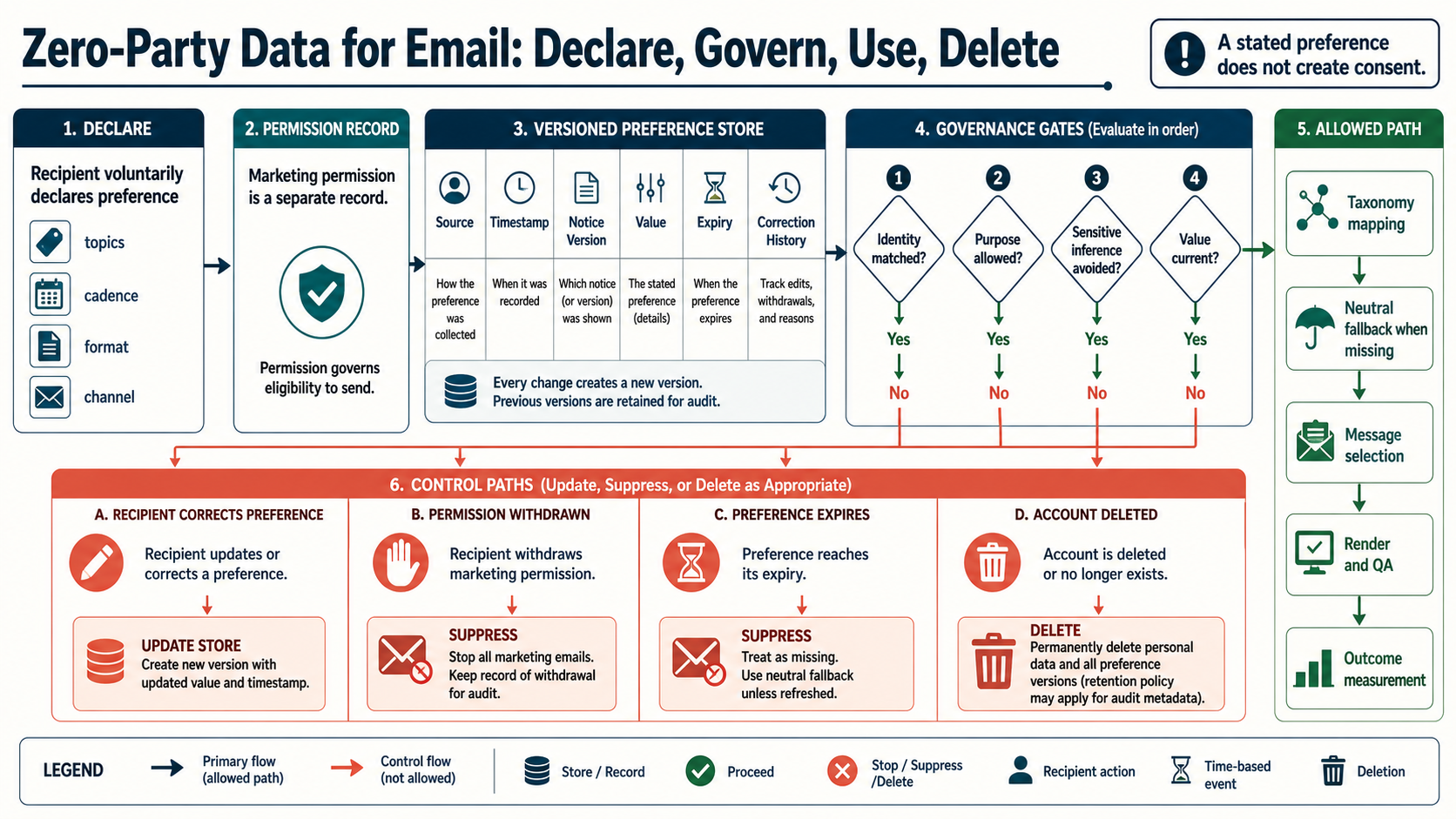
Segmentation can become unnecessary profiling when teams collect fields without a decision purpose. Maintain a field-level purpose, retention period and access role. Prefer coarse, explainable categories where exact values are not required. Do not infer sensitive attributes merely to increase campaign response.
Expose aggregate monitoring broadly and restrict recipient-level inspection. When data is deleted or consent scope changes, ensure derived segment tables, model features and exported audiences are updated too. Privacy controls belong in the same data contract as eligibility.
Segmentation production checklist
- Apply consent and suppression first.
- Give every segment a purpose, owner and version.
- Define entry, exclusion, exit, refresh and null behavior.
- Retain signal provenance.
- Resolve overlap with global priority.
- Apply frequency caps.
- Save recipient reason codes.
- Create holdouts before treatment.
- Monitor drift and outcomes.
Define a segment as a versioned decision, not a saved filter
A production segment answers: who is eligible now, for which program, under what evidence, with which exclusions, priority and exit condition? Give every definition an owner, purpose, effective version and refresh schedule. Save recipient-level reason codes so an operator can explain why one person was included without reconstructing a warehouse query weeks later.
| Contract field | Example | Failure prevented |
|---|---|---|
| Eligibility time | Dispatch-time UTC | Using stale snapshot after complaint |
| Program scope | Brand A renewal | Consent applied to unrelated promotion |
| Entry/exit | 25–30 days before renewal; exits on renewal | Recipient remains forever |
| Priority | Renewal above promotion | Competing journeys overmail |
| Version | renewal-v7 | Silent rule changes |
A human-readable name such as “high intent” is not the definition. The contract must identify source events, identity keys, null behavior, timezone and late-data handling.
Apply durable safety and permission rules before scoring
eligible = current_program_permission
  AND NOT complaint_suppressed
  AND NOT unsubscribe_suppressed
  AND NOT hard_bounce_suppressed
  AND NOT legal_or_policy_excluded
  AND NOT global_frequency_capped

treatment = choose_highest_priority(eligible_journeys)
Consent and suppressions are hard gates outside a predictive model. A high purchase score cannot reverse an unsubscribe, and a new CRM import cannot overwrite a complaint. Store reason, scope, source event and effective time. Reconcile these states across ESPs before audience export.
Perform a final eligibility check close to dispatch. A complaint or purchase can arrive after materialization and should cancel queued marketing or obsolete an abandonment message. Log every dispatch-time exclusion separately from selection-time exclusions.
Rank behavioral signals by meaning and observation quality
| Signal | Supports | Limitation |
|---|---|---|
| Authenticated product action | Known account behavior | May not imply marketing interest |
| Purchase/renewal | Customer lifecycle/value | Does not override opt-out |
| Qualified click/reply | Intentional interaction | Scanner filtering and identity coverage |
| Remote-image request | Content fetch | Apple privacy fetching/image blocking |
| Predicted score | Modeled propensity | Training bias, drift and calibration |
Retain raw events and classifier/model version. Never convert an unknown click or privacy-likely fetch into verified intent merely to increase audience size. Use recency, context and negative evidence together.
Resolve identity and time explicitly
Decide whether segmentation operates at person, account, household or address level. An enterprise renewal may belong to an account while a promotional preference belongs to an individual. Joining several email addresses into one customer can transfer engagement or suppression incorrectly; splitting one person can defeat frequency caps.
segment_snapshot(
  decision_id, subject_key, identity_level,
  segment_version, evaluated_at_utc,
  eligible, exclusion_reason, priority,
  holdout_assignment, source_watermark
)
Store event time and ingestion time. A daily job using local dates needs an explicit business timezone and daylight-saving tests. Source watermark identifies whether all required feeds were fresh. If permission or suppression data is late, fail closed for marketing rather than guessing.
Resolve journey overlap before any platform sends
| Conflict | Decision | Evidence retained |
|---|---|---|
| Renewal and sitewide sale | Renewal wins; promotion skipped/capped | Both qualifications and selected priority |
| Welcome and cart abandonment | Apply lifecycle rule and global cap | Entry times and treatment choice |
| Two brands share recipient | Respect consent scope and enterprise policy | Brand/program permissions |
| Complaint arrives after selection | Cancel every queued marketing treatment in scope | Suppression event and cancellation acknowledgment |
Do not leave priority to send-time race conditions between ESP journeys. Centralize or coordinate arbitration and reconcile selected, canceled and sent counts. A global contact policy needs a defined exception path for genuinely necessary service mail.
Measure whether the segment treatment creates incremental value
High-propensity segments can convert without email. Randomly assign a persistent eligible holdout before treatment selection and keep intention-to-treat. Prevent another journey from delivering an equivalent promotion to the holdout when isolation is required. Measure net margin, renewal, retention or product use plus complaints and unsubscribes.
absolute_lift = treatment_outcome_rate - holdout_outcome_rate
incremental_outcomes = absolute_lift * treatment_assigned
incremental_margin = treatment_net_margin - expected_holdout_margin
Report sample size, assignment unit, maturity window and uncertainty. Do not compare clickers with non-clickers; clicking is post-treatment behavior. Use path analytics for diagnosis and experiments for causal budget decisions.
Detect population, source and outcome drift
Monitor eligible count, new entries, exits, nulls, stale sources, suppression application, priority losses and final dispatch cancellations by segment version. Compare distributions for acquisition source, provider, lifecycle, identity confidence and activity age. A sudden 40% increase can be a promotion, broken join, timezone error or missing exclusion feed.
| Alert | Immediate check |
|---|---|
| Population jump | Source watermark, duplicates and rule release |
| Suppression rate drops | Join keys and import precedence |
| Provider complaints rise | Cohort/source/frequency, not blended total |
| Model score distribution shifts | Feature freshness and calibration |
| Holdout contamination rises | Cross-journey arbitration |
Pause selection when safety inputs are stale. Keep raw counts, denominators and unknowns rather than only rates.
Worked redesign: proxy opens inflate a “highly engaged” segment
A retailer defines highly engaged as an open in seven days and sends that population every day. Apple privacy fetching expands the segment, security scanners inflate clicks, and complaints rise. The team first preserves consent and suppression, then rebuilds intent using qualified site activity, recent purchases and authenticated product actions. A global five-day promotional cap applies before prioritization.
Renewal messages receive priority over promotions. Unknown-provenance and long-inactive records enter review instead of receiving a lower score. A persistent holdout measures incremental orders and margin. Recipient snapshots record old/new definition membership, allowing the team to explain every population change.
The audience becomes smaller, but provider complaints fall and incremental margin per eligible thousand rises. The result is not “better segmentation” because the click rate improved; it is better because the decision is reproducible, safe and causally measured.
Release a segment like production code
- Write positive, negative, null and boundary fixtures.
- Run the definition in shadow mode and reconcile population changes.
- Sample reason codes with governed recipient access.
- Verify suppression, frequency and overlap precedence.
- Create holdout assignment before treatment.
- Materialize an immutable snapshot and export checksum.
- Reconcile platform accepted, additionally suppressed and sent counts.
- Monitor first dispatch by provider and source.
Rollback restores the prior definition for eligible recipients but never reverses a complaint, unsubscribe or hard bounce that arrived meanwhile. Retain both versions and the incident record.
Build eligibility in auditable stages instead of one opaque query
WITH permissioned AS (
  SELECT subject_key, program_scope
  FROM current_permission
  WHERE program_scope = :program
), safe AS (
  SELECT p.subject_key
  FROM permissioned p
  LEFT JOIN suppression s
    ON s.subject_key = p.subject_key
   AND s.scope IN (:program, :brand, :global)
  WHERE s.subject_key IS NULL
), candidate AS (
  SELECT s.subject_key, e.last_qualified_action,
         l.lifecycle_state
  FROM safe s
  JOIN lifecycle l USING (subject_key)
  LEFT JOIN engagement e USING (subject_key)
)
SELECT *, :segment_version AS segment_version
FROM candidate
WHERE lifecycle_state = :target_state;
This illustrative structure makes counts reconcilable at permission, suppression, join and targeting stages. Production SQL needs point-in-time semantics, duplicate handling and the actual warehouse dialect. Save the source watermark and query checksum with the snapshot.
Use anti-join tests for null keys and duplicate suppressions. Count unique decision subjects rather than rows. A many-to-many identity join can multiply recipients without changing apparent conditions. Reconcile warehouse results with ESP accepted, platform-suppressed and sent records.
Govern predictive segmentation beyond an accuracy score
Define the predicted outcome, observation window, assignment unit and business action. Separate feature time from label time to prevent future leakage. Exclude direct proxies for protected/sensitive attributes unless there is a lawful, necessary and reviewed purpose. Keep consent and suppression as deterministic gates.
| Model control | Evidence |
|---|---|
| Training population | Eligibility, dates, exclusions and sampling |
| Feature provenance | Source, freshness, null behavior and privacy purpose |
| Calibration | Predicted versus observed outcome by score band |
| Decision threshold | Cost/value tradeoff and capacity |
| Drift | Feature and outcome distributions over time |
| Incrementality | Holdout performance by score band |
A propensity model can rank customers likely to purchase even if email adds no value. Test treatment lift within score bands before using propensity as proof of channel opportunity.
Operate a segment incident runbook
When complaints, population or frequency changes unexpectedly, freeze the exact selection artifact and segment version. Compare the first abnormal run with the last healthy run at each stage: permission, suppression, identity, source watermark, rule, priority, platform acceptance and dispatch. Preserve recipient examples under controlled access.
Contain the smallest unsafe cohort or journey. Do not lower frequency globally when one partner import is causal, and do not delete evidence to reduce the audience count. Correct one layer, rerun fixtures and shadow evaluation, then resume under provider/source monitoring.
Recovery requires population reconciliation, durable suppressions, stable provider outcomes and correct holdout assignment. Add the incident cohort as a permanent regression fixture. Close only after delayed complaint and conversion windows mature enough to assess the corrected decision.
Maintain a segment catalog and retirement process
Catalog active definitions, owners, consumers, source dependencies, export destinations, refresh schedules, last review and retirement date. Detect segments that still send but have no accountable owner or rely on deprecated fields. Prevent ad hoc copies from becoming independent production definitions.
Retirement stops refresh, cancels scheduled exports, removes downstream journey dependencies and archives the final definition and population evidence. Delete recipient-level snapshots under retention policy, but keep enough aggregate and version metadata to explain historical campaigns. Review the catalog after CRM, warehouse or ESP migration.
Worked case: three journeys select the same customer
A customer qualifies for a renewal reminder, an abandoned-cart promotion and a weekly newsletter on the same morning. Each journey is owned by a different team and its ESP workflow sees only its own send history. Without arbitration, all three dispatch within two hours.
A central decision service evaluates current permissions and suppressions, applies the brand-wide frequency policy, then ranks renewal above abandonment and newsletter. It selects renewal, records why the other treatments lost priority and assigns the customer’s persistent holdout state. A purchase event before dispatch cancels renewal during the final eligibility check.
Operators reconcile three candidate decisions, one selected treatment, one pre-dispatch cancellation and zero sends. This is a correct empty outcome, not a pipeline failure. The audit trail shows lifecycle state, priority version, event watermark and cancellation reason.
After release, teams report incremental outcomes from assigned eligible populations rather than claiming revenue from the recipients their individual journeys happened to reach first. The architecture reduces frequency and makes cross-journey decisions explainable.
Final review questions
Can an operator explain inclusion and exclusion for one recipient from stored evidence? Can a complaint arriving now cancel every queued marketing send? Can counts reconcile from permission through dispatch? Can a rule or model release be rolled back without weakening newer suppressions? If any answer is no, the segment is not ready for production.
Review these questions after each source, identity, CRM or ESP migration.
Catalog proof
Store the reviewer, approval time, active definition, source watermark and downstream consumers. This evidence makes later campaign and incident analysis fully reproducible.