Behavior-Based Email Automation: Events, State and Guardrails
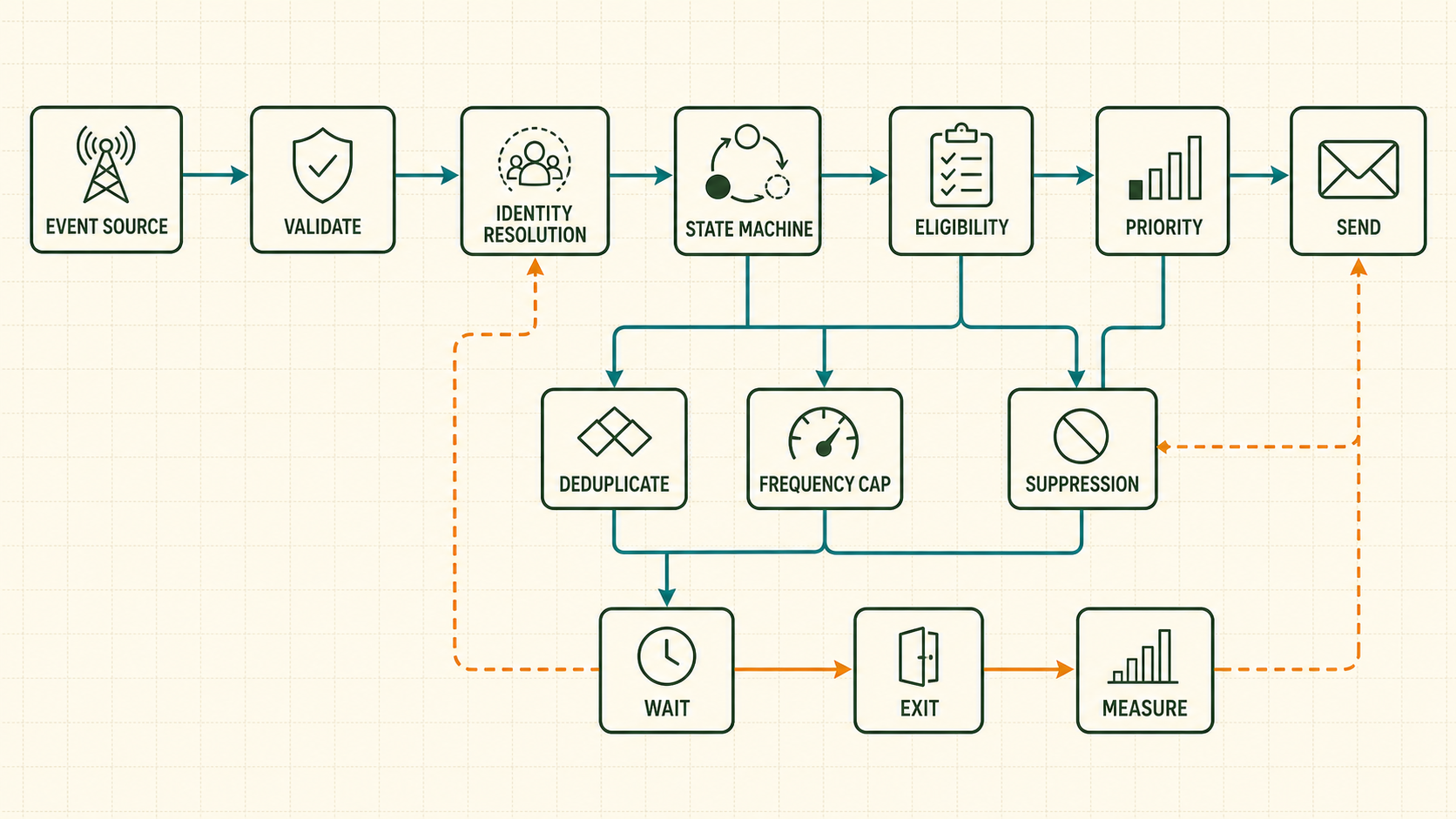
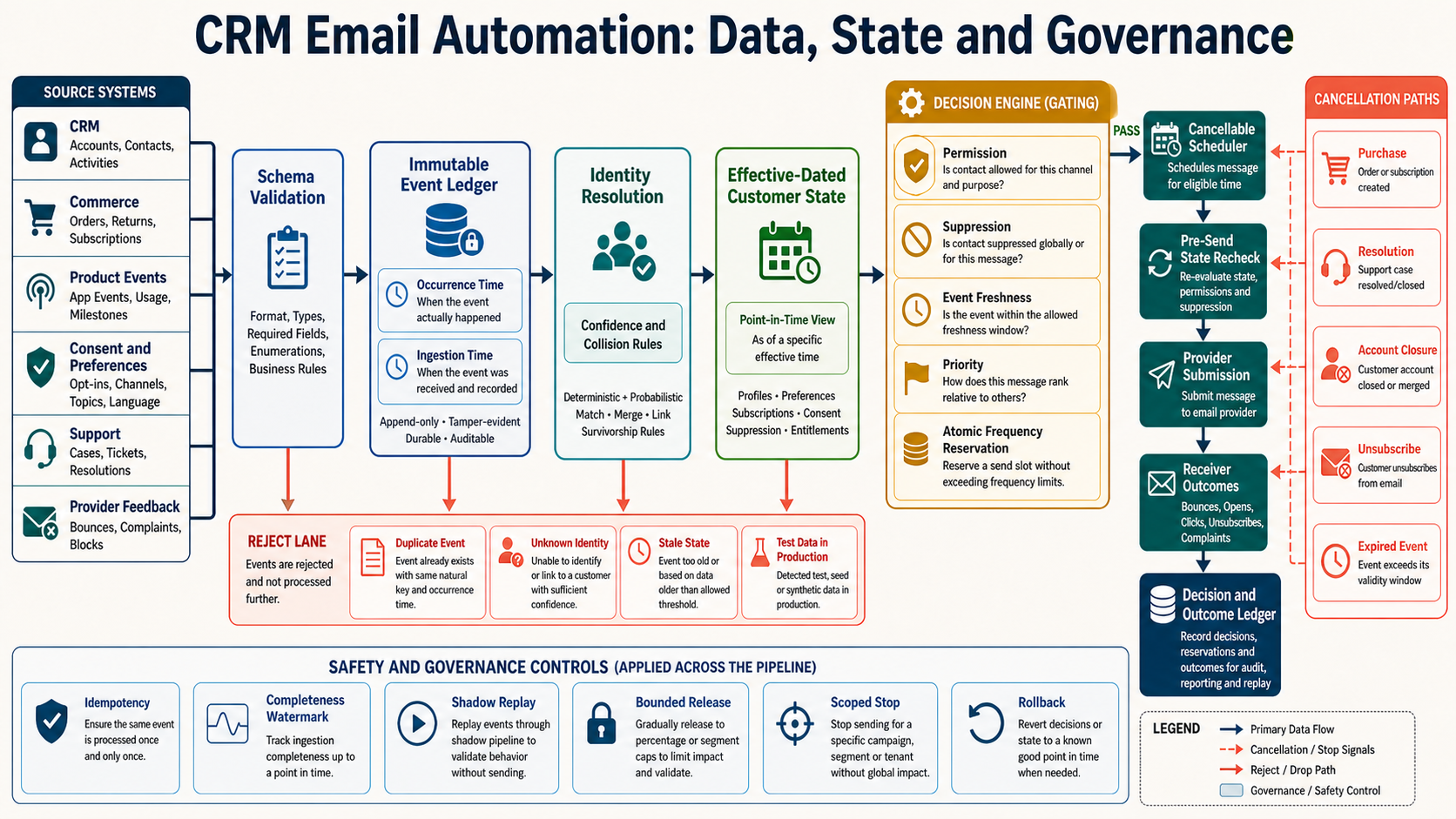
Behavior-based automation converts observed events into timed decisions. It should not react directly to every click or page view. Production systems validate event contracts, resolve identity carefully, update a versioned state machine, apply consent and suppression, arbitrate priority and frequency, deduplicate effects and measure an explicit outcome. The workflow must remain correct when events arrive late, twice or out of order.
Define a versioned event contract
event_id: globally unique
event_type: cart_updated
occurred_at: 2026-08-29T10:15:00Z
received_at: 2026-08-29T10:15:04Z
subject_key: account_123
properties: {cart_id, value, currency}
schema_version: 3
source: commerce
Validate required fields, types, allowed values and time bounds. Quarantine invalid events rather than guessing. Keep event time and ingestion time separate so delay is visible.
Resolve identity without unsafe merging
Prefer authenticated account or durable first-party identifiers. Email address alone can change, be shared or be entered incorrectly. Record merge source and confidence, and provide a reversible process for disputed joins. Do not join anonymous browsing to a known profile without the required notice and permission.
Apply deletion and consent changes to derived state, queued work and exports. Identity resolution is a privacy and safety boundary, not only a data-engineering convenience.
Model automation as a state machine
| State | Allowed transition | Exit evidence |
|---|---|---|
| Eligible | Schedule wait | Suppression or competing completion |
| Waiting | Recheck then send | Purchase, reply, expiry or cancellation |
| Sent step 1 | Wait or complete | Qualified goal or maximum steps |
| Completed | No further sequence sends | New independently eligible lifecycle |
| Suppressed | No marketing transitions | New valid permission under policy |
Persist state version and transition reason.
Make every effect idempotent
Deduplicate events by stable event ID and business key. Generate a deterministic send intent such as account, journey, step and eligibility version. Reprocessing should return the existing intent rather than create another message. Use an outbox or transactional boundary between state update and queue publication.
Consumers must tolerate at-least-once delivery. Record attempt, acknowledgement and final message ID so a timeout does not cause duplicate dispatch.
Recheck eligibility immediately before send
- Current consent covers purpose and brand.
- No complaint, unsubscribe or hard-bounce suppression applies.
- The goal event has not already occurred.
- The journey state and step remain current.
- Global frequency and quiet-time rules allow contact.
- No higher-priority message should replace this one.
Selection-time eligibility can become stale during a wait. The final check cancels unsafe queued marketing.
Measure the behavior the journey should change
Define one primary state transition such as activation, purchase completion, renewal or retained use. Assign eligible holdouts before the first message and prevent contaminating journeys when isolation is needed. Report eligible, excluded, scheduled, canceled, sent, accepted, qualified action and outcome.
Do not optimize solely for open. Privacy fetching creates machine image requests; security scanners can create clicks. Use authenticated product events, conversions and incremental lift with complaint and unsubscribe guardrails.
Define events before they trigger communication
behavior_event(
  event_id, subject_key, event_type,
  occurred_at_utc, ingested_at_utc,
  source, properties, schema_version,
  confidence_class
)
Define producer, semantics, identity level, idempotency key, freshness and correction. “Viewed product” must specify authenticated versus anonymous, scanner/bot classification and time. Store raw event and schema version; never let a dashboard rename change trigger meaning silently.
Put permission and suppressions before behavioral scoring
dispatch_eligible = current_program_permission
  AND NOT complaint
  AND NOT unsubscribe
  AND NOT hard_bounce
  AND NOT legal_or_policy_exclusion
  AND NOT frequency_capped
  AND journey_priority_wins
  AND triggering_state_still_current
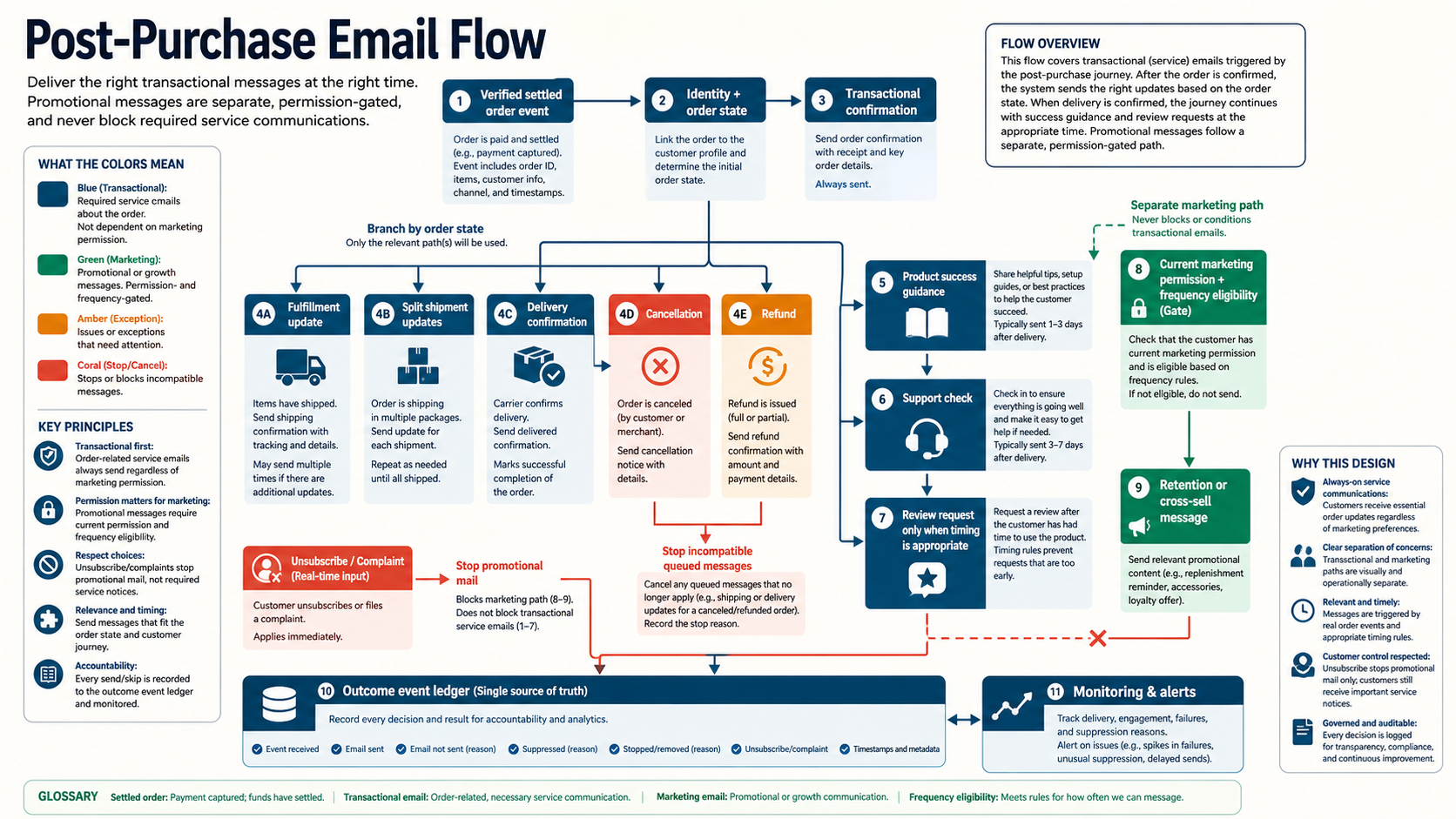
A behavior does not grant marketing permission. A purchase does not reverse opt-out. Perform final checks immediately before dispatch and cancel queued actions on stronger events.
Model journeys as explicit states and transitions
| State | Entry | Exit |
|---|---|---|
| Eligible/waiting | Valid trigger and gates | Delay elapsed or cancel event |
| Ready | Still eligible at dispatch | Send/hold/cancel |
| Sent | Platform accepted job | Outcome, next step or expiry |
| Converted | Verified business event | End/next lifecycle |
| Suppressed/canceled | Strong state or obsolete trigger | Only reviewed valid transition |
Persist transition reason and version. Do not depend on timer jobs with no state reconciliation.
Handle duplicate, late and out-of-order events
Consumers need idempotency by event ID and precedence by event time/business semantics. A late cart-add must not restart abandonment after purchase. A duplicate browse event must not schedule two journeys. Maintain correction/tombstone behavior.
if event_id_seen: acknowledge_without_duplicate_action
else if event.occurred_at < current_state_watermark:
    apply documented late-event policy
else:
    transition atomically and record scheduled_action_id
Use transactional outbox/lease patterns where appropriate so state and dispatch request do not diverge during crashes.
Arbitrate journeys globally
| Conflict | Resolution |
|---|---|
| Password/security and promotion | Security proceeds; promotion cooled |
| Purchase and cart abandonment | Purchase cancels abandonment |
| Renewal and win-back | Current renewal state wins |
| Several browsed products | One chosen treatment under rule |
| Global cap reached | Queue/skip by priority and expiry |
Central service or coordinated policy must see all journeys. Platform-local caps cannot prevent cross-ESP overmailing.
Make delay windows cancellable and business-aware
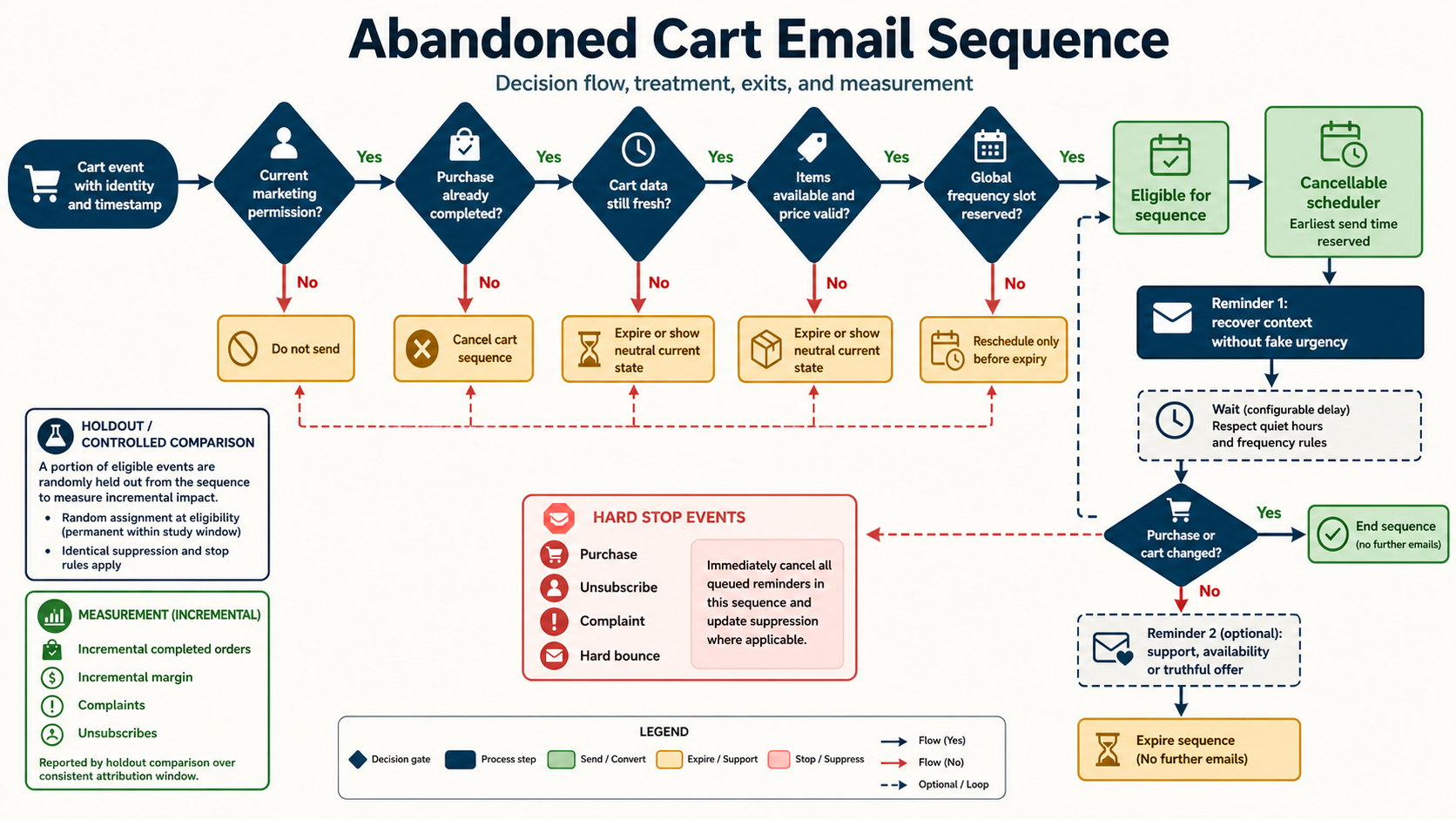
A 24-hour abandonment delay is not a sleep command; it is a scheduled decision. At execution, re-check purchase, stock, price, consent, suppression, frequency and identity. Expire actions after their usefulness.
scheduled_action(
  action_id, subject_key, journey_version,
  eligible_after, expires_at,
  trigger_event_id, cancel_event_types,
  status, final_reason
)
Cancel promptly on purchase, complaint, unsubscribe or account state change. Record cancellation acknowledgments from the ESP.
Use models/scores with calibration and hard boundaries
Document target, training window, features, leakage controls, threshold and drift. Keep consent/suppression outside the model. Privacy opens and scanner clicks need classification; sensitive inferences require strict purpose and review.
| Monitoring | Question |
|---|---|
| Feature freshness | Is score based on current data? |
| Calibration | Does each score band match outcome? |
| Population drift | Did audience/source change? |
| Incremental lift by band | Does email help high-score users? |
| Safety by band | Are complaints concentrated? |
Test automation with event and failure fixtures
- Valid trigger and expected dispatch.
- Duplicate trigger.
- Purchase before delayed action.
- Complaint/unsubscribe after scheduling.
- Out-of-order and corrected event.
- Identity merge/split.
- Stale source or suppression outage.
- ESP timeout and duplicate acknowledgment.
- Journey version changed while action waits.
Assert one final state, reason and maximum exposure. Run fixtures after schema, ESP and priority changes.
Worked case: late purchase event sends an abandonment message
An order service experiences ingestion delay. The cart journey’s timer fires before the purchase event reaches the warehouse, so a customer receives “complete your order” after paying. The automation checked only the original trigger snapshot.
The team pauses the journey, preserves event/ingestion times and dispatch state, then adds a real-time purchase/cancel feed and final source-freshness check. When purchase data is stale, the marketing action holds instead of sending. Idempotency prevents the delayed event from creating duplicate transitions.
Monitoring adds event lag, canceled scheduled actions and post-conversion send violations. Recovery is measured by zero obsolete dispatches under test and production observation.
Behavior automation production checklist
- Version event schemas and journey state.
- Use idempotency and late-event rules.
- Apply permission/suppression first.
- Arbitrate priority and global frequency.
- Re-check state at dispatch.
- Cancel obsolete scheduled actions.
- Fail safe on stale safety data.
- Test ESP retries/acknowledgments.
- Monitor event lag, drift and violations.
- Measure incrementality and safety.
Separate event ingestion, decisioning, scheduling and dispatch
producers -> validated event log -> identity/state processor
          -> eligibility/priority decision
          -> cancellable scheduler
          -> ESP/MTA dispatch
          -> acknowledgment/outcome log

suppressions and current permission gate decision and dispatch
Each boundary needs an idempotency key, schema/version, timestamp and owner. Do not let an ESP workflow be the only state store when other channels/journeys must arbitrate. Keep raw events separate from derived lifecycle states.
Design for at-least-once events and dispatch uncertainty
“Exactly once” rarely exists across event bus, database, scheduler and external ESP. Use idempotent consumers, unique action IDs, leases/outbox and acknowledgment reconciliation. If the network fails after the ESP accepts a request, retry can duplicate unless the provider honors an idempotency key.
| Boundary | Protection |
|---|---|
| Event producer/log | Unique event ID and deduplication |
| State/action creation | Atomic transaction/outbox |
| Scheduler workers | Lease and final-state check |
| ESP API | Idempotency key/status lookup |
| Webhook | Signature, replay protection and event ID |
Secure and validate ESP/provider webhooks
Verify provider signature/authentication, timestamp/replay window and endpoint TLS. Parse under size/schema limits, deduplicate event IDs and quarantine unknown types. Do not trust recipient/campaign fields before verification. Rotate webhook secrets with overlap.
webhook_event(
  provider, event_id, received_at_utc,
  signature_result, schema_version,
  event_type, subject_key, message_id,
  processing_state, raw_checksum
)
A failed complaint/unsubscribe webhook is a safety incident. Monitor lag and backlog; dispatch should fail safe when critical suppression data is stale.
Define automation service objectives and violation metrics
| SLO/violation | Meaning |
|---|---|
| Event ingestion lag | Can state be current? |
| Suppression propagation | How fast marketing stops? |
| Trigger-to-decision latency | Journey responsiveness |
| Obsolete send count | Messages after cancel condition |
| Duplicate action count | Idempotency failure |
| Unknown/quarantined events | Schema/data drift |
Report by journey/version and provider. A fast automation that sends wrong messages is not healthy.
Version journeys without changing waiting actions silently
When a journey definition changes, decide whether scheduled actions remain on the old version, migrate through an explicit transformation or cancel/re-evaluate. Do not reinterpret an old trigger under new offer/frequency without evidence.
scheduled_action includes:
  journey_version
  template_version
  eligibility_snapshot_version
  priority_policy_version
  execute_after / expires_at
Shadow new rules, compare populations and release gradually. Rollback preserves complaints, unsubscribes, purchases and other newer events.
Contain credential abuse and malicious event injection
Use least-privilege producers, schema authorization, rate limits and anomaly monitoring. An attacker with event-write access can trigger mass messages even if ESP credentials are protected. Compare trigger volume with business activity and approved campaigns.
| Threat | Control |
|---|---|
| Forged purchase/browse event | Authenticated producer and schema ACL |
| Stolen ESP key | Scoped key, cap and revoke |
| Replay | Event ID/timestamp dedup |
| Template/link swap | Approved version and allowlisted assets |
| Volume burst | Journey/source anomaly hold |
Measure automated journeys with persistent holdouts
Randomize eligible subjects before the first journey exposure and keep holdout stable across the intended measurement window. Prevent a parallel campaign from delivering equivalent treatment. Measure lifecycle/business transition, margin and safety.
journey_lift = P(target_outcome | assigned_treatment)
               - P(target_outcome | assigned_holdout)

include non-delivery, complaint and cancellation
under intention-to-treat analysis
Trigger-based audiences are highly selected; conversions after a trigger do not prove the automation caused them.
Recover automation without replaying obsolete actions
- Stop dispatch while state/event integrity is uncertain.
- Preserve event offsets, leases, scheduled actions and acknowledgments.
- Restore suppression and current business state first.
- Reconcile accepted ESP actions using idempotency/status.
- Cancel expired/obsolete actions.
- Resume bounded current decisions, not the entire old backlog.
- Monitor duplicates, violations and provider capacity.
A queue drain is not success if it sends abandoned-cart messages after purchase. Test region/database failover in staging and approved exercises.
Make source freshness part of every decision
Automation can be technically online while using stale purchase, permission or suppression data. Store a watermark and service objective for each required source. At decision and final dispatch, compare current time with the last complete event boundary, not merely the last received row.
| Stale source | Safe response |
|---|---|
| Complaint/unsubscribe | Stop marketing dispatch globally or for affected scope |
| Purchase/renewal | Hold abandonment or win-back actions |
| Inventory/price | Hold product offer or use verified fallback |
| Optional recommendation | Omit personalization; do not invent value |
Empty batches, partial partitions and clock skew need explicit detection. No new events is not automatically a healthy feed.
Enforce one contact policy across automation platforms
If lifecycle, commerce and regional teams each operate an ESP workflow, local caps will not prevent collisions. A central decision service or coordinated reservation ledger should evaluate person/account exposure, journey priority, message expiry and required service exceptions.
contact_reservation(\n subject_key, channel, journey, priority,\n reserved_at, expires_at, policy_version, status\n)\n\nfinal dispatch consumes a valid reservation\na cancel event releases itReservation is not permission. The dispatcher still checks current consent, complaint, unsubscribe, hard bounce and legal/policy exclusions. Record why a journey lost priority so teams do not independently retry it.
Bind approved content and links to the journey version
Automation often runs for months after its launch review. Store immutable template, From identity, reply route, tracking domain, destination and offer versions. Validate HTTPS, redirects, domain ownership, regional pages, accessibility, plain-text alternative and unsubscribe behavior on every release.
Dynamic fields need typed contracts, safe escaping, length limits and a defined missing-value outcome. Sensitive attributes should not be placed in URLs, headers or vendor template logs. If required data is absent, cancel or use an approved neutral version; never expose a raw placeholder.
Continuously monitor destination status and certificate/domain expiry. A compromised redirect or modified template should disable the affected journey through a tested kill switch.
Handle address, account and identity changes without duplicate journeys
When two customer records merge, decide which lifecycle state, frequency history, suppression and scheduled actions survive. When an account splits or a user leaves an organization, avoid carrying account behavior to an unrelated address. Never let a new address erase an existing person-level complaint or policy restriction without reviewed rules.
| Identity event | Required action |
|---|---|
| Duplicate merge | Reconcile suppressions and cancel duplicate actions |
| Email change | Verify address and preserve scoped history |
| User leaves account | End account-authorized communication |
| Household/shared mailbox | Avoid assuming one person performed every action |
Store effective-dated links and the identity version used by each decision.
Trace a message from trigger to final outcome
Operators need a correlation path across source event, state transition, eligibility decision, reservation, scheduled action, template version, ESP request, provider response, webhook and business outcome. Logs should use stable IDs and reason codes without exposing unnecessary recipient data.
trace keys:\nevent_id -> transition_id -> action_id -> message_id\n\nrecord occurred_at, decided_at, scheduled_at,\ndispatched_at, provider_reply_at and outcome_atDashboards should surface event lag, decision errors, queue age, cancellations, duplicate prevention, obsolete sends, suppression latency and provider outcomes by journey version. Alert on violations, not only infrastructure CPU.
Runbook for a behavioral automation incident
- Use the journey or source kill switch to stop new dispatch.
- Preserve event offsets, state versions, actions, reservations and ESP acknowledgments.
- Identify the earliest incorrect boundary: producer, identity, rules, scheduler, template, ESP or webhook.
- Apply current suppressions and business cancellations before remediation.
- Quarantine ambiguous actions; cancel anything expired or obsolete.
- Fix and replay test fixtures against a production-like snapshot.
- Resume a small current cohort and monitor provider and violation telemetry.
Do not replay every missed marketing message after recovery. Decide whether each action still has value and valid state. Notify support/security/privacy owners according to actual impact and preserve a post-incident evidence package.
Final automation production signoff
- Event semantics, identity, idempotency and correction behavior are versioned.
- Consent and suppression gate both selection and final dispatch.
- Source watermarks fail safe for safety and business state.
- State transitions, delays, cancellation and expiry are explicit.
- Global frequency and journey priority work across platforms.
- Templates, links, credentials and webhooks have security controls.
- Retries cannot create duplicate recipient actions.
- Tests cover late events, outages, identity changes and rollback.
- Tracing and alerts expose obsolete sends and suppression latency.
- Holdout analysis measures incremental value and recipient harm.
Behavioral automation is ready only when the team can explain why a message was selected, prove it was still valid at dispatch, stop it safely and measure whether it helped.
Release a new journey through shadow, canary and bounded expansion
Start in shadow mode: consume real events and produce decisions without dispatch. Compare predicted entries, cancellations and exits with the current business system and manually review boundary cases. Reconcile permission and suppression exclusions. Shadowing should include peak traffic, delayed feeds, duplicate events and an upstream empty batch.
Next, use internal/test identities to validate template data, links, acknowledgments and outcome webhooks end to end. Then release a small canary drawn from the approved eligible population. Keep the experimental assignment intact, cap volume by provider and watch event lag, duplicate prevention, obsolete sends, complaints, bounces and queue age. A canary is not just a percentage switch; it needs explicit success and rollback criteria.
Expand in planned stages only after enough evidence matures for the risk being evaluated. Infrastructure correctness can mature quickly, while complaints and business outcomes need longer. Do not let early opens or clicks override a suppression-latency or state-cancellation defect.
During rollback, stop new decisions, cancel waiting actions and preserve acknowledged sends. Restore the prior journey version without restoring old permission or business state. After release, compare treatment with persistent holdout for incremental outcomes and audit exposures across other journeys. Record final version, release populations, exceptions and owner so a future operator can reproduce every decision.
Close temporary release controls and exceptions
Give temporary flags, caps, cohort exclusions and credentials an owner and expiry date; otherwise a canary setting becomes permanent architecture. Reconcile source events, selected population, created actions, cancellations, provider acknowledgments and outcomes at every stage. Review manual interventions and convert repeated ones into tested policy or tooling.
A release closes only when exceptions are removed or explicitly accepted, monitoring reflects the final configuration, runbooks match actual behavior and recovery has been exercised. Archive the journey, template, policy and event-schema versions with the approval record. Confirm that the kill switch still targets the released version and that rollback will preserve newer complaints, unsubscribes, purchases and account changes.
Name accountable owners before the journey runs
Assign owners for events, identity, permission, lifecycle logic, templates, sending infrastructure, measurement and incident response. Document escalation coverage and authority to stop traffic. An automation with no current owner must be paused or retired; age and past success do not make an unattended journey safe.