Customer Lifecycle Emails: Map Triggers from Onboarding to Retention
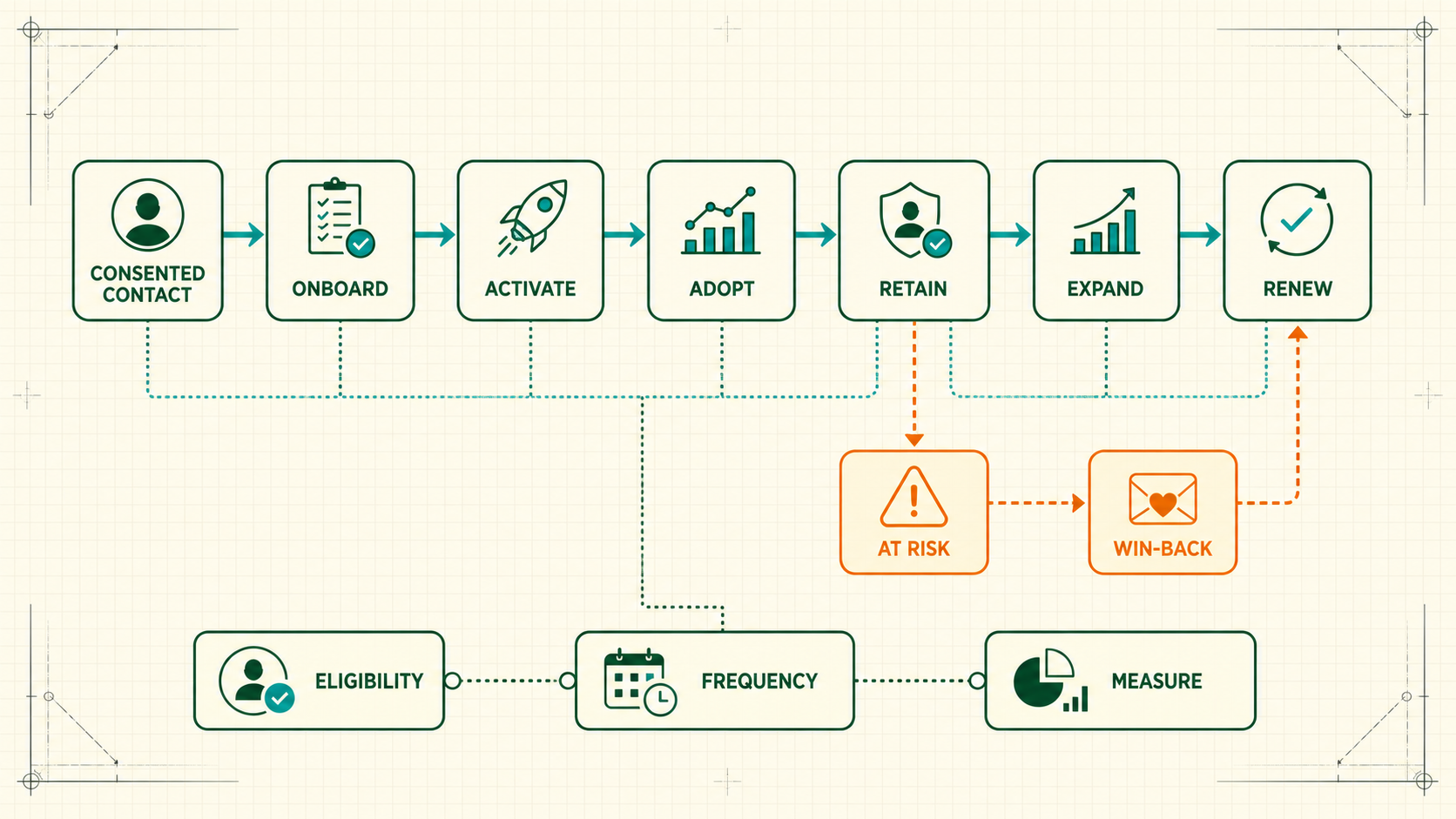
A lifecycle email map connects customer state to a useful message and a measurable next outcome. It is not a calendar of campaigns. Each state needs evidence, entry and exit rules, precedence, frequency controls and a clear separation between service communication and marketing. The map should follow the customer’s product relationship while consent, unsubscribe, complaint and delivery safety remain global gates.
Define states from observable evidence
| State | Entry evidence | Primary outcome |
|---|---|---|
| Onboard | Account or subscription created | Understand setup and expectations |
| Activate | Required first-value action incomplete | Reach first value |
| Adopt | Initial value reached; key habits incomplete | Use relevant capability |
| Retain | Healthy ongoing use or relationship | Sustain value |
| At risk | Meaningful activity declines against baseline | Resolve friction |
| Renew | Contract or plan approaches decision window | Complete an informed renewal |
Use product and account evidence, not opens alone.
Specify entry, exit and re-entry
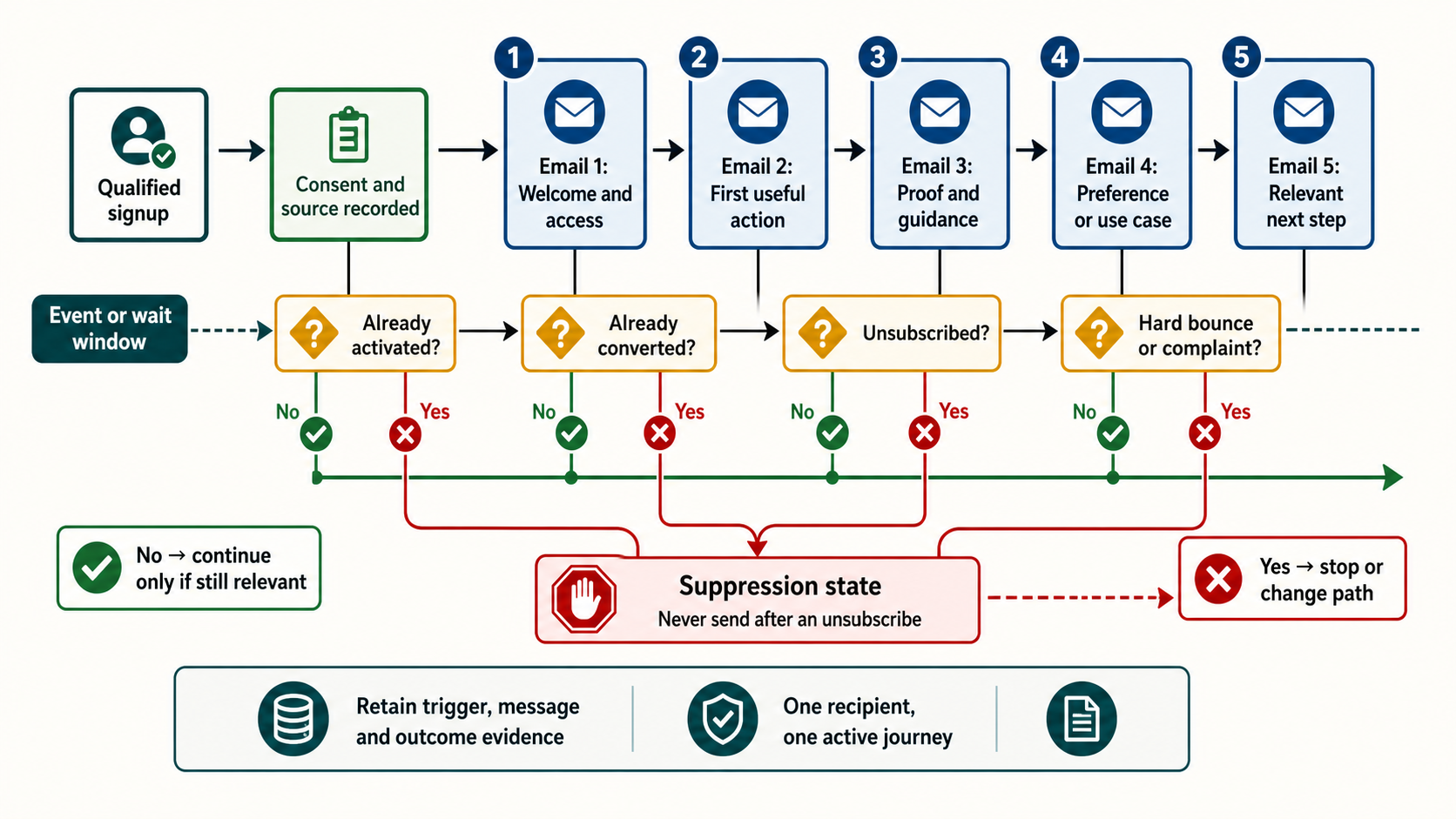
Every state needs an effective timestamp, source, version and exit condition. A recipient leaves activation after the qualifying product event, not simply after receiving three emails. Re-entry should be explicit: a renewed customer may return to adoption after a product change, while an unsubscribed contact never re-enters marketing through a lifecycle event.
Handle late and out-of-order events. Compare event time with ingestion time, deduplicate by stable event ID and prevent an older event from moving a customer backward incorrectly.
Give each message one lifecycle job
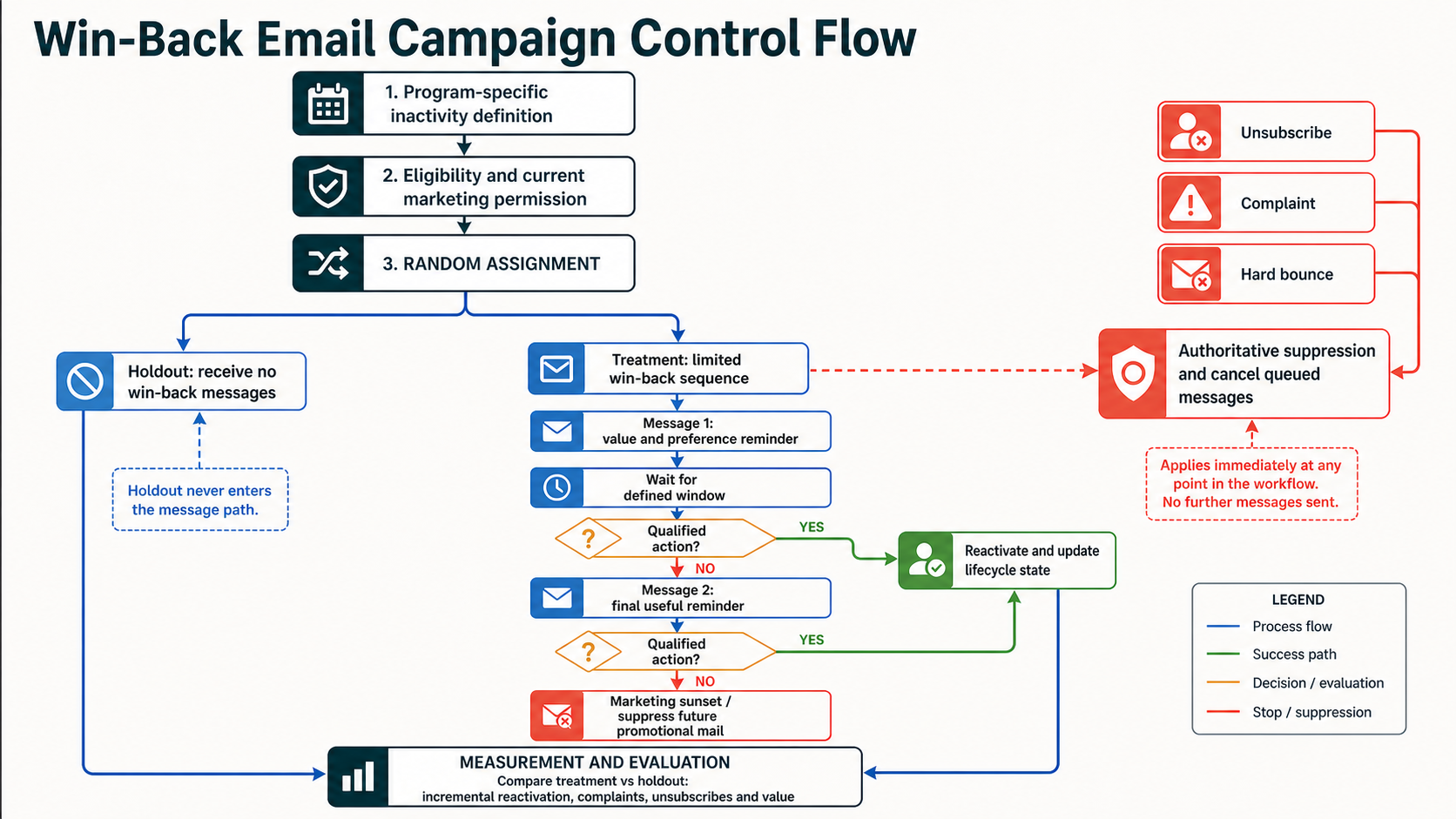
Onboarding confirms expectations and setup. Activation removes the next specific barrier. Adoption teaches capability connected to the customer’s goal. Retention communicates value, service or relevant education. Expansion is appropriate only when usage and permission support it. Renewal explains timing, value and action. Win-back is a bounded attempt after a defined lapse.
Separate necessary service notices from promotion in data, templates, stream and policy. “Transactional” is not a label that permits unrelated marketing.
Resolve competing journeys centrally
| Conflict | Resolution example |
|---|---|
| Incident notice and promotion | Send necessary notice; suppress promotion |
| Activation and newsletter | Protect activation frequency and defer newsletter if capped |
| Renewal and expansion | Prioritize renewal decision |
| At-risk and win-back | Use one state based on the formal lapse threshold |
| Complaint/unsubscribe and any marketing | Cancel queued marketing immediately |
Apply a global contact policy
Count recent contacts across lifecycle, promotion and newsletter systems. Define per-recipient, brand and channel caps plus cool-down after important messages. Priority decides which message consumes limited capacity. Do not let each workflow maintain an isolated cap.
Track deferred, replaced and skipped messages. If an email would be irrelevant after a delay, expire it rather than sending stale guidance. Service obligations may use a separate policy but still need clarity and restraint.
Measure the transition, not the open
For activation, measure completion of the first-value event. For adoption, measure sustained use. For renewal, measure renewal, downgrade and support need. For win-back, measure incremental return and downstream retention. Include complaints and unsubscribes as guardrails.
Randomize eligible holdouts when practical. High-intent customers often progress without email, so conversion among recipients is not causal proof. Preserve state and eligibility snapshots for analysis.
Define lifecycle states from observable business conditions
| State | Entry evidence | Primary communication purpose |
|---|---|---|
| Prospect/subscriber | Current program permission | Deliver promised publication/value |
| New customer | Verified first purchase/account event | Set expectations and activate |
| Activated | Meaningful product/service milestone | Build successful use |
| Retained | Repeated value/renewal behavior | Support relationship |
| At risk | Declining relevant activity or service issue | Remove friction, not merely discount |
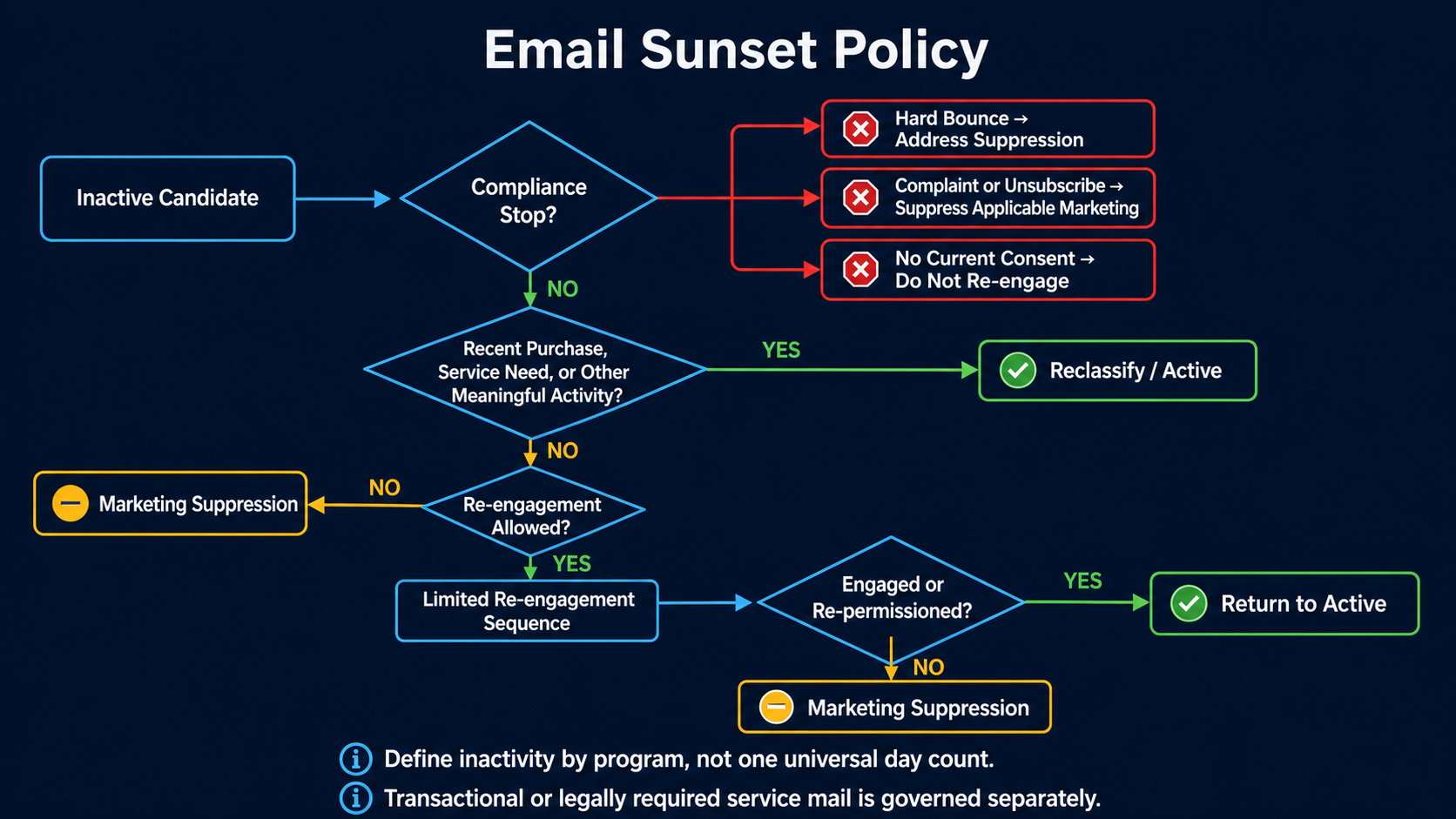
| Lapsed | Program-specific relationship threshold | Bounded eligible recovery or sunset |
State names are business definitions, not universal labels. Use event time, source and version. Consent/suppression remain independent hard gates.
Implement transitions as auditable events
lifecycle_transition(
  subject_key, from_state, to_state,
  effective_at_utc, triggering_event_id,
  rule_version, reason_code, source_watermark
)

communication_eligibility = lifecycle_state
  + current_permission
  + suppression
  + priority/frequency
  + channel availability
Prevent impossible transitions such as lapsed directly to activated without a supporting event. Handle late and corrected events explicitly. Preserve history rather than updating one status column with no reason.
The map should show what happens when data is missing: unknown/frozen is safer than automatically lapsing every customer.
Map each state to a job, entry, exit and stop rule
| Journey | Entry | Exit/stop |
|---|---|---|
| Welcome | Confirmed subscription or account event | Activation, unsubscribe, complaint, expiry |
| Onboarding | Eligible new customer, milestone incomplete | Milestone completed or support escalation |
| Education | Relevant feature/need | Action, state change or bounded sequence end |
| Renewal | Contract/subscription window | Renewed, canceled or window ended |
| At-risk help | Validated risk signal | Recovery, support route or stop rule |
| Win-back | Current permission and lapsed eligibility | Action, suppression or sequence completion |
Every journey needs purpose and maximum exposure. “No engagement” is not permission for endless reminders.
Choose person, account and subscription identity deliberately
A B2B renewal belongs to an account; product onboarding may belong to a user; marketing permission belongs to a person/address/program. Map these levels without copying activity or suppression incorrectly. Shared accounts and duplicate contacts can cause several users to receive one account message.
identity_links(
  person_key, account_key, subscription_key,
  email_address_key, relationship_type,
  valid_from, valid_to, confidence, source
)
Frequency and priority may need person-wide controls while service notifications remain account-specific. Store effective dates so departed users stop receiving account mail.
Resolve lifecycle competition through one contact policy
| Conflict | Decision |
|---|---|
| Security alert and promotion | Send security; suppress/cool promotion |
| Renewal and win-back | Current renewal state wins |
| Onboarding and newsletter | Apply global cap and value-based priority |
| Complaint after selection | Cancel all scoped marketing |
| Purchase after abandonment selection | Cancel obsolete message |
Centralize arbitration or coordinate platform acknowledgments. Journey race conditions are not a valid prioritization strategy.
Rank event quality before it drives a journey
Authenticated purchase, renewal or product milestone is stronger than a remote-image request. Security scanners can create clicks; Apple privacy can create opens. Store raw events, classifier/version and confidence. A model score needs training/calibration/drift evidence and must not override consent.
| Event | Safe use | Caution |
|---|---|---|
| Order settled | Post-purchase state | Refund/cancel may arrive later |
| Qualified product action | Activation milestone | Identity and event semantics |
| Qualified click/reply | Interest signal | Scanner/filter coverage |
| Open/fetch | Weak diagnostic | Not human intent |
Measure lifecycle programs with persistent eligible holdouts
Assign holdout before exposure and maintain it across recurring journeys where practical. Prevent equivalent treatment through another campaign. Measure activation, retention, renewal, net margin and negative outcomes, not only clicks.
absolute_lift = treatment_outcome_rate - holdout_outcome_rate
incremental_outcomes = absolute_lift * treatment_assigned

retain intention-to-treat:
  delivery failure and complaint remain treatment outcomes
High-risk customers may recover without email. Attribution credit is not incremental impact. Report assignment unit, maturity and contamination.
Create a source contract for every lifecycle decision
- Event definition, producer and owner.
- Event time versus ingestion time.
- Identity level and join behavior.
- Freshness/service objective and unknown state.
- Deduplication/idempotency key.
- Correction/cancellation behavior.
- Privacy purpose, access and retention.
- Downstream journeys and state versions.
If a critical source is stale, pause affected marketing decisions. Do not infer inactivity from a missing data feed.
Worked map: product data outage marks active customers lapsed
A nightly job receives no product-activity data and interprets null as no activity. Thousands of active customers enter lapsed state and a win-back journey. The first send uses a discount that confuses recently active customers.
Operators stop the journey, preserve the state snapshot and compare source watermark. They restore the last valid decision state, while keeping new complaints and unsubscribes suppressed. The rule changes so stale required data produces unknown and blocks marketing transitions.
Regression fixtures include source outage, late activity, renewal, complaint after selection and duplicate identities. The lifecycle map now represents business state plus data confidence rather than treating missing as negative.
Operate a lifecycle map with reconciled populations
- Population and transition counts by state/version.
- Unknown/frozen decisions and source freshness.
- Journey eligibility, priority loss and dispatch cancellation.
- Frequency exposure and suppression application.
- Provider acceptance, complaints and unsubscribe.
- Holdout integrity and incremental mature outcomes.
- Identity conflicts and orphaned journeys.
Every subject should occupy valid states at the chosen identity level. Explain population movement from events, not only dashboard totals.
Design onboarding around customer success milestones
Map the shortest path to first value, prerequisites, common failure and support escalation. Trigger from verified product/account events, not opens. Each message should help one milestone and cancel when the milestone is complete.
| Milestone | Evidence | Message decision |
|---|---|---|
| Account verified | Security/account event | Stop verification reminders |
| First setup completed | Product event | Advance to value education |
| Blocked/error | Support/telemetry signal | Offer help, avoid promotional pressure |
| First value achieved | Business-specific outcome | Exit onboarding |
Use elapsed-time education only when no action is required. Global caps prevent onboarding from colliding with newsletters and promotions.
Define at-risk state with explainable and actionable evidence
A decline in activity can be seasonality, completed use, technical outage or true risk. Build interpretable rules first. If using a churn model, document prediction target, window, features, threshold, calibration and drift. The intervention should match the risk reason.
risk_observation(
  subject_or_account, score_or_rule,
  reason_features, evidence_time,
  model_or_rule_version, confidence,
  recommended_action
)
Never use privacy opens as decisive activity or sensitive inferences without appropriate purpose/review. Test whether the intervention creates retention within score/reason bands; high predicted churn does not guarantee email helps.
Separate service obligations from marketing journeys
| Communication | Primary basis | Control |
|---|---|---|
| Security/account alert | Necessary account event | Accurate, timely, no promotional bundling |
| Receipt/status | Transaction/service | Expected identity and route |
| Onboarding/lifecycle promotion | Current channel/program permission | Unsubscribe, frequency and suppression |
| Newsletter | Publication subscription | Promise/cadence and easy exit |
Technical classification must follow actual purpose and content, not the label a team applies. An unsubscribe from marketing does not block necessary security mail, while a purchase receipt cannot carry unrelated promotion merely to bypass preference.
Coordinate email with product, support and other channels
A lifecycle map should show channel eligibility, purpose and precedence. In-product guidance may be better for an active user; support outreach may be better after an error; email can reach someone outside the product. Do not use another channel to evade an email opt-out if the communication is still marketing.
| Condition | Preferred response |
|---|---|
| User active in product | Contextual in-product help plus capped email |
| Repeated setup failure | Support route before promotion |
| Renewal approaching | Account/service notice and permitted education |
| Complaint/unsubscribe | Stop scoped marketing across channels as policy requires |
Record contact/exposure centrally so channel teams see the same customer experience.
Materialize lifecycle decisions with source freshness
WITH current_events AS (
  SELECT subject_key, MAX(event_time) AS last_event,
         MAX(ingested_at) AS watermark
  FROM qualified_lifecycle_event
  GROUP BY subject_key
), safe AS (
  SELECT p.subject_key
  FROM current_permission p
  LEFT JOIN suppression s USING (subject_key)
  WHERE s.subject_key IS NULL
)
SELECT safe.subject_key, derive_state(current_events.*) AS state,
       :rule_version AS rule_version
FROM safe LEFT JOIN current_events USING (subject_key);
This illustrative SQL needs point-in-time identity, duplicate and null handling. Persist source watermark and fail marketing transitions when required data is stale. Do not bury suppression inside derive_state; keep it auditable.
Validate state transitions with boundary fixtures
- New customer completes milestone exactly at cutoff.
- Purchase/refund/cancellation arrive out of order.
- Account has several users and addresses.
- Complaint occurs after journey selection.
- Source feed is empty or delayed.
- Customer returns after lapsed state.
- Contract renewal timezone/daylight-saving boundary.
- Identity is merged or split.
Assert state, reason, journey eligibility, priority and final dispatch. Re-run after schema, model, product or CRM changes.
Measure lifecycle value by state transition and holdout
For onboarding, measure incremental activation/time-to-value. For retention, measure renewal/churn and contribution margin. For education, measure qualified adoption. Include complaints, support burden and discounts. Report outcomes by assigned eligible population and maturity.
transition_lift = P(target_state | treatment_assigned)
                  - P(target_state | holdout_assigned)

incremental_margin includes retained value
  minus incentive, messaging and support costs
Do not credit every natural transition to the last email. Keep journey attribution for diagnostics and experimental lift for investment.
Maintain a lifecycle and journey catalog
Record each state definition, rule/model version, sources, identity level, owner, journeys, permission basis, maximum exposure, holdout, primary outcome, stop rule and retirement date. Detect orphaned journeys and duplicated state logic in ESPs.
Approve changes through product, lifecycle, deliverability, data, privacy/security and service owners as appropriate. Shadow population changes before release. Rollback restores prior state logic while preserving newer complaints, unsubscribes and account events.
Retire a journey by canceling scheduled actions, stopping triggers, archiving final version and verifying no platform copy remains active.
Worked design: subscription renewal without contradictory messages
A subscription account enters its renewal window 30 days before contract end. The account has an owner, three end users and two billing contacts. Sending the same renewal promotion to every address would create duplication and could expose commercial information to the wrong person. The lifecycle design selects the authorized billing contact for contractual reminders and uses product education only for currently permitted end users.
A successful payment, approved renewal, cancellation request or active support dispute cancels the scheduled marketing sequence. A failed payment creates a service workflow with accurate account status; it does not automatically create a promotional win-back. If billing data is delayed, the system holds the next marketing message until the source watermark is current.
The measurement unit is the account, not each recipient. The team reports renewed accounts and net retained value against account-level holdout, while complaints and unsubscribes remain person/address-level safety outcomes.
Runbook for a bad lifecycle transition
- Pause the affected journey and any downstream automation that trusts the same state.
- Preserve transition records, source watermarks, rule versions, selections and dispatch acknowledgments.
- Determine whether the defect is source data, identity resolution, transition logic, scheduler state or ESP execution.
- Apply current complaints, unsubscribes and hard bounces before considering replay.
- Restore the last valid state or recompute from an approved point-in-time snapshot.
- Cancel obsolete queued messages; do not simply drain the backlog.
- Release a small verified population and watch state, provider and complaint telemetry.
The incident record should count wrongly transitioned subjects, attempted and accepted messages, support impact and corrective suppressions. A dashboard correction alone is not remediation if scheduled actions remain active.
Make support and lifecycle automation share state
Support cases often explain apparent disengagement better than marketing signals. An open outage, unresolved billing case, fraud review or accessibility problem should change message priority. Define which case types pause promotion, which route to a human and which permit helpful product education.
| Support evidence | Lifecycle action | Release condition |
|---|---|---|
| Service outage | Pause affected promotion | Verified restoration plus cooldown |
| Billing dispute | Suppress renewal upsell | Case resolution and current account state |
| Setup assistance | Coordinate onboarding | Milestone or agent disposition |
| Fraud/security review | Stop marketing decision | Authorized risk-system event |
Do not expose sensitive ticket text to the marketing platform. Pass a minimal reason code, effective time and expiry under controlled access.
Reconcile lifecycle populations before and after every release
For each state version, begin with the prior valid population and explain additions, exits, merges, deletions and unknowns. Sudden growth in lapsed customers may be a source outage, an identity change or a real cohort boundary. The release gate should compare both counts and sampled subject histories.
prior_population + valid_entries - valid_exits +/- identity_corrections = expected_current_population\n\nunexplained_difference must be investigatedReconciliation also covers downstream selections: eligible, excluded by permission, excluded by suppression, frequency-capped, priority-lost, queued, canceled and dispatched. These boundaries show whether a change occurred in business state or communication execution.
Final lifecycle-map approval checklist
- Every state has observable entry, exit, owner and version.
- Unknown and stale-source behavior fails safe.
- Person, account, subscription and address identity are not conflated.
- Permission, complaint, unsubscribe and hard-bounce controls remain independent.
- Every journey has purpose, maximum exposure, cancellation and expiry.
- Service, support and marketing precedence is documented.
- Provider volume and global frequency are forecast.
- Point-in-time tests cover late events, corrections and identity changes.
- Holdout, primary outcome, maturity and negative outcomes are defined.
- Rollback cancels obsolete actions while preserving newer safety events.
A lifecycle diagram is complete only when data, decisions, execution and measurement can be audited from source event to final outcome.
Review the lifecycle model as a living operating system
A quarterly review should begin with state definitions and population reconciliation, not campaign creative. Compare the current state distribution and transition rates with the prior version, product releases, billing changes, acquisition sources and known data incidents. Sample complete subject histories at every boundary: newly activated, at risk, lapsed, recovered and unknown. Confirm that the event cited as the transition reason existed, was timely and belonged to the correct identity.
Next, inventory every message-capable system. Match each active trigger, timer and recurring audience to the approved lifecycle catalog. Look for copied ESP workflows, regional variants, forgotten tests and journeys whose owner has left. Verify that complaints and unsubscribes propagate within the documented objective and that service messages do not carry unrelated promotion.
Review customer experience by exposure rather than campaign. Measure how many people received zero, one, several or conflicting contacts across channels and which journey won priority. Examine support tickets and complaints for expectation failures that aggregate rates hide. Compare provider outcomes by lifecycle state, acquisition source and message purpose without treating SMTP acceptance as placement.
Finally, review experiments and economics after full maturity. Retire treatments with no incremental value, tighten unsafe cohorts and schedule fixes with accountable owners. Record decisions, evidence, exceptions and expiry dates. The output is a versioned map and action register, not a presentation that leaves the running automation unchanged.