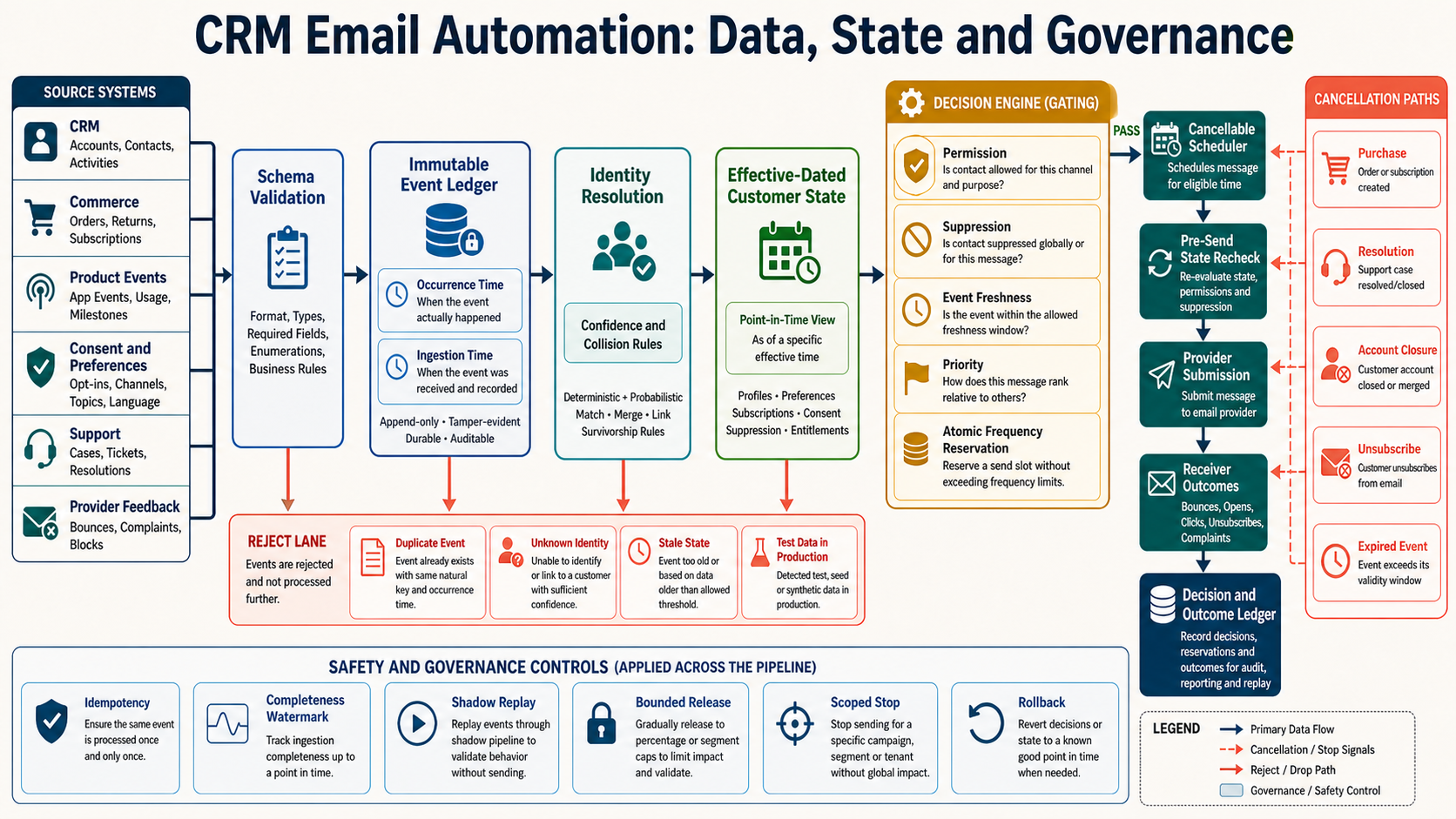
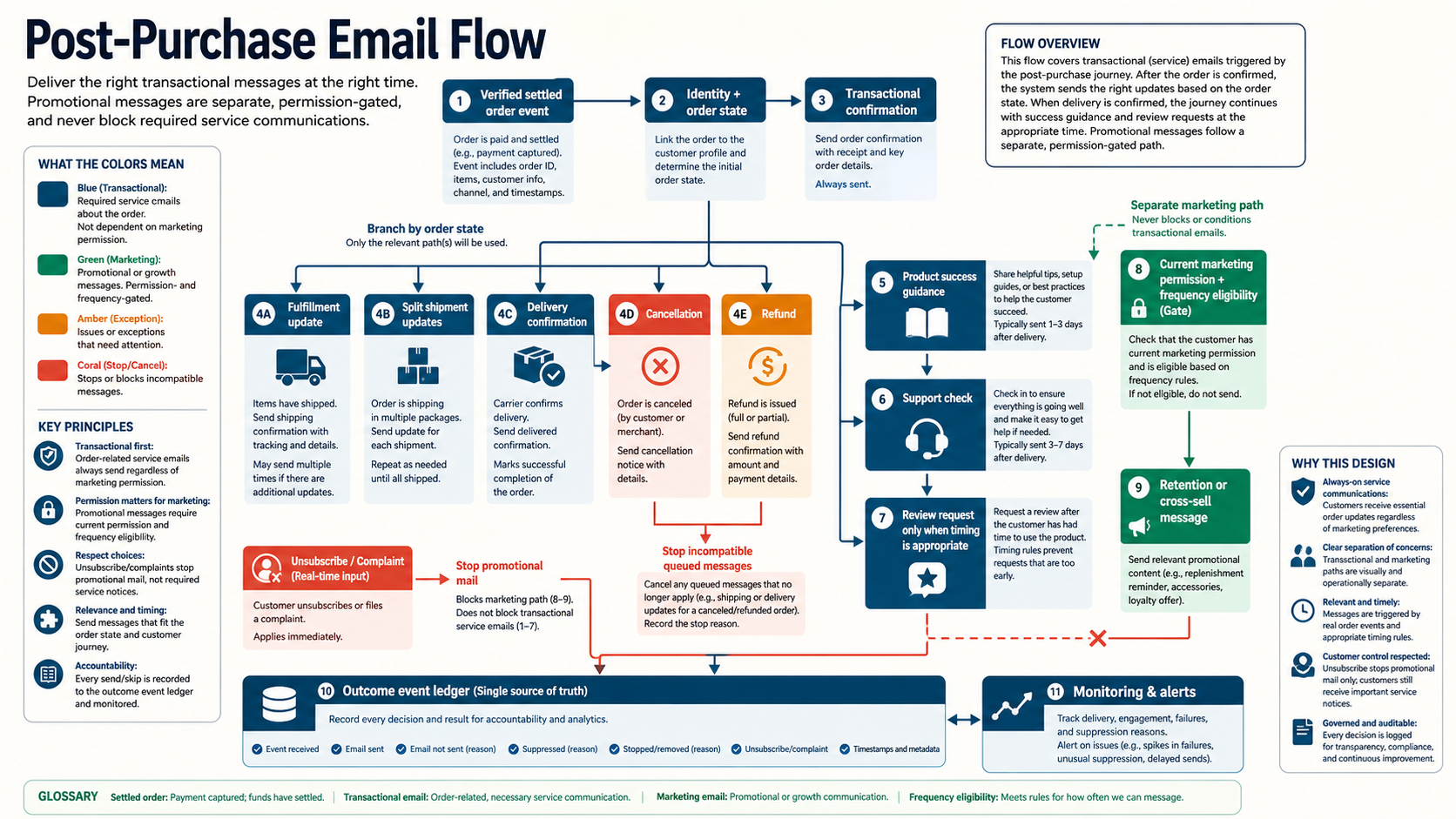
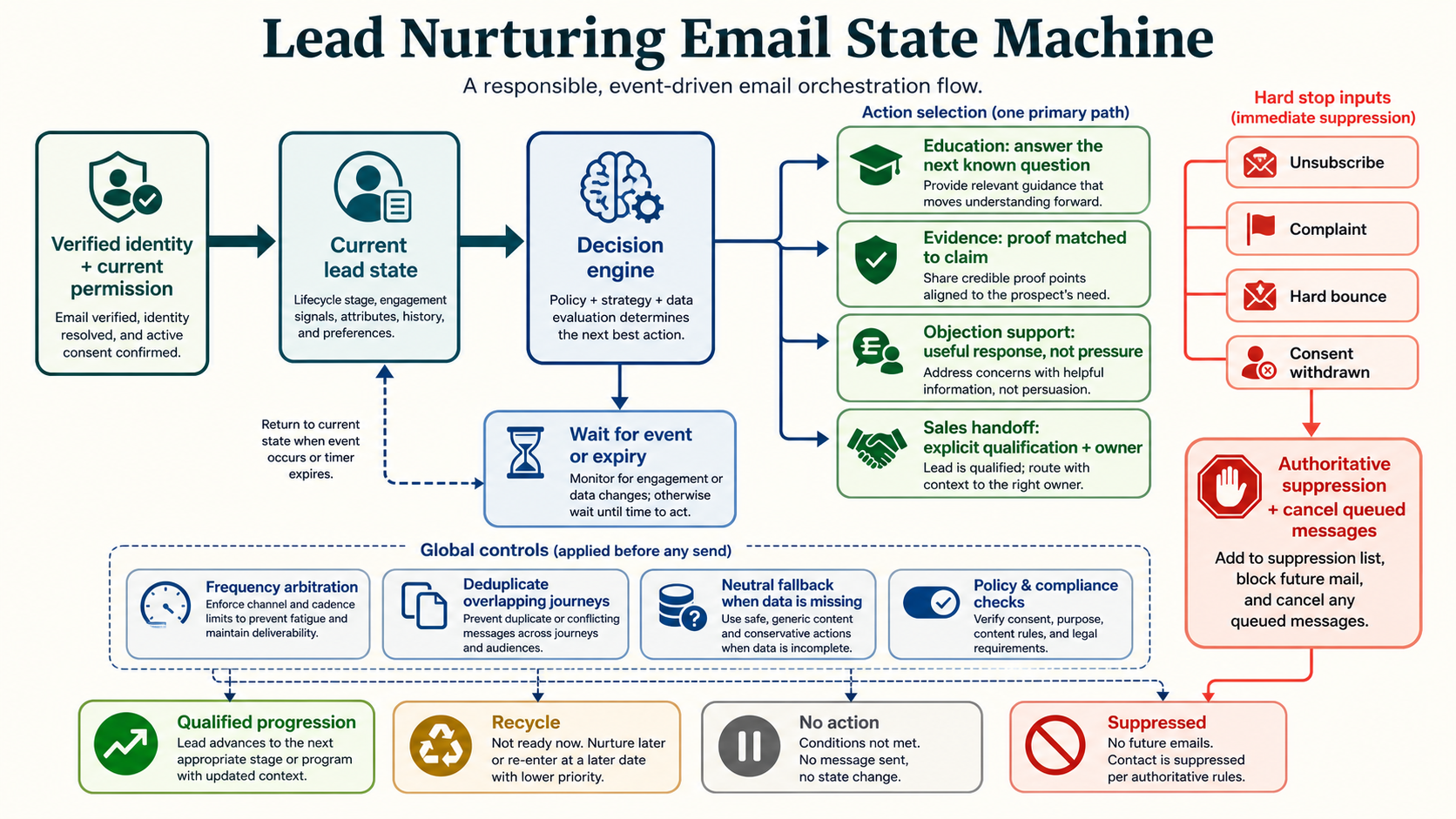
Abandoned Cart Email Sequence: Recovery Without Pressure
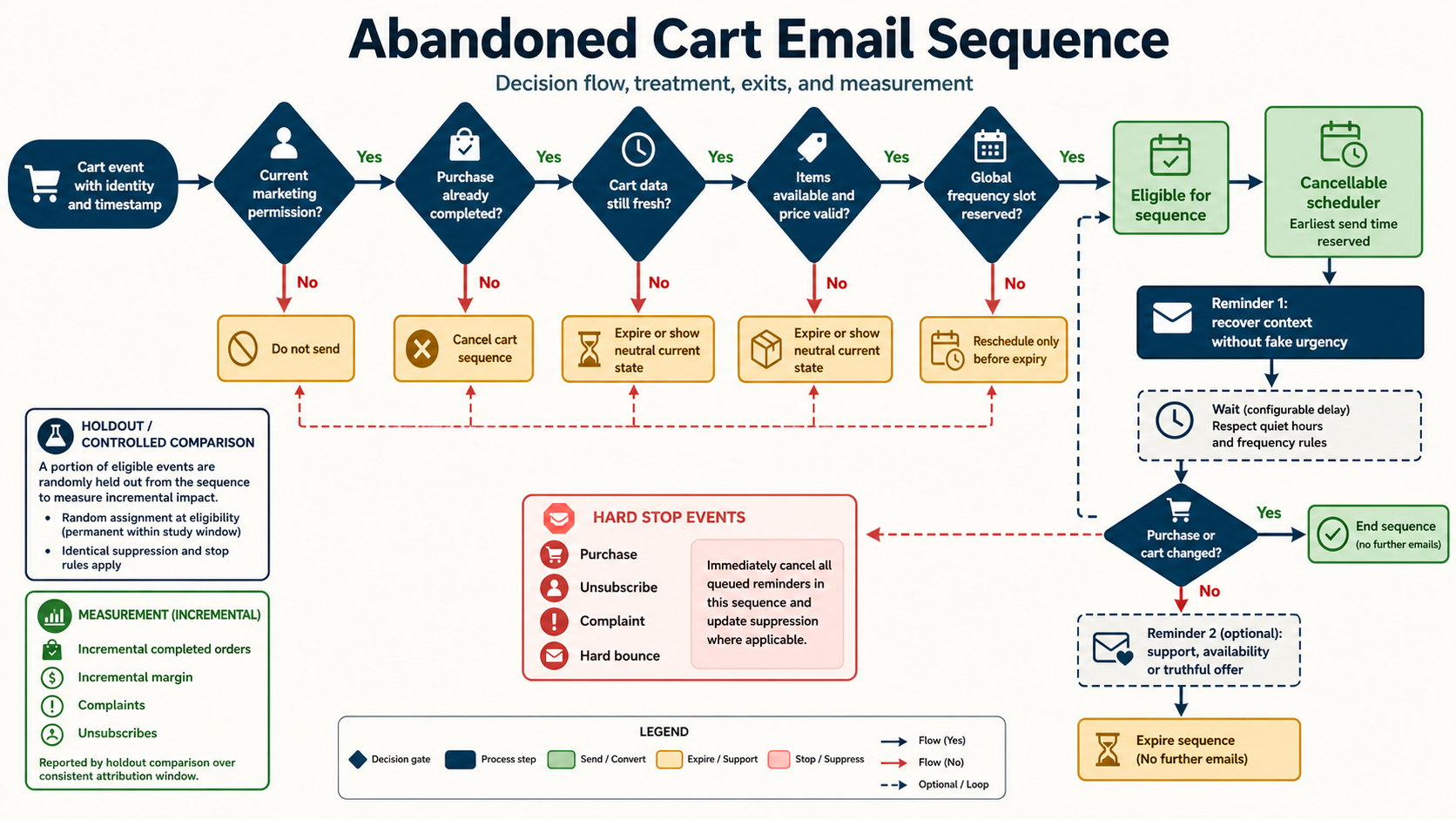
An abandoned-cart email sequence is a delayed decision based on an incomplete commerce event. It is not proof that a person intended to buy, agreed to marketing, or should receive four increasingly urgent messages. Production recovery requires reliable identity, cart and purchase events, current permission, stock and price validation, cancellable scheduling, global frequency controls, and an experiment that separates natural return from incremental recovery.
Define abandonment without guessing intent
A cart can remain open because the visitor is comparing products, changed devices, hit a payment error, encountered unexpected shipping, lost connectivity or intentionally stopped. Define the qualifying event, inactivity window, identity confidence and expiry for the business. A browse event is not a cart, and an anonymous cart should not be attached to an address without an appropriate identity and permission path.
Use event time as well as warehouse arrival time. Late purchase events are a common cause of obsolete reminders. Keep checkout session, cart version and order identifiers distinct.
Apply identity, purpose and suppression gates
| Condition | Action |
|---|---|
| Known customer with current program permission | Eligible after state checks |
| Email typed during checkout | Follow applicable notice and policy; do not assume unlimited marketing |
| Anonymous or low-confidence identity | No address-based recovery |
| Complaint, unsubscribe or hard bounce | Suppress marketing and cancel actions |
| Purchase, empty cart or expired quote | Cancel recovery |
A cart value or predictive score cannot override stronger suppression.
Create a commerce event contract
commerce_event(
  event_id, event_type, cart_id, order_id,
  subject_key, occurred_at_utc, ingested_at_utc,
  cart_version, currency, value, source, schema_version
)
Define cart created, item added or removed, checkout started, payment authorized, order settled, canceled and refunded. Producers need authentication, schema authorization and idempotency. A purchase event must reach the recovery system fast enough to cancel a scheduled send.
Use a cancellable scheduler instead of sleep timers
cart_action(
  action_id, subject_key, cart_id, journey_version,
  eligible_after, expires_at, trigger_event_id,
  cancel_on=[purchase, cart_empty, unsubscribe, complaint],
  status, final_reason
)
At execution, re-read cart, order, permission, suppression, inventory, price, offer and global contact state. Use idempotency so duplicate cart updates do not schedule duplicate messages. If purchase data is stale, hold the marketing action rather than assume no order exists.
Choose timing from product context and observed return
Natural return time differs for groceries, travel, high-value equipment and business procurement. Estimate the distribution of completed purchases after cart activity before applying treatment. A reminder sent too quickly can interrupt an active checkout; one sent too late can advertise unavailable stock or an expired quote.
Test timing within operational bounds. Set a useful-until time for every step and respect local quiet time where appropriate. No universal one-hour, 24-hour, 48-hour and 72-hour sequence is correct for every business.
Choose message jobs from diagnosed friction
| Signal | Message job | Avoid |
|---|---|---|
| Simple recent cart | Accurate reminder and return path | Pretending an item is reserved |
| Checkout or service error | Help and support route | Generic pressure |
| Delivery or returns concern | Clear current policy | Hidden material terms |
| Price sensitivity hypothesis | Controlled incentive test | Automatic discount for everyone |
| Stock genuinely limited | Accurate current availability | Fabricated scarcity or resetting timer |
Render cart content from current verified state
Show product, quantity, options, current price and currency only when the data is current and safe to expose. Do not reveal sensitive purchases in a subject line or preview text. A shared mailbox or forwarded message can expose cart contents to someone other than the intended customer.
Validate product links, regional availability, stock, tax and shipping behavior at execution. If the original price or promotion expired, explain the current terms rather than silently substituting them. Use a protected account/cart route for personal details.
Diagnose checkout before optimizing email
High abandonment may originate in shipping surprises, payment failures, account creation, slow pages, mobile usability, unavailable inventory, tax or currency mismatch, or trust concerns. Build a funnel from cart to checkout steps, authorization, settlement and fulfillment. Segment by device, region, payment method and error code under appropriate privacy controls.
Email cannot repair a broken checkout. Sending more reminders after a payment failure can increase frustration and complaints. Route verified technical errors to product and payments owners with count, impact and release version.
Make purchase cancellation fast and authoritative
Selection-time state can become obsolete during a delay or while the ESP queue waits. Run a final purchase check immediately before dispatch and propagate purchase events to scheduled actions. If the network fails after the ESP accepts a message, reconcile by action or message ID before retrying.
Measure post-purchase violations explicitly: recovery messages attempted or accepted after a settled order. The target should be operationally near zero, with each event investigated. Do not hide these contacts by removing purchasers from the reporting denominator after the fact.
Use incentives as an economic experiment
A discount may recover an order that would have returned naturally, train customers to abandon, leak publicly or attract fraud. Compare value reminder, service help, incentive and holdout where sample supports it. Enforce account eligibility, single-use redemption, expiry and material terms server-side.
| Outcome | Why it matters |
|---|---|
| Incremental settled orders | Natural return removed |
| Contribution margin | Discount and fulfillment included |
| Refund or cancellation | Quality of recovered demand |
| Repeat full-price behavior | Long-term incentive effect |
| Complaint or unsubscribe | Recipient and reputation cost |
Use only real scarcity and deadlines
Inventory, event registration, price validity and shipping cutoffs can create real constraints. The claim must have a source of truth, affected population, timezone and defined behavior after expiry. If the item remains available or the countdown resets, the message misrepresented the decision.
Do not claim that a cart is reserved unless the commerce system actually holds inventory for the stated time. Avoid “other people are viewing” or stock claims without reliable current evidence. Ethical urgency explains a consequence; it does not manufacture anxiety.
Resolve competition with other customer journeys
Cart recovery should lose priority to security alerts, order confirmation, active support, refund or renewal communication. It must share a global marketing cap with newsletters, promotions, browse recovery and win-back. A customer can have several carts or devices, so deduplicate at the appropriate person or account level.
Record whether a message was sent, deferred, replaced, expired or canceled. Do not send a stale cart reminder merely because capacity becomes available later. A higher-value cart should not automatically override a customer’s stated frequency preference.
Build an accessible and recognizable message
Use an accurate sender, subject and preheader. Keep the cart and next action understandable without images, provide descriptive links, useful alt text, readable type and sufficient contrast. Test long item names, localized currency, mobile layout, dark mode, zoom and image blocking.
Avoid interface imitation, fake reply prefixes and deceptive notification symbols. The email, cart page and checkout must describe the same items and terms. Rendering and seed tests find defects but do not prove population placement or intent.
Protect recovery links and commerce data
Use scoped, expiring tokens or authenticated cart access. Avoid personal details and reusable secrets in query strings. Validate redirect domains, TLS, template access and ESP credentials. A malicious event producer can create a mass-mail incident, so authorize schemas and monitor trigger volume against commerce activity.
Verify webhook signatures and prevent replay. Do not allow a cart ID alone to expose another customer’s order or address. Keep raw event and message logs under limited access and retain only what the operational purpose requires.
Release volume by provider and cohort
Cart programs can create sudden bursts after a data replay, site campaign or seasonal peak. Forecast eligible actions by receiving organization and hour, cap catch-up behavior and expire stale actions. Monitor complete SMTP responses, queue age, complaints, unsubscribes and hard bounces by acquisition source, cart age and sequence step.
Authentication and current subscription-message controls still apply to promotional recovery traffic. Moving old or poorly permitted carts to another IP does not fix the audience. Stop the source cohort and correct the permission or state defect.
Measure recovered value against natural return
incremental_order_rate = treatment_order_rate - holdout_order_rate
incremental_margin = incremental_orders * contribution_margin
                     - incentives - message_cost - added_support_cost

guardrails = complaints + unsubscribes + refunds
             + duplicate_or_post_purchase_sends
Assign holdout before the first treatment and keep it free from equivalent recovery messages. Report by cart age, value, acquisition source, provider and device with minimum samples. A last-click order is attributed, not necessarily caused.
Worked scenario: purchase data is delayed
A payment service experiences a 40-minute ingestion delay. The cart scheduler reaches its first action after 30 minutes and sees no order, so the ESP accepts a reminder. The customer receives it after the receipt and reports the message as spam. The problem is not copy or sending reputation; it is a stale business-state decision.
Operations pauses the journey, preserves event and dispatch times, and adds a source watermark requirement. If payment completeness is outside its service objective, recovery actions hold. A direct cancellation feed and final pre-dispatch check reduce the vulnerable window. The action remains recorded as a post-purchase violation for analysis.
Regression tests replay payment delay, duplicate events, partial settlement, cart merge and unsubscribe after scheduling.
Cart-recovery incident response
- Pause the affected journey, rule version or event source.
- Preserve carts, orders, watermarks, assignments, actions and ESP acknowledgments.
- Identify source, identity, rule, scheduler, content, offer or dispatch failure.
- Apply current purchases and suppressions before remediation.
- Cancel expired and obsolete actions; do not drain the backlog.
- Test corrected rules against boundary fixtures.
- Resume a small recent cohort under provider and violation monitoring.
Count duplicate, post-purchase and wrong-cart messages, discount leakage and exposed data. Correct CRM and attribution records too.
Maintain a recovery-program catalog
Catalog trigger definitions, identity rules, permission basis, cart and purchase sources, timing, maximum sequence, priority, frequency, incentive, template, holdout, stop rules, owners and retirement date. Shadow population changes after commerce, identity and ESP releases.
Review copied regional workflows and temporary seasonal overrides. Retire a journey by stopping triggers, canceling actions, invalidating unused offers and confirming no platform copy remains. Preserve mature experiment results so future teams do not repeat unprofitable pressure patterns.
Abandoned-cart production checklist
- Abandonment and identity confidence are defined.
- Permission and stronger suppressions gate selection and dispatch.
- Cart, order and purchase events are versioned and timely.
- Scheduled actions are idempotent, cancellable and expiring.
- Price, inventory, terms and destination are current.
- Urgency and scarcity have verifiable sources.
- Global frequency resolves competing journeys.
- Recovery links and event producers are secured.
- Provider and post-purchase violations are monitored.
- Holdout analysis measures incremental settled margin and harm.
A recovery sequence is ready only when it can stop faster than the customer can complete the purchase.
Handle guest checkout without inventing a relationship
A guest can provide an address to receive a receipt or continue checkout, but that field is not automatically permission for an ongoing promotional sequence. The collection surface, notice, jurisdictional policy and existing customer relationship determine eligibility. Keep the entered address tied to the checkout purpose until a valid broader permission event exists.
Identity resolution should avoid attaching a shared or mistyped address to a stored customer. Confirmation or authenticated account evidence may raise confidence, but must not create permission beyond the notice. If identity remains uncertain, preserve the cart for an on-site return instead of sending email.
After purchase, switch to accurate service communication and cancel recovery. If the guest later explicitly subscribes, create a new permission record with source and time. Never use validation or successful SMTP acceptance as proof that the person requested cart marketing.
Reconcile price, tax, currency and regional terms
A cart saved in one region may open in another currency or tax context. Promotions, shipping and product eligibility can change between trigger and send. Store the original quote context and fetch current terms at dispatch. If they differ materially, the message should explain the change or avoid presenting a stale total.
| Change | Required handling |
|---|---|
| Price increased | Do not show the old price as currently available |
| Price decreased | Use current verified value without false urgency |
| Currency changed | Label currency and destination region |
| Promotion expired | Remove code and state current terms |
| Item restricted | Cancel recommendation or explain eligibility |
Keep experiment economics in one reporting currency with a versioned exchange-rate source, while customer-facing values use the correct local context.
Govern cart incentives as controlled assets
Every incentive needs an owner, eligible population, budget, redemption rules, effective period, abuse controls and emergency deactivation. Bind the offer version to the journey assignment so a later template change cannot silently alter the experiment. Validate that support, checkout and mobile applications apply the same terms.
Monitor code sharing, repeated account creation, refund abuse, stacking and customer-service overrides. A public leaked code can inflate attributed orders without representing recovery lift. Use account-bound or single-use controls where appropriate and avoid putting sensitive eligibility data in the URL.
Review fairness across active and loyal customers. Repeatedly rewarding abandonment can train behavior and create inconsistent pricing. Compare no-incentive education, incentive and holdout through repeat full-price purchase and margin maturity, not only immediate redemption.
Recover from scheduler or event outages without stale sends
When a scheduler is unavailable, actions accumulate while carts and orders continue changing. On recovery, do not dispatch every waiting reminder. Re-evaluate current purchase, cart, permission, suppression, inventory, price, frequency and expiry. Cancel actions whose value window ended or whose triggering cart version is obsolete.
recovery decision per action:
  current and eligible -> bounded reschedule
  purchased or emptied -> cancel
  expired or data uncertain -> cancel or hold
  ESP accepted previously -> reconcile, do not duplicate
Resume under provider-aware capacity so a backlog does not create a reputation incident. Preserve counts for eligible, canceled, expired, unknown and dispatched actions. Recovery success is the absence of obsolete and duplicate mail, not an empty queue.
Review recovery by friction and cohort, not aggregate revenue
At maturity, compare assigned treatment and holdout by cart age, product, value, device, region, acquisition source, provider and diagnosed checkout friction. Reconcile settled orders, cancellations, refunds, discounts, fulfillment and support. Report post-purchase violations and complaints with counts.
Use product analytics to determine whether email is compensating for a broken checkout. If payment errors or shipping surprises dominate, assign fixes to those owners and reduce treatment while remediation is tested. A large last-click number must not delay a checkout repair.
Decide separately for each cohort: no message, help, reminder, controlled incentive or retirement. Preserve the evidence and rule version. Confirm that nonresponders and purchasers exited and that no copied ESP workflow continues the old sequence.
Reconcile cart, checkout and order populations before release
Start with all qualifying cart versions and explain exclusions for anonymous identity, permission, suppression, purchase, empty cart, stock, price, frequency and expiry. Then reconcile scheduled, canceled, attempted, accepted and converted actions. A large unexplained difference often exposes a one-to-many join, late order feed or copied ESP rule.
Sample complete histories at threshold boundaries, including a purchase milliseconds before dispatch, merged carts, split devices, partial payment and a suppression after selection. Confirm the selected message contains the same current cart and offer as checkout. Test source watermarks by delaying or emptying each required feed.
Publish counts with rule and data versions. Do not fix reconciliation by dropping unknown rows. Hold them, investigate and release only after the system can explain why every recipient is eligible now.
Final cart-recovery approval record
The release owner should sign the qualifying cart event, identity confidence, permission treatment, source freshness objectives, timing, maximum sequence, priority, expiry and purchase-cancellation path. Commerce owns price, inventory and checkout; lifecycle owns permission and frequency; deliverability owns provider capacity; analytics owns assignment and mature net value.
Attach the exact message, destination, offer, experiment and kill-switch test. State rollback triggers for post-purchase sends, duplicate actions, complaints, provider deferrals and checkout errors. Approve a bounded first cohort and an explicit observation window.
After approval, freeze material versions for the stage. Emergency changes receive an owner and expiry. This prevents an offer, timer or audience edit from changing the treatment while reporting still labels it as the reviewed campaign.
Retain the evidence needed to explain one recovery message
For every accepted message, operations should be able to retrieve the qualifying cart version, identity and permission decision, purchase-source watermark, final stock and price check, frequency reservation, message and offer version, ESP acknowledgement and terminal business outcome. Keep reason codes usable without exposing unnecessary cart contents. This evidence turns a customer complaint or post-purchase violation into a reproducible decision instead of a search across mutable dashboards.
Primary references
- FTC dark patterns report
- Gmail email sender guidelines
- Gmail email subscription guidelines
- RFC 8058 One-Click Unsubscribe
- WCAG 2.2