Post-Purchase Email Flow: Service, Education and Retention
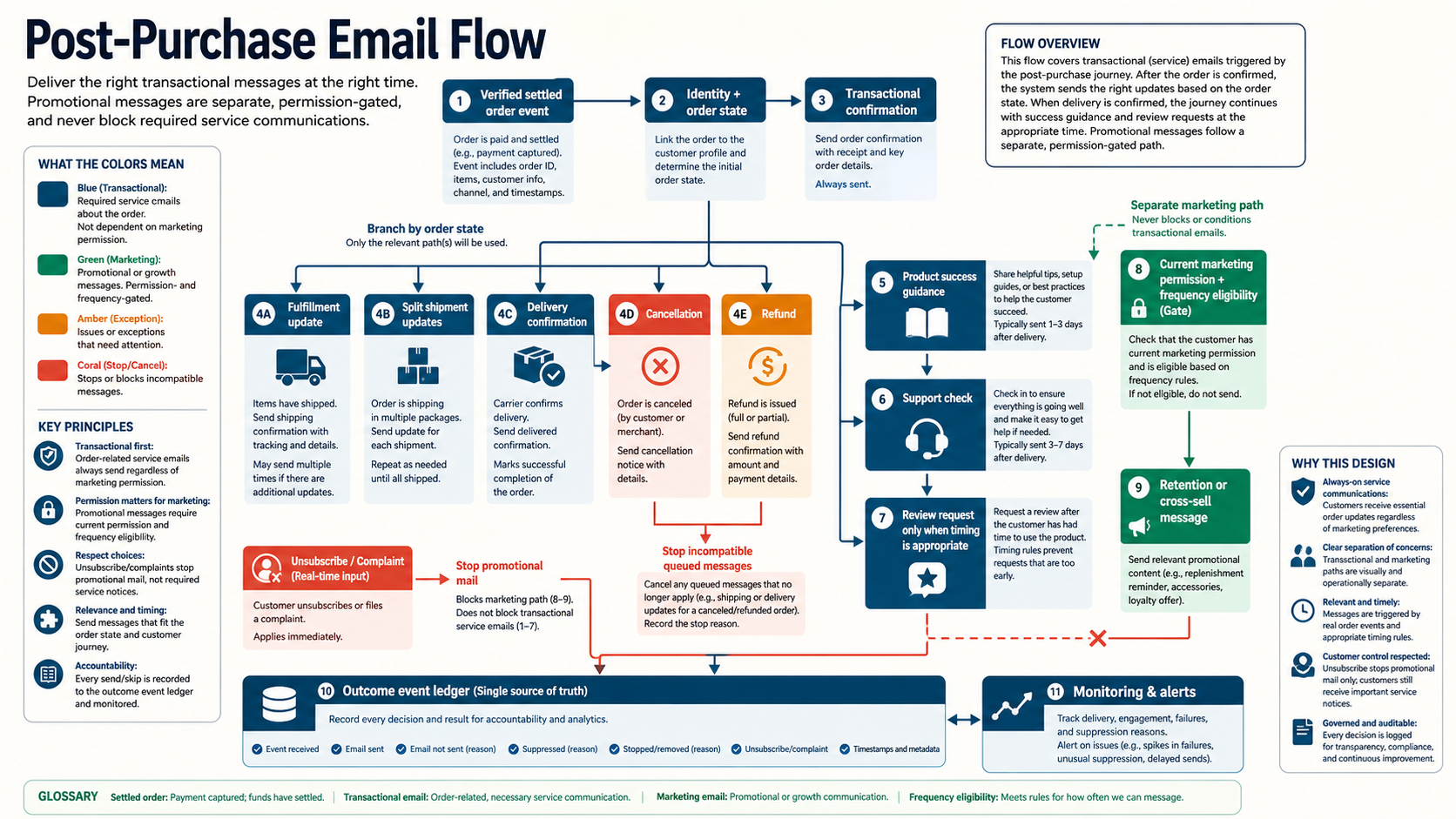
A post-purchase email flow begins with the customer’s transaction and service expectations, not an immediate upsell. Receipt, fulfillment, delivery, product education, support, review, replenishment and retention messages have different purposes, data dependencies and permission rules. A reliable flow follows the real order state, cancels stale automation, protects sensitive information, and sends marketing only when the relationship and current permission support it.
Separate service communication from promotion
| Message | Primary purpose | Key control |
|---|---|---|
| Receipt or order confirmation | Confirm agreed transaction | Accurate order, amount and support path |
| Fulfillment or delivery | Explain service status | Current event and protected tracking link |
| Safety, recall or security | Protect customer | Urgent accuracy and no promotional distraction |
| Product education | Help successful use | Relevant product and lifecycle timing |
| Cross-sell, loyalty or replenishment | Marketing or retention | Current permission, unsubscribe and frequency |
A customer relationship does not make every later message transactional. Classify primary purpose from actual content and recipient expectation. Mixing a discount into a receipt can change both the customer experience and applicable treatment.
Drive the flow from an auditable order state machine
created -> authorized -> settled -> allocated
allocated -> shipped -> delivered
any_open_state -> canceled | refunded | disputed

message eligibility = current_order_state
  + current contact authority + purpose
  + permission and suppression + priority
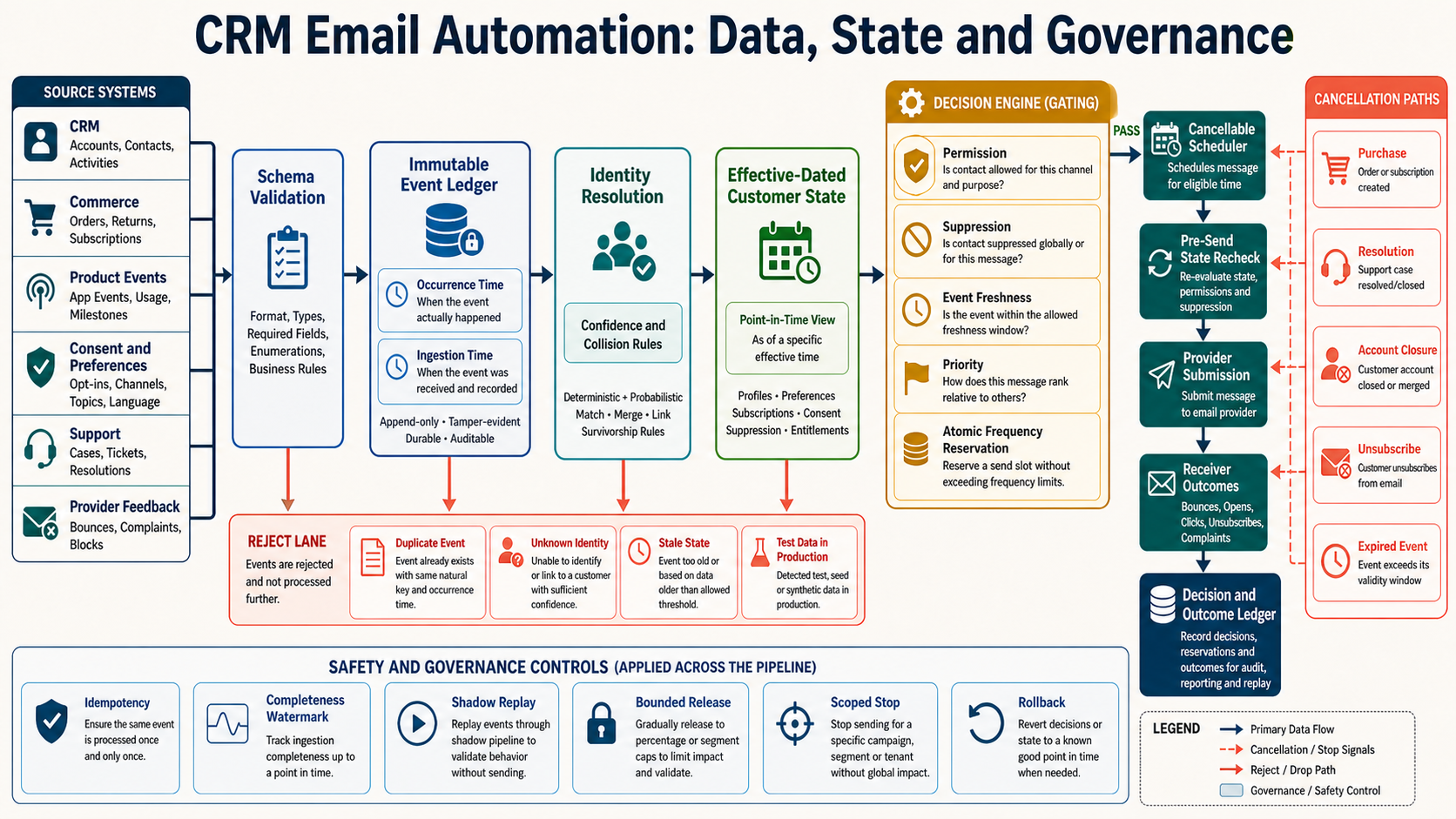
Use event time and ingestion time, deduplicate stable event IDs and preserve corrections. A delayed shipment event must not overwrite a later delivery; a canceled order must cancel education and cross-sell tied to possession. Keep a state reason and source watermark so missing events create an unknown state rather than an invented success.
Choose the correct customer, account and recipient identity
An order can involve a purchaser, recipient, account administrator, billing contact and gift recipient. Each has different authority and communication needs. The shipping recipient should not receive invoice details without authorization; the buyer should not receive sensitive product-use information intended for another person. Store effective roles and scope each message deliberately.
Shared mailboxes and forwarded receipts complicate interaction data. Do not attach every click to the purchaser or use a delivery click to infer marketing preference. When identities merge, preserve applicable complaints and unsubscribes and cancel duplicate scheduled actions.
Design confirmation for accuracy and recovery
State what was ordered, amount and currency, current payment status, expected next step and a trusted support route. Minimize personal information, avoid full payment details and use an authenticated account view for sensitive data. The visible sender, reply path and link domains should be recognizable and consistent.
Do not require image loading to understand the order. Provide meaningful plain text, descriptive links and accessible structure. If the order system is uncertain, acknowledge receipt without claiming settlement or shipment. Idempotency is essential: a payment-provider retry must not create duplicate confirmations or orders.
Communicate fulfillment from verified events
| Event | Message decision | Cancellation |
|---|---|---|
| Allocation confirmed | Set packing expectations | Cancellation or allocation failure |
| Carrier acceptance | Provide protected tracking route | Shipment void or return |
| Delay or exception | Explain known status and support | Newer resolution event |
| Delivery scan | Confirm with dispute/help option | Lost-package investigation |
| Digital entitlement | Secure activation path | Refund or access revocation |
Do not promise a delivery date that the source does not support. Preserve carrier status and internal interpretation separately.
Time education to possession and first value
Education should help the customer reach a product-specific milestone. For digital products, activation may begin immediately after entitlement; physical-product guidance should follow plausible possession; services may require scheduling or onboarding. Trigger from product and account evidence rather than a universal two-day delay.
Stop introductory reminders after the milestone is complete. If telemetry reports repeated errors or support has an unresolved case, route help and pause promotion. Explain prerequisites, safety requirements, warranty implications and limitations before advanced advice. Education that prevents returns can be valuable, but it must not conceal a legitimate return option.
Design branches for cancellation, return and dispute
A cancellation should produce a clear status, expected refund path and support route. Return authorization, item receipt, inspection, refund and replacement are separate events; do not announce completion early. A chargeback or fraud review requires controlled service communication and may restrict marketing until resolved.
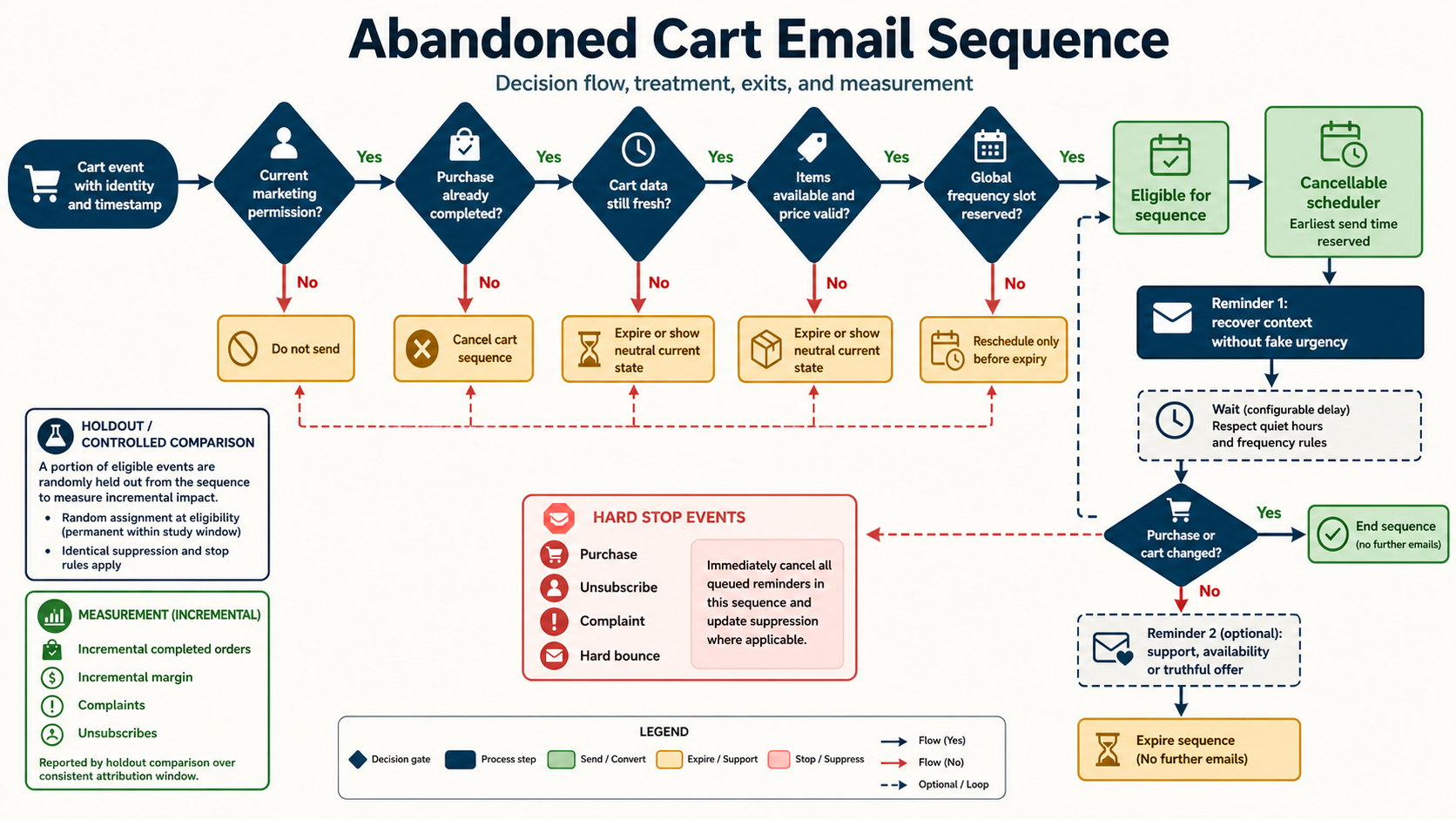
Cancel queued review, replenishment and cross-sell actions when the customer no longer owns or can use the product. Preserve the marketing suppression state independently from the order outcome. Do not attempt to soften a dispute with an unrelated offer.
Coordinate support before promotional follow-up
| Support state | Automation response |
|---|---|
| Missing or damaged order | Pause satisfaction, review and upsell |
| Setup problem | Send approved help or route human assistance |
| Billing dispute | Suppress promotional treatment for the order |
| Resolved case | Apply a suitable cooldown and current state |
| Safety concern | Escalate; prioritize accurate service notice |
Pass a minimal case reason and effective time to marketing systems, not sensitive ticket text. Support closure alone does not prove satisfaction.
Make cross-sell conditional on success and fit
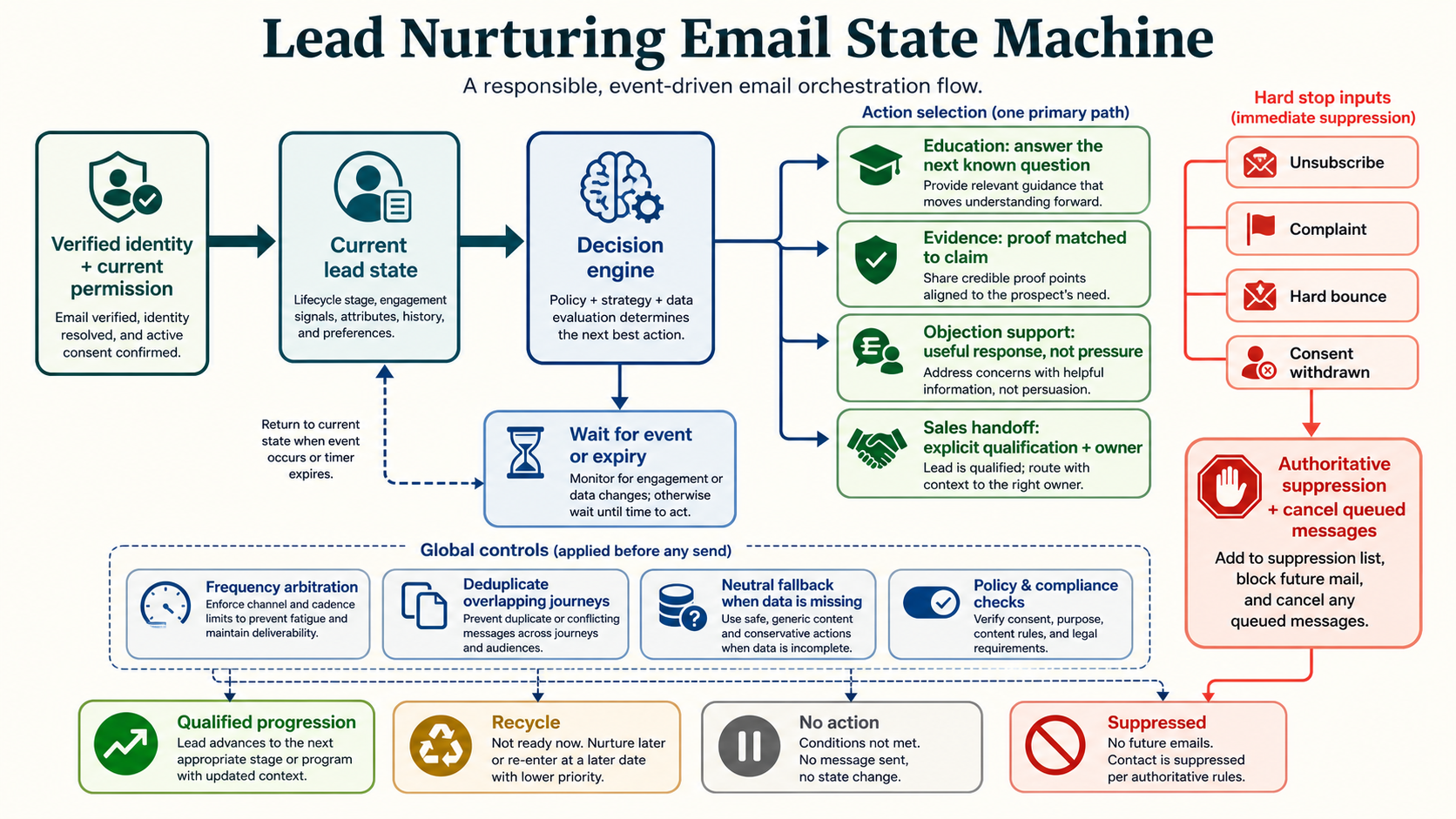
A related product recommendation should solve an adjacent need and reflect actual compatibility, inventory, geography and customer state. Avoid recommending an item already purchased, returned, incompatible or unavailable. Explain why the recommendation is relevant without exposing surveillance-like detail.
Current marketing permission, one-click unsubscribe where required, global frequency and journey priority apply. Test education-only, recommendation and holdout groups to separate natural repeat purchase from incremental effect. An immediate add-on may increase order value but also increase regret, support and returns, so measure net contribution after maturity.
Estimate replenishment from real consumption intervals
Replenishment timing varies with quantity, household or account size, usage, season and subscription state. Build a distribution from settled purchases and qualified repeat behavior; do not send “you are running out” unless the evidence supports it. Provide preference controls for frequency and product category.
estimated_replenishment_window =
  purchase_or_delivery_time
  + cohort_usage_distribution
  - known_subscription_or_recent_purchase

cancel when reordered, returned, suppressed or expired
Test a neutral reminder against an incentive and holdout. Discounts can shift natural orders rather than create value.
Ask for honest feedback when experience can exist
A review request should follow sufficient use time, account for returns and open support problems, and invite honest feedback rather than only positive ratings. Do not condition service on a favorable review, route only satisfied people to a public platform, or hide the feedback path for dissatisfied customers. If an incentive is offered, disclose and govern it appropriately.
One request and a restrained reminder may be reasonable; endless review chasing is not. Record the product, order, request time and response so duplicate item-level and order-level workflows do not collide.
Treat loyalty enrollment and status as separate purposes
A purchase may earn points in an existing program, but it should not silently create permission for unrelated promotional programs. Explain balance, expiry and material conditions accurately. Account statements or earned-benefit notices should remain focused on the relationship; promotional offers need the applicable marketing controls.
When status changes because of returns or corrections, send a clear explanation if appropriate and update scheduled campaigns. Avoid gamified countdowns that pressure unnecessary purchases or obscure the actual threshold.
Build messages that work without images or a mouse
Use a valid multipart message with a useful text alternative and semantic HTML when HTML is included. Provide descriptive link text, sufficient contrast, readable type, logical headings and meaningful alt text. Make order numbers and important status text selectable rather than image-only. Destinations should support keyboard navigation, zoom and accessible authentication.
Test major clients, mobile widths, dark mode, image blocking and long localized values. The confirmation must remain understandable when styles are stripped. Rendering success does not prove delivery or correctness, so validate the underlying order data separately.
Protect order data, tokens and message infrastructure
Use scoped, expiring, single-purpose links for sensitive account actions; avoid placing personal details in query strings. Validate redirect domains, TLS, DNS ownership and template changes. Do not include full payment credentials, secret answers or excessive shipment details. Apply least privilege to event producers and ESP credentials.
Verify provider webhooks with signatures and replay protection. A forged delivery or refund event can trigger harmful messages even when the sending API is secure. Monitor sudden event and message bursts against actual commerce volume, and keep a journey-specific kill switch.
Operate service and marketing streams deliberately
Use recognizable From identities and consistent message categories. Current Gmail guidance distinguishes subscription messages from explicit-action messages such as receipts, and recommends separate addresses for different types. Implement authentication, valid formatting and provider requirements for the traffic you send.
Forecast peaks from launches and seasonal orders. Monitor provider-level acceptance, deferral, rejection, queue age, complaint and hard-bounce outcomes. Do not let a promotional cross-sell inside every receipt expose critical service communication to the same complaint pressure. A separate stream is not a license to send unwanted marketing.
Measure customer success and incrementality
Track correct confirmation, delivery status, activation, support contact, return or refund, qualified use, repeat purchase, contribution margin, complaint and unsubscribe. Cross-sell attribution alone cannot show incrementality because recent buyers often purchase again naturally. Randomize at customer or account level and keep necessary service messages outside experimental withholding.
incremental_retained_margin =
  treatment_matured_net_margin
  - comparable_holdout_matured_net_margin

include returns, discounts, fulfillment,
support cost and total contact exposure
Test timing, education and offer separately where sample permits. State the maturity window and preserve assignment despite delivery failure.
Worked scenario: a delivery event arrives after a refund
An order is canceled and refunded after a warehouse allocation error, but a delayed carrier webhook later marks the old shipment record as in transit. A workflow that sorts by ingestion time sends tracking, product education and a review request. The customer has no product and contacts support again.
Operations pauses the order journey, preserves event and action history, and confirms the carrier event belongs to a voided label. The state processor changes to use order semantics and event precedence, not last-arriving row. Refund and cancellation become terminal for ownership-based messages unless a later verified replacement order exists.
Regression fixtures cover refund before shipment, replacement, split shipment, partial return, delivery dispute and duplicate webhook. Current complaints and marketing opt-outs remain applied throughout recovery.
Post-purchase automation incident response
- Stop the affected journey or event source while retaining necessary independent service notices.
- Preserve order versions, source watermarks, scheduled actions, templates and dispatch acknowledgments.
- Identify the earliest incorrect boundary: commerce, identity, state logic, scheduler, template or ESP.
- Apply current cancellation, refund, dispute and suppression before any replay.
- Cancel expired or obsolete actions rather than draining a backlog.
- Validate correction against boundary fixtures and a production-like snapshot.
- Resume a small current cohort and monitor support and provider signals.
Count wrong-status messages, exposed data, promotional collisions and customer-service impact. Correct downstream CRM and reporting state too.
Maintain a post-purchase journey catalog
Record each message purpose, eligible order states, identity role, source events, earliest send, expiry, cancellation events, permission treatment, template, stream, owner, holdout and retirement date. Reconcile the catalog with active workflows after commerce, carrier, support and ESP changes.
Review actual exposure by customer, not only individual campaigns. Expire temporary holiday logic and discount exceptions. Retire a journey by stopping triggers, canceling waiting actions and verifying that copied regional workflows no longer run. Preserve a decision ledger for experiments and material operating changes.
Post-purchase production checklist
- Every message has a classified primary purpose.
- Order and delivery states use verified event precedence.
- Purchaser, recipient and account identities are scoped correctly.
- Confirmation remains accurate and usable without images.
- Education follows possession and stops at first value.
- Returns, disputes and support cases cancel conflicting promotion.
- Recommendations validate compatibility, inventory and permission.
- Templates, links, events and webhooks have security controls.
- Service and marketing streams have appropriate provider operations.
- Holdout measurement includes refunds, support and recipient harm.
The flow is ready when every message is correct for the current order, useful to the authorized recipient and cancellable before it becomes stale.
Handle split shipments, partial fulfillment and replacements
One order can produce several packages, digital entitlements and backordered lines. Model fulfillment at line and shipment level while presenting a coherent order view. Do not declare the whole order shipped because one label was created, and do not send one generic delivery celebration when another item remains delayed. Link each tracking event to its package and preserve the customer’s selected communication preference.
| Condition | Message decision |
|---|---|
| Partial shipment | List shipped and remaining lines accurately |
| Backorder | Explain options, revised estimate and support |
| Replacement | Connect to original case without duplicate promotion |
| Partial return | Stop education only for returned items |
| Gift order | Separate purchaser and recipient information |
Frequency and review requests should deduplicate across package events. A replacement delivery should not restart loyalty enrollment or count as a new commercial purchase.
Operate post-purchase flows for subscriptions and services
A subscription includes activation, trial conversion, recurring billing, plan change, renewal, cancellation and service entitlement. Each state has material terms and different message purpose. Confirm the agreed plan, price, renewal timing and management route without burying conditions. Promotional upgrade suggestions require current permission and must not obscure a billing or cancellation notice.
Use account and entitlement events to stop onboarding after success and to route failed payments or access problems to service workflows. A card retry is not a reason to send repeated marketing. When a trial ends, distinguish an agreed paid conversion from expiration and follow the actual contract and applicable requirements.
For professional services, milestones may be discovery, scheduling, deliverable acceptance and support transition. Coordinate with the assigned owner so automation does not announce completion before human approval. Measure time to value, renewal, support and net retained margin, not just repeat charges.
Coordinate fraud and account-security states
Fraud review can delay fulfillment or reverse an order. Marketing systems should receive a minimal hold reason, not the customer’s risk score or evidence. Pause celebratory, review and cross-sell messages until an authorized event resolves the state. Security or verification communication must be accurate, recognizable and limited to the necessary action.
Do not expose review status, payment method or purchase detail in a subject line visible on a lock screen. Use a known account route and warn against sending credentials by email. Authenticate event producers so an attacker cannot forge “approved” or “delivered” messages.
When an order is rejected, explain available support without revealing controls that enable evasion. Apply retention and access policies to fraud data separately from marketing analytics. A later legitimate purchase does not justify restoring old promotional actions that expired during review.
Define source freshness and completeness objectives
Order, payment, inventory, carrier, returns, support and preference sources fail differently. For each, record the last complete event boundary, acceptable delay, owner and fail-safe behavior. A recent row is not proof that every partition is current. Detect empty batches, sequence gaps and provider webhook backlog.
post_purchase_release_gate:
  payment_state complete through watermark
  cancellation and refund feeds healthy
  suppression propagation within objective
  template and destination versions approved
  provider-hour forecast within capacity
If purchase or suppression state is stale, hold marketing. If optional recommendation data is stale, omit the module. Necessary service communication may use a separately verified source. Dashboards should expose freshness beside send volume so operators do not mistake successful API calls for correct customer state.
Audit post-purchase experience across systems
Review a sample from settled, delayed, delivered, returned, disputed, supported and repeat-purchase cohorts. Reconstruct which events arrived, which messages were eligible, what was accepted by the provider and what the customer saw. Compare actual exposure with the journey catalog and ensure that support and cancellation events stopped promotion.
Reconcile order lines, packages, scheduled actions, messages and outcomes. Investigate duplicate confirmations, education before possession, review requests during disputes, inaccessible templates and promotions inside service mail. Segment complaints and unsubscribes by message purpose, product, source and provider rather than one blended rate.
Close temporary holiday rules, carrier exceptions and discount offers. Update event fixtures with incidents and require commerce, service, lifecycle, deliverability, data, security and accessibility owners to accept material changes. The audit is complete when running workflows match the documented state model.
Close the customer loop after outcome maturity
Reconcile each order from assignment through accepted messages, product use, support, return, refund, repeat purchase and mature margin. Compare treatment with account-level holdout for optional education or promotion while keeping necessary service notices intact. Review whether the flow improved time to value or merely claimed purchases that would have occurred naturally.
Turn findings into product and workflow changes. A repeated setup question belongs in onboarding or product design; delivery confusion belongs in event and carrier handling; review complaints may require timing or suppression changes. Retire losing cross-sell and incentive variants and cancel remaining actions.
Confirm that temporary holiday rules, carrier workarounds and offers have expired. Archive event, template, measurement and decision versions. The post-purchase program closes only when order state, customer experience and every active automation reconcile.
Primary references
- FTC CAN-SPAM compliance guide
- Gmail email subscription guidelines
- Gmail email sender guidelines
- RFC 2046 MIME media types
- WCAG 2.2