Lead Nurturing Email Sequences: Intent, Timing and Handoffs
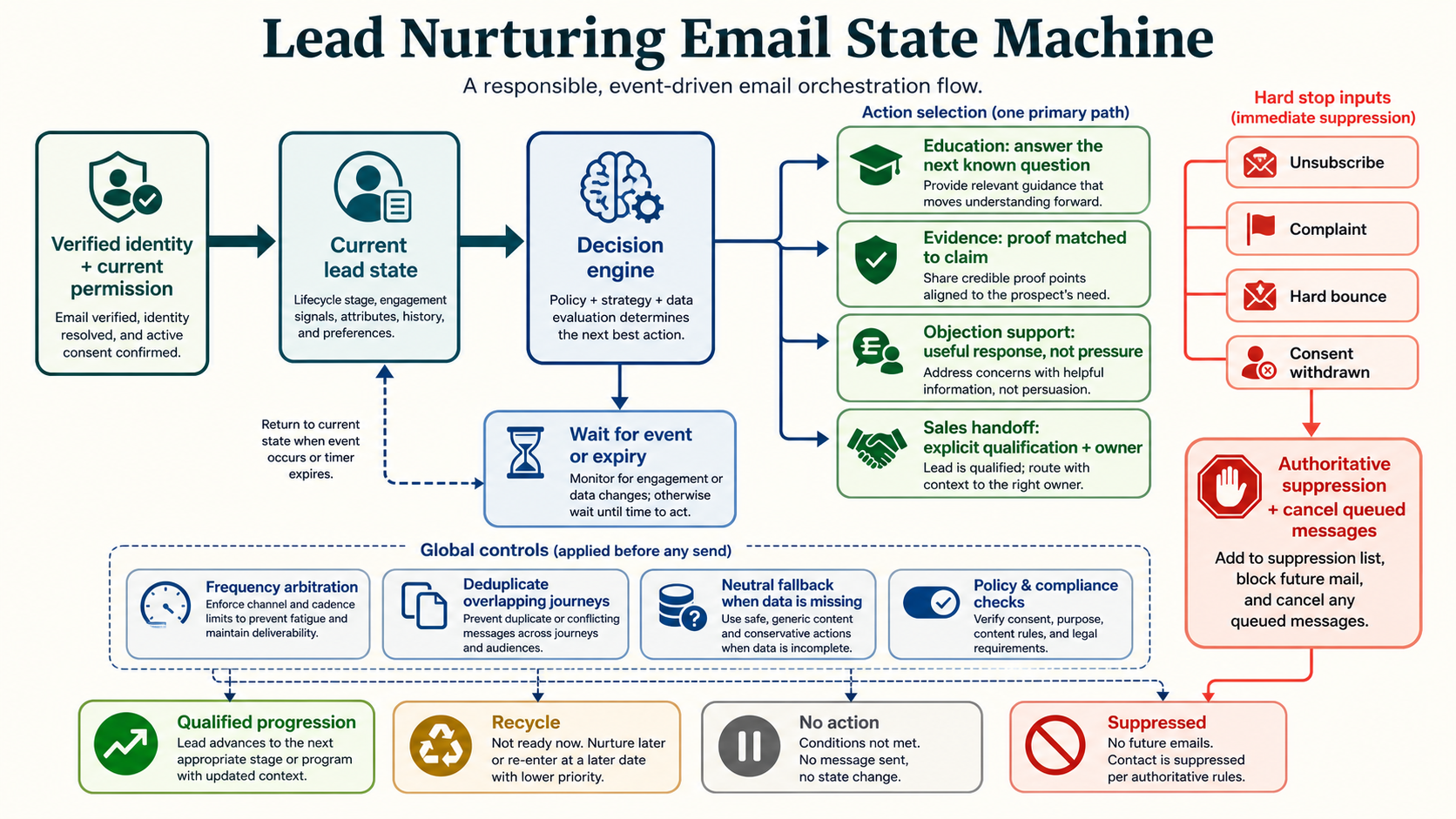
A lead nurturing email sequence should help a permitted prospect make a better decision while giving sales and marketing a reliable view of intent. It is not a five-message countdown that assumes every person moves from awareness to purchase on schedule. A production design defines lifecycle states, accepts multiple paths, uses current evidence, stops obsolete messages, and measures whether the sequence creates qualified progress rather than merely collecting opens.
Start with the decision the sequence should improve
Define the audience, problem, product decision and next useful state. A new research subscriber may need orientation; an evaluation-stage account may need implementation evidence; a person with an active sales conversation may need no automated promotion. The message job must follow the relationship rather than an internal content calendar.
Write an explicit non-goal. Nurturing must not manufacture consent, inflate a score until a lead appears qualified, or repeatedly contact someone who has declined. The business outcome may be a qualified consultation, trial activation, documented no-fit decision or later recycle, not always an immediate sale.
Model lead state from observable evidence
| State | Evidence | Communication job |
|---|---|---|
| New permitted lead | Verified form or subscription event | Deliver promise and set expectations |
| Learning | Declared need or qualified content behavior | Explain problem and choices |
| Evaluating | Product comparison, reply or authenticated action | Provide proof, constraints and fit |
| Sales engaged | Accepted meeting or active opportunity | Coordinate and avoid automated collision |
| Not ready | Valid relationship but no current project | Recycle at an appropriate cadence |
| Suppressed | Complaint, unsubscribe or policy exclusion | No marketing in scope |
Opens are weak evidence because images can be blocked or privacy-prefetched. Persist state reason, effective time, source and rule version.
Keep permission and lead score separate
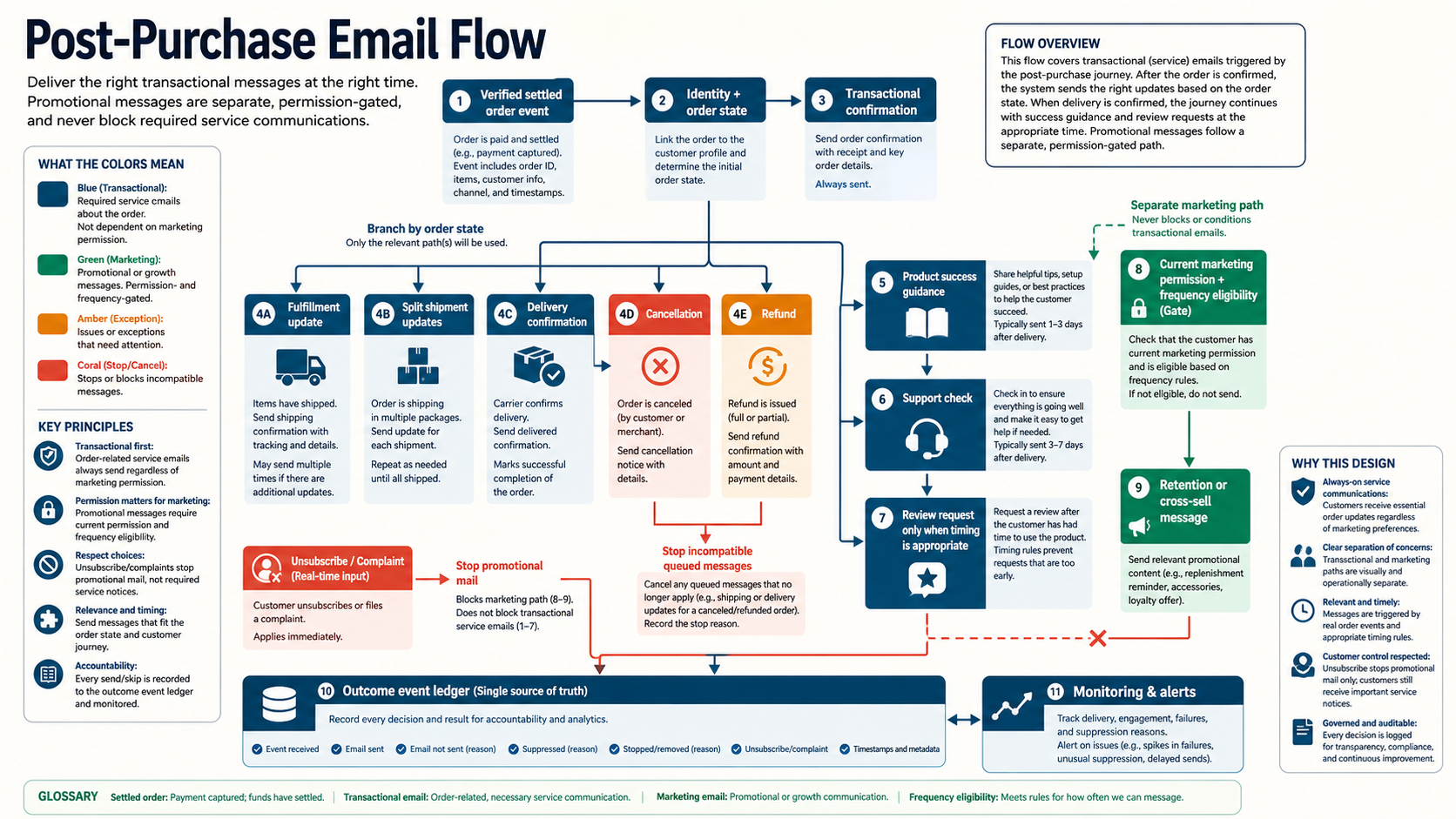
A form submission, event registration, product account and newsletter subscription can represent different purposes. Store the notice, program, brand, source and time. A high intent score cannot override an unsubscribe, complaint, hard bounce or purpose restriction. A purchase or sales call also does not silently subscribe someone to an unrelated newsletter.
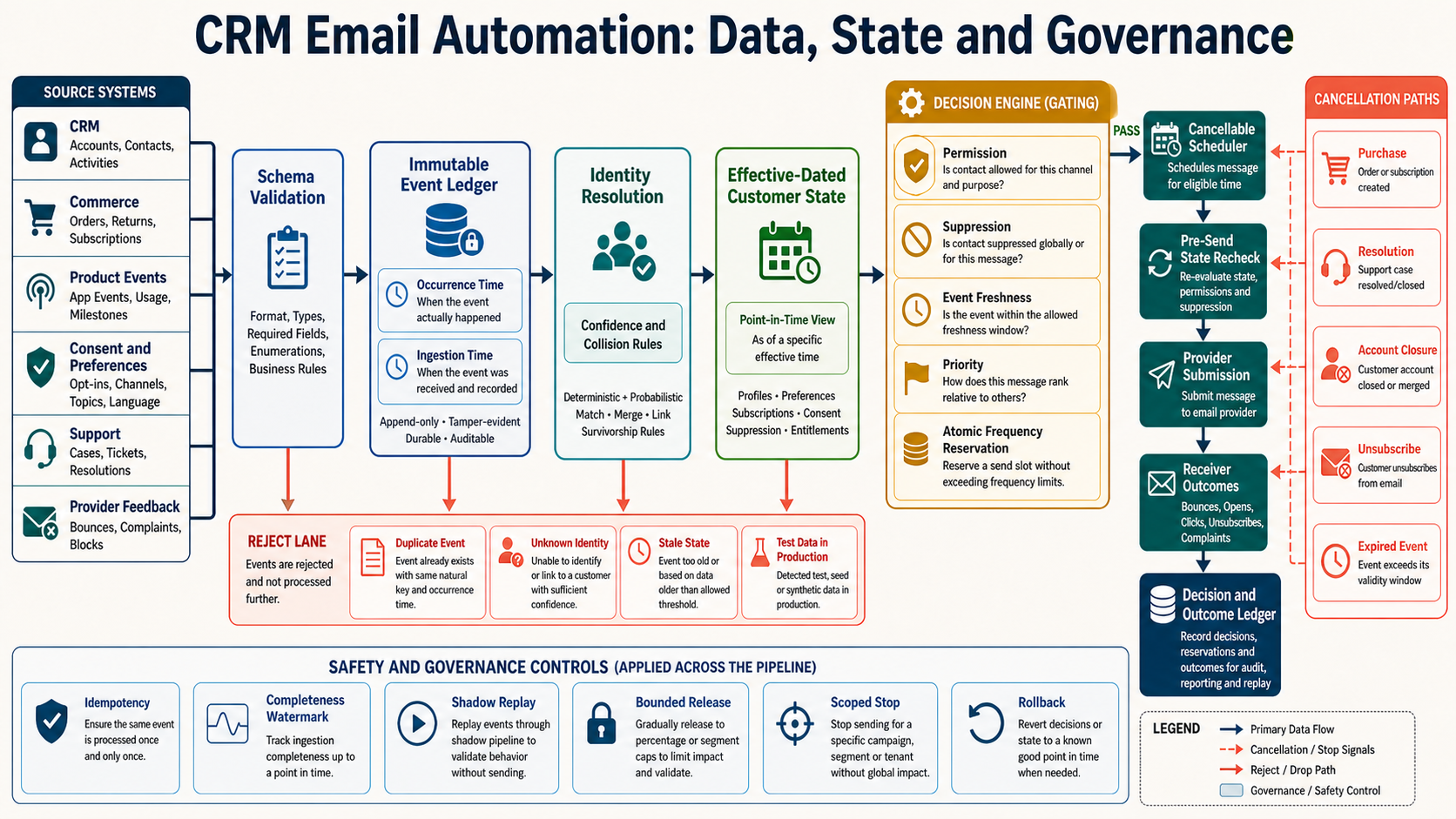
Apply the strongest current suppression before selection and immediately before dispatch. When systems disagree, hold marketing and reconcile. Suppression must propagate to queued messages and copied workflows, not only the next audience export.
Replace a fixed countdown with conditional paths
new_lead -> promise_delivered -> learning
learning + qualified_intent -> evaluation
learning + no_current_need -> bounded_recycle
evaluation + accepted_handoff -> sales_engaged
any_marketing_state + unsubscribe_or_complaint -> suppressed
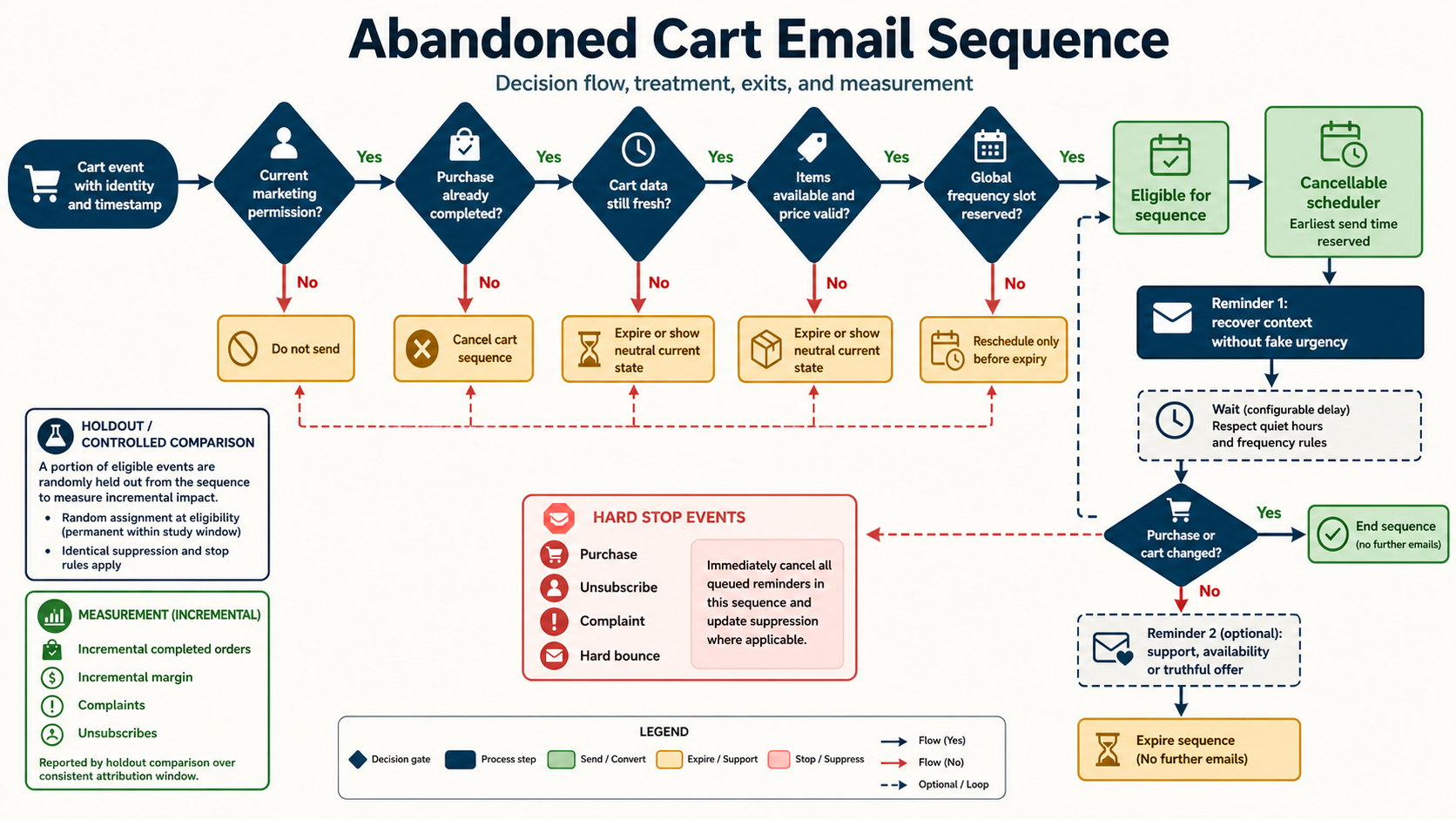
Each step needs entry, purpose, earliest send, expiry, cancellation events and maximum exposure. The next email should be selected from the current state, not because day three arrived. Cancel a comparison email after a no-fit decision and cancel introductory content after the person becomes a customer.
Map evidence to useful content rather than pressure
| Question | Useful evidence | Possible message |
|---|---|---|
| What problem are we solving? | Declared role or need | Problem model and self-assessment |
| Is this approach credible? | Evaluation behavior | Method, limitations and relevant case evidence |
| Will it work here? | Technical or operational concern | Architecture, prerequisites and implementation plan |
| What is the risk? | Security, procurement or migration concern | Controls, ownership and rollback |
| Are we ready? | Explicit reply or qualified action | Clear human handoff |
Social proof must be accurate, representative and relevant. Do not invent customer outcomes or hide requirements behind a curiosity click.
Derive timing from value, behavior and expiry
Time between messages should allow the reader to use the previous material and reflect the buying cycle. A daily sequence may be suitable for a short event registration; an enterprise infrastructure decision may need weeks and a human checkpoint. Define earliest-send time, useful-until time and cancellation conditions for every action.
Do not interpret silence as a request for higher frequency. Global contact policy must include newsletters, events, product mail and sales outreach. Quiet times and local timezones matter, but timezone inference should remain conservative. When timing evidence is weak, use the subscriber preference or a restrained default and test it.
Build an evidence hierarchy for intent
Explicit replies, requested consultations, authenticated trial milestones and current pricing or implementation actions are stronger than a remote image request. A link click may come from a security scanner; a shared account can make account behavior appear personal. Store the raw event, classification, identity scope and confidence.
| Signal | Safe use | Caution |
|---|---|---|
| Requested meeting | Offer human scheduling | Confirm scope and attendee |
| Qualified reply | Route to owner | Do not force into generic score |
| Authenticated product action | Advance relevant education | Account versus user identity |
| Qualified click | Interest hypothesis | Scanner and forwarding |
| Open or image fetch | Weak diagnostic | Privacy and image blocking |
Use lead scoring as a versioned decision aid
A score needs a defined target, observation window, features, weights or model, threshold, calibration and owner. Separate fit from behavior: a company can match the profile but have no project, while an active evaluator can be a poor fit. Negative evidence and data freshness matter as much as positive points.
lead_score_observation(
  subject_or_account, fit_score, intent_score,
  reason_features, observed_at, source_watermark,
  model_or_rule_version, confidence
)
Never add arbitrary points until the queue matches a sales target. Review score bands against actual qualification and incremental response. Consent and suppression remain hard gates outside the score.
Define a sales handoff contract
Marketing and sales should agree on the qualifying event, identity unit, required evidence, ownership, acceptance time and rejection reason. Send enough context to continue the conversation without exposing unnecessary behavioral history. A handoff is incomplete until sales accepts, rejects or returns it with a structured reason.
Automation should pause or change when an opportunity is active. Sales outreach must see current subscription and suppression state; a representative should not import an unsubscribed contact into a personal sequence. When sales returns a lead, choose a documented recycle state rather than restarting the welcome series.
Handle accounts and buying groups explicitly
In business buying, a researcher, technical evaluator, security reviewer, procurement contact and budget owner may represent one account but different permissions and needs. Do not copy one person’s behavior to all colleagues or send confidential pricing to an unrelated user. Define which state is person-level and which is account-level.
Account intent can prioritize research, but person-level contact still requires an appropriate relationship. Frequency may need a person cap and an account coordination rule. A booked meeting for one stakeholder should not automatically stop necessary education requested by another, yet duplicate sales introductions should be prevented.
Personalize from declared and reliable context
Useful personalization chooses the relevant problem, product version, industry constraint or lifecycle path. It does not require pretending that automation is a personal note. State a recognizable sender, use accurate data and provide a neutral fallback when a field is missing. Never expose internal score labels in a subject line or URL.
Minimize sensitive attributes and avoid inferring health, finance or other high-risk conditions without appropriate purpose and review. Version the segment logic and record why a person received the content. A wrong first name is less serious than a message that reveals an unsafe identity merge, but both require prevention and testing.
Make nurture messages usable across clients and abilities
Build a valid multipart message with a meaningful plain-text alternative and an accessible HTML part when HTML is used. Keep the primary value available without images. Use readable hierarchy, sufficient contrast, descriptive links, useful alt text and a clear reply or support route. Test mobile width, dark mode, zoom, image blocking and keyboard access to destinations.
Do not hide material qualifications in an image or tiny footer. The subject, preheader, From identity, opening, body and landing page must describe the same offer. Rendering tests find technical defects; they do not prove inbox placement or persuasion.
Plan volume and reputation by stream
A nurture program can produce bursts after events, imports or scoring changes. Forecast recipients by receiving organization, domain and hour. Separate service messages from subscription promotion through consistent operational identities and categories. Implement current authentication, message formatting and unsubscribe requirements for relevant marketing traffic.
Monitor complete SMTP responses, queue age, complaints, unsubscribes and hard bounces by acquisition source and sequence step. A blended acceptance rate can hide one damaged cohort. Do not rotate IPs or domains to escape poor permission or overmailing; stop the causal audience and correct it.
Measure qualified progress and incrementality
Report eligible, assigned, excluded, attempted, accepted, replied, qualified, handed off, accepted by sales, converted, recycled and suppressed populations. Define qualification with evidence and owner. A click can support diagnosis, but scanners and privacy behavior require classification.
incremental_qualified_rate =
  qualified_accounts_assigned_treatment / treatment_accounts
  - qualified_accounts_assigned_holdout / holdout_accounts

cost_per_incremental_qualified =
  total_program_cost / incremental_qualified_accounts
Keep persistent account-level holdouts where practical and prevent equivalent treatment through another campaign. Include complaints, unsubscribes, sales rejection and time-to-decision as guardrails.
Worked scenario: the highest score is not ready
A software vendor scores a contact highly after a webinar registration, two document clicks and a pricing-page visit. The first click is confirmed as a security scanner, the registration says the project is exploratory and the person has requested a quarterly technical update. An automatic same-day sales sequence would violate the stated cadence and misread intent.
The decision engine removes the scanner event, retains the declared interest and routes the contact to a quarterly evaluation track. Six weeks later the contact replies with an implementation window and requests architecture review. That explicit event creates the handoff. The sales record includes topic, account, timing and consent scope, while unrelated browsing history stays out.
The example shows why signal quality and preference beat an accumulated point total. It also produces a useful no-action outcome instead of treating every delay as lost revenue.
Runbook for a bad scoring or sequence release
- Pause the affected rule, cohort or journey without disabling necessary service mail.
- Preserve assignments, score features, state transitions, scheduled actions and ESP acknowledgments.
- Identify whether the defect came from source data, identity, classification, score logic, frequency policy or dispatch.
- Apply all current complaints, unsubscribes and customer conversions before remediation.
- Cancel obsolete actions rather than draining the backlog.
- Recompute in shadow mode and compare population changes with a valid baseline.
- Resume a small bounded cohort under provider and complaint monitoring.
Count wrongly selected contacts, attempted and accepted mail, handoff pollution and suppression delay. Correct the CRM and sales queue as well as the email platform.
Operate a nurture catalog and decision ledger
Catalog each journey version, audience, state rules, sources, message purpose, permission scope, maximum exposure, content versions, holdout, qualification definition, owner, stop conditions and retirement date. Detect copied workflows and temporary event campaigns that never expired. Review after CRM, product, scoring or ESP changes.
Keep a decision ledger for experiments and operating changes. Record the hypothesis, release population, evidence window, guardrails, result and action. Retire a sequence by stopping triggers, canceling timers, archiving the final version and confirming that no regional or personal-sales copy remains active.
Lead nurturing production checklist
- The audience and useful next decision are explicit.
- Permission scope and source evidence are current.
- Lead state has observable entry, exit and unknown behavior.
- Scoring is versioned, calibrated and subordinate to suppression.
- Timing is value-based, cancellable and globally frequency-capped.
- Content answers a real question and discloses limitations.
- Sales handoff includes acceptance, rejection and recycle.
- Account and person identity are not conflated.
- Provider operations expose cohort and sequence-step risk.
- Holdout analysis measures qualified incremental progress and harm.
A nurture sequence is ready when the team can explain why each person is eligible now, what useful state the message serves and exactly which event will stop it.
Build a point-in-time lead decision pipeline
Materialize nurturing decisions from effective-dated permission, identity, lifecycle, product and sales data. Keep event occurrence separate from warehouse ingestion and record the completeness watermark for every required source. A missing activity batch must produce unknown or frozen state, not automatically convert thousands of leads to inactive. Join at the intended person or account level and test one-to-many relationships before release.
lead_decision_snapshot(
  subject_key, account_key, lifecycle_state,
  permission_version, suppression_state,
  fit_version, intent_version, source_watermarks,
  selected_journey, selected_reason, decided_at_utc
)
Persist eligible and excluded reasons so population counts reconcile. A decision snapshot supports complaint investigation, sales questions and rule comparison without rebuilding history from today’s CRM values. Restrict access to raw behavior; most downstream systems need a state and reason code, not a complete activity trail.
Use negative and contradictory evidence safely
No recent event can mean no interest, a tracking failure, a long buying cycle or activity in an unconnected channel. Stronger negative evidence includes an explicit no, a project cancellation, a changed role, a no-fit review or an active service dispute. Define which event pauses, recycles or ends the journey and how long the state remains valid.
| Evidence | Response | Do not do |
|---|---|---|
| Explicit not now with date | Recycle after requested window | Continue urgency sequence |
| No-fit reason | End product nurture or route alternative | Add more score points |
| Source feed stale | Freeze dependent transitions | Infer inactivity |
| Sales opportunity lost | Use disposition and policy | Restart welcome automatically |
| Unsubscribe or complaint | Suppress applicable marketing | Treat as low score |
Store the source and expiry of a negative state. Never use an internal sales rejection to erase a person’s valid subscription to a separately requested publication.
Turn sales feedback into governed learning
Sales rejection reasons should be structured enough to improve targeting: wrong account, wrong contact, no project, no budget window, duplicate, active customer, unsupported requirement or data error. Free-text notes can contain sensitive information and should not become uncontrolled marketing features. Review reason consistency and allow sales to flag an unsafe or irrelevant automation immediately.
Compare handoff cohorts by score band and evidence type. Report accepted, contacted, qualified, converted and returned counts with time to action. A high acceptance rate can still hide poor customer experience if representatives contact people who did not expect sales outreach. Sample call and reply context under appropriate controls to validate expectation.
Close the loop by changing one rule at a time, running it in shadow mode and measuring population movement. Do not tune scoring merely to raise the percentage sales accepts; optimize incremental qualified value while keeping complaints, opt-outs and representative capacity visible.
Match nurture and handoff volume to human capacity
An event, import or model change can create more qualified leads than sales can handle. Queueing all of them while continuing time-sensitive messages produces stale handoffs and duplicate outreach. Forecast accepted leads per day by region, product and owner, then use priority and expiry rather than silent backlog growth. Leads not reached within the promised window need an honest route, not a false “someone will call shortly.”
Capacity constraints should not bias the score invisibly. Record that a qualified lead lost capacity priority, preserve holdout assignment and decide whether to offer self-service or defer with consent. Avoid repeatedly rescoring the same person into the top of the queue.
Monitor oldest handoff age, unowned leads, duplicate ownership, SLA breaches, sales sequence collisions and contact attempts per person. During recovery, resume only current eligible leads; do not drain a month-old backlog as if the buying context remains unchanged.
Audit the nurture system as a cross-team product
Each quarter, reconcile permission and suppressions across CRM, warehouse, ESP and sales tools. Sample complete histories from new, learning, evaluating, handed-off, recycled and suppressed states. Verify that the cited source event belongs to the correct identity and that every scheduled message had a valid current state at dispatch.
Inventory active workflows, personal sales sequences, event campaigns and regional copies. Compare them with the journey catalog and global frequency policy. Review source watermarks, classifier drift, score calibration, sales dispositions, provider outcomes and holdout contamination. Find rules that depend on opens, stale job titles or missing data.
Close the audit with owned changes and dates: retire orphaned workflows, correct mappings, update fixtures and remove temporary exceptions. Re-run population reconciliation before promotion. The deliverable is an operating decision register, not a slide that leaves the automation unchanged.
Close a nurture experiment without leaving automation behind
After outcome maturity, reconcile assigned treatment and holdout, qualification, sales acceptance, conversion, complaints and unsubscribes. Review whether natural high-intent accounts drove the attributed pipeline and whether the sequence created incremental progress. Compare timing, source and state cohorts without presenting exploratory cuts as confirmed winners.
Translate the result into running-system changes: promote the reviewed rule, retire losing variants, cancel their scheduled actions and update score or handoff fixtures. Remove temporary capacity exceptions and verify that CRM, ESP and sales tools use the same current state. Archive exact content, assignment, metric version and decision.
A program is not closed because a dashboard was presented. It closes when every active workflow reflects the approved decision, nonresponders reach the intended recycle or sunset state, and an owner accepts the next review date.
Primary references
- Gmail email subscription guidelines
- Gmail email sender guidelines
- RFC 8058 One-Click Unsubscribe
- Apple Mail Privacy Protection
- WCAG 2.2