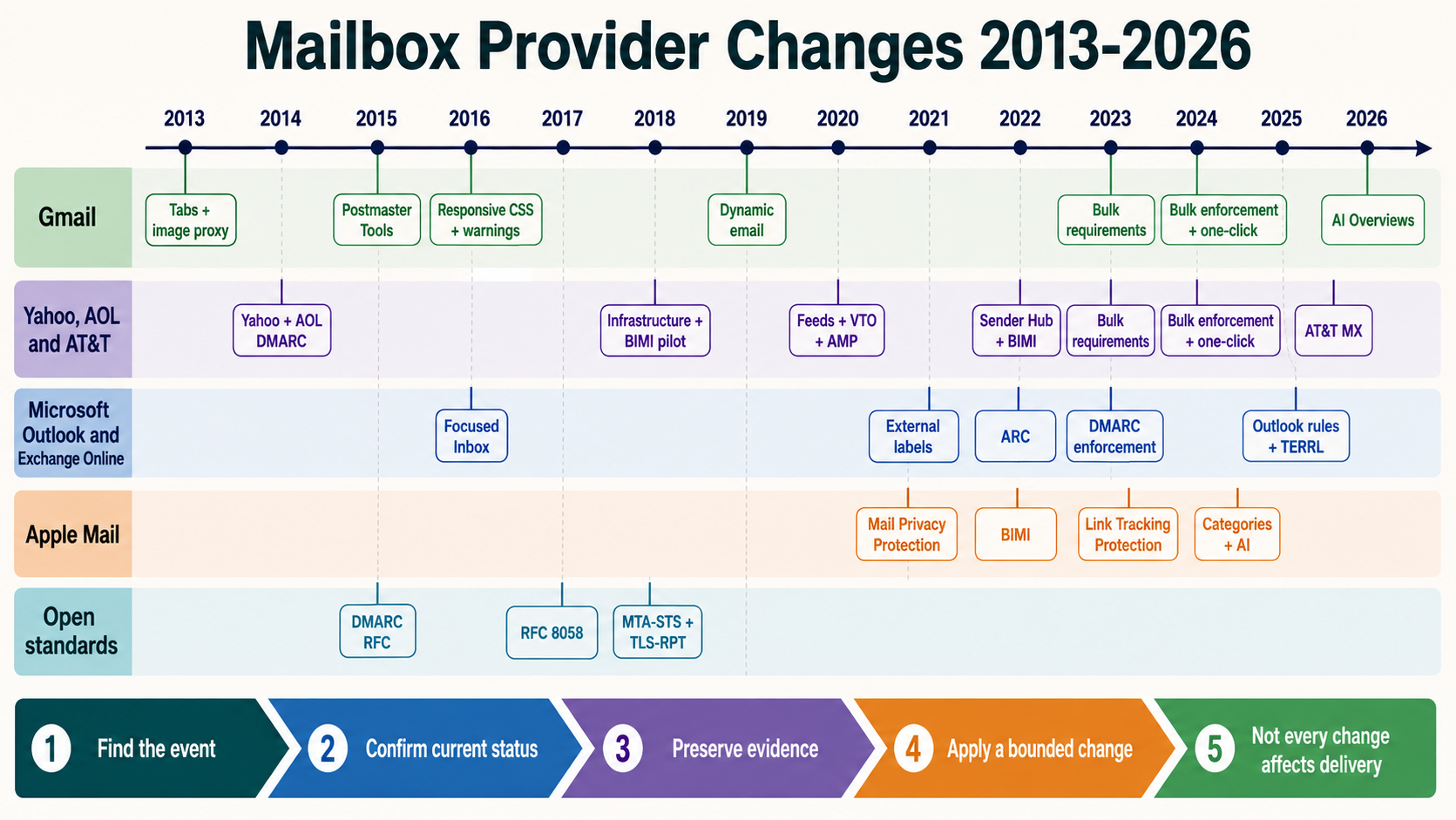
AOL DMARC Reject Policy in 2014: Mailing List and ESP Consequences
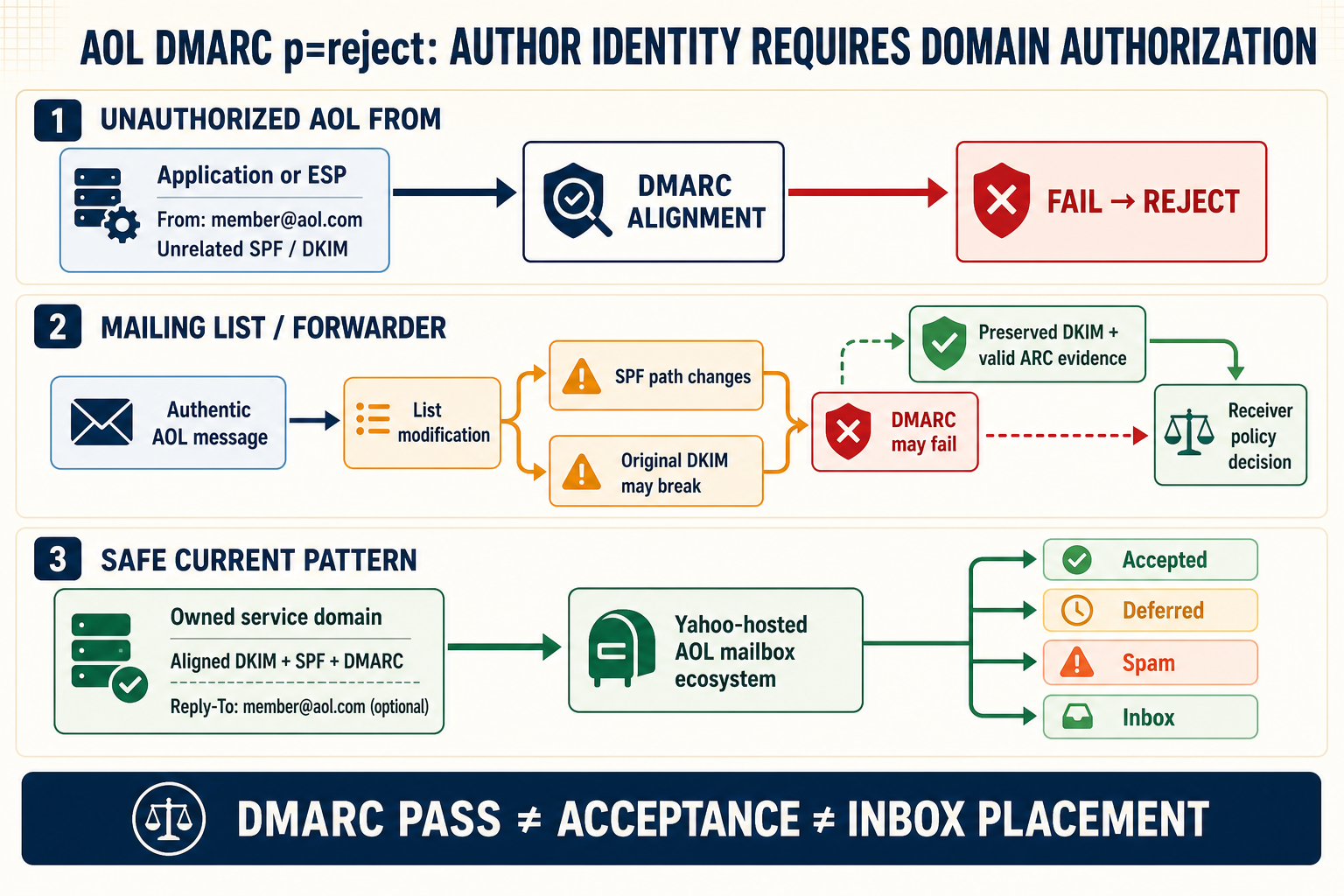
On April 22, 2014, AOL announced a DMARC policy requesting rejection of messages that claimed an aol.com visible From identity but did not pass aligned SPF or DKIM. The move responded to spoofed mail abusing AOL identities, but its effect was broader than malicious traffic. Mailing lists, invitation services, share-by-email features and ESP campaigns could also fail when they borrowed an AOL member’s address as the author while sending through infrastructure that AOL had not authorized.
The dated mailbox-provider change
| Event field | Verified value | Why it matters |
|---|---|---|
| Historical event date | April 22, 2014 | This is the provider-change date, not the NitWings publication date. |
| Mailbox provider | Yahoo Mail ecosystem / AOL | The affected provider estate determines which recipient cohorts require separate evidence. |
| Change area | Authentication/DMARC | This identifies whether the change altered authentication, filtering, visibility, measurement or sender operations. |
| Current status | active-under-yahoo-ecosystem | Historical instructions are interpreted against the feature or standard that exists now. |
The policy arrived during a concentrated period of consumer-domain abuse. Recipients were seeing messages that appeared to come from familiar AOL contacts even though the messages originated elsewhere. DMARC gave AOL a way to publish an identity policy in DNS and ask participating receivers to reject mail that used aol.com in RFC5322.From without aligned authentication.
AOL’s announcement followed Yahoo’s strict policy change earlier in April 2014. The two events exposed the same design weakness across many third-party systems: an application treated a user-supplied email address as permission to place that address in the visible author field. Before strict enforcement, receivers might deliver such mail if an unrelated ESP signature or a reputable sending IP passed other checks. After enforcement, authentication had to align with the domain visible to the recipient.
The exact date matters. April 22, 2014 is the provider-change date, not the date of this NitWings analysis. The original AOL Postmaster announcement is no longer maintained, so the event record is supported by contemporaneous reporting, standards-community history, current Yahoo Sender Hub documentation and the current DNS policy. That distinction prevents a retired help page from being presented as a current operating interface.
AOL later became part of the Yahoo-hosted mailbox ecosystem. Feedback, support and sender requirements now operate through Yahoo Sender Hub, while aol.com remains a visible recipient and author domain. Current teams therefore need both historical domain-specific evidence and an understanding of the consolidated provider infrastructure.
How the system worked before the change
Before the strict policy, an application could accept `[email protected]` from a form and construct a message whose visible From field was that AOL address. The application’s ESP might authenticate its own bounce domain with SPF and sign with an ESP or customer domain. Those results proved something about the sending route, but neither result necessarily aligned with aol.com.
Forwarding and mailing lists created another path. AOL could send an authentic, DKIM-signed message to a list. The list redistributed it from its own server. SPF normally evaluated the list server rather than AOL’s original server, and common list modifications such as subject prefixes, footers or MIME changes could invalidate AOL’s original DKIM signature. If the visible From still showed the AOL member, aligned authentication could be lost.
Many receivers already used reputation, content filters and authentication before April 2014. A DMARC failure did not automatically mean the message was safe before the policy, and a pass did not guarantee inbox placement. The operational difference was that AOL had not yet published the same explicit reject request for unauthenticated use of its domain.
That looser environment encouraged fragile product designs. Contact forms sent a visitor’s address as From instead of Reply-To. Advocacy tools represented a constituent as the technical author. Invitation products used a member’s consumer address to improve recognition. List managers assumed redistribution was transparent. These designs mixed human context with domain authorization, leaving the breakage hidden until strict policy enforcement made the boundary visible.
What changed on the provider side
AOL published a DMARC record with a reject disposition for aol.com. A receiver evaluating a message with an aol.com RFC5322.From domain first checked whether at least one authenticated identifier aligned with that domain. An SPF pass counted only when the RFC5321.MailFrom domain aligned. A DKIM pass counted only when the signing `d=` domain aligned. If neither aligned, the DMARC result failed and the published policy requested rejection.
This was not a block on AOL recipients, a prohibition on sending mail to AOL, or a universal rejection of every message that traversed a forwarder. It protected the author domain. Authentic AOL mail could pass using an AOL-aligned DKIM signature even after forwarding if the signed content survived unchanged. Indirect mail became vulnerable when forwarding broke SPF alignment and transformation invalidated the aligned signature.
An ESP could not fix borrowed aol.com identity by adding its own DKIM signature. A valid signature from `esp.example` authenticated that domain, not aol.com. The customer also could not add the ESP to AOL’s SPF record or obtain AOL’s signing keys. The durable correction was to use a From domain controlled by the application or organization, authenticate it, and preserve the AOL member’s address separately when a reply genuinely belonged with that person.
For mailing lists, the tradeoff was harder. Rewriting From to a list-controlled domain could restore alignment, but it affected recognition, replies, threading and display. Preserving the original author in Reply-To, Sender, List-ID and body context required deliberate client testing. Later ARC standards offered receivers authenticated evidence about an intermediary path, but ARC did not turn a DMARC failure into an automatic pass or require a receiver to accept the message.
Message path before and after
Before
Member enters [email protected]
        |
        v
Application, ESP or mailing list
        |
        +----> SPF passes for unrelated bounce domain
        +----> DKIM passes for unrelated signing domain
        |
        v
Visible From remains [email protected]
        |
        v
Receiver applies local filtering without AOL reject request
After
Message claims From: [email protected]
        |
        v
Receiver evaluates SPF and DKIM alignment
        |
        +----> Aligned SPF or aligned DKIM passes ----> DMARC pass
        |
        +----> Neither aligns ----> DMARC fail
                                      |
                                      v
                               AOL p=reject request
                                      |
                                      v
                           Reject or receiver policy action
Who and what the change affected
| Traffic or stakeholder | What changed | Required interpretation |
|---|---|---|
| AOL-originated mail | AOL could protect its own consumer identity with aligned authentication and reject policy. | Check the delivered aligned signature; do not assume every aol.com message is authentic from visible text alone. |
| ESP campaigns using an AOL From address | The ESP’s unrelated SPF or DKIM identity could not satisfy aol.com alignment. | Change From to an owned authenticated domain and use Reply-To only for a real reply requirement. |
| Mailing lists | Redistribution could break SPF and invalidate the original AOL DKIM signature. | Test list transformation, From rewriting, Reply-To, Sender and List-ID behavior together. |
| Forwarders and gateways | A surviving aligned DKIM signature could pass; modified mail could fail. | Retain original authentication evidence and a valid ARC chain where supported. |
| Invitation and share-by-email products | User-entered AOL identity stopped being a safe technical author identity. | Represent the service as sender and identify the initiating user transparently in Reply-To or content. |
| AOL recipient traffic | The change did not itself impose a new rule on all inbound mail to AOL accounts. | Separate author-domain DMARC failures from AOL recipient reputation and throttling incidents. |
Effect on delivery, placement and recipient visibility
The direct delivery effect appeared as policy rejection at receivers that evaluated DMARC and honored AOL’s requested disposition. The SMTP failure could occur at an AOL destination or at a completely different mailbox provider because the protected identity was aol.com in From. Provider cohorting by recipient domain alone therefore missed part of the incident.
Legitimate applications were affected when their identity model was unauthorized, not necessarily because their IP reputation had deteriorated. An IP change, warmup, content rewrite or throttling adjustment could not create alignment with aol.com. The repair had to occur in message identity and authentication.
Forwarded mail required message-level evidence. SPF normally failed or lost alignment because the forwarder became the connecting host. DKIM could preserve DMARC if an AOL-aligned signature remained valid. Subject modification, footer insertion, MIME re-encoding and antivirus transformation could break that signature. A blanket claim that “forwarding breaks DMARC” was therefore too broad, while a claim that forwarding was unaffected ignored common transformations.
Mailing-list remediation also affected recipient experience. A list-controlled From could pass DMARC yet confuse members if Reply-To sent responses to the wrong destination or client displays obscured the original contributor. Operational success required transport acceptance, authentication, recognizable presentation and correct conversation behavior.
Today, AOL recipient traffic should be monitored through the Yahoo ecosystem while retaining the aol.com domain as a cohort. Authentication eligibility, Yahoo deferrals, complaint feedback, spam placement and recipient engagement are separate layers. A DMARC pass repairs author authorization; it does not promise acceptance, inbox placement or attention.
Effect on measurement and diagnosis
The most useful incident dimension was the visible From domain. Teams needed to count failures for aol.com authors across every receiving provider, application and route. Restricting the investigation to mail delivered to AOL accounts could hide rejections at Gmail, Microsoft, enterprise gateways and other DMARC-aware systems.
SMTP diagnostics needed their own classification. A permanent DMARC policy failure should not be stored as an unknown-user bounce, and the recipient should not be globally suppressed as invalid. The recipient address might be correct. The sending application’s author identity was the defective component.
Headers from accepted control messages provided the alignment proof. Operators needed the exact RFC5322.From, RFC5321.MailFrom, DKIM `d=` domains, signature results, Authentication-Results and intermediary Received chain. A dashboard showing green SPF and green DKIM without their domains was insufficient because DMARC depends on alignment, not only independent authentication success.
After From rewriting, measurement had to cover user behavior as well as transport. Reply rates, accidental replies to a list, threading, display-name recognition, complaints and unsubscribe behavior could change. A decline in policy rejection with a rise in user confusion was an incomplete implementation.
Current measurement should retrieve live DNS during an incident and timestamp the result. As of the recorded verification on August 31, 2026, aol.com requested `p=reject` with `pct=100`. Copied DNS values age quickly, so the article uses that observation as a dated fact rather than an eternal constant.
Advantages for email marketers
| Potential advantage | When the advantage is real | Evidence to verify |
|---|---|---|
| Reduced direct spoofing of AOL identities | Receivers validate DMARC and honor the published disposition. | Fewer unauthorized aol.com sources and aligned authentication on legitimate messages. |
| Clear separation between human identity and sending authority | Applications use a domain they control for From. | Owned-domain alignment plus transparent initiator context. |
| Faster diagnosis of identity failures | SMTP replies and headers retain DMARC detail. | Policy failures categorized separately from users, reputation and content. |
| Better application architecture | Products stop treating a user-entered address as infrastructure authorization. | Stable From domains, governed Reply-To and abuse controls. |
| More trustworthy list remediation | List operators test both authentication and conversation behavior. | Aligned redistribution with correct replies, threading and recognition. |
Disadvantages and operational risks
| Cost or risk | How it appears | Control |
|---|---|---|
| Legitimate indirect mail rejection | Forwarding or list modification destroys the aligned path. | Preserve DKIM where possible, apply list-aware identity handling and retain ARC evidence. |
| ESP campaign outage | An account uses an AOL consumer address as campaign From. | Migrate to an owned domain before enforcement and verify alignment in delivered headers. |
| Recipient over-suppression | A DMARC reject is categorized as a nonexistent mailbox. | Suppress the defective route or identity, not a valid recipient without separate evidence. |
| Broken replies after From rewriting | Client Reply or Reply All targets an unintended address. | Test Reply-To, Sender and list headers across representative clients. |
| Security success mistaken for placement success | DMARC passes but mail remains deferred or filtered. | Continue provider reputation, complaint and placement analysis after authentication repair. |
| ARC treated as a bypass | A sender expects any ARC chain to cancel policy. | Validate the chain and understand that the receiver still makes a local trust decision. |
What email teams needed to do at the time
- Find every aol.com visible From identity. Search campaigns, contact forms, invitations, alerts and list traffic, not only mail sent to AOL recipients.
- Replace borrowed From addresses. Use a controlled service domain with aligned DKIM and SPF where practical.
- Preserve the person separately. Use Reply-To or clear body attribution only when recipients should actually reply to the AOL member.
- Change list handling deliberately. Test From rewriting, Sender, Reply-To, List-ID, threading and moderation workflows together.
- Store complete SMTP responses. Separate DMARC policy rejects from invalid users, spam blocks and temporary deferrals.
- Inspect post-transformation headers. Determine whether the original AOL DKIM signature survived forwarding or list modification.
- Explain the identity correction. Tell users why an application-domain From is safer and how replies will behave.
- Monitor the rollout. Compare authentication, rejections, replies, complaints and product conversion before and after the change.
What email teams should do now
- Use only authorized From domains. An AOL member address must not be used as the author for unrelated bulk or automated infrastructure.
- Publish aligned authentication. Operate DKIM, SPF and DMARC for each controlled organizational domain and sending stream.
- Use current DMARC specifications. Build new implementations around RFC 9989 and the separate reporting specifications, not an unqualified RFC 7489 citation.
- Retain indirect-mail evidence. Preserve original signatures and valid ARC sets, while remembering that ARC informs rather than commands the receiver.
- Operate through current Yahoo sender channels. Use Yahoo Sender Hub for requirements, complaints, Insights and support affecting AOL-hosted mailboxes.
- Keep AOL as a reporting cohort. Consolidated infrastructure does not remove the value of recipient-domain and stream-level comparisons.
- Test replies and accessibility. A technically aligned list message must remain understandable and usable in common clients.
- Query live DNS during incidents. Record the timestamp, resolver response and policy rather than depending on historical screenshots.
- Continue placement controls. Manage consent, complaints, reputation, content and frequency after DMARC passes.
Worked deliverability scenario
A petition platform allows a participant to send a message to colleagues. It inserts the participant’s AOL address into From and sends through the platform’s ESP. SPF passes for the ESP bounce domain and DKIM passes for the platform domain, but neither identity aligns with aol.com. After April 22, receivers begin returning permanent policy failures.
The operations team first suspects its sending IP because acceptance changed abruptly. Header review shows that the same IP and content succeed when the platform’s own From domain is used. The differentiating factor is the aol.com author. Rotating the IP or reducing volume would leave the alignment failure unchanged.
The platform changes From to `[email protected]`, signs with aligned DKIM and uses an aligned envelope domain. It places the participant’s verified AOL address in Reply-To because replies are intended for that participant. The visible display name and first sentence identify who initiated the message, and rate limits prevent the feature from becoming an abuse channel.
Before release, the team tests direct delivery, forwarded delivery, replies, complaints and policy-error classification. Permanent DMARC rejects decline without suppressing valid recipients. Some destinations still defer mail based on reputation, proving that identity repair and provider delivery remain separate workstreams.
Evidence and diagnostics
- Author identity: exact RFC5322.From address, display name and organizational domain.
- SPF identity: connecting IP, RFC5321.MailFrom domain, result and alignment with aol.com.
- DKIM identity: every `d=` domain, selector, result and whether an AOL-aligned signature survived modification.
- DMARC decision: evaluated policy domain, pass or fail, disposition and receiver Authentication-Results.
- SMTP evidence: recipient domain, remote MX, response, enhanced status, queue ID and attempt timestamp.
- Intermediary path: Received chain, list or forwarder transformation and ARC set where present.
- User experience: rendered From, Reply-To, Sender, List-ID, threading and reply targets.
- Current provider state: live aol.com DMARC record and current Yahoo Sender Hub evidence.
Failure modes and incorrect conclusions
- Checking only whether SPF and DKIM are green. Their authenticated domains must align with the visible author domain.
- Changing the IP to fix DMARC. IP reputation work cannot authorize a third party to use aol.com in From.
- Suppressing valid recipients. A policy reject describes the message identity, not necessarily the mailbox.
- Rewriting From without testing replies. Authentication can improve while conversations and moderation break.
- Calling every forwarded failure unavoidable. Preserved aligned DKIM can survive some paths, while transformation details determine others.
- Assuming Yahoo consolidation removed AOL distinctions. Infrastructure is shared, but domain cohorts and identity policies still matter.
- Treating DMARC pass as inbox proof. Acceptance, spam filtering, category placement and attention remain separate decisions.
Current status and superseding changes
The aol.com domain continues to publish a strict reject policy. A live DNS observation recorded on August 31, 2026 showed `p=reject` and `pct=100`. Incident responders should query the current record because DNS policies and reporting destinations can change after publication.
AOL mailbox operations are now part of Yahoo’s sender ecosystem. Current requirements, support, complaint feedback and diagnostic products are managed through Yahoo Sender Hub. This affects operational ownership, but it does not make April 2014 irrelevant. The change established the author-domain boundary that applications still need to respect.
The standards context has also advanced. RFC 7489 has been obsoleted by RFC 9989, with aggregate and failure reporting specified separately in RFCs 9990 and 9991. ARC is described by RFC 8617 and can preserve intermediary authentication evidence, but final receivers retain local policy authority.
The safe current pattern is stable: use a From domain the sender controls, align authenticated identifiers, preserve a human address only in an appropriate reply or content field, and treat list transformation as an explicit engineering problem. Then continue normal reputation and consent work because authorization alone does not earn the inbox.
Operator checklist
- Record April 22, 2014 as the AOL provider-change date.
- Inventory aol.com From use across every application, list and ESP route.
- Verify SPF and DKIM alignment rather than independent pass results.
- Move automated From identity to an owned authenticated domain.
- Use Reply-To only when replies should reach the identified AOL member.
- Test list rewriting, replies, threading and DKIM preservation.
- Classify DMARC rejects separately from invalid recipients and reputation blocks.
- Retain ARC evidence without treating it as an acceptance guarantee.
- Use Yahoo Sender Hub for current AOL-hosted mailbox operations.
- Query the live DNS policy during every material incident.
- Measure placement, complaints and outcomes after authentication succeeds.
Primary and contemporaneous references
- Yahoo Sender Hub: DMARC FAQ: Current guidance for strict Yahoo and AOL consumer-domain policies.
- AOL and TechCrunch: April 22, 2014 policy report: Contemporaneous report citing AOL’s published response and policy change.
- DMARC.org: Yahoo and AOL strict-policy background: Standards-community history for the 2014 consumer-domain changes.
- RFC Editor: RFC 9989 DMARC: Current Standards Track DMARC protocol.
- RFC Editor: RFC 8617 ARC: Authenticated Received Chain protocol for intermediary evidence.