AOL Feedback and DMARC Reporting Moved to Yahoo in 2018
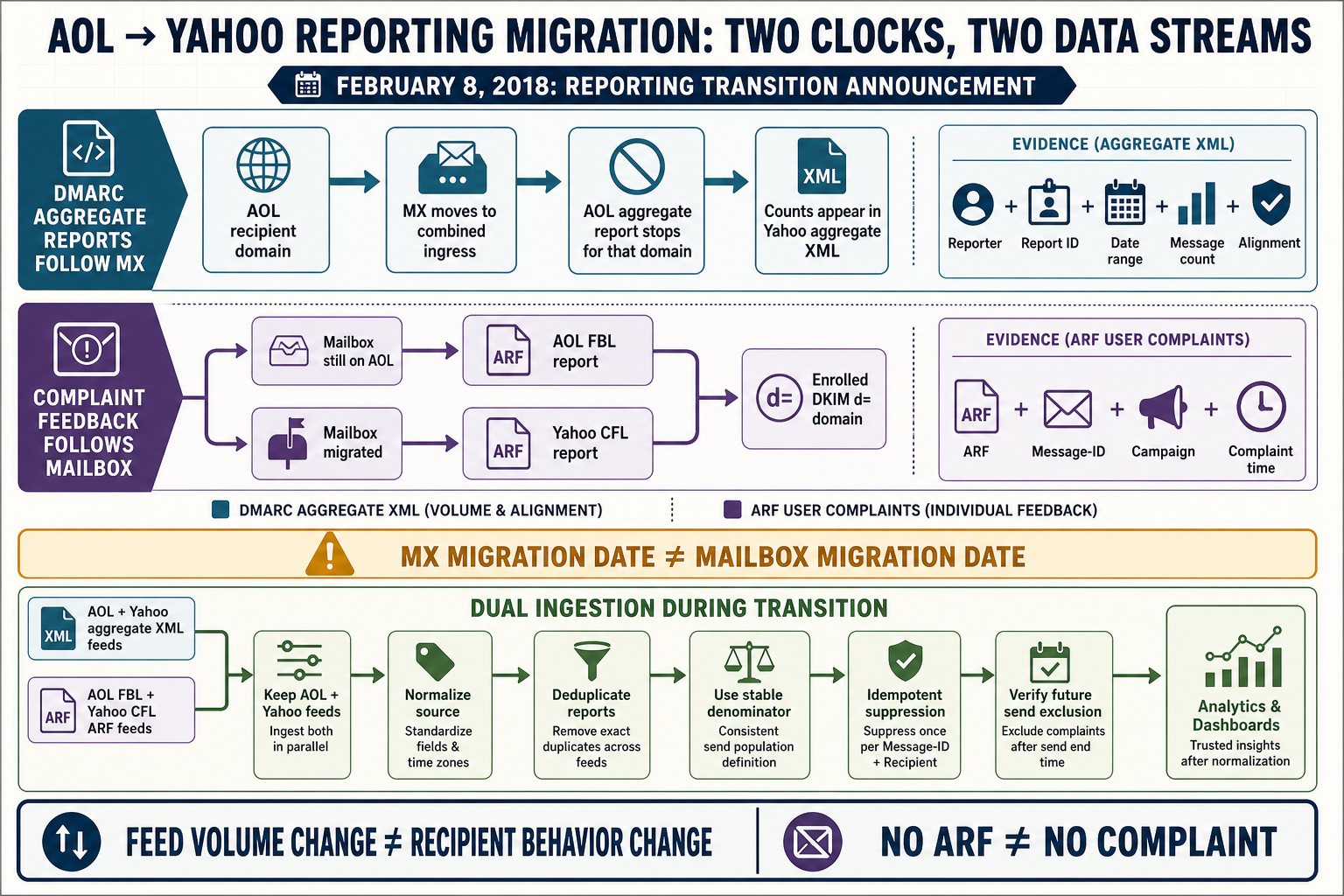
On February 8, 2018, AOL published an infrastructure update that separated two reporting changes. As AOL-domain MX records moved to the combined Yahoo/Oath receiving estate, DMARC aggregate data for those domains stopped coming from AOL and appeared in Yahoo reports. Complaint feedback followed a different clock: AOL feedback continued while a mailbox remained on AOL infrastructure, then Yahoo handled complaints after that mailbox migrated. Senders therefore needed overlapping registrations, DKIM coverage and reconciliation rather than a one-day reporting cutover.
The dated mailbox-provider change
| Event field | Verified value | Why it matters |
|---|---|---|
| Historical event date | February 8, 2018 | This is the provider-change date, not the NitWings publication date. |
| Mailbox provider | Yahoo Mail ecosystem | The affected provider estate determines which recipient cohorts require separate evidence. |
| Change area | DMARC reporting/FBL | This identifies whether the change altered authentication, filtering, visibility, measurement or sender operations. |
| Current status | migration-complete-current-yahoo-domain-based-cfl | Historical instructions are interpreted against the feature or standard that exists now. |
The January MX announcement had already introduced combined ingress in simple pass-through mode. That routing step did not mean every reporting system had moved. The February update described how external sender telemetry would change as distinct parts of the receiving platform transitioned.
DMARC aggregate reports describe how a receiver evaluated messages claiming a domain that publishes a reporting address. The reporting organization is the receiver. AOL explained that once an AOL recipient domain pointed to the new MX, its evaluation counts would be included in Yahoo-generated aggregate reports rather than separate AOL files.
Complaint feedback reports arise when an individual mailbox user marks a message as spam and the provider can map the message to an enrolled sender. Because mailbox populations migrated progressively, complaints could appear in AOL reports for one user and Yahoo reports for another user at the same branded domain during the transition.
The systems also used different enrollment models. AOL feedback had historically been IP-oriented, while Yahoo’s complaint loop was tied to DKIM signing domains. A sender prepared only for IP enrollment could lose visibility when migrated mailboxes began generating Yahoo complaints.
How the system worked before the change
Before the reporting transition, operators ingested AOL and Yahoo as separate receiving organizations. DMARC processors recognized distinct report metadata, source IP groups and reporting addresses. Feedback-loop processors mapped AOL reports to IP enrollment and Yahoo reports to authenticated-domain enrollment.
Dashboards often showed provider complaint counts without recording the feed source or enrollment basis. That was adequate while infrastructures were stable, but it made a staged migration look like a sudden behavioral change. A fall in AOL ARFs could be read as improved recipient satisfaction even when complaints simply moved to Yahoo.
DMARC data had a related denominator problem. Combining reports from two organizations could change file counts, report identifiers and source-IP groupings without changing total mail. Analysts who tracked number of XML files instead of underlying message `count` values could report false growth.
Suppression pipelines also depended on consistent recipient evidence. ARF reports may redact content or recipient information according to provider policy. A system needed Message-ID, headers, DKIM identity, campaign identifiers and provider metadata to match a complaint safely without suppressing the wrong subscriber.
What changed on the provider side
The February update linked DMARC reporting to the MX stage. When a domain’s receiving route moved to the new estate, AOL stopped producing its separate aggregate report for that domain and Yahoo included the domain in its report. This was a report-source consolidation, not a change to the sender’s own DMARC policy.
Complaint feedback remained linked to mailbox location. A mailbox still served by AOL produced AOL-side feedback. Once migrated, the same user’s spam action was handled through Yahoo. The provider explicitly recommended subscription to both loops during consolidation.
Yahoo eligibility depended on DKIM. Senders needed stable, valid signatures using an enrolled `d=` domain on mail sent to AOL-branded as well as Yahoo-branded recipients. An IP-only program could not assume Yahoo would infer ownership after migration.
For operations, the correct design was dual ingestion with a migration-aware source dimension. The same branded recipient domain could not be assigned permanently to one feed during the transition. Reporting ownership had to be observed from the received ARF or aggregate report itself.
Message path before and after
Before
Mail sent to AOL mailbox
    |
    +----> AOL receiving system evaluates DMARC
    |          +----> AOL aggregate XML report
    |
    +----> AOL user marks spam
               +----> AOL feedback report based on AOL enrollment

Mail sent to Yahoo mailbox
    +----> Yahoo DMARC aggregate report
    +----> Yahoo DKIM-domain complaint feedback
After
AOL recipient domain MX migrates
    |
    +----> DMARC evaluations included in Yahoo aggregate reports
    |
    +----> Mailbox still on AOL ----> AOL complaint feedback
    |
    +----> Mailbox migrated --------> Yahoo complaint feedback
                                           |
                                           v
                              enrolled DKIM signing domain

Dual ingestion + normalization + deduplication
    +----> suppression and complaint analytics
Who and what the change affected
| Traffic or stakeholder | What changed | Required interpretation |
|---|---|---|
| DMARC report processors | AOL-domain counts progressively appeared under Yahoo reporter metadata. | Aggregate underlying message counts, not file counts. |
| Complaint-loop processors | ARFs could arrive from AOL or Yahoo based on mailbox state. | Run both feeds and record the reporting source. |
| DKIM signing programs | Yahoo complaint eligibility depended on enrolled signing domains. | Sign every stream consistently and enroll each required `d=` domain. |
| IP-based AOL senders | Historical IP enrollment no longer provided complete future coverage. | Add domain-based Yahoo enrollment before migration. |
| Suppression systems | The same brand cohort could generate two report formats. | Normalize identity and make suppression idempotent. |
| Deliverability analysts | Feed movement could imitate complaint or DMARC trend changes. | Use stable denominators and migration annotations. |
Effect on delivery, placement and recipient visibility
The migration did not create complaints; it changed where senders observed them. If AOL ARF volume declined while Yahoo volume increased, the combined rate could remain stable. Judging reputation from either feed alone could hide continuing dissatisfaction.
Missing Yahoo enrollment created a blind period. Recipients could mark a message as spam, Yahoo could act on the signal, and the sender would receive no ARF for an unenrolled DKIM domain. Absence of feedback never proved absence of complaints.
Multiple DKIM signatures required care. A platform signature, customer signature and forwarded signature might coexist. Current Yahoo CFL services are tied to enrolled DKIM `d=` domains. Operators should know which signature the provider uses for attribution and ensure the domain’s owner processes the resulting complaint.
Suppression speed mattered more than report branding. Once a complaint arrived, the recipient needed to be removed from the relevant subscription stream quickly. A later send after a complaint could create another negative signal and undermine permission evidence.
DMARC aggregate movement affected diagnosis rather than placement directly. Authentication failures could appear under a new reporting organization or different source-IP grouping. The sender still needed to correct authorization and alignment; changing the reporting parser did not fix delivery.
Effect on measurement and diagnosis
Normalize DMARC XML by reporter organization, policy domain, source IP, disposition, SPF alignment, DKIM alignment and message count. Preserve raw files for audit, but calculate trends from record counts. The number and size of files are transport artifacts.
Normalize ARFs into reporting provider, DKIM domain, source IP, recipient domain, complaint time, original Message-ID and campaign evidence. Hash sensitive identifiers where practical, control retention and limit access because complaints can contain original headers or content.
Deduplication must be explicit. Retransmitted reports, multiple internal aliases and parallel old/new ingestion can create duplicate suppression events. Use a stable composite key and idempotent subscriber-state update while retaining every raw arrival for troubleshooting.
Build a transition dashboard with AOL ARFs, Yahoo ARFs and the combined complaint numerator. Divide by an appropriate delivered or inbox denominator when available and state its scope. Comparing complaint reports to attempted volume produces a different rate from provider reporting based on inbox-delivered mail.
For DMARC, annotate the first day each AOL domain appears in Yahoo reports and the last day it appears in AOL reports. Expected overlap or gaps should trigger investigation, not automatic interpolation. DNS and SMTP evidence help confirm which receiving estate handled the traffic.
Advantages for email marketers
| Potential advantage | When the advantage is real | Evidence to verify |
|---|---|---|
| Consolidated aggregate reporting | Yahoo files correctly include migrated AOL-domain evaluations. | Stable total message counts across reporter change. |
| Domain-authenticated complaint ownership | Every production stream uses an enrolled DKIM domain. | ARFs map to accountable brand or platform owner. |
| Broader Yahoo-managed coverage | Current CFL enrollment covers supported Yahoo-hosted domains. | Controlled complaints arrive for enrolled test streams. |
| Cleaner suppression automation | Both feeds normalize to one idempotent event model. | No repeat send after complaint processing. |
| More accurate trend interpretation | Dashboards retain source and migration stage. | Combined rate stays explainable during feed shifts. |
Disadvantages and operational risks
| Cost or risk | How it appears | Control |
|---|---|---|
| AOL decline is called improvement | Yahoo complaints rise as AOL reports fall. | Use a combined numerator and stable denominator. |
| Yahoo CFL was never enrolled | Migrated-mailbox complaints disappear from sender view. | Enroll and verify DKIM domains before cutover. |
| DMARC file count is treated as volume | One receiver changes aggregation or compression. | Sum XML record counts and validate date ranges. |
| Duplicate ARFs double-suppress | Parallel ingestion processes the same complaint twice. | Use idempotent keys and state transitions. |
| Wrong DKIM owner gets the report | Platform and customer signatures have unclear responsibility. | Document signing hierarchy and feedback ownership. |
| Recipient is suppressed globally by mistake | A stream complaint removes required account mail. | Apply approved stream scope and legal policy. |
What email teams needed to do at the time
- Keep both feedback registrations active. Do not retire AOL ingestion while mailboxes remain there.
- Enroll Yahoo DKIM domains. Cover brand and platform signatures used for affected traffic.
- Normalize both ARF sources. Preserve provider, domain, message and campaign evidence.
- Annotate DMARC reporter movement. Track last AOL and first Yahoo coverage by recipient domain.
- Rebuild complaint dashboards. Show each feed and the combined numerator.
- Make suppression idempotent. Duplicate reports must not produce inconsistent subscriber state.
- Audit stream ownership. Assign every signing domain to an accountable suppression operator.
- Monitor for blind spots. Absence of ARFs needs enrollment and ingestion checks before a positive conclusion.
What email teams should do now
- Use the current Yahoo Sender Hub. Add and verify domains in the active account system.
- Enroll every required DKIM `d=` domain in CFL. Confirm the visible status in Manage Services.
- Process ARF reports securely. Authenticate the report, parse MIME safely and restrict sensitive data.
- Suppress complaints promptly. Remove the recipient from the applicable subscription stream.
- Monitor current Yahoo Insights separately. Provider complaint-rate data and ARFs are related but distinct services.
- Use a shared domain registry. Track selectors, owners, report address and enrollment status.
- Test platform signatures. Confirm which signature generates CFL coverage when multiple signatures exist.
- Reconcile complaint denominators. Document attempted, delivered or inbox-delivered scope.
- Retain current DNS and SMTP evidence. Reporting alone cannot explain every placement change.
- Review vendor offboarding. Move feedback destinations before keys, aliases or accounts are removed.
Worked deliverability scenario
An ESP dashboard reports a 60 percent fall in AOL complaints during February 2018 and declares a reputation improvement. At the same time, Yahoo complaints increase, but the feeds are owned by separate teams and no combined view exists.
Analysts group ARFs by recipient brand, reporting source and DKIM domain. The decrease in AOL reports closely matches the rise in Yahoo reports for the same campaign streams. DMARC XML also begins including AOL-domain traffic under Yahoo report metadata.
The ESP enrolls its stable platform DKIM domain and customer domains in Yahoo CFL, then sends all normalized ARFs to one idempotent suppression service. It retains feed-source fields and deduplicates by message and complaint evidence. Dashboards use a combined numerator against delivered volume.
The corrected rate is nearly unchanged. The team responds by reducing frequency for inactive subscribers rather than celebrating a false improvement. The incident becomes a reporting-migration control, not an algorithm-change story.
Evidence and diagnostics
- DMARC raw evidence: reporter, report ID, date range, policy domain and XML record counts.
- Authentication evidence: SPF domain, DKIM `d=` and selector, results and DMARC alignment.
- ARF evidence: reporting provider, complaint time, original headers and feedback type.
- Enrollment evidence: Yahoo Sender Hub account, verified domain, CFL status and report address.
- Message mapping: Message-ID, campaign, stream, recipient domain and subscription.
- Suppression evidence: event ID, scope, effective time, downstream acknowledgements and future exclusion.
- Rate evidence: numerator source, denominator scope, time zone and late-arriving reports.
- Migration evidence: observed MX, first Yahoo report, last AOL report and mailbox-stage annotation.
- Security evidence: ARF authentication, parser result, retention and access audit.
Failure modes and incorrect conclusions
- Combining DMARC and complaint reports. Aggregate authentication telemetry and user complaints answer different questions.
- Tying both transitions to the same date. DMARC followed MX; feedback followed mailbox movement.
- Trusting a zero-ARF day. Enrollment, volume, redaction or ingestion can explain it.
- Counting XML files. Aggregation changes make file count meaningless as mail volume.
- Using IP enrollment for Yahoo coverage. Current CFL attribution is based on enrolled DKIM domains.
- Suppressing without stream scope. A promotional complaint does not automatically define every communication obligation.
- Discarding raw evidence. Normalization bugs become impossible to audit.
Current status and superseding changes
The AOL and Yahoo infrastructure migration was declared complete in April 2019. Current complaint operations for Yahoo-managed domains, including AOL, use Yahoo Sender Hub rather than the separate AOL-era program.
Yahoo’s current CFL is domain based and requires DKIM-signed mail. When a user marks an enrolled message as spam, Yahoo sends an Abuse Reporting Format report to the verified destination so the sender can suppress that recipient.
Current Yahoo documentation states that Sender Hub services are tied to the DKIM signing domain. ESPs can use a platform-level signature for scalable service enrollment, but responsibility and customer-specific suppression still need documented governance.
The lasting control is migration-aware measurement. Provider reporting systems can change independently of recipient behavior. Retain raw sources, stable denominators, domain ownership and cross-system suppression so infrastructure movement cannot masquerade as a deliverability improvement.
Operator checklist
- Record February 8, 2018 as the reporting-transition announcement.
- Explain that DMARC reports followed MX movement.
- Explain that complaint feedback followed mailbox movement.
- Keep historical AOL and Yahoo feeds separate before combining trends.
- Enroll and verify the DKIM domains responsible for complaint handling.
- Normalize ARF and DMARC data into different event models.
- Use idempotent complaint suppression with explicit stream scope.
- Sum DMARC record counts rather than counting files.
- Use current Yahoo Sender Hub and CFL for Yahoo-managed domains.
- Treat missing reports as an observability question, not proof of zero complaints.
Primary and contemporaneous references
- Yahoo Postmaster archive: DMARC reporting and FBL: Primary historical transition guidance.
- Spam Resource: AOL/Yahoo transition update: Contemporaneous dated interpretation.
- Yahoo Sender Hub: Complaint Feedback Loop: Current domain-based CFL operation.
- Yahoo Sender Hub: FAQ: Current enrollment, coverage and ARF details.
- Yahoo Postmaster: It’s Done: Provider completion record.