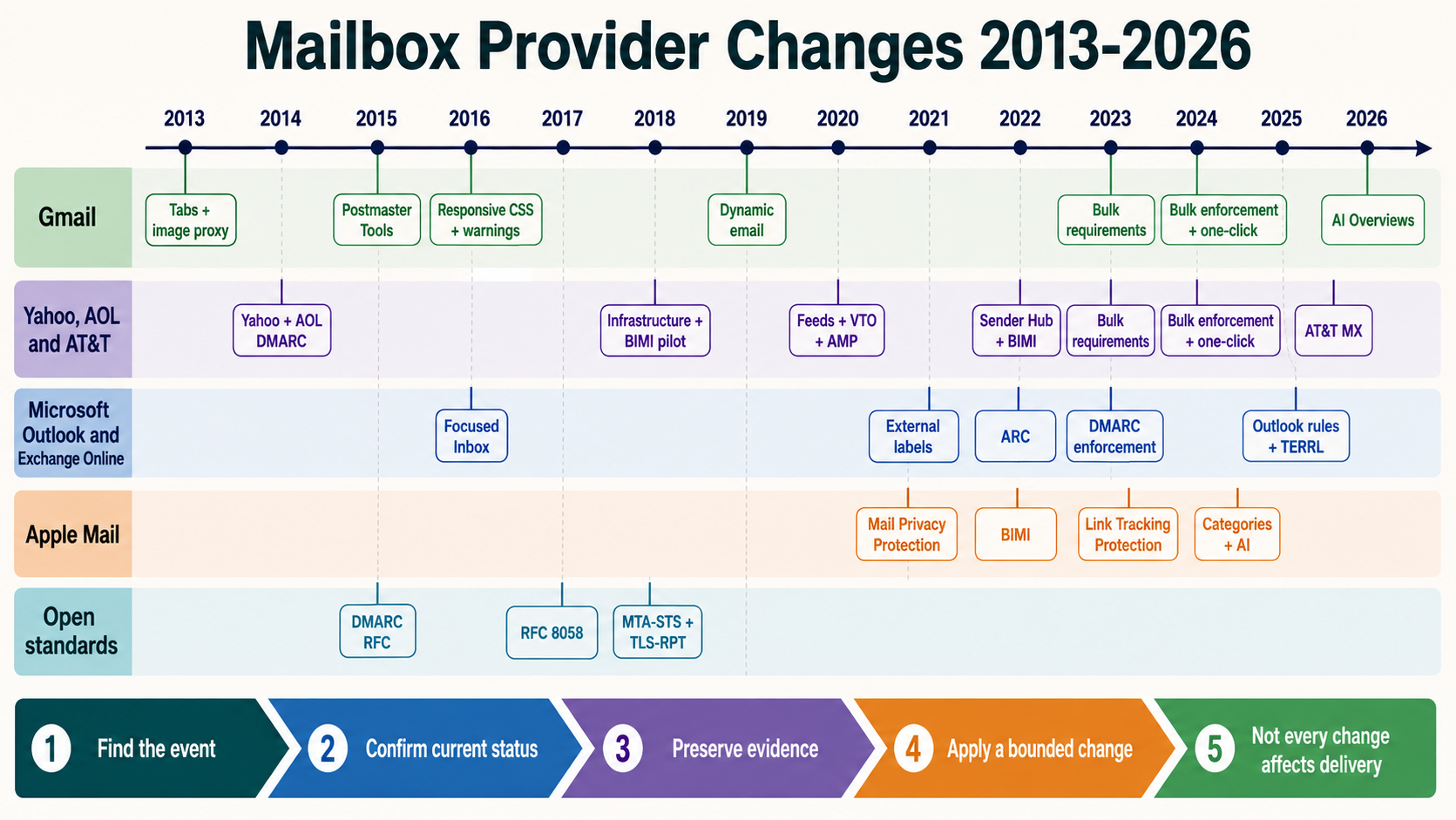
AOL and Yahoo MX Consolidation in 2018: The First Infrastructure Transition
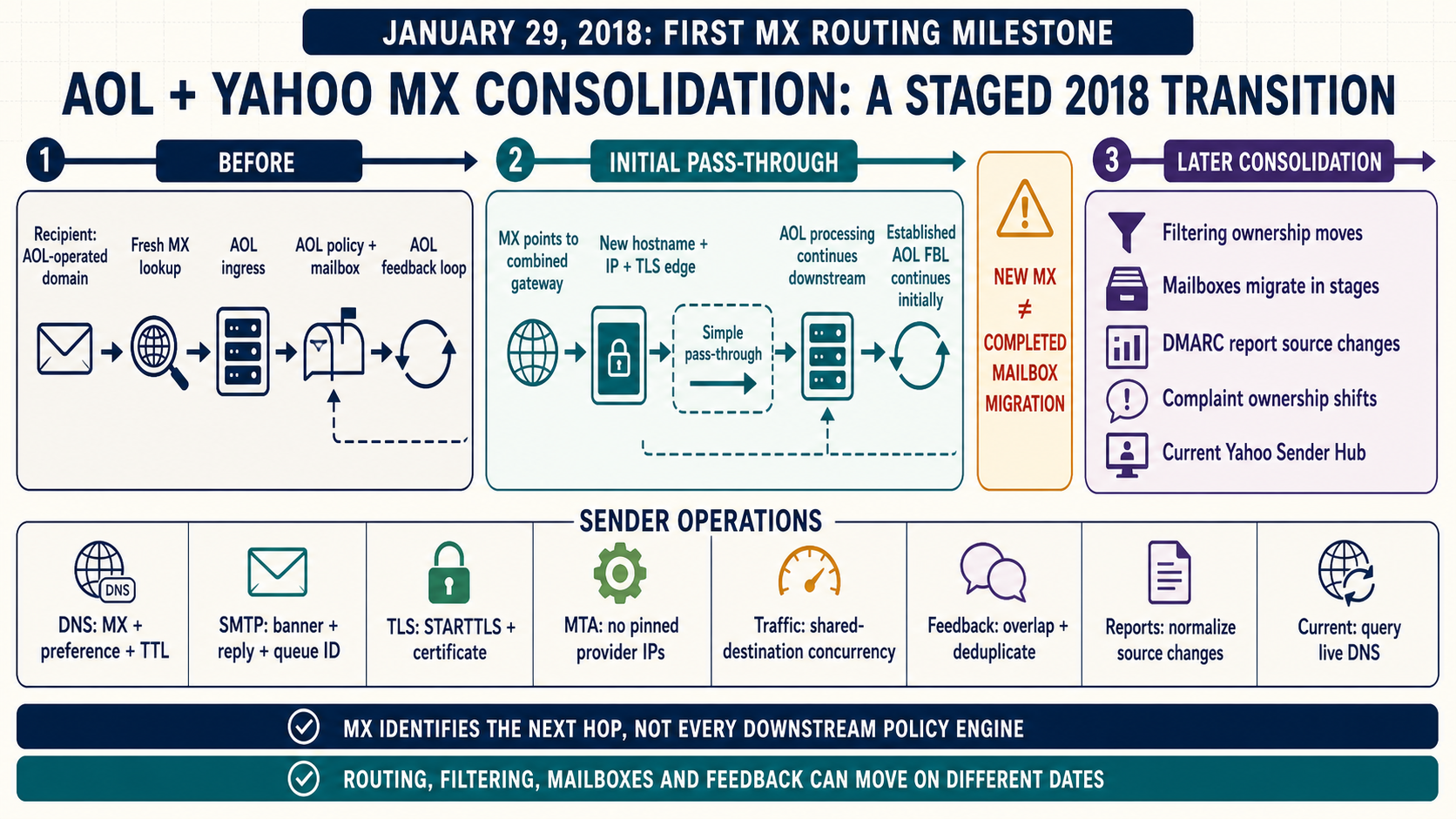
On January 29, 2018, the AOL Postmaster team announced the first routing stage of the AOL and Yahoo infrastructure consolidation under Oath. Starting that week, the majority of AOL MX records would point to combined servers operating in simple pass-through mode. The announcement said established AOL feedback loops would continue during this first step. This distinction is essential: DNS began directing senders to new front doors, but mailbox processing, filtering ownership and feedback reporting did not all change at once.
The dated mailbox-provider change
| Event field | Verified value | Why it matters |
|---|---|---|
| Historical event date | January 29, 2018 | This is the provider-change date, not the NitWings publication date. |
| Mailbox provider | Yahoo Mail ecosystem | The affected provider estate determines which recipient cohorts require separate evidence. |
| Change area | Infrastructure | This identifies whether the change altered authentication, filtering, visibility, measurement or sender operations. |
| Current status | initial-pass-through-stage-completed-and-infrastructure-consolidated | Historical instructions are interpreted against the feature or standard that exists now. |
Verizon had combined Yahoo and AOL assets under Oath, creating a business reason to merge large consumer-mail systems. From a sender’s perspective, however, a corporate merger did not immediately create one mail platform. DNS, SMTP gateways, reputation systems, mailbox stores, complaint loops and postmaster processes could move on different schedules.
A contemporaneous deliverability report reproduced the January 29 provider statement. It said the majority of AOL MX records would begin pointing to combined servers that week and that those servers would operate in simple pass-through mode. AOL expected the change to be transparent to ordinary senders and said established feedback-loop reports would continue from AOL infrastructure.
The transition unfolded beyond that announcement. February reporting described AOL-domain DMARC reports shifting as each domain’s MX changed, while complaint feedback could still depend on where the mailbox resided. Later in February, industry operators observed AOL recipient domains pointing to Yahoo-hosted infrastructure more broadly.
This article treats January 29 as the first staged MX milestone. It does not claim the mailbox merger finished that day. That date precision protects the analysis from a common error: seeing a new MX hostname and assuming all policy, reputation and reporting semantics switched simultaneously.
How the system worked before the change
Before the transition, AOL recipient domains published AOL-operated MX routes and senders built AOL-specific operational views. They monitored AOL replies, reputation behavior, complaint feedback and postmaster processes separately from Yahoo. Some MTAs also contained hand-built destination groupings or static smart routes for AOL domains.
A standards-compliant sending MTA queries the recipient domain’s MX records, sorts by preference and connects to the returned hosts. DNS provides a level of indirection so the mailbox operator can change receiving infrastructure without requiring every sender to edit configuration. Static destination IPs defeat that design.
Large senders often grouped provider domains for connection limits and analytics. That can be useful, but a domain label is not permanent infrastructure ownership. `aol.com`, `aim.com`, `verizon.net` and related domains could share or diverge in routing during a migration. Hard-coded assumptions made staged changes fragile.
Feedback data was also platform-specific. An AOL complaint report and a Yahoo domain-based complaint flow had different registration and matching behavior. A sender that saw the MX change but discarded AOL reporting could lose abuse visibility before the recipient population completed its move.
What changed on the provider side
The first step changed the advertised ingress route for the majority of AOL MX records. Combined servers accepted the SMTP connection and passed mail onward to AOL processing. That meant the network endpoint could change while the downstream filtering and mailbox behavior remained associated with AOL.
In a pass-through stage, the greeting hostname, IP range and TLS certificate can look new even though the final policy engine has not completely changed. Monitoring must retain the recipient domain and observed MX separately from inferred provider ownership. An IP-based dashboard alone can split one destination into misleading new categories.
The announcement explicitly preserved existing AOL feedback loops for this phase. Later stages changed DMARC-report origins and complaint ownership as domains and mailboxes moved. Senders needed overlapping registration and reconciliation rather than an abrupt cutover from one data source to another.
The safest MTA behavior was ordinary DNS-based routing with no static AOL next hop. Senders still needed reasonable connection reuse, retry and backoff based on actual responses. They should not multiply traffic simply because several AOL-branded domains resolved to the same combined host estate.
Message path before and after
Before
Recipient address at an AOL-operated domain
    |
    v
Standards-based MX lookup
    |
    v
AOL MX hostname and AOL ingress
    |
    v
AOL policy and mailbox processing
    |
    +----> SMTP response
    +----> AOL complaint and postmaster signals
After
Recipient address at an AOL-operated domain
    |
    v
Fresh MX lookup during staged DNS transition
    |
    +----> cached earlier AOL route until TTL expires
    |
    +----> combined Yahoo/AOL ingress
                |
                v
        initial simple pass-through gateway
                |
                v
        AOL processing and mailbox estate
                |
                +----> existing AOL FBL continues initially
                +----> later reporting and mailbox stages migrate
Who and what the change affected
| Traffic or stakeholder | What changed | Required interpretation |
|---|---|---|
| AOL recipient domains | Their advertised MX paths began moving to combined servers. | Resolve each domain dynamically and record the observed answer. |
| Yahoo and Oath infrastructure | New front doors could pass traffic to the existing AOL estate. | Gateway ownership did not prove final filtering ownership. |
| Sending MTAs | Static AOL routes and pinned IPs could fail or bypass intended routing. | Use standards-based MX preference and DNS refresh. |
| Feedback-loop operators | AOL complaint flows continued initially and shifted later. | Maintain overlapping registrations and deduplicate evidence. |
| DMARC analysts | Report origin could change as the receiving path migrated. | Treat reporter identity changes as infrastructure movement, not traffic growth alone. |
| Deliverability dashboards | One provider brand could appear across old and new IP estates. | Keep recipient domain, MX, reply and reporting source as separate dimensions. |
Effect on delivery, placement and recipient visibility
The January pass-through design was intended to be transparent, but large infrastructure changes can reveal sender assumptions. A pinned AOL IP might stop accepting traffic. A firewall allowlist could block a new Yahoo-hosted range. TLS monitoring could alert on a different certificate or greeting even when delivery was legitimate.
Reputation interpretation was especially delicate. The receiving IP belonged to the combined front end, while downstream filtering could still use AOL data. A sender could not conclude that strong Yahoo performance would immediately repair weak AOL performance, or that AOL history disappeared when DNS changed.
Connection management also needed reevaluation. Several recipient domains could now converge on the same MX estate. Separate high-concurrency pools for each brand could aggregate into excessive pressure at the shared infrastructure. The remote SMTP responses and published provider guidance, not a historical per-domain assumption, should control pacing.
During DNS propagation, different recursive resolvers could return different routes according to cached TTLs and rollout state. That is normal. A sender should retry temporary failures through standards-compliant MX handling, retain attempt-level evidence and avoid manually forcing a route based on one lookup.
Later consolidation stages could change filtering outcomes, FBL volume and DMARC report sources. Those are separate dated events in this series. The first MX article establishes the routing boundary so later reporting changes are not incorrectly attributed to January 29.
Effect on measurement and diagnosis
Record DNS answers with timestamps, resolver identity, TTL, preference and hostname. A single command copied into a ticket is not enough during a gradual rollout. Compare authoritative answers and multiple operational resolvers when diagnosing inconsistent routes.
At the SMTP layer, retain the resolved IP, banner, EHLO response, TLS negotiation, response code, enhanced status, diagnostic text, queue ID and recipient domain. The hostname in a banner can reflect a shared gateway and should not replace the original destination in reporting.
Feedback monitoring must track source. Count AOL and Yahoo complaint reports by DKIM domain, recipient domain and event time, then deduplicate by stable message evidence where possible. A decline in one feed and rise in another can represent migration rather than a real complaint-rate change.
DMARC aggregate reports also need reporter normalization. New report organizations or source-IP groupings can appear when receiver infrastructure changes. Compare underlying message counts and aligned identities before interpreting a new reporter as new audience volume.
Operational baselines should include acceptance, deferrals, rejections, retry age, TLS, complaint reports and business outcomes. Segment by the observed MX route during transition. That permits a controlled comparison between the old ingress, pass-through gateway and later consolidated processing.
Advantages for email marketers
| Potential advantage | When the advantage is real | Evidence to verify |
|---|---|---|
| Simplified provider infrastructure | The combined gateway operates reliably across brands. | Stable acceptance and route latency after migration. |
| Standards-based transparent routing | Senders follow live MX records instead of pinned hosts. | No sender configuration change required for DNS cutover. |
| Consolidated operational tooling | Later stages align support and feedback services. | Clear registration ownership and reconciled reports. |
| Better route observability | Teams retain recipient, DNS, SMTP and report-source dimensions. | Incidents isolate the exact transition stage. |
| Removal of brittle MTA rules | Static AOL next hops are retired. | Configuration audit shows DNS-driven delivery. |
Disadvantages and operational risks
| Cost or risk | How it appears | Control |
|---|---|---|
| Pinned route fails | The MTA continues connecting to retired AOL infrastructure. | Remove static hosts and honor MX DNS. |
| Gateway is mistaken for policy engine | A Yahoo hostname is called complete filtering migration. | Trace pass-through and later stages separately. |
| Shared estate is overrun | Per-domain connection pools aggregate at one MX. | Control concurrency by observed destination and responses. |
| FBL coverage is lost | AOL registration is removed before mailbox migration. | Maintain both systems during documented transition. |
| Complaint rates appear to jump | Reports move sources or are double-counted. | Normalize and deduplicate transition data. |
| DNS cache variance is treated as attack | Resolvers show old and new routes during TTL windows. | Timestamp answers and compare authoritative state. |
What email teams needed to do at the time
- Remove static AOL routes. Let recipient-domain MX records direct each attempt.
- Audit firewalls and TLS controls. Permit legitimate combined hosts without disabling verification broadly.
- Capture pre-change baselines. Preserve AOL acceptance, deferral, rejection and complaint trends.
- Track route dimensions. Store recipient domain, MX hostname, IP, banner and final reply.
- Maintain AOL feedback enrollment. The first pass-through phase explicitly preserved existing reports.
- Prepare Yahoo enrollment. Later mailbox stages could move complaint ownership.
- Review aggregate concurrency. Multiple AOL domains could converge on one receiving estate.
- Reconcile DMARC reporters. Separate infrastructure-source change from authentication change.
What email teams should do now
- Use current Yahoo Sender Hub. Yahoo now owns the operational sender ecosystem for Yahoo, AOL and related hosted brands.
- Resolve current DNS during every incident. Historical MX names are evidence of the transition, not routing instructions.
- Follow current authentication requirements. Use SPF, DKIM and DMARC appropriate to present Yahoo guidance.
- Enroll current DKIM domains in the Yahoo CFL. Keep registration ownership and contacts maintained.
- Use current SMTP diagnostics. Classify the exact Yahoo reply and enhanced code before changing volume.
- Control shared-destination concurrency. Observe how branded domains converge on common MX infrastructure.
- Retain route-level TLS evidence. Monitor certificates, protocol and STARTTLS without assuming the brand hostname.
- Remove obsolete AOL-only tooling. Retire it only after confirming current replacement coverage.
- Keep recipient validity separate from policy failure. A shared MX rejection does not make the mailbox nonexistent.
- Review acquisition transitions as stages. DNS, gateway, filtering, mailbox and reporting rarely move simultaneously.
Worked deliverability scenario
A sender routes `aol.com`, `aim.com` and `verizon.net` through a statically configured AOL smart host. After the January announcement, queues grow for two domains while direct tests using public DNS reach a combined Yahoo/AOL host successfully.
Operators initially whitelist the old host more broadly and increase retries. That worsens queue pressure. A configuration audit shows that the static route bypasses recipient-domain MX discovery and that separate concurrency pools could generate excessive aggregate sessions if simply pointed at the new shared host.
The team removes the pinned next hop, restores MX preference handling and groups connection controls by observed receiving estate. It retains destination-domain labels in analytics. AOL feedback enrollment remains active, and Yahoo CFL readiness is added without counting the same complaint twice.
Queues drain under normal retry behavior. The incident review states that the DNS route changed while downstream processing remained staged. No claim is made that January 29 completed the mailbox merger. That distinction prevents later DMARC-report and FBL changes from being misdiagnosed as unexplained reputation events.
Evidence and diagnostics
- DNS: authoritative and recursive MX answers, preference, TTL, lookup time and resolver.
- Route: recipient domain, selected MX, resolved address and connection pool.
- SMTP: banner, EHLO capabilities, reply, enhanced status, diagnostic and queue ID.
- TLS: STARTTLS advertisement, protocol, cipher, certificate names and validation result.
- MTA configuration: static routes, provider groupings, concurrency, retry and backoff.
- Feedback: AOL and Yahoo report source, DKIM domain, message identity and deduplication.
- DMARC reports: reporter organization, source IP, volume, alignment and first-seen time.
- Current ownership: present Yahoo Sender Hub guidance, registered domains and support case.
- Business impact: queue age, delivered count, complaint trend and recipient outcomes.
Failure modes and incorrect conclusions
- Equating MX change with completed mailbox migration. The announced first stage was pass-through.
- Pinning old IPs. It defeats the DNS mechanism designed for provider routing changes.
- Dropping AOL FBL immediately. The provider said it continued during the initial stage.
- Counting both FBL feeds as separate complaints. Transition overlap can inflate apparent abuse.
- Assuming Yahoo reputation instantly replaced AOL history. Filtering ownership moved in stages.
- Multiplying connections by brand domain. Several brands can land on the same receiving estate.
- Using historical MX names today. Always query current DNS and current provider documentation.
Current status and superseding changes
The initial simple pass-through stage is complete. AOL recipient domains now operate within Yahoo-managed mail infrastructure, and current sender requirements, postmaster guidance, SMTP codes and complaint services are presented through Yahoo Sender Hub.
The historical AOL feedback and postmaster arrangements changed after the first MX step. Current operators should enroll verified DKIM domains in the active Yahoo Complaint Feedback Loop and maintain current account ownership rather than depending on a historical AOL form.
Present routing must be discovered from live DNS. The 2018 hostnames and dates explain how consolidation happened; they are not a static configuration template. Shared infrastructure can change addresses, topology and TLS presentation without changing recipient branding.
The enduring lesson is staged ownership. An MX record identifies where an MTA should connect, not every downstream policy component. During any provider merger, record DNS ingress, filtering, mailbox storage, complaints, authentication reports and support ownership independently until evidence shows each stage is complete.
Operator checklist
- Use January 29, 2018 as the first provider-announced MX transition milestone.
- State that combined servers initially operated in simple pass-through mode.
- Do not claim the mailbox, filtering and feedback migration completed that day.
- Use standards-based MX lookup and remove pinned provider IPs.
- Record recipient domain, MX, IP, banner, TLS and exact SMTP reply.
- Manage aggregate connections when multiple domains share one estate.
- Keep overlapping feedback registrations during a staged transition.
- Normalize DMARC and complaint-source changes before comparing rates.
- Use current Yahoo Sender Hub, CFL, requirements and SMTP codes now.
- Query live DNS for every present incident.
Primary and contemporaneous references
- Spam Resource: AOL Announces Mail System MX Changes: Contemporaneous reproduction of the January 29 AOL Postmaster announcement.
- Word to the Wise: AOL and Yahoo transition records: Contemporaneous operational coverage of the routing change.
- Spam Resource: AOL/Yahoo transition update: Later DMARC-report and feedback-loop stage.
- Yahoo Sender Hub: Best practices: Current Yahoo ecosystem requirements.
- Yahoo Sender Hub: SMTP error codes: Current response-code diagnosis.
- Yahoo Sender Hub: Complaint Feedback Loop: Current complaint registration service.